
Golf is as much a mental game as it is a physical one. The difference between a great round and a frustrating one often comes down to how well you manage your emotions. Here’s the key takeaway: focus keeps you grounded in the present moment, while frustration pulls you into a spiral of negative thoughts and tension that can ruin your performance.
Key Points:
- Focus: Direct your attention to controllable elements like breathing, target, and pre-shot routine. This helps execute consistent swings and maintain composure.
- Frustration: Triggered by missed expectations, bad luck, or technical mistakes. It leads to muscle tension, rushed decisions, and erratic play.
- Recovery: Use techniques like the "2 Second Rule", mindfulness, and visualization to quickly reset after mistakes and regain focus.
- Practical Tips: Build a consistent pre-shot routine, practice "Target & Tempo" drills, and maintain calm body language to avoid emotional spirals.
Quick resets and mental strategies can transform your game. The ability to recover from setbacks and refocus is what separates consistent players from those who let frustration take over.
167 How To Manage Your Emotions To Improve Your Golf
What Focus Means in Golf
Understanding focus in golf isn’t just about clearing your mind of distractions – it’s about aligning your intentions with where your attention is directed. This kind of concentration is what allows elite golfers to execute smooth, instinctive swings.
As mental coach David MacKenzie explains:
Focus in golf is when your intention for your focus is currently aligned with what you are actually directing your attention to.
The difference between focused and distracted golfers isn’t the absence of negative thoughts. Instead, top players excel at redirecting their attention back to the present task. Whether it’s their target, tempo, or breathing, they quickly notice when their mind has wandered and refocus. This ability to stay present is often the deciding factor between a solid round and one that falls apart.
Characteristics of Focused Golfers
What separates focused golfers from the rest? They emphasize process over outcome. Instead of obsessing over scores or leaderboard positions, they commit to their pre-shot routines and focus on executing each shot. Dustin Johnson, who has 24 PGA Tour victories, embodies this mindset:
For me, I don’t go into an event saying I’m going to win this tournament. For me, it’s more of the process of how I get there.
These players also maintain calm composure no matter the outcome of their shots. Whether sinking a birdie putt or mishitting a wedge, they keep their mannerisms neutral, avoiding emotional spirals that can lead to poor decisions.
Focused golfers are experts at narrowing their attention. They block out external distractions like crowd noise, hazards, or weather, as well as internal distractions such as mechanical swing thoughts or anxiety about past mistakes. Instead, they focus their energy on controllables – their attitude, self-talk, and the current shot.
| Focus Category | What Focused Golfers Concentrate On | Distractions Eliminated |
|---|---|---|
| Internal | Target, tempo, pre-shot routine, breathing | Mechanical swing thoughts, score anxiety, past mistakes |
| External | Specific landing spot, wind direction | Hazards (water/sand), opponent’s skill, crowd noise |
| Controllable | Attitude, self-talk, current shot strategy | Weather, course conditions, final tournament score |
How to Maintain Focus
Staying focused on the course takes practice. Start by developing a consistent pre-shot routine and incorporating mindfulness exercises between shots. These routines act as mental cues to narrow your attention and fully commit to the task at hand.
Another useful technique is the "Permission to Forget" journal. During a round, jot down any technical thoughts or "fixes" that come to mind. This lets you mentally set them aside, so they don’t clutter your focus during play.
For practice sessions, try the "Target & Tempo" (T & T) drill. Choose a clear target and focus solely on maintaining a smooth tempo, ignoring technical details. Experts recommend practicing this until you can hit focused shots at least 85% of the time before expecting it to carry over to the course.
Dr. Deborah Graham, who has worked with nearly 400 professional players and contributed to 31 major championship wins, stresses this approach:
Champion focus for golf is the ability to narrow your attention over the ball, effectively eliminating all distractions as you athletically execute each shot and putt.
These strategies not only sharpen focus but also prepare you for high-pressure situations on the course.
Focus Examples on the Course
Scottie Scheffler’s second Masters win is a prime example of focus in action. Instead of fixating on scores, Scheffler concentrated on his mental attitude and process throughout the tournament:
I’m mostly focused on my mental attitude. I’m not looking at results.
This mindset kept him present and composed during four intense rounds at Augusta National.
Dave Stockton’s performance on the Champions Tour also highlights the power of focus. In one event, Stockton topped a tee shot on the 18th hole while holding a one-stroke lead. Instead of letting frustration take over, he applied the "2 Second Rule" – allowing himself just two seconds to react before shifting back to his mental routine. A quick joke with his caddy helped him reset, and he went on to par the hole, securing the win.
Jon Rahm’s journey underscores the importance of managing emotions to maintain focus. Since 2014, he’s worked hard on this aspect of his game, which he credits for his consistent performance:
I’ve been working on [managing my emotions] really, really hard since 2014. It’s a process… one of the reasons why I’m so consistent and playing better.
These stories show that focus isn’t about perfection – it’s about recovering quickly when things go wrong and staying locked in on what you can control.
How Frustration Hurts Your Game
Frustration doesn’t just feel awful – it sets off a chain reaction of mistakes that can cost you strokes on the course.
What Causes Frustration
In golf, frustration usually boils down to three main culprits: technical mistakes, bad luck, and unmet expectations. Technical errors, like chunking a shot or struggling with a recurring swing issue, often spark immediate emotional responses. Bad breaks – like an unlucky bounce, a ball rolling into a hazard, or a lip-out – can leave you feeling like the universe is against you. And when your performance doesn’t stack up to your own expectations, disappointment can quickly spiral into full-blown frustration.

Tour mental-game coach Julie Elion highlights how crucial it is to monitor your emotional state:
The key is to be aware of your emotional state because your mood can affect your shots as much as your clubface.
Your body often gives away your frustration before your mind catches up. Pay attention to signs like shallow breathing, gripping the club too tightly, sweaty palms, or even a queasy stomach. Intrusive thoughts – like "don’t miss this" or "this round is ruined" – are also red flags that your emotions might be taking over.
How Frustration Affects Performance
Once frustration takes hold, it impacts both your mind and body. Mentally, it invites self-doubt and overthinking, making it harder to trust your instincts and swing naturally. It can also lead to poor decision-making, like trying to force shots or overcompensating in other areas of your game.
Physically, frustration shows up as muscle tension, shallow breathing, and an overly tight grip on the club. These physical changes disrupt the fluid, athletic motion needed for a good swing. The result? A "snowball effect", where one bad shot leads to another, and the mistakes keep piling up. In fact, unchecked frustration can add anywhere from 1 to 10 strokes to your round.
| Emotional Trigger | Physical Symptom | Performance Impact |
|---|---|---|
| Missed Short Putt | Tight grip / Sweaty hands | Loss of feel and precision on future greens |
| Unlucky Bounce | Quickened breathing | Rushed pre-shot routine, leading to poor tempo |
| Out-of-Bounds Drive | Muscle tension | Restricted swing, resulting in poor recovery |
These examples show how frustration doesn’t just affect your mood – it directly impacts your performance.
Frustration Examples on the Course
Even pros aren’t immune to frustration. Take Guido Migliozzi, for example. During the November 2022 Nedbank Golf Challenge, he was tied for third going into the Saturday round. But frustration got the better of him on the par-4 17th hole. After a bunker shot, a penalty area drop, and two chunked shots, he ended up with a sextuple-bogey 10. That single hole dropped him 24 spots on the leaderboard, from T3 to T27.
And then there’s Tiger Woods. At the June 2019 Memorial Tournament, Woods endured six or seven lip-outs during the third round. Reflecting on the day, he said:
I’d never seen a round that lipped out more shots than today… It’s frustrating, because that was the highest round I could possibly have shot today.
Despite playing well overall, Woods finished with a 70 – a reminder that even the best players can let frustration affect their game. Recognizing these patterns is the first step toward turning frustration into focus.
Focus vs. Frustration: Direct Comparison
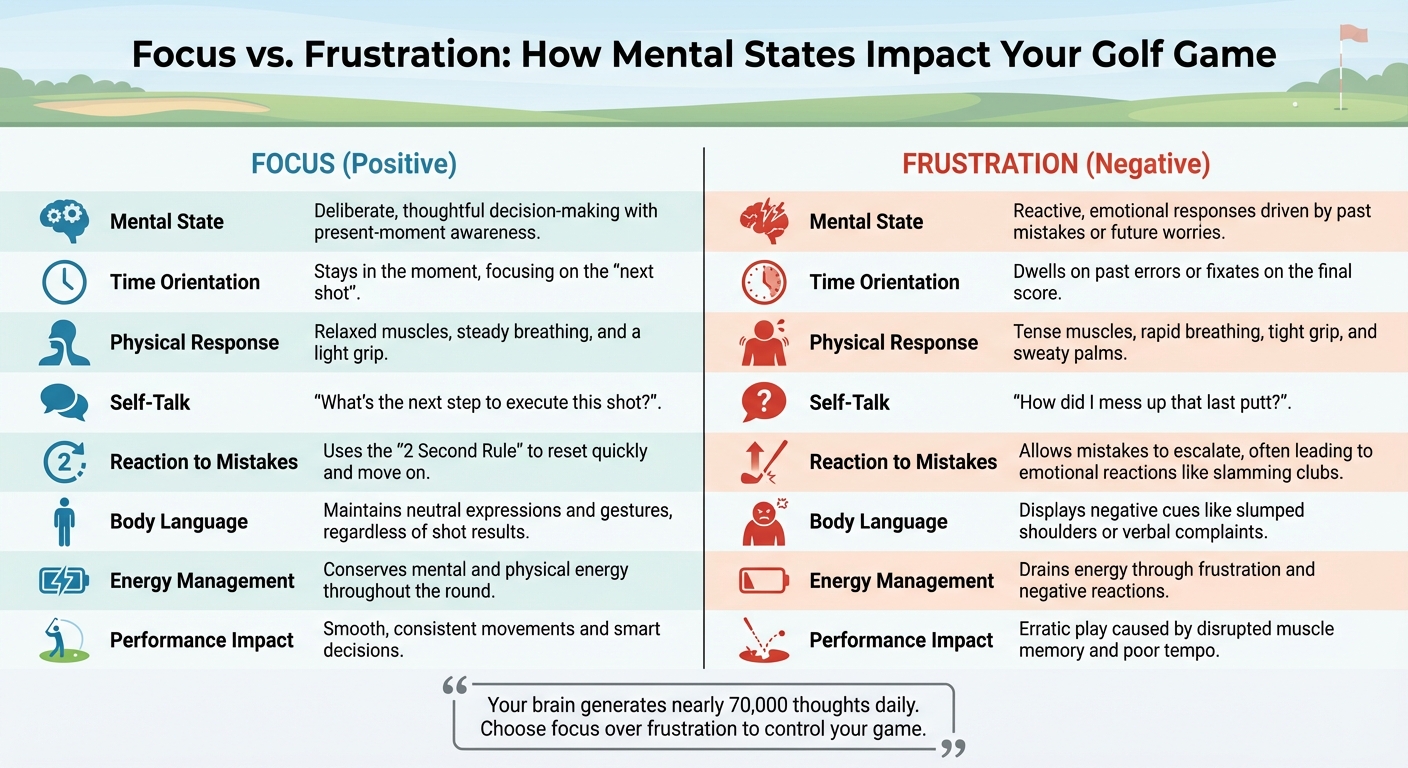
Focus vs Frustration in Golf: Mental State Comparison Chart
When it comes to mental performance on the course, understanding the contrast between focus and frustration is crucial. Spotting the difference early can help you adjust before it impacts your game. These two states influence everything from how you breathe to how you make decisions.
Comparison Table
Here’s a breakdown of how focus and frustration differ in key areas during a round:
| Feature | Focus | Frustration |
|---|---|---|
| Mental State | Deliberate, thoughtful decision-making with present-moment awareness | Reactive, emotional responses driven by past mistakes or future worries |
| Time Orientation | Stays in the moment, focusing on the "next shot" | Dwells on past errors or fixates on the final score |
| Physical Response | Relaxed muscles, steady breathing, and a light grip | Tense muscles, rapid breathing, tight grip, and sweaty palms |
| Self-Talk | "What’s the next step to execute this shot?" | "How did I mess up that last putt?" |
| Reaction to Mistakes | Uses the "2 Second Rule" to reset quickly and move on | Allows mistakes to escalate, often leading to emotional reactions like slamming clubs |
| Body Language | Maintains neutral expressions and gestures, regardless of shot results | Displays negative cues like slumped shoulders or verbal complaints |
| Energy Management | Conserves mental and physical energy throughout the round | Drains energy through frustration and negative reactions |
| Performance Impact | Smooth, consistent movements and smart decisions | Erratic play caused by disrupted muscle memory and poor tempo |
Your brain generates nearly 70,000 thoughts every day, and this comparison highlights how focused players manage to steer their mindset toward positive, controllable factors. They focus on their attitude, routine, and target, maintaining relaxed muscles and steady breathing. Frustration, on the other hand, can hijack your game, tightening your grip and throwing off the rhythm you’ve worked so hard to build.
Up next, we’ll explore actionable strategies to transition from frustration back into a focused state.
sbb-itb-bcd8bdd
How to Move from Frustration to Focus
Shifting from frustration to focus doesn’t require a complete overhaul of your mindset. It starts with recognizing when you’ve lost your composure and using simple techniques to reset. By building these habits, you can break the cycle of negativity and maintain consistent performance throughout your round.
Mindfulness and Reset Methods
One effective way to manage emotions on the course is the "2 Second Rule." Give yourself exactly two seconds to react to a poor shot – whether it’s a sigh, a grimace, or even a quiet curse. Then, let it go and refocus on what you can control, like your mental routine or your next target.
"He would give himself no more than 2 seconds to react to any ‘less than ideal’ shot or putt. Only 2 seconds to release frustration then he would quickly take his thoughts to something he could truly control, namely his mental routine."
– Dr. Deborah Graham, Licensed Counseling Psychologist
This rule helped golfer Dave Stockton achieve 14 wins on the Champions Tour. In one instance, he topped a tee shot on the 18th hole while leading by one stroke. Instead of spiraling, he reset, parred the hole, and secured the win.
The 4-Step Process offers another way to reset your mindset. Start by acknowledging your feelings (e.g., "I feel frustrated"). Accept that it’s normal to feel this way and remind yourself that emotions are temporary. Next, identify where you feel tension in your body. Finally, reset by taking a deep breath, offering a small smile, or repeating a positive affirmation.
Box Breathing is a physical tool to calm your body after a tough hole. Inhale for 4 counts, hold for 4, exhale for 4, and hold again for 4. Pair this with grounding techniques, like observing the treetops or the sky, to create emotional distance from your last swing.
"Being your best means creating a space between stimulus and response, and in that space you have the freedom and power to choose a response that is in alignment with your values and goals."
– George Mumford, Mindfulness Expert
Another strategy is the "Fake-It-Till-You-Make-It" approach. Act as if you’re already calm and confident, projecting the demeanor of a champion. Imagine how you’d look on a TV broadcast – composed, shoulders back, and walking with purpose. This not only helps control your emotions but also prevents physical reactions like slumped shoulders or slamming your club.
Once you’ve regained control of your breathing and reactions, use visualization techniques to shift your focus forward.
Visualization Techniques
Visualization is a powerful way to move your attention from past mistakes to upcoming shots. Picture the specific details of your next shot – its trajectory, distance, and shape – so your mind stays engaged with the task ahead instead of dwelling on errors.

The PETTLEP Model takes visualization to the next level by simulating on-course conditions. Here’s how to apply it:
- Physical: Feel your grip and ground your feet.
- Environment: Notice the wind or warmth of the sun.
- Task: Visualize the ball’s trajectory and distance.
- Timing: Rehearse your swing at its natural rhythm.
- Emotion: Focus on feelings like "calm confidence" and repeat them to yourself.
Studies show that golfers who used this model for bunker shots improved by 8%, and those combining it with physical practice saw a 22% improvement.
For a quick mental reset, try "Fake-It" imagery. Picture yourself as a composed champion, confidently walking to your next shot as if you were being watched on TV. This external perspective helps shift your focus away from frustration.
While mental resets are essential, smart decision-making on the course can also reduce frustration.
Smart Play to Reduce Frustration
Making smarter choices during your round can help you avoid emotional triggers. Assess your game before and during play. If your driver isn’t working or your wedges feel inconsistent, adjust your strategy – use a 5-wood or rely on bump-and-run shots instead. Adapting to the day’s conditions gives you more control and reduces the risk of compounding mistakes.
Shift your focus to process goals rather than outcomes. Instead of fixating on your final score or the result of a single shot, concentrate on executing your pre-shot routine, maintaining a steady tempo, and committing fully to your target. This approach minimizes the emotional impact of a bad shot and keeps you grounded.
"The most important shot in golf is the next one."
– Ben Hogan, Professional Golfer
Simplify your mental game with the Performance Game. For every shot, focus on two tasks: visualize the ball flight and trust your swing. By keeping your attention on the target and eliminating mental clutter, you can swing with confidence and clarity.
How To Break 80 Resources for Mental Toughness

Building on mental reset strategies, How To Break 80 provides tools specifically designed to sharpen your focus and mental resilience on the course.
Products for Developing Focus
Instead of focusing solely on swing mechanics, How To Break 80 offers digital resources aimed at strengthening your mental game. The How to Break 80 eBook ($29.00) helps golfers shift their attention from obsessing over scores to refining their pre-shot routines. This approach minimizes frustration after a bad hole and encourages strategic thinking throughout the round.
For those who feel the pressure on the greens, the Precision Putting Video Course ($49.00) is tailored to improve emotional control during critical putts. It includes mental exercises to tackle the "yips" and reduce tension, helping you stay calm and confident in high-stakes moments.
Techniques and Drills from How To Break 80
Practical drills are at the heart of How To Break 80’s approach to mental toughness. One standout method is Sense Foraging, a technique that redirects your focus to external sounds – like the rustling wind or chirping birds – to interrupt negative thought loops. This method targets the brain’s "Default Mode Network", which often fuels frustration after mistakes.
Another key concept is the 78-22 Rule, which encourages you to focus on the 78% of your game that’s working well rather than fixating on the 22% that isn’t. There’s also the 20/20/20 Drill, which involves hitting 20 slow-motion balls, 20 with exaggerated rehearsals, and 20 using your full pre-shot routine. These exercises help train your mind to stay present and fully engaged with each shot.
These techniques work seamlessly with the available resources, as illustrated in the comparison table below.
How To Break 80 Products Comparison
Each product is designed to strengthen your mental game, addressing different aspects of focus and emotional control.
| Resource | Mental Game Benefit | Price | Focus Benefit |
|---|---|---|---|
| How to Break 80 eBook | Builds mental resilience and strategic thinking | $29.00 | Encourages prioritizing pre-shot routines over score fixation. |
| Precision Putting Video Course | Improves emotional control under pressure | $49.00 | Helps overcome "yips" and tension during crucial putts. |
| Essential Golf Improvement eBook Bundle | Covers all aspects of mental and physical improvement | $19.00 | Offers strategies for managing emotions across your entire game. |
Select the resource that aligns with the part of your game where frustration tends to creep in – whether it’s approach shots, putting, or maintaining focus throughout the round.
Conclusion
Learning to manage your emotions on the golf course can have a direct impact on your performance. When tension creeps in, it tightens your grip, speeds up your breathing, and throws off your swing – none of which help your game. Staying focused helps conserve mental energy and builds the confidence needed to consistently lower your scores.
Shifting your mindset allows you to see challenges on the course as opportunities to grow. Emotional control isn’t just a natural talent – it’s a skill you can develop. Take Jon Rahm, for example. His ongoing efforts to manage his emotions have shown that mental resilience leads to steadier, more consistent play. Similarly, Dave Stockton achieved 14 wins on the Champions Tour after mastering the "2 Second Rule", which helped him control perfectionism and frustration.
You cannot play your best golf without managing your emotions.
– Dr. Patrick Cohn, Golf Psychology Expert
Techniques like the 2-Second Rule and mindful acceptance take practice to master, but they become invaluable tools under pressure. By focusing on controllable elements – like your pre-shot routine – rather than worrying about unpredictable outcomes, you can replace anxiety with calm and unlock the potential for your best golf.
Whether you explore resources like How To Break 80 or practice these mental reset techniques, learning to manage the "game within the game" is what separates consistent players from those who let one bad hole ruin their round.

FAQs
How can I refocus quickly after a bad golf shot?
Refocusing after a bad shot is all about letting go of frustration and turning your attention to what’s next. Start by recognizing the mistake, but don’t let it linger – remind yourself, “It’s done, time to move forward.” A deep breath can work wonders to calm your nerves and clear your head. Pair that with a simple cue, like saying “reset” or “focus” to yourself, to help shift your mindset.
Picture your next shot vividly – see the target and imagine how you’ll make it happen. Then, return to your routine: check your stance, grip, and alignment as if you’re starting from scratch. A bit of positive self-talk, like “I’ve got this,” can give you the boost you need to rebuild confidence. By practicing these steps often, you’ll train yourself to recover quickly and stay sharp for the rest of your game.
How can I stay calm and focused on the golf course when frustration hits?
Managing frustration on the golf course often comes down to resetting your mindset after a tough shot. Treat every shot as a clean slate, leaving past mistakes behind. Combine this mental reset with deep, steady breaths to calm your heart rate, loosen your grip, and release tension in your muscles.
Shift your inner dialogue with positive self-talk. Instead of dwelling on what went wrong, focus on what’s still possible. For example, tell yourself something like, "I can make up for it on the next hole." Reflecting on moments when you played well earlier in the round can also help rebuild your confidence and refocus your energy.
Another key is sticking to a steady pre-shot routine. Visualize your target, take a smooth practice swing, and then commit to your shot. If frustration starts to build, take a moment to regroup – step back, sip some water, or reset your breathing. These small actions can help you regain control of your emotions and keep your attention on the game.
For more strategies and drills to sharpen your mental approach, explore the resources at How To Break 80.
How does staying focused improve your golf game?
Maintaining focus is crucial for improving your golf game because it ensures you approach each shot with intention and a clear mind. When you’re truly present, you’re less likely to let distractions or frustration creep in, which means smoother swings and more consistent results. Plus, staying focused helps you bounce back quickly from mistakes, so one bad shot doesn’t throw off your entire round.
On the flip side, losing focus can mess with your rhythm and lead to poor decisions, which often snowball into more errors and a higher score. To sharpen your concentration, consider techniques like pre-shot routines, visualization, or setting small, manageable process goals. These methods can help you stay calm, keep your muscles relaxed, and focus on the task at hand, leading to steadier play and better overall performance.
If you’re serious about improving your mental game, How To Break 80 provides practical resources like drills, video lessons, and step-by-step guides to help you stay mentally sharp throughout your round.
Related Blog Posts
- 5 Tips To Stay Calm During Golf Tournaments
- Common Golf Distractions And How To Avoid Them
- How to Bounce Back After a Bad Round
- Mental Game Tips from Golf Biographies
