
Your core is the secret to hitting longer, more consistent golf shots. It connects the power from your lower body to your upper body, fueling your swing with energy and stability. Without proper core engagement, you might be relying too much on your arms, leading to wasted energy, inconsistent shots, and even injuries.
Here’s what you need to know:
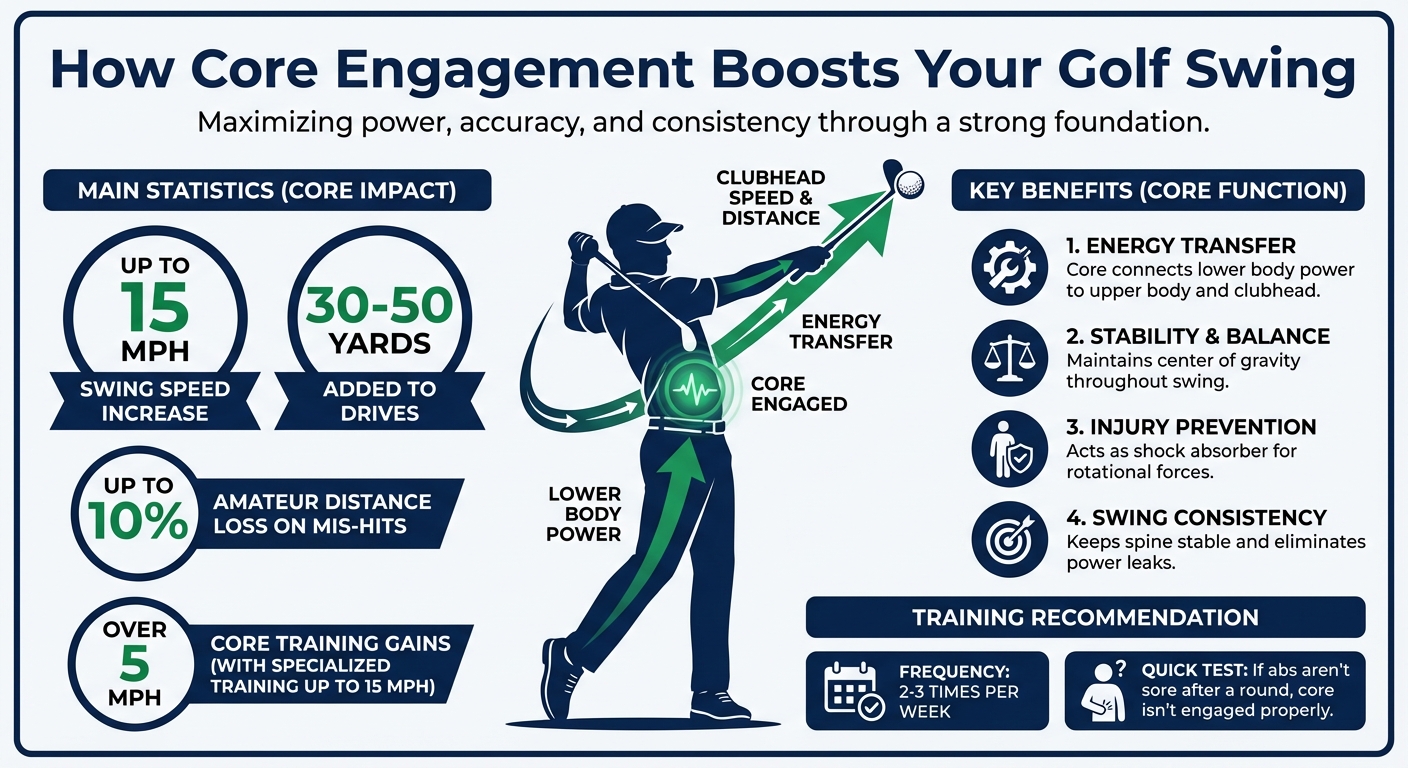
- A strong core improves swing speed by up to 15 MPH, adding 30–50 yards to your drives.
- It protects your spine and shoulders by managing rotational forces and reducing strain.
- Core stability enhances balance, helping you maintain control throughout your swing.
- Exercises like Dead Bugs, Pallof Presses, and Russian Twists build the strength and control needed for a powerful, stable swing.
If your abs aren’t sore after a round, your core isn’t doing its job. Focus on targeted drills 2–3 times a week, track your progress, and watch your game improve.
Core Engagement Benefits for Golf Swing Power and Distance
How Core Engagement Increases Swing Power
Energy Transfer Through the Core
Your core acts as the powerhouse that connects the force from your lower body to your upper body, ultimately fueling your swing. This process starts with ground reaction forces that travel through your hips and torso, delivering energy to the clubhead.
The obliques play a leading role in this energy transfer. These muscles control and initiate hip rotation, generating the rotational speed needed for distance. When your obliques engage properly, they create a whip-like effect, loading and releasing energy efficiently. This approach reduces the reliance on your arms and maximizes rotational speed.
This seamless energy flow not only amplifies swing power but also helps maintain balance throughout the motion.
Stability and Balance During Swings
A stable core is essential for keeping your center of gravity steady during the swing. Without this stability, energy is wasted, and extra effort is needed just to maintain balance.
"Greater balance and stability allow you to transfer more energy into generating power from your core during your swing, rather than wasting effort trying to maintain control."
- Jeremy James, DC, CSCS, GOLFFOREVER
Anti-rotation exercises strengthen your ability to maintain a neutral spine, ensuring energy flows directly where it’s needed while also reducing unnecessary strain.
Rotational Power and Consistency
Once energy transfer and balance are in sync, your core’s rotation becomes the driving force behind consistent and powerful swings. A well-coordinated core aligns the movements of your upper and lower body, creating a smooth and powerful sequence . This precise coordination is what separates consistent players from those who struggle with accuracy, often requiring professional golf lessons to master.
Beyond generating power, your core also plays a critical role in deceleration after impact. By engaging your obliques, your hips are pulled inward, creating the torque required for explosive power while protecting your spine during the follow-through .
sbb-itb-bcd8bdd
Benefits of Core Engagement in Golf
Increased Driving Distance
Engaging your core effectively can significantly boost your driving distance. By channeling energy from the ground through your body to the clubhead, a fully engaged core increases clubhead speed and results in longer drives. The transverse abdominis, a key core muscle, stabilizes your pelvis and lumbar spine, creating a solid base that prevents power loss during the swing. Studies show that golfers who strengthen their core can achieve swing speed increases of over 5 MPH, with some specialized training programs leading to gains as high as 15 MPH.
"This stability allows for a more efficient transfer of force from the lower body to the upper body, resulting in increased swing speed and distance."
- True Geometry
Reduced Risk of Injuries
Core strength doesn’t just enhance performance – it also protects your body from the repetitive stresses of the game. A strong core acts like a shock absorber, managing the rotational forces that can strain your lower back and shoulders. Without proper core engagement, these forces can overload the lower back, increasing the risk of injuries like lumbar strain or disc irritation. By engaging your core, you ensure that rotation occurs in the correct parts of your spine, reducing unnecessary stress on vulnerable areas.
"Core stability is central to protecting the spine and hips during the golf swing. The core acts as a stabilizing system that manages rotational forces and supports posture under load."
- Cynthia Ann Mitsch Bearden, Trainer and Founder
Fatigue is another factor to consider. As your core tires later in a round, your posture can deteriorate, leading to compensatory movements that heighten injury risks. A well-conditioned core provides the endurance needed to maintain proper mechanics throughout all 18 holes, reducing the chance of cumulative damage over time.
Improved Swing Consistency
A strong core is a game-changer when it comes to swing consistency. By keeping your spine stable and your posture controlled, your core ensures smooth rotation under load and eliminates power leaks that lead to erratic shots.
"When your core is strong you will be able to control power through rotation and your swing becomes more explosive, stable, and repeatable."
- Jacob Molnar, Golf Fitness Coach
The numbers back this up: amateur golfers can lose up to 10% of their distance on mis-hit shots. Strengthening your core reduces these inconsistencies by helping your lower body stay approximately 6 inches ahead of your upper body at impact – an essential position for solid contact. Even something as simple as holding your follow-through for five seconds can reveal the stability of your core and the consistency of your swing.
More Core, Less Hands for Your Golf Swing
Core Engagement Drills for Golfers
A strong, efficient golf swing starts with a well-trained core. Your core is the engine that transfers energy through your body, making it essential to focus on exercises that enhance stability, strength, and control. Below are drills designed to improve your performance on the course.
Dead Bug for Core Stability
The Dead Bug exercise is all about teaching your core to stabilize your spine while your limbs move independently – a key skill for controlling your swing. To do this:
- Lie on your back with your arms pointing straight up and your knees bent at a 90-degree angle.
- Slowly lower your right arm overhead while straightening your left leg, keeping your lower back pressed firmly against the floor.
- Return to the starting position and repeat on the opposite side.
The trick here is slow, controlled movement. This prevents your spine from arching and builds the anti-extension strength you need for a stable swing. Aim for 2 sets of 10 reps per side to see results. Once you’ve got this down, move on to the Pallof Press to target anti-rotation strength.
Pallof Press for Anti-Rotation Strength
Anti-rotation strength is crucial for maintaining a neutral spine and avoiding unnecessary strain during your swing. The Pallof Press is a simple but effective drill:
- Attach a resistance band to a sturdy anchor at chest height.
- Stand sideways to the anchor, holding the band with both hands at your chest.
- Press your arms straight out in front of you, resisting the band’s pull to keep your torso square.
This exercise mimics the forces your core must resist in a golf swing, ensuring energy flows efficiently to the clubhead.

"Core training for golfers isn’t just about building strength… It’s about training your body to use core strength effectively during your swing."
- Jeremy James, DC, CSCS
Next up: Russian Twists to build rotational power.
Russian Twists for Rotational Power
Russian Twists are perfect for strengthening your obliques and boosting the rotational power needed for faster clubhead speed. Here’s how to do them:
- Sit on the ground with your knees bent and feet slightly off the floor.
- Lean back at about a 45-degree angle and hold a medicine ball (4 to 12 pounds is ideal).
- Rotate your torso side to side, tapping the ball on the ground near each hip.
Focus on twisting from your core, not just swinging your arms. This movement mirrors the hip and shoulder separation required for a dynamic swing. It also helps train your body to disassociate upper and lower body movements – an essential skill for generating power.
Planks for Endurance
Planks are your go-to for building core endurance, helping you maintain proper swing mechanics through all 18 holes. To perform a plank:
- Start in a forearm plank position, with your elbows directly under your shoulders and your body in a straight line.
- Squeeze your glutes and brace your core as if bracing for impact.
- Hold for 30 to 60 seconds, focusing on perfect form.
Good technique is more important than holding the position for a long time. A strong core foundation prevents posture breakdowns as you fatigue, reducing erratic movements and poor shots.
Half-Kneeling Chops for Dynamic Energy Transfer
The half-kneeling chop trains your core for the dynamic energy transfer that’s crucial in golf. Here’s how to do it:
- Kneel with your right knee down and your left foot forward.
- Hold a cable or resistance band anchored above your right shoulder.
- Pull the handle diagonally across your body toward your left hip, keeping your shoulders stable.
This drill teaches your core to transfer energy efficiently while resisting unwanted rotation. The movement pattern mirrors the bracing your body performs during a swing to decelerate your lower body and transfer speed to your arms and clubhead. Perform 2 sets of 10 reps per side, focusing on controlled, deliberate movements without relying on momentum.
These drills will help you build a stronger, more efficient core, giving you the stability and power you need to elevate your game.
Tracking and Improving Core Engagement
Testing Core Mobility and Rotation
Before diving into core training, it’s smart to assess your current core mobility and control. A straightforward way to check this is with a trunk rotation test, which evaluates whether your core can independently move your upper and lower body. This ability, often called hip-shoulder separation, is crucial for efficient movement. One simple test is the Windshield Wiper Test: lie on your back with your legs bent at a 90° angle, then slowly rotate your legs from side to side while keeping your shoulders flat on the ground. If your upper body moves along with your legs, it’s a sign that your core isn’t isolating effectively.
Another useful assessment is the Half-Kneeling Horizontal Chop, which tests your spine’s stability when under load. If you struggle to maintain a neutral spine during this exercise, it could mean your core isn’t strong enough to stabilize your movements properly. Jacob Molnar, a World Long Drive Professional, puts it this way:
"If your body can’t control rotation under load, you may leak power, lose consistency, and place excess stress on your lower back and shoulders." – Jacob Molnar
Pay attention to muscle fatigue during these tests. If your arms tire out but your core feels fresh, it’s a clear sign that your core engagement is falling short.
A thorough assessment of your core mobility lays the foundation for improving energy transfer in your movements. This directly impacts your accuracy and distance, making it essential to measure how these enhancements affect your swing performance.
Measuring Swing Improvements
Once you’ve assessed your core mobility, it’s time to track how your training translates into better swing performance. Start by recording your baseline driving distance and clubhead speed using a launch monitor. From there, tools like Hackmotion and SAM Balance Lab can help you track progress. Research shows that focused core training can boost swing speed by up to 15 mph in just 30-minute sessions. This can translate to impressive gains of 30 to 50 yards off the tee when your core is properly engaged.
Skills Assessment Challenges are another practical way to monitor improvements. For instance, hit shots at fixed distances – like 20, 40, 80, and 160 yards – and check for consistency. If you notice inconsistencies, it could point to a breakdown in how your core powers your swing. For more detailed tracking, Hackmotion can measure wrist extension and flexion, giving you insight into how well your hand speed aligns with your core movements. Meanwhile, the SAM Balance Lab can track weight shifts and pressure distribution throughout your swing, offering a deeper look at your overall mechanics.
Conclusion
An engaged core is the bridge that transfers energy from your lower body to your golf club, fueling every swing with power and precision. This connection turns wasted effort into explosive distance while providing the stability needed for consistent, clean contact.
The drills shared earlier focus on building stability, anti-rotation strength, and dynamic power – key components for a reliable swing. By training your core 2–3 times a week, you’ll notice a stronger connection and more power in every swing. Here’s a quick test: if your abs aren’t feeling it after a round, chances are you’re overusing your arms instead of relying on your core.
Studies show that dedicated core training can increase swing speed by as much as 15 mph, which could mean an extra 30 to 50 yards off the tee. Even experienced golfers have seen remarkable results. For example, a 69-year-old golfer boosted his swing speed by 15 mph by focusing on transferring power from his core to his hands.
To get started, evaluate your core mobility and use the drills to address specific weaknesses. Track your progress with tools like launch monitors or skills assessments, and pay attention to how your body feels during and after your rounds. From improving energy transfer to reducing the risk of injury, your core plays a central role in elevating every aspect of your swing. The more you train it to be the driving force, the more fluid and athletic your movements will feel – and the lower your scores will go.
Commit to strengthening your core, monitor your improvements, and watch your swing transform. With these targeted drills, you’re on your way to a more powerful and effective game.
FAQs
How do I know I’m using my core instead of my arms?
To determine if you’re engaging your core instead of relying on your arms during a golf swing, pay attention to how your body moves and transfers energy. When your hips and torso are leading the motion, it’s a good sign your core is doing the work. On the other hand, if your swing feels dominated by your arms, try incorporating drills that focus on rotational stability and controlled power transfer. These exercises can help ensure your core is activated and contributing effectively to your swing.
Which core exercise helps golfers the fastest?
The rotational bench press is a fast and effective core exercise that can help take your golf game to the next level. By focusing on building rotational power and stability, it targets the key muscles needed for a stronger, more controlled golf swing.
Can core training reduce lower-back pain from golf?
Absolutely. Strengthening your core, particularly the deeper spinal stabilizers, plays a crucial role in reducing lower-back pain caused by golf. A strong and stable trunk gives you better control during your swing, which helps distribute the forces more evenly across your body. This reduces the strain placed on your lower back.
Not only does this improve your performance on the course, but it also lowers the risk of injuries, keeping you in the game longer and pain-free.
Related Blog Posts
- 5 Balance Drills for a Steady Golf Swing
- Fix Common Balance Issues in Your Swing
- Kinetic Chain Basics for Golfers
- Fix Power Leaks in Your Golf Swing
