
Hitting the center of the clubface is the key to consistent and predictable golf shots. When you strike the ball on the sweet spot, energy transfer is maximized, leading to better distance, accuracy, and shot control. Miss the center, and you risk losing distance, accuracy, and precision due to twisting and inefficient energy transfer.
Key Takeaways:
- Sweet Spot Impact: The sweet spot delivers the best energy transfer, resulting in optimal ball speed, spin, and launch conditions.
- Consistency Matters: Even small vertical mis-hits can cost strokes. A 3.5 mm miss can reduce performance by 3.6 strokes in Strokes Gained: Approach.
- Technology’s Role: Tools like launch monitors have shown that vertical strike consistency is critical for improving golf performance.
- Physics of Striking: Off-center hits cause clubface twisting, leading to hooks, slices, or unpredictable ball flights.
- Smash Factor: A measure of shot efficiency; hitting the center improves this metric.
How to Improve:
- Use feedback tools like strike spray or launch monitors to identify your strike pattern.
- Adjust setup and swing, focusing on tee height, grip pressure, and attack angle.
- Practice drills like the Three-Tee Drill or Quadrant Drill to refine precision.
- Get professionally fitted clubs to match your swing and strike tendencies.
By focusing on center face contact, you can stabilize your shots, improve your scoring, and gain more control over your game.
The Physics Behind Center Face Contact
The Sweet Spot and Energy Transfer
Think of the clubface like a trampoline: when you hit the center, energy transfers smoothly, but stray from that spot, and energy starts to scatter. A shot that hits the sweet spot allows the clubface to flex and rebound, sending the ball forward with maximum efficiency. Miss that center, and instead of transferring energy to the ball, the clubhead twists, wasting power.
"A center face hit, landing right in the middle of this trampoline, allows for efficient energy transfer, launching the ball high and far with minimal loss." – Ellie Wagner, Square Launcher Golf
In short, hitting the sweet spot is key for generating more ball speed and achieving the ideal launch conditions.
Gear Effect and Ball Flight Variability
When you hit the ball off the heel or toe of the club, the clubhead rotates around its center of gravity. This twist creates side spin on the ball, a phenomenon referred to as the gear effect. For right-handed golfers, a heel strike typically closes the clubface, causing a hook, while a toe strike opens the face, often leading to a fade or slice.
"Off-center hits result in inefficient energy transfer, leading to slices, hooks, and unpredictable flight paths due to club face twisting at impact." – Ellie Wagner, Square Launcher Golf
Modern drivers are designed with perimeter weighting, which helps minimize the twisting caused by heel-and-toe strikes. However, vertical misses – hitting too high or too low on the clubface – are harder to manage. As Golf Digest writer Luke Kerr-Dineen puts it, "Heel-to-toe clubface misses are annoying, but won’t kill you like top-to-bottom clubface misses". These vertical misses are harder for club technology to correct, making consistent strike location along the vertical plane essential for better shot predictability. Mis-hits in this area disrupt energy transfer and reduce overall efficiency.
Smash Factor and Shot Efficiency
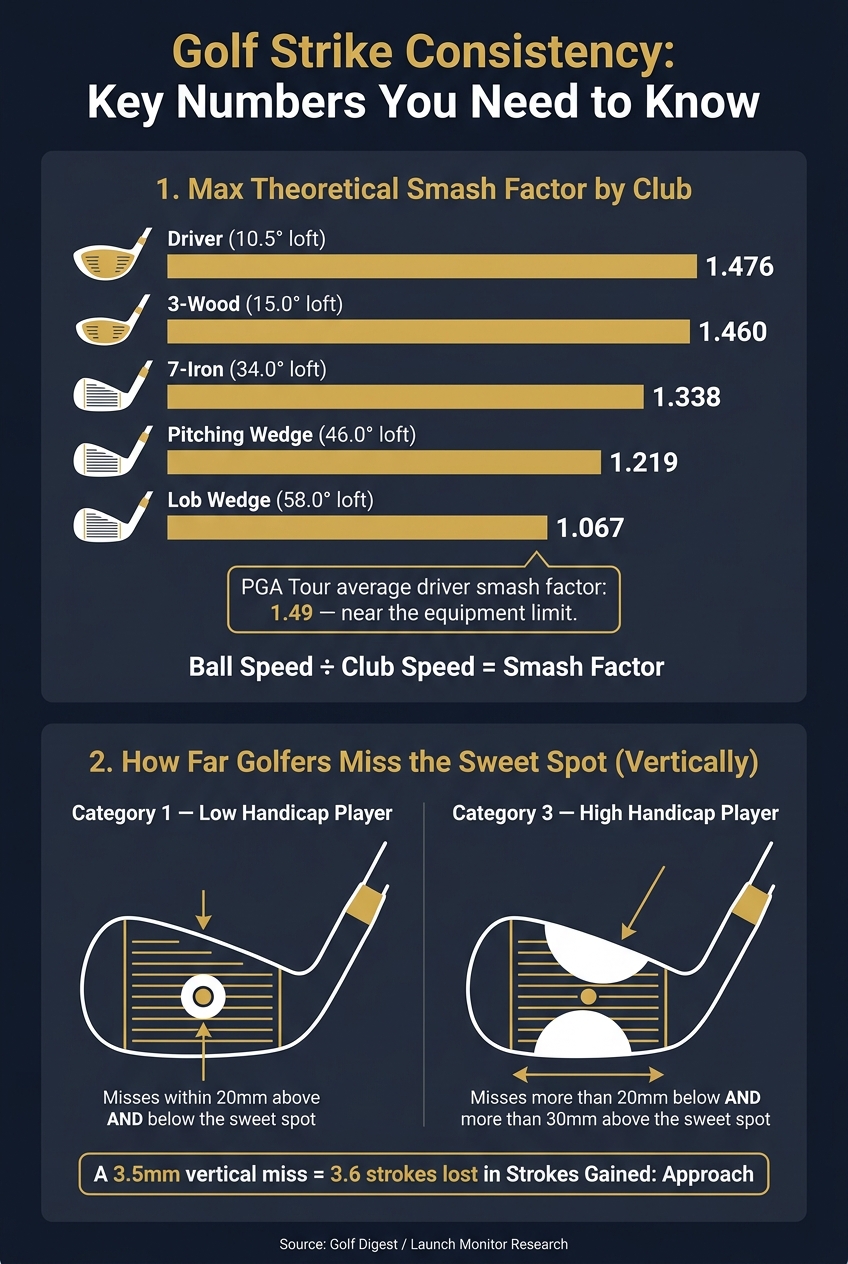
Smash factor ties all these elements together by measuring shot efficiency. It’s calculated as Ball Speed ÷ Club Speed and reflects how well your swing speed translates into ball speed. Hitting the center of the face is critical for getting close to the theoretical maximum smash factor for your club.
The maximum smash factor depends on the club’s loft. The table below outlines the differences across various clubs:
| Club | Typical Loft | Max Theoretical Smash Factor |
|---|---|---|
| Driver | 10.5° | 1.476 |
| 3-Wood | 15.0° | 1.460 |
| 7-Iron | 34.0° | 1.338 |
| Pitching Wedge | 46.0° | 1.219 |
| Lob Wedge | 58.0° | 1.067 |
For example, PGA Tour players average a smash factor of 1.49 with their drivers – pushing the limits of equipment regulations. With a 7-iron, a smash factor of 1.30 equates to about 97% efficiency. By comparing your smash factor to the maximum for each club, you can figure out how consistently you’re striking the center of the face.
sbb-itb-bcd8bdd
How To Consistently Hit The Center Of The Clubface (every time)
What Research and Data Show
Golf Strike Consistency: Smash Factor & Vertical Miss Data by Club & Skill Level
Launch Monitor Data and Findings
Research backed by launch monitor data and Strokes Gained analysis highlights the importance of where the ball strikes the clubface, especially in terms of vertical impact location. This refers to how high or low the ball makes contact on the clubface, and it plays a major role in differentiating skill levels among golfers. Sports scientist Alex Ehlert, PhD, notes that low-handicap players (Category 1) usually keep their vertical strike variability within 20 mm above or below the sweet spot. In contrast, high-handicap players (Category 3) often miss by more than 20 mm below and 30 mm above the sweet spot.
Adam Young, a Golf Digest Best in State Teacher, emphasizes the significance of even small adjustments:
"Now, I shifted the whole pattern up around a groove. That’s 3.5mm! Now we have a predicted 3.6 strokes lost." – Adam Young, Golf Digest Best in State
This data underscores the precision required for consistent performance and sets the stage for understanding how club design interacts with these dynamics.
Club Fitting and Engineering Research
While launch monitors highlight the importance of precision in impact, research into club engineering shows that even the best technology has its limits. Modern clubs are designed to reduce the effects of heel-and-toe mis-hits, but vertical mis-hits remain a challenge. Strikes that are too high on an iron face, for instance, undercut the club’s efficiency, leading to shots that fall short of their intended distance.
The variability in vertical impact by skill level is summarized below:
| Golfer Category | Vertical Miss (Below Sweet Spot) | Vertical Miss (Above Sweet Spot) |
|---|---|---|
| Category 1 (Low Handicap) | < 20 mm | < 20 mm |
| Category 3 (High Handicap) | > 20 mm | > 30 mm |
How to Improve Center Face Contact
If you’re looking to consistently hit the sweet spot, these practical golf tips – rooted in research – can help you refine your game.
Using Feedback Tools to Identify Strike Patterns
Many golfers don’t realize exactly where they’re striking the ball on the clubface. You might consistently hit off the heel or toe without even knowing it. That’s where feedback tools come in handy.
One simple option is using an impact spray (or a dedicated Strike Spray) on the clubface before each shot. When you hit the ball, it leaves a visible mark showing where contact occurred. Another budget-friendly trick is marking the back of the ball with a dry-erase pen. Beyond visual feedback, pay attention to the feel of your shots – a centered strike gives a crisp, satisfying "pop", while a mishit feels dull and may cause a twisting sensation in your hands.
"Experience a satisfying pop at impact, indicating a centered strike." – Ellie Wagner, Square Launcher Golf
For golfers who love data, launch monitors can track metrics like launch angle and spin rate. Consistent numbers suggest centered strikes, while erratic data points to inconsistent contact.
Once you’ve identified your strike pattern, you can fine-tune your setup and swing for better results.
Setup and Swing Adjustments That Affect Contact
Off-center strikes often come down to issues with tee height or attack angle, especially with drivers. If you’re hitting too high on the ball, you’re likely making contact low on the clubface, which robs you of distance. As Top 100 Teacher Bernie Najar explains:

"Hitting less ‘up’ on the ball with driver may be your secret to more yards."
Experiment with different tee heights – low, medium, and high – to find what helps you hit the center of the face. Using impact spray alongside these adjustments provides instant feedback.
For irons, focus on keeping your hands slightly ahead of the ball at impact and maintaining a relaxed, fluid swing. Surprisingly, grip pressure and rhythm can have a huge impact. A tense or rushed swing makes it tough to return the clubhead to the same spot consistently.
Once your setup is dialed in, specific drills can help lock in your center face contact.
Drills to Build Strike Consistency
Drills are a great way to reinforce precision and improve energy transfer during your swing.
The Three-Tee Drill is perfect for fixing low-face driver strikes. Start by teeing up your ball as usual, then place two additional tees just in front of it along your target line. The goal is to hit the ball cleanly and drive the clubhead through the two forward tees. As Bernie Najar notes:
"By catching the ball and the two other tees you’ll successfully de-loft the club a bit and stay more on path."
If you tend to hit toward the heel, try deliberately aiming for the extreme toe. This exaggerated adjustment can help shift your natural strike closer to the center. Another helpful exercise is the Quadrant Drill, where you mentally divide the clubface into four zones (toe-high, toe-low, heel-high, heel-low) and practice hitting each one deliberately.
Equipment Considerations for Centered Strikes
Even with perfect technique, the wrong equipment can hold you back. One key factor is shaft length. Clubs that are too long can force compensatory swings, pulling your strike away from the center. Getting fitted for the right shaft length can improve your consistency without requiring major swing changes.
Clubhead design also plays a role. Modern irons are built to reduce the effects of heel-and-toe mishits, but vertical mis-hits remain harder to address. A professional club fitting session, focused on your actual strike patterns rather than just ball flight, ensures your gear matches your swing style effectively.
Conclusion and Key Takeaways
Key Benefits of Center Face Contact
Striking the center of the clubface doesn’t just feel great – it’s a game-changer for your performance. Center strikes help stabilize the clubface, leading to consistent launch angles, predictable spin, and tighter shot dispersion. The result? More greens in regulation and fewer errors.
Studies show that even slight mishits can cost you valuable strokes. As Golf Digest Best in State Teacher Adam Young explains:
"If a golfer over the course of their round hit a smattering of shots just a few grooves above the sweetspot, it would result in almost four shots lost on SG: Approach."
Maintaining vertical consistency in your strikes is crucial, as even modern clubs can’t fully compensate for high or low face contact – especially with irons. These insights lay the groundwork for improving your ball striking.
Next Steps for Golfers
To refine your center face contact, start with small, actionable steps. Use impact spray or tape during practice sessions to monitor where you’re striking the ball. This is especially helpful for improving driver accuracy and hitting more fairways. Aim to keep your contact points within a tight vertical range; for reference, lower-handicap players typically stay within 20 mm (0.79 inches) of the sweet spot.
For a more structured plan, How To Break 80 provides drills, video lessons, and swing guides to help you develop more consistent ball striking. These tools can make a noticeable difference in your game.
FAQs
How do I know where I hit the clubface?
You can figure out where you’re striking the ball on the clubface by focusing on the feel and feedback during your swing. A shot that hits the "sweet spot" feels solid and produces a crisp, pleasing sound. On the other hand, off-center hits feel less stable and can lead to reduced distance and accuracy. For a visual aid, try using impact tape or stickers on your clubface – they’ll clearly show the contact point after each swing.
Why are high or low face strikes so costly?
Striking the ball too high or too low on the clubface can seriously impact your game. Off-center hits reduce how efficiently energy is transferred, which means you lose out on distance, accuracy, and consistency. Hitting the center of the face, however, allows for maximum energy transfer and better control, leading to improved performance overall.
What setup change helps center contact fastest?
The quickest way to boost your center contact is by using the three-tee drill. Start by placing your golf ball on a tee as you normally would. Then, set up two additional tees just slightly ahead along the target line. This setup helps train your swing to hit the ball cleanly while navigating through the tees, making it easier to achieve consistent, centered strikes.
Related Blog Posts
- How to Fix Poor Impact Position in Golf
- Open vs. Square Clubface: Key Differences Explained
- How to Improve Driving Consistency
- How Launch Monitor Data Improves Golf Swing Analysis
