
More range time does not mean lower scores. If I want to get better at golf, I need to practice with a clear target, track the right stats, and change my plan when the numbers say it’s time.
Here’s the short version:
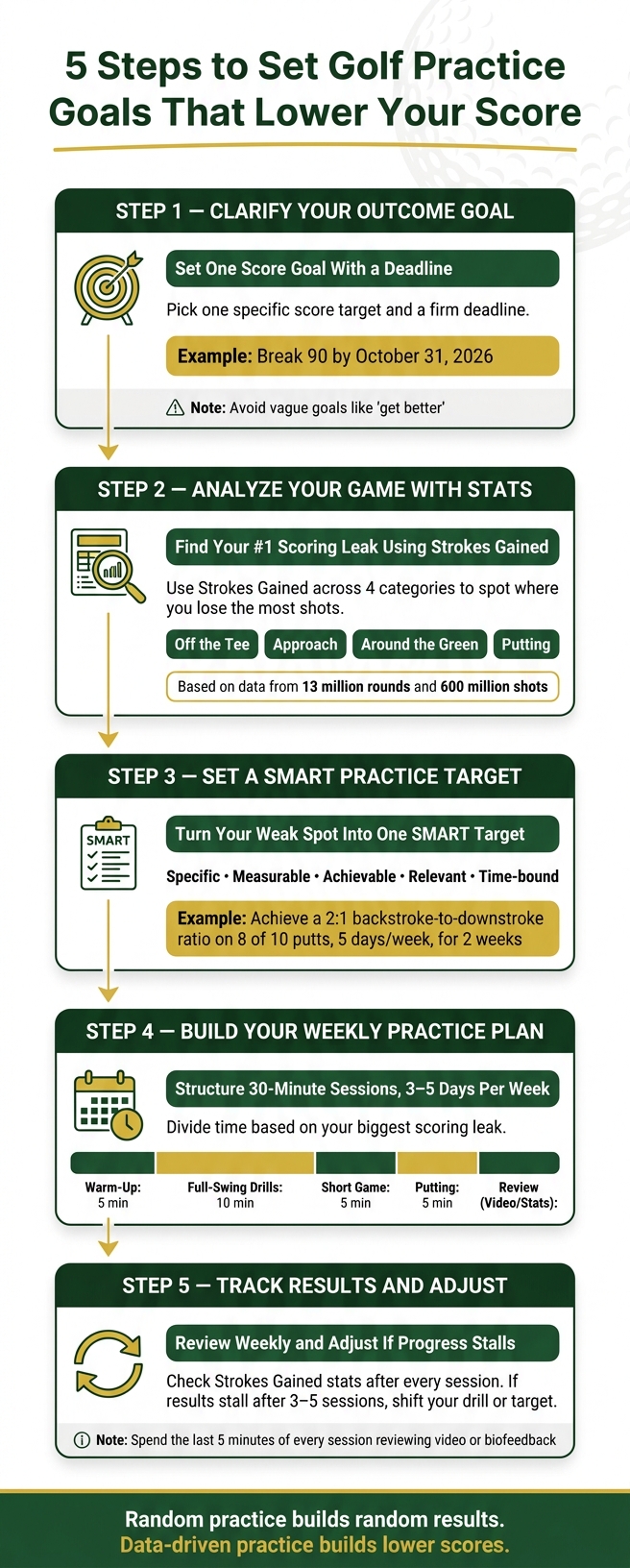
- I start with one score goal and a deadline, like break 90 by October 31, 2026.
- I check my game stats to find one main scoring leak.
- I turn that weak spot into one SMART practice target.
- I build 30-minute sessions, 3 to 5 days per week around that target.
- I review results each week and adjust if progress stalls after 3 to 5 sessions.
The big idea is simple: random practice builds random results. Data from 13 million rounds and 600 million shots shows that golfers lose strokes in repeatable patterns, so I should practice based on my weak area, not guesswork.
A few points stand out fast:
- Outcome goals = the score I want
- Performance goals = the stats I need to change
- Process goals = the drills and reps I do in practice
- Strokes Gained helps me spot where I lose the most shots: off the tee, approach, around the green, or putting
- A short session with feedback beats hitting balls with no plan
If I keep my goal clear, my sessions short, and my feedback honest, I give myself a much better shot at lower scores.
5 Steps to Set Golf Practice Goals That Lower Your Score
Setting Golf Goals to Develop Your Game | Titleist Tips
sbb-itb-bcd8bdd
Why Goal-Setting Matters in Golf Practice
Most golfers walk onto the range, grab a bucket, and start hitting. The problem? After that bucket is gone, there’s often nothing to show for it that you can measure. That kind of random practice doesn’t just waste time. It can also lock in bad habits.
"Without ball flight or a coach watching, golfers can repeat the same bad movement for hours." – Britt Olizarowicz, Golf Professional
Intentional practice changes that. When you know exactly what you’re working toward – like breaking 90 by October 31, 2026, or getting your handicap down to a set number – each session has a clear aim. And once that aim is clear, the next move gets simpler: separate the score you want from the stats and drills that help you get there.
Outcome Goals vs. Performance Goals vs. Process Goals
These three goal types link your score goal to what you do in practice. If you get the difference, it’s much easier to build a plan that leads to lower scores on the course.
| Goal Type | What It Focuses On | Example for a U.S. Golfer |
|---|---|---|
| Outcome | The end result | Break 90 by October 31, 2026 |
| Performance | Measurable stats | Average fewer than 32 putts per round |
| Process | What you do in practice | Start each putting session with 10 reps using a 2:1 tempo |
Your outcome goal is the end result. It can fire you up, but it’s not something you can control shot by shot during a practice session. Your performance goals are the numbers that need to change for that outcome to happen. Your process goals are the drills, reps, and habits you use to move those numbers.
That’s the bridge between wanting a lower score and knowing what to do today at the range or on the putting green.
Why Random Practice Stalls Progress
Hitting balls with no target and no feedback makes improvement hard to track. You may feel busy, but busy isn’t the same as getting better. Data shows golfers close to breaking 80 tend to share a few common weak spots, which means practice should begin with the weakest one. That gives your session a point. Instead of trying to fix everything at once, you work on the one area most likely to help your score.
"Random practice rarely produces real progress. Instead, structure short, focused sessions that cover key movement patterns." – Britt Olizarowicz, Golf Professional
How Specific Goals Make Practice More Efficient
Most golfers don’t have hours a day to practice, so being specific matters. A focused 30-minute session built around clear drills works better than mindless ball striking. When you know your process goal before you start, you stop guessing. Each rep gives you feedback. Each drill ties back to a number you can track.
1. Clarify Your Long-Term Golf Outcome
Pick one score goal that lines up with the weakest part of your game.
Give it a clear deadline. For example, aim to break 90 by June 30, 2027. Skip fuzzy goals like “get better.” They sound nice, but they don’t give you anything solid to work toward.
Your goal should match your biggest scoring leak, not just what sounds good. If you’re dropping the most shots off the tee, playing smart saves strokes and helps you recover. If three-putts and missed short putts are wrecking your card, point the goal at your work on the greens. You can start with putting drills to sharpen your short game.
"Breaking 80… is the universal marker of respect among golfers in the recreational ranks." – Luke Kerr-Dineen, Golf Digest
That score target becomes the anchor for your performance and process goals in Step 2 and Step 3.
2. Analyze Your Current Game With Simple Stats
Once you’ve set your score goal, turn it into numbers. The easiest way to do that is with Strokes Gained. It shows where you’re giving shots away by breaking your game into four parts: Off the Tee, Approach, Around the Green, and Putting.
Start simple. Look for the one area that costs you the most shots, then use the right golf drills to fix it.
Strokes Gained compares your play in each category to a scratch golfer, which is set at 0.0. Negative numbers mean you’re losing shots. That makes it a fast way to spot the biggest leak in your game. The examples below show how different weak spots can hurt scoring.
| Golfer Archetype | Avg. Driving Distance | Primary Weakness | SG Loss |
|---|---|---|---|
| Mental Mistake Makers | 255 yards | Approach | -2.403 |
| Disaster Shotmakers | 224 yards | Tee-to-Green (Contact) | -6.293 |
| Yippy Putters | 262 yards | Putting | -3.621 |
| Short & Straight Hitters | 209 yards | Approach | -3.650 |
| Landmine Golfers | 229 yards | Off the Tee & Putting | -2.745 / -3.448 |
| New Low Point Finders | 261 yards | Approach & Around the Green | -2.820 / -1.849 |
SG data is relative to a scratch golfer (0.0).

Treat these as benchmarks, not labels. For example, "Yippy Putters" are the longest hitters in this group at 262 yards off the tee, but they still lose 3.621 strokes per round on the greens. That’s a good reminder: distance doesn’t tell the whole story.
Pick the category where you lose the most strokes. If your tee shots keep missing in the same direction, that pattern can lead to blow-up holes. That’s the area to carry into Step 3 as your practice target.
3. Turn Weak Areas Into SMART Practice Targets
Pick your biggest scoring leak and turn it into one SMART target. A fuzzy goal like “improve your golf game” isn’t enough. You need a target that’s Specific, Measurable, Achievable, Relevant, and Time-bound.
If three-putts are costing you shots, a SMART version looks like this: Achieve a 2:1 backstroke-to-downstroke ratio on 8 of 10 putts in a 10-minute home session, five days a week, for two weeks.
"Even at home, quality beats quantity. Every swing should serve a clear purpose and provide measurable information." – Britt Olizarowicz, Golf Professional
That’s the pattern to follow every time: one action, one metric, one deadline.
| Weakness | SMART Target | Metric for Success |
|---|---|---|
| Three-Putts | Achieve a 2:1 backstroke-to-downstroke ratio on 8 of 10 putts using biofeedback sensors within 3 weeks | Ratio drill data (e.g., HackMotion) |
| Missed Fairways | Eliminate open face at P2 in 15 of 20 reps | Biofeedback or video check |
| Poor Wedge Control | Complete 30 "L-to-L" wedge swings daily while keeping the towel in place | Towel stays under arms throughout |
| Inconsistent Contact | Use foot spray on the clubface during range sessions to track exact impact point on the face | Exact impact location on the face |
Not every weak spot is technical. “Mental Mistake Makers” lose -2.403 SG on approach shots, often because they take too little club or pick poor targets. In that case, your SMART target should focus on a single shot-selection rule instead of swing mechanics.
Use the target from this step when you build your weekly practice plan in Step 4.
4. Build a Weekly Practice Plan Around Your Targets
Turn your SMART target into a weekly plan made up of focused practice blocks. In plain English: your target becomes the structure you repeat each week.
A 30-minute session might look like this: 5 minutes of warm-up and movement prep, 10 minutes of full-swing drills, 5 minutes of short game, 5 minutes of putting, and 5 minutes reviewing video or stats.
Keep one primary focus for each session – takeaway, impact, or putting rhythm. That keeps the work tight and gives each block a clear job. If one part of your game is costing you the most shots, that’s where most of your weekly time should go.
Use on-course data to divide your practice time. If putting is where you lose the most strokes, give putting more minutes. If full-swing and contact are the main leak, shift more time there instead. Start with that as your baseline, then adjust it after you track results in Step 5.
5. Track Results and Adjust Goals Regularly
Once your weekly plan is set, check if it’s moving your numbers. Practice only pays off when you measure what happens, both in training and on the course.
Review your course stats and practice feedback each week. Then, spend the last 5 minutes of every session looking at video or biofeedback. That short review can show small issues before they turn into bad habits.
On the course, track Strokes Gained in Off the Tee, Approach, Around the Green, and Putting. Those numbers show where shots are slipping away. Use that data to decide if your drill needs a small change or if the target itself is off.
"Feedback is everything – without it, you risk training the wrong habits." – Britt Olizarowicz, Golf Professional
If your results stall after 3–5 sessions, that’s a sign something’s off. You may be working on the wrong area, or you may not have enough objective feedback to judge progress. In that case, shift your focus or test a different drill for the same goal. If you’re still struggling, consider professional golf lessons to identify technical flaws. Change the target only when the evidence shows the current one isn’t doing the job.
Use the next section to compare weekly plan structures by goal focus.
Sample Weekly Golf Practice Plans
Use the weakness you found in Step 2 and Step 3 to pick one weekly split. These three plans turn the five steps into a simple practice week built around 4 hours per week, broken into 30-minute sessions, 3 to 5 days per week. Pick the split that lines up with the part of your game that leaks the most strokes.
Balanced 4-Hour Weekly Plan
Use this split when no single stat jumps off the page. It also works well if you still haven’t pinned down one main weak spot.
Putting-Priority Weekly Plan
If putting is your biggest problem, move most of your weekly time to the greens. If SG: Putting is worse than -3.0, use the 2:1 Ratio Drill for distance control and add a putting mirror and gates to tighten up stroke consistency.
Short-Game-Heavy Weekly Plan
If chipping and pitching are costing you the most strokes, put most of your weekly time into the short game. Focus on the Towel-Under-Arms Drill to calm overactive hands on chip shots, and use L-to-L swings to help your body keep turning through impact.

Here’s how each plan splits the four hours:
| Plan Type | Full Swing | Short Game | Putting | Strategy/Review |
|---|---|---|---|---|
| Balanced | 80 min | 60 min | 60 min | 40 min |
| Putting-Priority | 40 min | 40 min | 120 min | 40 min |
| Short-Game-Heavy | 40 min | 120 min | 40 min | 40 min |
Practice Plan Comparison Table by Goal Focus
Use this table to line up your biggest scoring leak with the weekly split that fits it best.
| Plan | Best Use Case | Main Benefit | Possible Drawback |
|---|---|---|---|
| Balanced | Average across stats, but lose shots to strategy and mistakes | Keeps every part of the game active | May not fix a severe, specific flaw fast |
| Putting-Priority | Strong ball-striking, weak putting | Fastest path to lower scores | Full-swing reps drop, which can hurt ball-striking |
| Short-Game-Heavy | Weak wedge contact, chipping, or scrambling | Quickly improves par-saving ability | Doesn’t fix driving distance or accuracy |
Once you pick a plan, the next section shows the mistakes that can weaken it.
Common Mistakes to Avoid When Setting Golf Practice Goals
Once you set a goal and map out your week, a few common mistakes can still throw you off. The main problem usually isn’t effort; it’s scattered effort that prevents you from seeing results.
Setting Too Many Goals at Once
If you try to fix everything in a single week, your attention gets split. That makes it harder to improve the weak area your weekly plan is supposed to target. Stick with one main goal and one practice focus for the week.
Using Vague Practice Targets
“Get better at putting” sounds fine, but it doesn’t give you a clear target. And if you can’t measure it, how do you know if you’re improving?
Use something specific instead, like aiming for a 2:1 backstroke-to-downstroke ratio for 10 consecutive putting reps. That gives you a target you can track.
"Feedback is everything – without it, you risk training the wrong habits." – Britt Olizarowicz, Golf Professional
Ignoring On-Course Data
Your practice plan should come from what your scorecard says, not from what seems off. A lot of golfers misread their weakest area.
That’s why practice should be based on actual round data, especially the Strokes Gained categories from Step 2. This helps you spend time on the part of your game that costs you the most shots.
"Each set of golfers has its own unique strengths and, crucially, its own set of weaknesses that stop them from shooting in the 70s consistently." – Luke Kerr-Dineen, Golf Digest
Skipping Regular Progress Reviews
Even a good plan can drift if you never check it. Practice without review often means repeating the same mistake over and over.
Set aside the final 5 minutes of every session to review feedback, whether that’s video or sensor data. That short check helps you spot what’s changing and what isn’t. Without it, you can’t tell if your target still makes sense or if it needs to be changed or replaced. Regular stat reviews also help keep your goals tied to your biggest weakness.
Conclusion
Start with honest data: scorecards, stats, and the part of your game that’s costing you the most shots.
That’s what makes these steps matter. They turn practice from random range time into progress you can track. If putting is the issue, work on putting. If tee-to-green play is where shots disappear, go there first. Specific, measurable goals tied to on-course results beat vague plans every time.
Short, focused sessions – 30 minutes, 3–5 days per week – can move your game forward faster than hours of drifting through practice. Add a brief review at the end of each session, and your goals stay clear as your game shifts. Follow the five steps with consistency, and your progress will come from deliberate practice, not guesswork. That’s how the five-step process turns practice into lower scores.
FAQs
How do I know which stat matters most?
Focus on the stats that move your score the most. Look back at your rounds and watch for patterns, like blow-up holes, short-game trouble, or too many three-putts.
For putting, pay close attention to your make rate from 6 to 12 feet. If your goal is breaking 80, the most important stat will depend on your game. That’s why objective data matters. It shows you what’s happening, instead of what you think is happening.
What if I don’t track Strokes Gained yet?
You can still set effective practice goals by tracking simple round data like total score, fairways hit, greens in regulation, and total putts.
You don’t need advanced stats to learn a lot. If you log your results hole by hole and jot down notes on mishaps, patterns start to show up. You can spot your best and worst holes, see where strokes are slipping away, and use that information to guide your practice.
When should I change my practice goal?
Change your practice goal after one to two weeks of focused work on a specific fault or objective, or once you’ve fixed that area or locked in the movement pattern.
Stick with the same routine and track your performance for at least four weeks before judging score improvement. That gives you enough time to spot real progress instead of reacting to a bad day or two.

Review your results often so you know when it’s time to move on and work on the next weakness.
Related Blog Posts
- Golf Practice Checklist: 8 Drills for Weekend Warriors
- How To Plan A 1-Hour Golf Practice Session
- How to Set SMART Goals for Golf Success
- How Pros Structure Their Practice Routines
