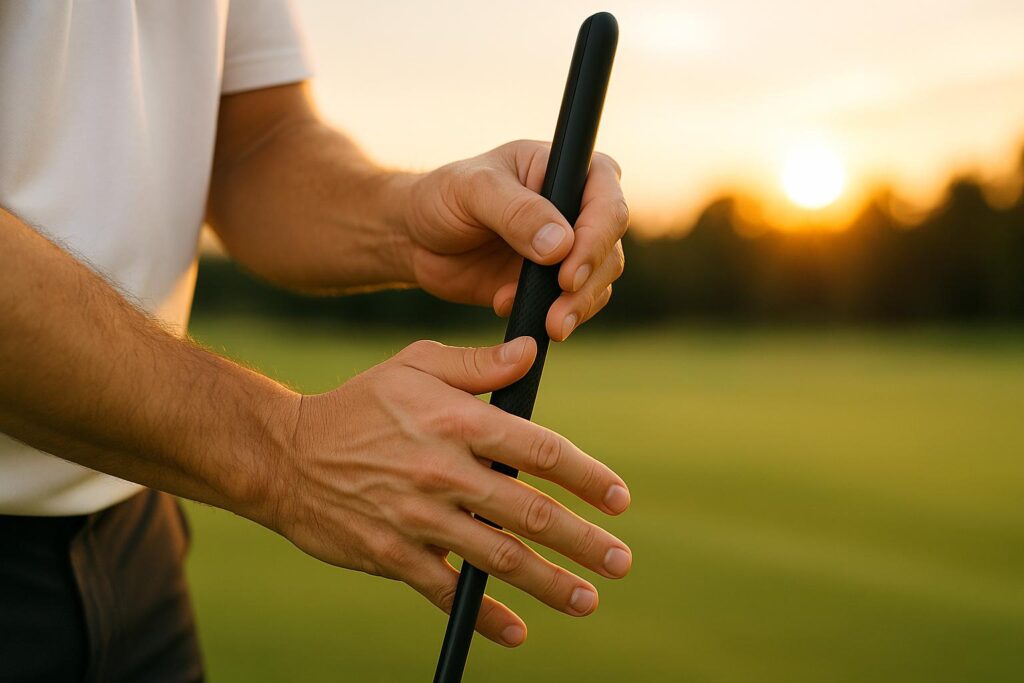
Your grip is the key to controlling the ball’s flight path in golf. Minor changes in hand positioning can help you shape shots like fades and draws, giving you more control over your game. Here’s a quick breakdown:
- Fade: Ball curves left-to-right (for right-handed golfers). Use a weaker grip (hands rotated slightly counterclockwise). Ideal for precision, softer landings, and avoiding trouble on the right.
- Draw: Ball curves right-to-left. Use a stronger grip (hands rotated slightly clockwise). Great for distance, lower trajectory, and cutting through wind.
Key Differences:
- Fade: Open clubface, weaker grip, extended lead wrist at impact.
- Draw: Closed clubface, stronger grip, bowed lead wrist at impact.
Practice grip adjustments on the range to build muscle memory. Whether you’re facing tight greens or long tee shots, mastering fades and draws can elevate your golf strategy.
Should you change your grip to draw and fade
How to Hit a Fade: Grip and Setup
A consistent fade starts with tweaking your grip and making a few adjustments to your stance.
Fade Grip Position
To shape a fade, you’ll need to weaken your grip by rotating both hands slightly counterclockwise. This subtle change opens the clubface at impact, creating the spin needed for that smooth left-to-right curve.
Here’s how to position your hands: with your left hand (for right-handed golfers), aim to see only one or two knuckles, and let your left thumb rest slightly left of center. Your right hand should be positioned so the palm faces the target, with the thumb-and-index V pointing toward your left shoulder instead of your right.
At first, this grip might feel awkward. The trick is to ease into it slowly. Practice gripping the club this way while making controlled swings to build muscle memory. Since your hands will naturally want to revert to their usual position, regular practice is essential.
Also, keep an eye on your grip pressure. A light grip – around 4 or 5 on a scale of 10 – helps the clubface stay open through impact, which enhances the fade. Avoid squeezing the club too tightly; a relaxed grip is key.
Fade Setup and Swing Path
Once your grip is set, your stance plays a big role in shaping the fade. Open your stance slightly by aligning your feet, hips, and shoulders just left of the target line. Meanwhile, keep the clubface aimed directly at the target. This creates the necessary contrast between your swing path and the clubface position.
The fade swing path moves slightly out-to-in through the ball. Essentially, the club approaches the ball from inside the target line and cuts across it after impact. This motion generates the clockwise spin needed for a fade.
Pay attention to your lead wrist at impact. Keeping it extended helps maintain the open clubface angle created by your grip. Many golfers accidentally close the clubface by rolling their wrists, which can turn a fade into a hook.
During your backswing, aim for a slightly more upright plane than usual. This steeper motion naturally supports the out-to-in swing path. A good visual cue is to take the club back along your shoulder line rather than wrapping it around your body.
When you combine the right grip, stance, and swing path, you’ll be able to shape reliable fades.
Best Times to Hit a Fade
Once you’ve mastered the mechanics, fades are ideal for situations where control matters most. The higher trajectory and softer landing make fades great for approach shots to elevated greens or when the pin is tucked behind a front bunker.
Fades are also useful when there’s trouble on the right side of the fairway or green. The left-to-right curve keeps the ball moving away from hazards like water, bunkers, or out-of-bounds areas, giving you more room for error.
In windy conditions, fades can be a smart choice. Against a left-to-right crosswind, a fade resists the wind and stays straighter. And when hitting into a headwind, the higher flight of a fade can help carry the ball farther than you might expect.
For left-side pin positions, aim toward the center or right side of the green. The fade will naturally curve toward the flag, keeping you away from left-side trouble while still giving you a chance to attack the pin.
Many tournament players rely on fades during high-pressure moments because the shot is often easier to control than a draw. While you might lose a bit of distance, the added precision can make all the difference when accuracy is critical.
How to Hit a Draw: Grip and Setup
A draw shot curves from right to left, and achieving it consistently requires specific adjustments to your grip and stance. These changes are the opposite of what you’d use to hit a fade.
Draw Grip Position
To hit a draw, you’ll need to slightly strengthen your grip. Rotate both hands about a quarter-turn clockwise on the club handle. This adjustment naturally closes the clubface at impact, creating the right-to-left spin needed for a draw.

A proper draw grip shows three knuckles on your left hand, with the "V" shapes formed by your thumbs and index fingers pointing toward your right shoulder. This grip encourages a slightly bowed lead wrist at impact, which is key to closing the clubface. Unlike the weaker grip used for a fade, this stronger grip supports the wrist action necessary for a draw. Start with subtle grip changes – just a quarter-turn clockwise from your usual position is often enough. Keep your grip relaxed yet steady to allow smooth wrist movement through the swing.
Draw Setup and Swing Path
Your stance and swing path are just as important as your grip when shaping a draw. Begin by closing your stance: align your feet, hips, and shoulders slightly to the right of your target. Then, position the clubface so it’s slightly open to the target but closed relative to your stance line. This setup creates the conditions for the ball to curve from right to left.
As you swing, focus on starting your backswing along an inside path. On the downswing, keep your hands close to your body to maintain an inside-to-out swing path. Rather than aiming directly at the target, swing along the line of your feet. At impact, let your lead wrist flex slightly while your trailing hand rotates over. This movement helps close the clubface and produce the desired draw. The ball should start just right of your target and curve back left, following the natural shape of a draw.
Best Times to Hit a Draw
A draw is particularly useful for approach shots to pins on the right side of the green. Its right-to-left curve not only helps guide the ball toward the flag but also avoids hazards on the right. Adding a draw to your skillset gives you more flexibility to handle various course challenges effectively.
sbb-itb-bcd8bdd
Fade vs Draw: Direct Comparison
When comparing fade and draw grips, the key lies in grip strength and clubface positioning. A fade requires a weaker grip and an open clubface, while a draw benefits from a stronger grip and a closed clubface.
Technical Differences Chart
Here’s a quick breakdown of the grip elements that differentiate a fade from a draw:
| Element | Fade | Draw |
|---|---|---|
| Grip Strength | Weaker grip keeps the clubface open | Stronger grip helps square or close the clubface |
| Hand Position ("V" Direction) | The "V" formed by your hands points toward the left side of your body | The "V" formed by your hands points toward your right shoulder |
| Lead Wrist at Impact | More extension (cupped wrist) at impact | More flexion (bowed wrist) at impact |
| Clubface Position | Open relative to the swing path | Closed relative to the swing path |
For a fade, focus on cupping your wrists during the downswing. For a draw, ensure your wrists are bowed as you approach impact.
Pros and Cons of Each Shot
The fade, achieved with a weaker grip and cupped wrists, keeps the clubface open, offering a controlled ball flight. On the other hand, the draw, with its stronger grip and bowed wrists, promotes a closed clubface, ideal for a powerful and penetrating trajectory. Mastering these grip techniques allows you to fine-tune your shot shape and adapt to various on-course scenarios. From here, work on drills that reinforce these grip adjustments to take your game to the next level.
Practice Drills for Grip Changes
Building consistent grip adjustments for fades and draws takes practice, and specific drills can help develop the muscle memory needed for success. Since wrist action accounts for about 80% of ball flight control, focusing on these drills can make a noticeable difference.
Grip Change Practice Drills
Begin with exaggeration drills to counteract natural tendencies. For fades, slow down your swing, pause at the top, and emphasize cupping your lead wrist. For draws, concentrate on bowing your lead wrist while imagining the clubface closing through impact.
To take it a step further, the HackMotion wrist sensor can provide real-time feedback, helping you confirm your wrist angles are correct. These drills tie directly into the grip techniques covered earlier, ensuring your shot shaping becomes more consistent.
Pre-Shot Routine for Shot Shaping
Incorporate these grip drills into your pre-shot routine for a more reliable setup. A solid pre-shot routine helps align your grip, stance, and focus with your intended shot. Start by checking your grip to ensure it’s consistent and aligned with your goal. Visualize the shot you want to hit and the ball flight you’re aiming for.
For fades, think about the feeling of a weaker grip and a cupped lead wrist. For draws, focus on a stronger grip and the sensation of a bowed lead wrist at impact. Once your grip feels right, confirm the "V" formed by your thumbs and index fingers points left for a fade or right for a draw. Practicing this routine repeatedly can make it second nature, removing uncertainty and helping you set up for the shot you want every time.
Training Tools for Better Grip Control
To enhance your practice, consider using specialized training aids. Tools like The Draw Board can help you perfect the inside-to-outside swing path needed for draws. The Divot Board offers instant feedback on your swing path, showing whether you’re achieving the desired inside-to-out path for draws or outside-to-in path for fades. Another option, The Connector, reinforces proper grip mechanics and helps maintain consistency. These tools can be valuable additions to your practice sessions, ensuring better grip control and improved shot shaping.
Key Points: Grip Changes for Fades and Draws
Main Grip Differences
The grip you use plays a huge role in shaping your shots. For a fade, you’ll want a weaker grip, which means rotating your hands slightly counterclockwise. This position encourages a cupped lead wrist and an open clubface, resulting in left-to-right spin. On the other hand, a draw requires a stronger grip, achieved by rotating your hands clockwise. This setup promotes a bowed lead wrist and a closed clubface, producing right-to-left ball flight.
These subtle grip changes directly affect the clubface angle at impact, making them essential tools for controlling your shot shape.
Next Steps for Improvement
Once you’ve got the basics down, it’s time to put these grip adjustments into practice. Start on the range before taking them to the course. Begin with half-swings for each grip, focusing on the feel of the adjustments. Alternate between five fade shots and five draw shots to build muscle memory and confidence.
When you’re ready to test these techniques on the course, look for opportunities to use them strategically. For example, dogleg left holes are ideal for practicing draws, while dogleg right holes are perfect for fades. This real-world application helps reinforce the mechanics and gives you a better sense of when to use each shot.
FAQs
What’s the best way to adjust my grip for consistent fades and draws?
To fine-tune your grip for shaping shots like fades and draws, focus on making small adjustments to your hand position and grip pressure. For a fade, adopt a slightly weaker grip by rotating your hands a bit to the left (if you’re right-handed). This adjustment helps keep the clubface more open at impact. On the other hand, for a draw, strengthen your grip by rotating your hands slightly to the right, encouraging the clubface to close.
Spend time at the range practicing these subtle changes. Hit a few shots with each grip, paying attention to how the ball reacts. With consistent practice, you’ll gain better control and precision when shaping your shots.

What are the most common grip mistakes golfers make when adjusting for fades or draws, and how can they fix them?
One common misstep in golf is having a grip that’s either too strong or too weak, which can lead to unpredictable ball flights. Another mistake golfers often make is not positioning the lead hand correctly or overlooking proper wrist alignment. These errors can make it tough to control the ball’s curve.
To address these problems, try making small, deliberate adjustments to your grip. If you want to hit a fade, turn your hands slightly counterclockwise on the club to weaken your grip. On the other hand, for a draw, rotate your hands clockwise to strengthen the grip. Practice these tweaks gradually, ensuring they feel comfortable, so you can maintain both control and consistency in your shots.
How does wind impact the choice between hitting a fade or a draw in golf?
Wind can make or break your decision to play a fade or a draw. When you’re facing a headwind, both shot types tend to curve more. The ball flies lower, and its lateral movement increases, making it harder to control. In these cases, many golfers opt for a lower punch shot to cut through the wind and reduce its effects.
With a tailwind at your back, the wind’s impact on the ball’s trajectory lessens. This gives you better control over both distance and shot shape, allowing for more precision. Crosswinds, however, add a layer of complexity. To stay accurate, players often adjust their aim and choose either a fade or a draw to counteract the wind’s push.
Adapting your shot to the wind isn’t just about technique – it’s about keeping your accuracy and distance on point, no matter how challenging the weather gets.
Related Blog Posts
- Why Does My Golf Ball Slice? Expert Solutions Explained
- How Club Choice Affects Shot Shape
- Shot Shaping Basics for Approach Accuracy
- 5 Steps to Hit a Fade in Golf
