
Golf isn’t just about technique – it’s a mental game too. Even skilled players can lose strokes due to common mental errors, making it harder to break 80 and shoot like the pros. Here’s how these mistakes affect your performance and what you can do to fix them:
- Overthinking Your Shots: Analyzing every detail creates tension and disrupts your natural rhythm. Simplify your approach by sticking to a clear routine and trusting your instincts.
- Dwelling on Bad Shots: Focusing on past mistakes divides your attention and raises stress levels. Reframe errors as learning opportunities and use techniques like controlled breathing to reset.
- Letting Anxiety Take Over: High-pressure moments can cause physical tension and cloud your judgment. Focus on process goals, use calming breathing techniques, and maintain confident body language.
- Obsessing Over Your Score: Constant score-checking adds unnecessary pressure and distracts from your game. Prioritize process goals and evaluate your round based on execution, not numbers.
- Making Poor Decisions: Overestimating your abilities or taking unnecessary risks can lead to big mistakes. Play smarter by choosing safer targets, using clubs you trust, and focusing on specific goals.
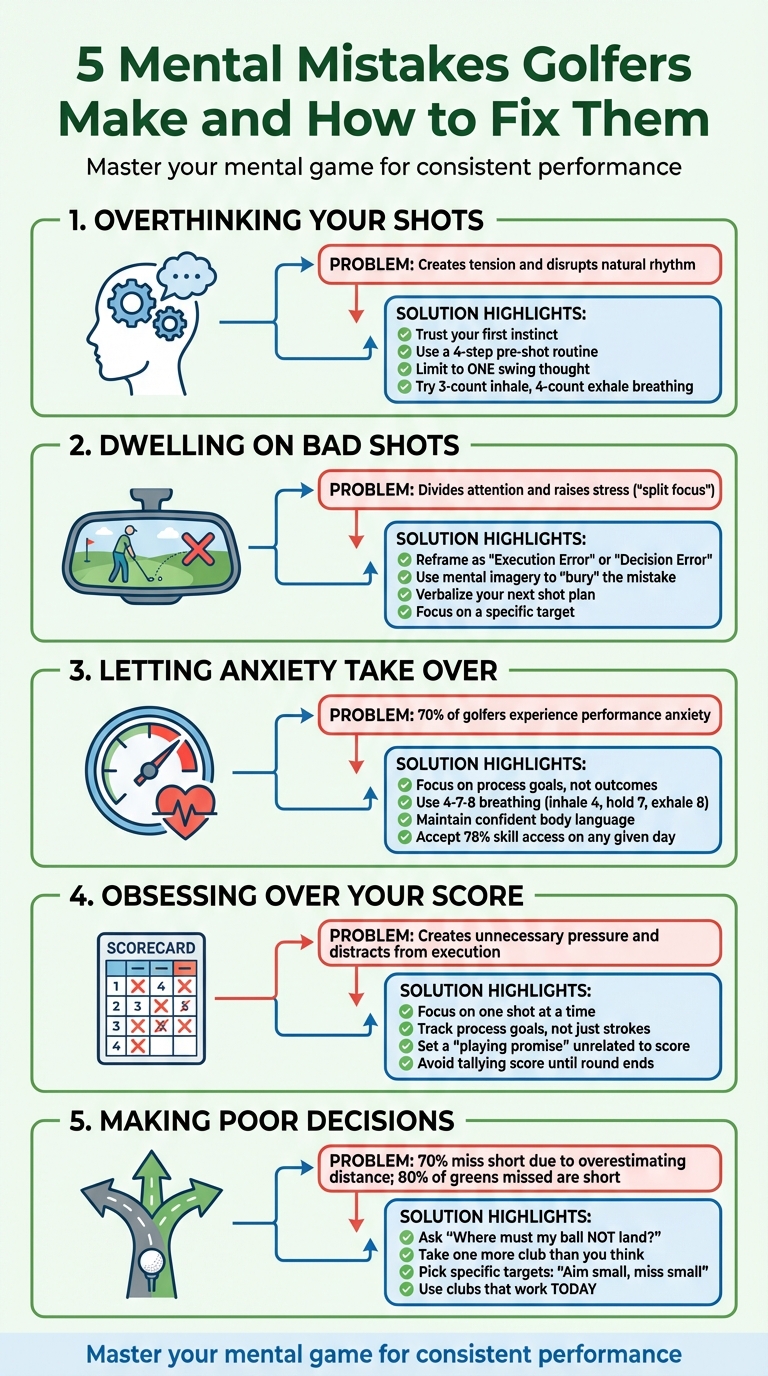
5 Mental Mistakes Golfers Make and How to Fix Them
Overthinking Your Shots
Why Overthinking Hurts Your Game
When you’re standing over a shot, analyzing every tiny detail – your grip, stance, swing path – you shift out of your natural rhythm and into overthinking mode. This mental shift disrupts your flow and can lead to "paralysis by analysis". Overanalyzing locks up your body, creating tension that often results in inconsistent shots. On top of that, second-guessing yourself invites a cascade of negative "what if" thoughts.
The truth is, overthinking can cost you more strokes than playing on instinct. Decision fatigue sets in, leading to overcompensation and unnecessary mistakes. Instead of staying in the moment, your mind spirals, and your performance suffers.
How to Simplify Your Approach
The key to improving your golf game is to simplify your process and make clear, confident decisions. Trust your instincts – your first impression about club selection, target, and shot shape is usually spot on, especially if you’ve played for a while. Once you’ve made a decision, stick to it.
Separate your planning from your execution. Handle all your decision-making – like choosing a club, assessing the wind, and calculating yardage – before stepping up to the ball. When you’re in position, flip the switch to "athlete mode" and focus entirely on your target or your tempo.
Take PGA Tour pro Adam Long as an example. During the final hole of the American Express tournament in January 2019, he faced a high-pressure 7-iron approach. Reflecting on the moment, he said:
I got over it and thought, ‘I’ve got to be an athlete about it and somehow will this towards the hole.’
To keep things simple, follow a straightforward 4-step pre-shot routine: relax and trust your initial read, commit fully to your target and club, feel the shot in your body, and visualize the ball’s flight path. Limit yourself to one clear swing thought – like "smooth tempo" – instead of juggling multiple mechanical cues. Finally, control your breathing to calm your nerves. Try inhaling for three counts and exhaling for four to lower your heart rate and release tension before you swing.
sbb-itb-bcd8bdd
Dwelling on Bad Shots
How Past Mistakes Affect Your Focus
Ever notice how a bad shot can linger in your mind, replaying like a broken record? Experts call this a "split focus" – your attention gets divided between the mistake you just made and the shot you’re about to take. And when your mind is stuck on that misstep – whether it’s a poorly executed wedge shot or a frustrating three-putt from earlier – it’s almost impossible to fully concentrate on what’s in front of you.
But it’s not just your mind that suffers. Your body reacts too. Frustration triggers a stress response: your heart rate spikes, muscles tense up, breathing becomes shallow, and your grip tightens. These physical changes can sabotage your next swing before you even start. Mental performance experts agree that focus is one of the most crucial elements for playing at your best in golf. Dwelling on mistakes? That’s a fast track to losing it.
And then there’s recency bias – our tendency to overemphasize a recent error and assume it’s bound to happen again. It’s like your brain is wired to set you up for a downward spiral. Mental performance consultant Ed Tseng puts it perfectly:
Focusing on a past shot is like driving a car only looking in the rear view mirror.
When you obsess over past errors, your ability to stay present crumbles. That’s why mastering a mental reset is so important.
Ways to Reset Your Mind
The key to bouncing back is learning to reset your mindset quickly. Clearing the mental clutter from past mistakes lets you approach your next shot with a fresh, focused perspective.
Start by removing the emotional charge from bad shots. Instead of calling a shot "bad", think of it in more objective terms. Was it an "Execution Error" (a technical mistake in your swing) or a "Decision Error" (a poor choice of strategy)? Reframing the mistake this way turns it into a learning opportunity rather than a personal failure.
Another trick? Use mental imagery to let go of the error. LPGA star Lydia Ko has a unique approach: she mentally "buries" a bad shot and moves on. As she explains:
I just kind of [dig a hole and] bury it and then just walk away and try and not think about it again.
Other golfers imagine dismissing the mistake, much like swiping away a notification on your phone.
Before your next shot, verbalize your plan – either out loud or silently. Say something specific, like “high draw to the center of the green,” to give your muscles a clear message and block out lingering doubts. Pair this with controlled breathing: take a deep breath through your nose, relax your eyes, and exhale slowly. This calms your nervous system and helps you refocus. Finally, zero in on a specific target for your shot. The more precise your focus, the less room there is for negative thoughts to creep in.
A great example of a mental reset comes from Bryson DeChambeau during the 2020 U.S. Open at Winged Foot. Frustrated with his putting early in the final round, he made a conscious decision to shift his mindset. He told himself:
Nope, you gotta focus on each and every hole.
That mental adjustment helped him shoot a 3-under 67 and secure his first major championship. Proof that the right mindset can make all the difference.
Letting Anxiety Control Your Performance
What Causes Performance Anxiety
Anxiety, much like overthinking, doesn’t just cloud your mind – it can completely derail your performance. While resetting your mindset after a bad shot is important, learning to manage anxiety in key moments can be a game-changer.
When you face a high-pressure shot, your prefrontal cortex often goes into overdrive, flooding your mind with every possible worst-case scenario. This isn’t a personal failing – it’s your brain’s survival instinct kicking in. It interprets a poor shot as a threat. As Dr. Raymond Prior, a performance consultant, explains:

"Anxiety is a survival tool that seeks to keep us from taking risks. But in performance, where we’re trying to thrive, it’s disruptive because it causes us to play it safe."
The impact of anxiety isn’t just mental – it’s physical too. Your shoulders tighten, your hands may tremble, and your heart races. This physical tension throws off the natural rhythm and tempo of your swing . In extreme cases, anxiety can lead to the yips, a sudden inability to control fine motor skills, making even simple shots feel impossible. It can even leave you frozen over the ball. Research shows that up to 70% of golfers experience some degree of performance anxiety during play.
Anxiety also clouds your judgment. You might start playing it safe, avoiding risks instead of going for the shot you need. For example, studies on Tiger Woods revealed he made more par putts than birdie putts from the same distance – his fear of a three-putt outweighed his focus on making the birdie. Anxiety shifts your focus inward, making you hyper-aware of your body’s movements instead of zeroing in on your target. This creates mixed signals for your muscles, further disrupting your performance .
Recognizing these triggers is the first step toward developing strategies to maintain confidence under pressure.
How to Build Confidence Under Pressure
You can’t eliminate nerves entirely, but you can learn to keep them from taking over. Sports psychologist Dr. Bhrett McCabe emphasizes this point:
"I don’t want you to feel calm. I want you to feel connected to your process."
Instead of fixating on outcome goals like your score, focus on process goals – things like sticking to your pre-shot routine or committing to a specific target. Accept that you may only access about 78% of your skill on any given day . The key is to work with what you have, rather than trying to fix what’s missing mid-round.
When anxiety creeps in, try the 4-7-8 breathing technique: inhale for 4 counts, hold for 7, and exhale for 8. This simple exercise can quickly calm your nervous system. Before stepping up to the ball, verbalize your intention – say something like, “high draw to the center of the green.” This gives your brain a clear directive and helps silence second-guessing . On high-pressure shots, like the first tee, choose a club you trust to deliver a consistent result.
Rather than fighting negative thoughts, let them come and go while maintaining confident body language. Standing tall and keeping your head up can actually influence how you feel internally . By combining these techniques, you can stay grounded and perform at your best, even when the stakes are high.
Top Golf Psychologist Reveals Unique Mental Game Skills
Obsessing Over Your Score
Fixating on your score can create unnecessary stress, pulling your attention away from what really matters – playing your best golf.
Why Watching the Score Backfires
Constantly checking your score can throw off your rhythm and focus. Instead of staying in the moment, your mind shifts to protecting your numbers. This mental distraction can cause physical reactions – like a faster heart rate and tighter muscles – that disrupt your natural flow .
When you’re caught up in the scorecard, you’re more likely to play cautiously, worrying about future results or dwelling on past mistakes. As GOLF Top 100 Teacher Joe Plecker explains:
"When players come out with a rigid mentality of scoring and it’s the only metric, they lose the ability to score and really have a good day".
Even golf legends aren’t immune. LPGA Hall of Famer Annika Sorenstam, after her historic 59 in March 2001, admitted she immediately focused on a missed putt for 58. It’s a reminder that even incredible achievements can feel overshadowed when you’re too focused on the numbers.
What to Focus on Instead
Rather than obsessing over your score, direct your energy toward effective golf strategy and things you can control. Take it one shot at a time, focusing on your process rather than the outcome. This shift in mindset can turn your game around. For more ways to improve, explore our practical golf tips.
Concentrate on process goals – specific actions within your control. For example, stick to a consistent pre-shot routine or hold your finish for two seconds. Before each shot, set a clear intention, like “high draw starting at that tree” or “low fade to the right edge.” This not only sharpens your focus but also helps push out doubts.
You can also create a mental game scorecard alongside your regular one. Track whether you stick to your process goals – like committing to your target or following your routine – rather than just counting strokes. Another idea is to set a “playing promise” unrelated to your score, such as taking a deep breath before every shot, and evaluate your round based on how well you kept that promise.
Try to avoid tallying your score until the round is over. Sports psychologist Dr. Bhrett McCabe suggests:
"I don’t want you to feel calm. I want you to feel connected to your process".
By focusing on the joy of executing quality shots instead of chasing a number, you’ll often find that the scores take care of themselves. As Joe Plecker puts it:
"Your best golf starts to be played when you’re not thinking about score. You’re just invested in the process and the joy of hitting a great drive, or chip or putt".
Making Poor Decisions on the Course
Overthinking and dwelling on mistakes aren’t the only culprits that can derail your golf game – poor decisions on the course can be just as damaging. These mental missteps between shots often have a bigger impact on your score than the physical execution of your swing. A single bad choice can turn a promising round into a frustrating one.
When Overconfidence Leads to Trouble
Letting your ego take over is a surefire way to inflate your score. Trying to pull off shots you’ve never practiced – like threading the ball through a narrow gap in the trees or attempting to clear a water hazard from an unrealistic distance – can quickly backfire. GOLF Top 100 Teacher Kevin Sprecher highlights this common mistake:
"I always see amateurs try to hit shots they haven’t practiced… And that usually leads to failure when it comes to trying to execute something you don’t really know how to do".
The stats confirm this. Golfers with a handicap of 21 or higher miss their targets short 70% of the time because they overestimate their maximum distance. In fact, 80% of greens missed and 72% of hazards occur short of the target. This tendency to aim beyond your actual capabilities often results in penalty strokes and extra frustration.
Another frequent misstep is going for the pin when it’s tucked near trouble. This can leave you with short-sided chips, bunker shots, or worse – double bogeys. Recognizing these patterns is the first step toward smarter decision-making on the course.

How to Play Smarter Golf
Playing smarter doesn’t mean playing scared – it means being strategic. Before every shot, ask yourself: "Where must my ball not land?". Identify the areas to avoid and plan your shot accordingly. A bogey is always better than a triple.
Consider club selection carefully. Since most hazards are in front of the green and many amateur golfers tend to miss short, taking one more club than you initially think might be the better choice . For example, a 20-handicap golfer is more than twice as likely to hit the green from 210 yards using a hybrid instead of a long iron. Don’t let pride dictate your decision – let logic guide you.
If a particular club isn’t working for you that day, adapt. For instance, if your driver is causing trouble, try teeing the ball lower for more control or switch to a 5-wood or 7-wood . Use the equipment that’s working for you in the moment – it’s a practical way to keep your round on track.
Once you’ve chosen the right club, focus on a specific target. Instead of aiming broadly at "the fairway" or "the green", pick something precise, like a tree branch or a distant chimney. As Jordan Spieth wisely says:
"Aim small, miss small".
This kind of focused targeting helps you commit fully to the shot, reducing mental errors and improving your chances of success.
Conclusion
Mastering your mental approach is just as important as perfecting your swing when it comes to achieving consistent performance. Struggling with overthinking your shots, dwelling on past mistakes, letting anxiety take control, obsessing over your score, or making impulsive decisions can lead to physical changes – like increased tension, disrupted tempo, and a loss of rhythm – that block you from performing at your best.
The good news? These challenges aren’t permanent. By shifting your focus away from outcome-driven goals (like your final score) and toward process-driven goals (like sticking to your pre-shot routine and fully committing to each swing), you can create the mental space needed for a smooth, confident game. Negative thoughts can sabotage your performance, so learning to manage your mindset is not just helpful – it’s essential, as explored in our golf articles.
FAQs
How do I stop overthinking my golf shots?
Overthinking can throw off your focus and performance on the golf course. To help quiet your mind, try creating a simple pre-shot routine. This might involve taking a deep breath, picturing your shot, and sticking to one key swing thought – like "smooth tempo." Having a consistent routine can shift your mind away from overanalyzing and toward simply executing.
Another helpful approach is to concentrate on the process rather than the results. Instead of stressing over your score or worrying about mistakes, focus on the task at hand – whether it’s lining up your shot or fully committing to your chosen path. Practicing this mindset during training can make it second nature when you’re out on the course. And don’t underestimate the power of relaxation – taking slow, steady breaths can ease tension and keep you grounded in the moment.
How can I manage anxiety while playing golf?
Managing anxiety during a round begins with pinpointing what sparks your nervousness and finding ways to steady both your body and mind. Common stressors – like a rough start or dealing with slow-playing partners – can throw you off, so it’s smart to have a plan in place. Something as simple as a breathing exercise can make a big difference: try inhaling for 4 seconds, holding for 2, and exhaling for 6. This can help slow your heart rate and ease muscle tension.
Pair these physical techniques with mental strategies to sharpen your focus. Before stepping up to the ball, visualize a successful shot to boost your confidence. Instead of fixating on your score, set process-driven goals, like concentrating on a smooth, controlled swing. A reliable pre-shot routine – such as checking your alignment and taking a deep breath – can also ground you in the moment and quiet those racing thoughts. For more in-depth advice, How To Break 80 offers practical tools to strengthen your mental approach and refine your game.
What can I do to make smarter decisions on the golf course?
Making better decisions on the golf course starts with controlling the things within your reach. Instead of obsessing over your score, shift to a process-focused mindset. Pay attention to your pre-shot routine, stay in the moment, and practice positive self-talk. This way, every shot becomes a learning opportunity rather than just part of a win-or-lose scenario.
It’s also important to be honest about your abilities under pressure. Understand the gap between what you’re capable of and what you can reliably execute during a round. Stick to targets and strategies that fit your comfort zone to avoid unnecessary risks. For example, know how far you can carry the ball with each club and decide when it’s smarter to lay up instead of going for a high-risk shot that could lead to big mistakes.
On a practical level, think ahead with each shot. Use smart angles off the tee to set up easier approach shots, and stick to a clear plan for club selection to avoid second-guessing yourself. Staying calm and focused between shots – using simple breathing exercises or mindfulness techniques – can also sharpen your decision-making and improve your execution. If you’re looking for more tips to strengthen your mental game and course management, check out the guides and lessons on How To Break 80.
Related Blog Posts
- 7 Common Putting Mistakes Beginners Make (And How to Fix Them)
- 5 Tips To Stay Calm During Golf Tournaments
- Common Golf Distractions And How To Avoid Them
- Golf Psychology: Recovering from a Bad Start
