
Professional golfers practice with purpose – and you can too. Unlike amateurs who often hit balls aimlessly, pros focus on specific goals, track their progress, and divide their time strategically between full swings, short game, and rest. Their sessions are deliberate, data-driven, and designed to simulate on-course pressure.
Key Takeaways:
- Set Clear Goals: Pros analyze stats to target weaknesses and plan their sessions.
- Focus on Short Game: Around 70% of practice time is spent on shots within 100 yards, especially putting drills.
- Simulate Pressure: Practice includes drills that mimic real-game scenarios.
- Prioritize Rest: Quality trumps quantity – pros stop when focus fades.
Even with limited time, you can achieve better results by practicing smarter, not longer. Start by tracking your stats, focusing on weaker areas, and keeping sessions intentional.
Golf Practice Routine Used By NCAA & D1 College Golfers
sbb-itb-bcd8bdd
Core Principles Pros Use to Structure Practice
Professional golfers stick to three key principles when structuring their practice: setting clear goals, balancing skill work, and prioritizing proper rest.
Setting Specific Goals for Each Session
When pros head to the range, they arrive with a plan. They analyze stats from recent rounds to identify areas for improvement – like struggling with scrambling from 40 yards or missing fairways – and tailor their practice to address those weaknesses. For example, in August 2018, Justin Thomas used a TrackMan launch monitor to practice hitting specific distances between 126 and 150 yards. This targeted approach, guided by his coaches Mike Thomas and Matt Killen, helped him rise to world No. 1.
Practice sessions are typically split into two phases: a technical phase (about 30%) for working on mechanics and drills, and a performance phase that mimics real on-course scenarios. During the performance phase, pros aim at specific targets – like a telephone pole or alignment gates – and regularly switch clubs and targets to replicate the unpredictability of a round [7,9].
A great example of goal-oriented practice comes from the 1996 Masters. Nick Faldo and his caddie, Fanny Sunesson, simulated full rounds on the practice tee. Sunesson gave Faldo precise pin placements, such as "10 paces right, five from the back", for each shot. This approach helped Faldo prepare for the course layout and sharpen his focus.
Once goals are in place, pros move on to balancing their time across different types of shots.
Dividing Time Between Short Game and Full Swings
Most professionals dedicate three to four hours daily to practicing their full swing and short game. Experts suggest spending up to 70% of that time on shots within 100 yards, with half of it focused on putting.
Dustin Johnson’s routine is a prime example of this principle. He practices four specific wedge distances – half, three-quarter, full, and max – which make up 80% of his sessions. This helps him refine his distance control. Similarly, Justin Thomas allocates 30% to 40% of his pre-round warm-up to wedge shots, ensuring his distances and spin are dialed in.
Pro golfers often begin their range sessions with "baby wedges" or soft pitch shots (60–90 yards). These shots help them establish rhythm and ensure clean contact before moving on to longer clubs. Unlike many amateurs, who tend to focus on mid-irons, pros prioritize "scoring clubs" – mainly wedges and drivers – since these have the biggest impact on their scores.
But practice isn’t just about hitting balls. Rest and recovery are just as important for maintaining quality.
Building in Rest and Recovery
"As soon as I start losing my concentration, I either go play or leave. You should, too." – Dustin Johnson, Professional Golfer
Pros understand that mindless practice does more harm than good. When focus starts to waver, the quality of practice suffers. To avoid this, many professionals limit their sessions to around 1.5 hours after several days of intense practice, rather than pushing through the usual 3+ hours. They also incorporate recovery methods like functional exercises, stretching, and cardio to stay physically prepared for the demands of the game.
Mental recovery matters just as much. Many pros eliminate distractions – often leaving their phones behind – to stay fully engaged. Some, like Dustin Johnson, even prefer practicing on the course. Playing nine holes and experimenting with different lies provides a dynamic, real-world practice experience that a static range can’t replicate.
Sample 7-Day Practice Schedule
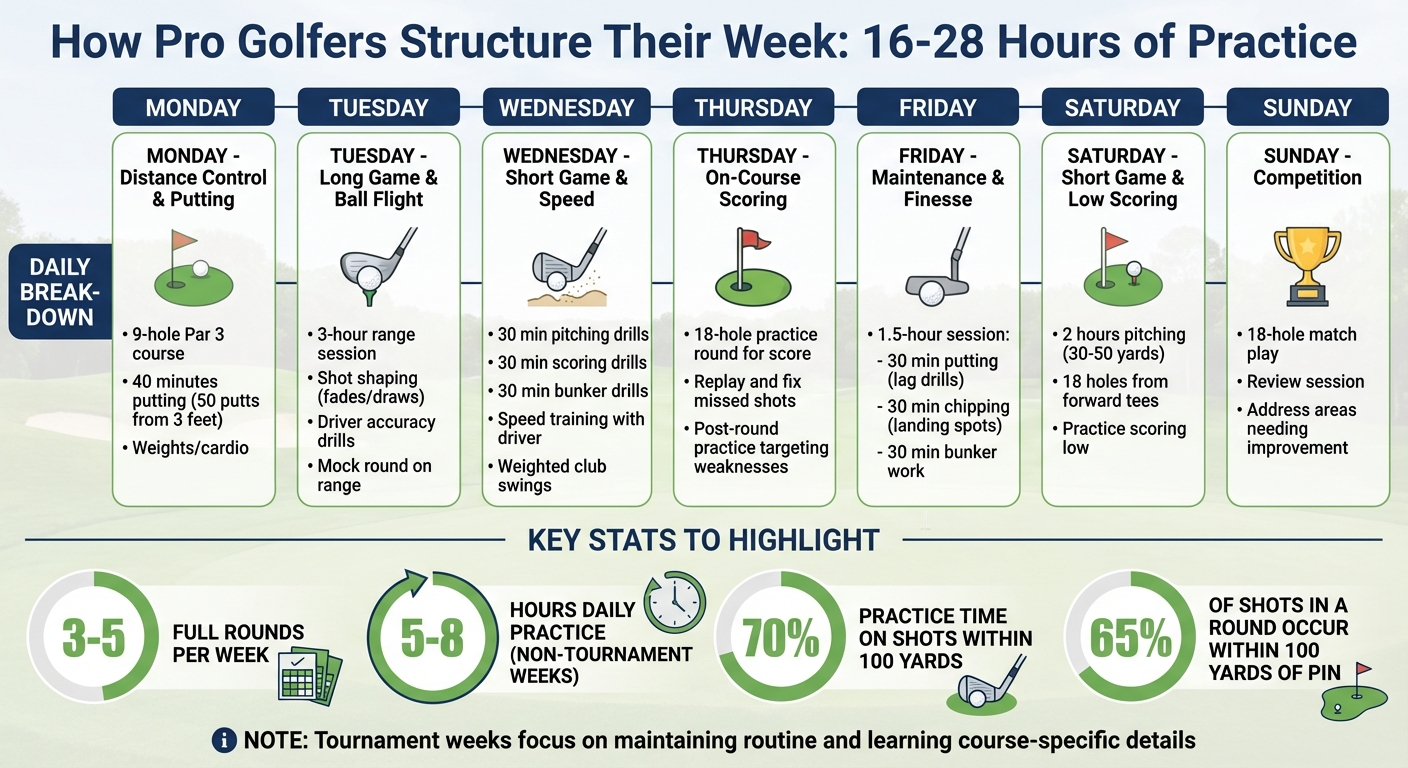
Professional Golfer Weekly Practice Schedule: 7-Day Breakdown
Professional golfers dedicate 16–28 hours a week to practice, balancing skill-building with recovery, fitness, and course strategy. During weeks without tournaments, they typically spend 5–8 hours a day honing their short game, long game, putting, and playing on the course. In tournament weeks, the focus shifts to maintaining their routine and learning course-specific details, like green speeds and layout nuances . Here’s a sample weekly schedule that illustrates how pros structure their practice time.
What Pros Practice Each Day
A typical week for a pro golfer includes 3–5 full rounds to refine course management and build confidence under tournament-like pressure. Daily practice sessions are tailored to address specific skills, guided by performance data and upcoming priorities.
| Day | Primary Focus | Key Activities |
|---|---|---|
| Monday | Distance Control & Putting | 9-hole Par 3 course; 40 minutes of putting (50 putts from 3 feet); weights/cardio |
| Tuesday | Long Game & Ball Flight | 3-hour range session; shot shaping (fades/draws); driver accuracy drills; mock round on the range |
| Wednesday | Short Game & Speed | 30 minutes each on pitching, scoring, and bunker drills; speed training with driver; weighted club swings |
| Thursday | On-Course Scoring | 18-hole practice round for score; replay and fix missed shots; post-round practice targeting weaknesses |
| Friday | Maintenance & Finesse | 1.5-hour session: 30 minutes putting (lag drills), 30 minutes chipping (landing spots), 30 minutes bunker work |
| Saturday | Short Game & Low Scoring | 2 hours pitching (30–50 yards); 18 holes from forward tees to practice scoring low |
| Sunday | Competition | 18-hole match play, followed by a review session to address areas needing improvement |
After each round, pros analyze key statistics to fine-tune their focus for the next day. This structured approach ensures every practice session is purposeful and aligned with their goals.
How Pros Divide Their Practice Hours
To maximize both productivity and recovery, pros follow a well-organized daily routine. Their schedule balances focused practice with time for rest, nutrition, and mental preparation. They prioritize 7–9 hours of sleep and incorporate mobility work, such as yoga or foam rolling, into their day.
| Time | Activity | Focus Areas |
|---|---|---|
| 6:00 AM – 7:00 AM | Warm-up | Stretching, light cardio, and mental visualization |
| 7:00 AM – 9:00 AM | Short Game | Putting (3–6 feet and lag), chipping touch, and bunker trajectory work |
| 9:00 AM – 12:00 PM | Long Game | Wedges (yardage gaps), mid/long irons (shot shaping), and driver practice |
| 12:00 PM – 1:00 PM | Lunch | Balanced nutrition and a mental reset |
| 1:00 PM – 4:00 PM | On-Course | 9–18 holes simulating tournament conditions |
| 4:00 PM – 5:00 PM | Assessment | Reviewing stats and analyzing errors for 30–60 minutes |
| 5:00 PM – 6:00 PM | Fitness | Golf-specific strength training, core stability, and flexibility exercises |
| 6:00 PM – 9:00 PM | Recovery | Dinner, foam rolling, and mental training or reviewing film |
Throughout their sessions, pros rely on launch monitors to track metrics like yardage control, swing speed, ball speed, spin rate, and clubface angle. This data-driven approach ensures they focus on measurable performance improvements. The emphasis on short game practice – roughly 65% of shots in a typical round occur within 100 yards of the pin – is a key factor in their preparation strategy.
How Amateurs Can Use Pro Practice Methods
You don’t need to be a professional golfer to practice like one. By focusing on quality over quantity, amateurs can adopt pro-level strategies in shorter, more focused practice sessions. It’s about setting clear goals and cutting out distractions. Let’s dive into two practical ways to bring these ideas to life: condensing your routine and keeping track of your progress.
Condensing Routines into Shorter Sessions
A well-structured 60-minute session can be just as effective as a longer, less focused practice. The trick? Divide your time strategically. Start with a quick 5-minute warm-up using dynamic stretches to prepare your body. Then, spend 15–20 minutes on technical drills, such as slow-motion swings with alignment rods to fine-tune your stance and ball position.

Next, focus on the short game. Since 70% of shots happen within 100 yards, dedicate 20 minutes to putting, working on both short-range accuracy (3–6 feet) and lag putting from longer distances. Follow that with 15–20 minutes of chipping and pitching to sharpen your touch and control. To make the most of your limited time, PGA Tour Canada pro Ben Hadden offers this simple but powerful advice:
"Take your phone, put it in your bag. You’ve only got an hour, you need full focus."
When hitting balls, avoid overdoing it. Limit yourself to two balls per iron and four per wood to replicate the variety of on-course play. Pros also suggest starting with "baby wedges" – 5–10 shots from 60 to 90 yards – to establish rhythm and solid contact before progressing to full swings.
Tracking Your Practice Progress
Once your routine is streamlined, tracking your progress becomes essential. Without it, any improvement is purely accidental. Golf instructor Hank Haney emphasizes the importance of measurement:
"If you’re not at least tracking your target and the distance each shot flies, any game improvement that comes from your range session will come by accident."
Using tools like golf-analysis apps or stat trackers can pinpoint weaknesses, helping you focus your efforts where they matter most.
For putting, a structured routine can work wonders. Golf Digest writer Luke Kerr-Dineen shared his experience in August 2025, where he spent 10 minutes on alignment drills followed by 30 minutes of random one-ball practice. Tracking 18 different putts per session with the Stack Putting App, he saw a dramatic improvement – moving from losing 1.5 strokes to maintaining a +2 handicap and consistently gaining at least 0.5 strokes per session. Even simpler methods, like using foot spray on your clubface to check for center-face contact, can be just as effective as high-tech tools.
If you’re looking for more structured guidance, How To Break 80 offers resources to help you practice smarter. Their Precision Putting Video Course ($49.00) is packed with drills for consistent putting, while the Essential Golf Improvement eBook Bundle ($19.00) provides strategies for every part of your game. These tools can help you bring the same focus and intention to your practice that the pros rely on – even when you’re short on time.
Conclusion
Top players approach every practice session with purpose, setting clear goals and dividing their time wisely between key areas like the short game and mastering your swing. They leave nothing to chance, tracking every detail to ensure steady improvement. As Dustin Johnson explains:
"If you’re not working on the correct things, not practicing with any kind of focus, you’re actually hurting your game."
The good news? You don’t need endless hours on the range to see progress. A focused, one-hour session with specific objectives can deliver better results than aimlessly hitting balls for twice as long. Start by identifying your weaknesses through stat tracking – maybe it’s approach shots from 75 yards or leaving putts short on uphill greens.
Once you know your target areas, tailor your practice. Use drills with alignment sticks, aim at varied targets, and create scenarios that mimic real-game pressure. These small adjustments can turn your practice sessions into a game-changer.
Quality matters more than quantity. Hitting 30 deliberate shots with immediate feedback is far more effective than 100 random swings without a plan. This is why pros stop practicing the moment they lose focus – they understand the value of staying intentional .
Keep track of your progress and fine-tune your focus as you go. Even minor improvements, like shaving off a single stroke per round, can add up over time. Build your routine with intention, and you’ll be well on your way to playing like the pros.
FAQs
How can I practice to handle pressure like the pros?
To get better at handling pressure like a seasoned pro, try recreating situations that mirror the intensity of real games. Picture yourself sinking a putt to clinch a tournament or driving the ball down a tight fairway with everything on the line. These simulated high-pressure moments can sharpen your mental resilience.
Another great strategy is to practice under time constraints or with intentional distractions to mimic the nerves you might feel on the course. The key is to stick to your routine and use visualization techniques – just like the pros do. With consistent practice, you’ll find it easier to stay composed and confident when the stakes are high during actual rounds.
Why do golfers focus more on the short game during practice?
Golfers often focus on the short game during practice because it plays a huge role in lowering scores. Techniques like chipping, pitching, and putting help players recover from errors and shave off strokes by getting the ball closer to the hole. Plus, these skills are usually easier to refine with targeted practice, making them an efficient way to boost overall performance on the course.
Spending time perfecting the short game not only improves a golfer’s ability to handle key scoring moments but also builds confidence and consistency. It’s a strategy that many professionals rely on to stay ahead in competition.
What are the best ways to track progress in my golf practice?
Improving your golf game starts with tracking your practice progress effectively. Begin by using a structured checklist to focus on key aspects like putting, driving, and refining your swing mechanics. This approach keeps your practice sessions organized and ensures consistency.
You can also take advantage of golf stat-tracking apps or tools. These provide detailed insights into your performance, making it easier to spot strengths and pinpoint areas that need work. To take it a step further, set specific, measurable goals for each session. For example, aim to boost your accuracy or perfect a particular drill. Regularly review your progress against these goals to measure your growth and keep moving forward.
Related Blog Posts
- Golf Practice Checklist: 8 Drills for Weekend Warriors
- How To Plan A 1-Hour Golf Practice Session
- How Pros Divide Practice Time for Putting and Full Swing
- How to Build a Progressive Practice Routine
