
The AimPoint Express system simplifies green reading for golfers by combining science and feel. Here’s how it works:
- What It Is: A green-reading method developed by Mark Sweeney in 2003, used by over 200 pros and 75,000 amateurs, including champions like Adam Scott and Jordan Spieth.
- How It Works: Feel slope percentages (1%-5%) with your feet, hold up the corresponding number of fingers, and aim based on the outer edge of your fingers.
- Why It Matters: It removes guesswork and builds confidence by relying on physics instead of visual judgment.
Steps to Use AimPoint Express:
- Feel the Slope: Stand at the midpoint of your putt and assess the tilt using your feet.
- Assign a Percentage: Estimate slope between 1%-5% based on weight distribution.
- Find the Aim Point: Use the finger method to determine where to aim.
- Align and Putt: Trust your read, align to the aim point, and execute with steady speed.
Practice Tips:
- Use a digital level to calibrate your slope-reading skills.
- Spend 15 minutes before each round adjusting for green speed.
- Practice drills like the "Variable Location Drill" to sharpen your reads under pressure.
AimPoint Express is ideal for golfers who prefer a structured, repeatable approach to putting. By combining accurate reads with consistent mechanics, you can improve your putting and lower your scores.
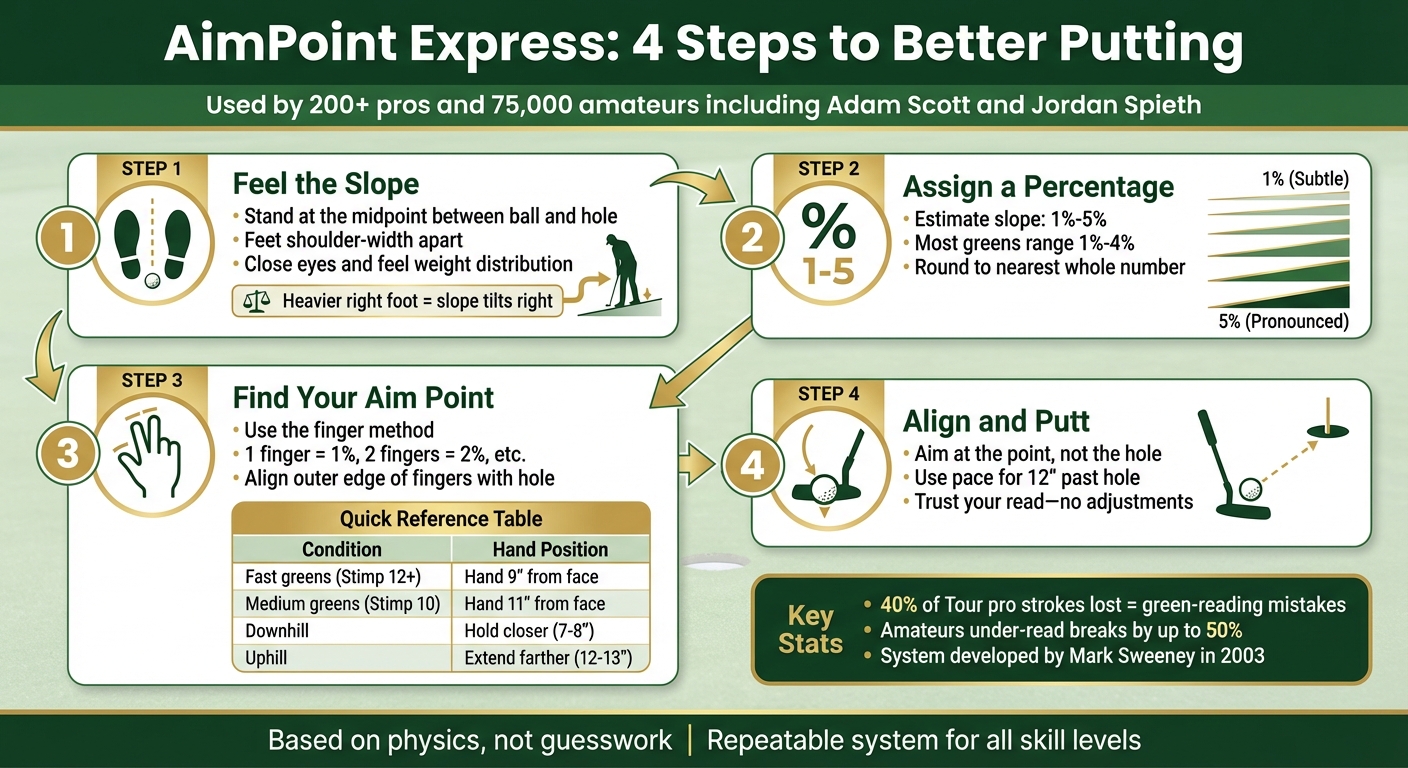
AimPoint Express 4-Step Green Reading Method for Golfers
Getting Ready to Use AimPoint Express

Building a Consistent Putting Foundation
To make the most of AimPoint Express, you need to start with two essentials: consistent speed control and a repeatable stance. The system is based on the concept of a "dying putt" – one that reaches the hole with just enough speed to drop in. Why is this important? Slower putts are more affected by gravity, which makes this approach key to accurate reads.
"The read typically assumes a ‘dying putt’ speed at the hole, as this is where gravity’s influence is most pronounced." – Sean Carlino, PGA Certified Golf Instructor
Your stance plays a huge role, too. Always stand with your feet shoulder-width apart when reading a slope. This consistency helps you feel weight distribution the same way, no matter the green conditions. If your stance changes, your slope readings can become unreliable. A steady, repeatable stance is the foundation of accurate green reading.
AimPoint Express is particularly suited for linear putters – those who aim at a specific spot and roll the ball straight toward it. If you’re someone who visualizes the entire curve of a putt, you’ll need to adjust your mindset. Focus on the start line and trust the system’s physics to handle the rest.
Once your stance and speed control are solid, shift your focus to developing your ability to read slopes using your feet.
Learning to Read Slope Percentages
The core of AimPoint Express lies in feeling slope percentages with your feet. Most greens have slopes ranging from 1% to 5%, and to succeed, you need to differentiate between these percentages within a 1% margin. This isn’t an instinctive skill – it takes practice and the right tools.
Start by using a digital level (set to percentage mode) to identify specific slopes on a practice green, such as 0.5%, 1%, 1.5%, 2%, 2.5%, and 3%. Stand with your feet shoulder-width apart, close your eyes, and focus on how each slope feels in terms of weight and balance. This helps recalibrate your sense of slope.
"Feeling the slope with your feet is the primary skill of AimPoint." – Emily Kuhfeld, LPGA Professional
Refine this skill with the "guess and check" method or other proven putting drills. Walk to a random spot on the practice green, straddle the line, and estimate the slope percentage based on what your feet tell you. Then, use the digital level to check your guess. Create a practice circuit with markers for different slopes, paying close attention to the subtle differences between 1% and 3%.
Before every round, spend at least 15 minutes on the practice green to recalibrate for that day’s green speed. Faster greens require different adjustments than slower ones, and this quick pre-round routine ensures your reads stay sharp. By practicing these steps regularly, you’ll develop a dependable foundation for AimPoint readings during your game.
sbb-itb-bcd8bdd
The SECRET TRICK pro golfers use to read greens! (AIMPOINT LESSON)
How to Use AimPoint Express: Step-by-Step
Now that you’ve nailed down the basics of slope reading and setup, here’s how to quickly improve your golf game by putting AimPoint Express into action during your putt.
Step 1: Feel the Slope with Your Feet
Start by standing at the midpoint between your ball and the hole, aligned with the intended line of your putt. Your feet should be about shoulder-width apart – just like during your calibration practice. For putts between 7 and 20 feet, assess the slope at the 1/3 and 2/3 points along the line.
To focus, close your eyes and tune into the sensations in your feet. Pay attention to which foot feels heavier. If your right foot carries more weight, the slope tilts to the right; if it’s your left, the slope tilts to the left.
Step 2: Assign a Slope Percentage
Next, assign a slope percentage from 1% to 5%, depending on the weight shift you feel. A subtle shift might indicate a 1% slope, while a more pronounced tilt suggests 3% or higher. Most greens you’ll encounter will range between 1% and 4%.
Your prior practice with a digital level has trained you for this step. Use those calibrated sensations to estimate the slope and round to the nearest whole number – AimPoint Express relies on full percentage increments.
Step 3: Use the Finger Method to Find Your Aim Point
Position yourself one to two feet behind your ball. Raise the number of fingers that corresponds to your slope percentage: one finger for 1%, two for 2%, and so on. Close your non-dominant eye to focus, and extend your arm with your palm facing you, fingernails pointing toward the hole.
Align the outside edge of your fingers with the center of the hole. The outer edge represents your aim point – the spot where you’ll start your putt.
- For faster greens (Stimp 12 or higher): Hold your hand closer to your face, about 9 inches away.
- For slower greens (Stimp 8–10): Extend your arm farther, around 11–14 inches.
- For downhill putts: Bring your hand closer for more break.
- For uphill putts: Extend your arm farther for less break.
Here’s a quick guide:

| Forward Slope | Stimp 10 (Medium-Fast) | Stimp 12 (Fast) | Hand Position |
|---|---|---|---|
| -2% (Downhill) | 8" from face | 7" from face | Hold closer |
| 0% (Flat) | 11" from face | 9" from face | Standard |
| +2% (Uphill) | 13" from face | 12" from face | Extend farther |
Once you’ve identified your aim point, you’re ready for the next step.
Step 4: Align and Execute Your Putt
Align your putter face with the aim point you determined – not directly at the hole. You’re aiming for a specific spot on the green, allowing the slope and speed to guide the ball into the cup.
Use a stroke with enough pace to roll the ball about 12 inches past the hole. Trust your read and avoid second-guessing or making last-minute adjustments. The system works best when you commit to your aim point and maintain steady speed control.
Practice Drills for AimPoint Express
Practice on Familiar Slopes
To make AimPoint Express second nature, it’s essential to fine-tune your ability to feel and interpret slopes accurately. A great way to do this is by calibrating your feet on slopes you already know.
Grab a digital level set to percentage mode and head to your practice green. Locate areas with slopes of 1%, 2%, 3%, and 4%, and mark these spots with tees or notecards. This setup becomes your "calibration station", where you can connect the physical sensations in your feet with the actual slope percentage.
Once your station is ready, use the Guess and Check method: feel the slope with your feet, then compare that sensation to the reading on the digital level. Spend a few minutes on each slope to get a solid understanding of your local greens.
Next, use your fingers to determine the aim point, then place a tee peg at that spot. Putt toward the tee and watch how the ball breaks. If it moves toward the peg, you’ll know your read was accurate. This visual feedback is crucial for building trust in your reads, especially when the pressure is on.
After practicing these drills, take what you’ve learned to the course and apply it during live play. This will help solidify your confidence in real-game situations.
Practice During Your Rounds
Incorporating AimPoint into your rounds is key to mastering it under real pressure. Focus on using the full AimPoint routine for putts under 10 feet – these shorter putts mimic the high-stakes moments where quick, confident reads are essential. Trusting your feel and committing to your read is the goal here.
A helpful exercise is the Variable Location Drill. Pick a hole and hit 10 putts from 10 different spots around it, like the numbers on a clock. Avoid repeating the same location twice. This forces you to approach each putt with a fresh AimPoint read, without relying on memory or adjusting your stroke based on past attempts.
As George Watts from Golf Practice Planner explains, “The confidence you’ll gain in knowing the accurate read will improve your technique because you won’t feel the need to make manipulations during the stroke”. This drill not only sharpens your AimPoint skills but also strengthens your overall putting technique.
Improving Your Putting with Additional Resources
Combining AimPoint with Precision Putting Drills
Once you’ve built a solid foundation with AimPoint, the next step is refining your stroke through targeted drills. While AimPoint Express gives you an accurate read of the green, it’s putting posture and putter style that turn that read into made putts. Research shows that 40% of strokes lost on the greens by Tour pros come from green-reading mistakes, while another 40% are due to directional mis-hits. This highlights the importance of pairing a precise read with a repeatable stroke.
The Precision Putting Video Course from How To Break 80 ($49.00) focuses on improving stroke mechanics. It offers drills to ensure your putter face stays square and your ball launches on the correct line. Tyson Deskins, a Certified Instructor, emphasizes:
"Most golfers don’t aim where they think they’re aiming, and most golfers also don’t read enough break in their putts… the only way to make a putt is to compensate in your stroke".
By combining AimPoint reads with stroke calibration drills, you eliminate the need for mid-stroke adjustments. This allows you to trust your read fully and focus solely on mechanics – rolling the ball with controlled speed. Speed control is critical for AimPoint’s accuracy since its effectiveness depends on delivering the ball at the right pace to match the intended break.
Integrating these drills with AimPoint can sharpen your putting skills and help you lower your scores.
Using AimPoint to Break 80
To take your game even further, pair AimPoint Express with resources like the How To Break 80 eBook ($29.00). Refining your putting and short game can reduce your score by 3–5 strokes. With more than 50,000 golfers – including over 250 touring professionals with 45 worldwide wins – having mastered the AimPoint system, its success spans all skill levels.
John Hobbins, a Level III Certified AimPoint Instructor, explains:
"Not every golfer has the ability to become a better ball striker, but every golfer has the ability to have a great short game".
Conclusion
Key Takeaways
AimPoint Express is a straightforward, physics-driven approach that removes the uncertainty from green reading while delivering consistent results. It focuses on four essential skills: feeling the slope with your feet at the midpoint, assigning an accurate slope percentage (usually between 1% and 4%), using the finger method to find your aim point, and executing with confidence. Studies reveal that amateur golfers often under-read putt breaks by up to 50%, leading to frequent three-putts – especially from distances like 20 feet, where 17-handicappers miss 25% of the time. AimPoint tackles this issue by training golfers to sense slope percentages with their feet and creating a repeatable pre-shot routine that holds up under pressure.
What makes AimPoint so effective is its simplicity and adaptability. Once calibrated, it works seamlessly across greens of varying speeds, and it takes only seconds to apply. Emily Kuhfeld, LPGA Professional, highlights the cornerstone of the method:
"Feeling the slope with your feet is the primary skill of AimPoint".
This heightened awareness of slope not only improves putting but also enhances chipping and lag putting. With its foundation in physics, AimPoint golf strategy ensures every putt is approached with precision and confidence.

Next Steps
These principles are your roadmap to immediate improvement. Start by calibrating your feet using a digital level and the "guess and check" method to identify 1–3% slopes. Since most greens feature slopes between 1% and 5%, mastering these percentages will prepare you for the majority of putts you’ll encounter.
Incorporate your calibrated reads into a consistent pre-shot routine to reinforce your skills. During practice, vary your putting locations around the green – avoiding repetitive shots from the same spot – to ensure your stroke isn’t influenced by prior attempts. To further refine your mechanics, consider the Precision Putting Video Course from How To Break 80 ($49.00), which focuses on keeping your putter face square and your ball on the intended line.
With over 200 touring professionals and 75,000 amateur golfers already using AimPoint, the system has proven its reliability across all levels of play. Commit to the process, trust your reads, and turn uncertain guesses into confident, accurate putts.
FAQs
How do I know if a slope is 1% or 2%?
Using the AimPoint method, you can figure out the slope percentage by using your feet. Simply stand midway between the ball and the hole, focus on the tilt you feel, and assign it a value: 1% for gentle slopes and 2% for more noticeable slopes. This hands-free approach lets you judge the slope more precisely without depending entirely on your eyes.
What if my putt has more than one break?
If your putt has multiple breaks, the AimPoint Express method suggests analyzing each break individually, paying close attention to the most severe ones. For the best results, place twice as much importance on the break nearest to the hole. This strategy ensures you consider all the breaks effectively, increasing the likelihood of sinking the putt.
Do I need AimPoint training or can I learn it myself?
Learning AimPoint Express on your own is possible, but it takes a lot of dedicated practice to build the right feel and consistency. While formal training sessions can be pricey, they often speed up the learning curve and help sharpen your accuracy. For many golfers, blending self-study with professional lessons strikes the perfect balance for mastering this approach.
Related Blog Posts
- 7 Common Putting Mistakes Beginners Make (And How to Fix Them)
- Ultimate Guide to AimPoint Green Reading
- How to Master Speed Control on the Greens
- How to Plumb Bob a Putt
