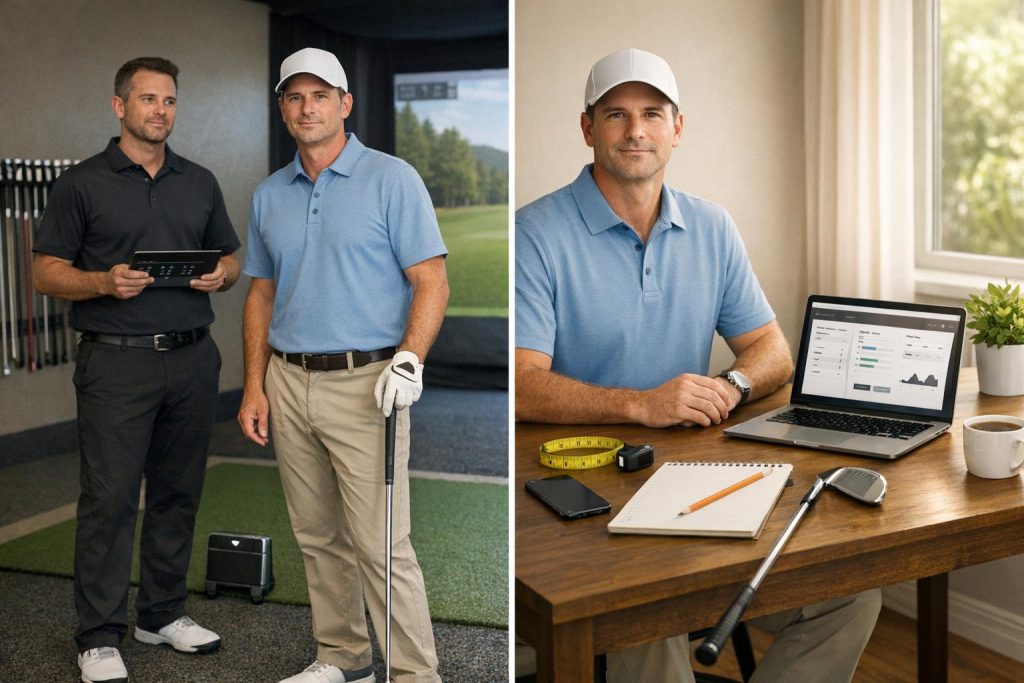
Looking to improve your golf game? Choosing the right club fitting method is key. Ping offers two options: virtual fittings using tools like WebFit and in-person fittings with professional fitters. Each has its strengths, and the best choice depends on your priorities – convenience or precision.
- Virtual Fitting: Done online with tools like WebFit, where you input your measurements, swing data, and preferences. It’s quick, affordable (free or $39), and perfect for those in remote areas or on a budget. However, it relies on self-reported data and lacks the personal touch of a professional fitter.
- In-Person Fitting: Conducted by experts using advanced tools like launch monitors. You test clubs, get real-time adjustments, and receive a highly tailored setup. It’s more accurate but costs more (starting around $60) and requires scheduling.
Quick Comparison
| Factor | Virtual Fitting | In-Person Fitting |
|---|---|---|
| Accuracy | Relies on user inputs | High, with real-time data |
| Cost | Free or $39 | $60–$450+ |
| Convenience | Online, anytime | Requires travel/scheduling |
| Customization | Standard recommendations | Tailored adjustments |
| Best For | Budget-conscious golfers | Serious players optimizing performance |
Bottom Line: Virtual fittings are great for convenience, while in-person fittings offer unmatched precision. Start with virtual fitting for a baseline, then fine-tune with an in-person session if needed.
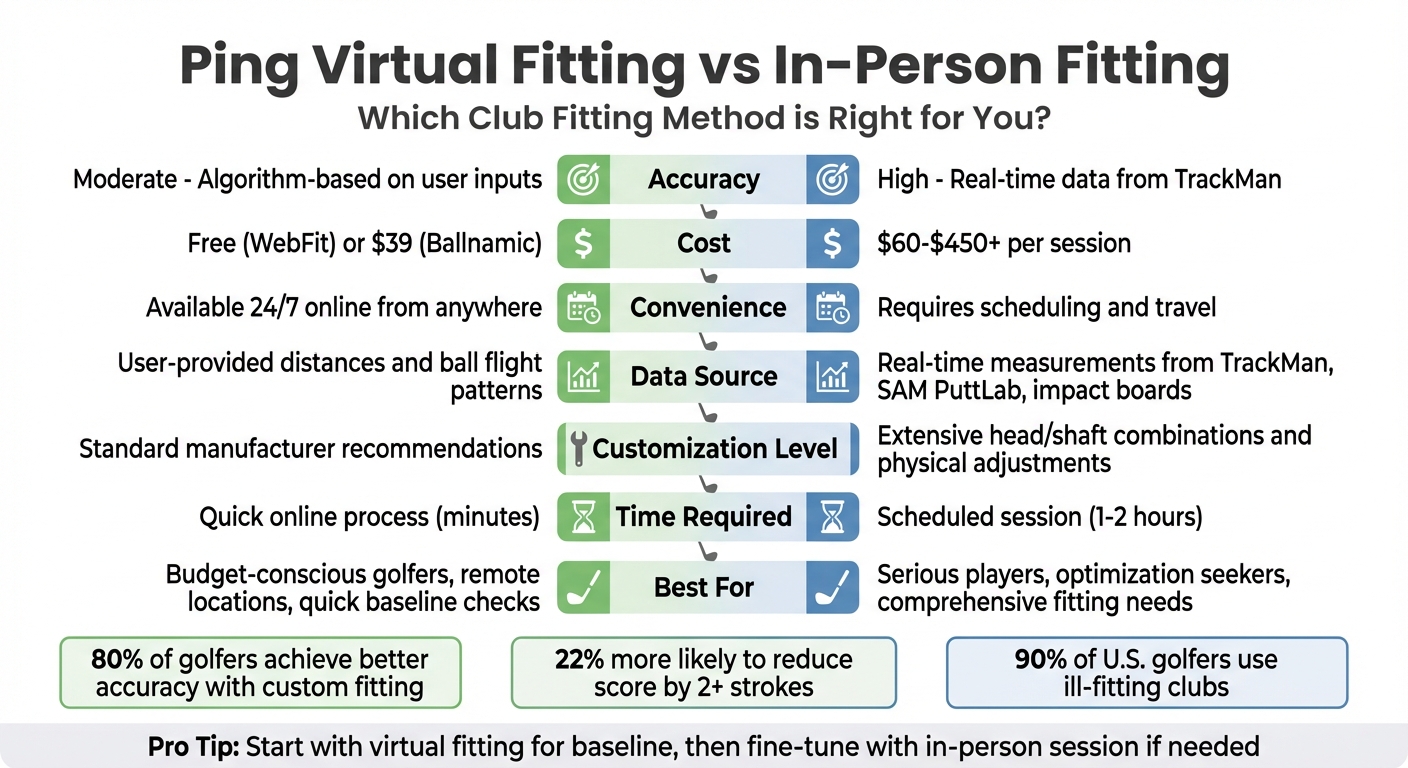
Ping Virtual vs In-Person Golf Club Fitting Comparison
How a PING Iron fitting should look starring Kippa and Matt Austin.
sbb-itb-bcd8bdd
Ping Virtual Fitting: How It Works
Ping’s virtual fitting process offers a modern, convenient way to get club recommendations tailored to your game. By analyzing the measurements and performance data you provide, it creates a profile to guide your club selection. While it might not capture every subtlety of your swing like an in-person fitting, it’s a practical alternative that leverages extensive user data to deliver personalized results.
Using Ping’s WebFit Tool
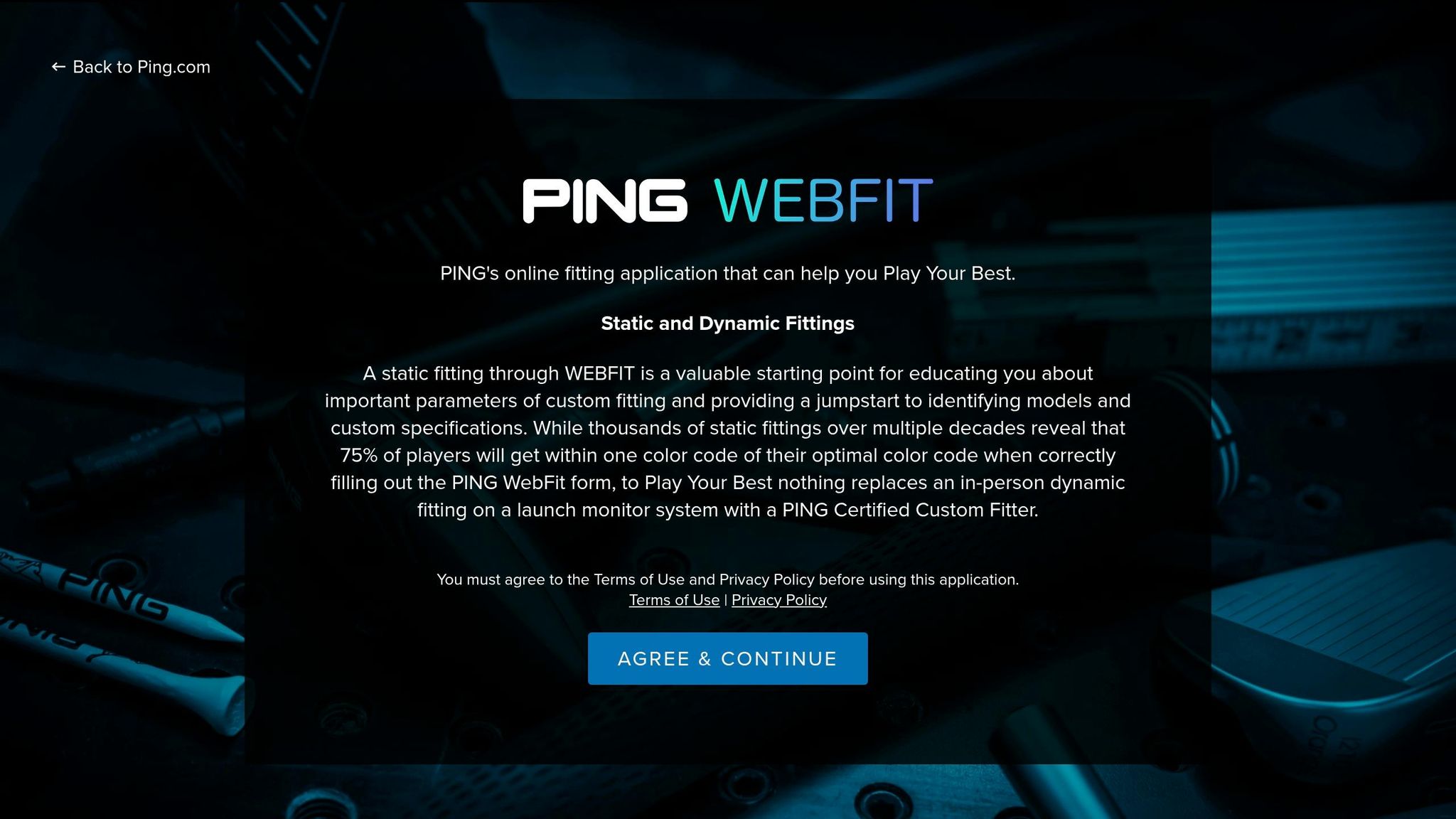
Ping’s WebFit tool walks you through a series of questions to create your club profile. You’ll start by entering basic information like your gender, handicap, and preferred measurement units. Then, you’ll input physical details such as:
- Height
- Wrist-to-floor distance
- Hand size and longest finger length
These measurements help determine the ideal club length, lie angle, and grip size using Ping’s color code system.
Next, you’ll provide performance metrics like your average driver carry distance and total distance. As GOLF.com highlights:
Most golfers tend to overestimate their distances through the bag, but within the Ballnamic platform, lying simply doesn’t help at all.
Accurate data is key – exaggerating your numbers can lead to incorrect shaft flex recommendations. You’ll also select details about your ball flight pattern (e.g., hook/draw or fade/slice), your preferred shot shape, and whether you typically strike the center of the clubface or tend to hit off-center.
Once all the inputs are verified, the tool generates recommendations for the club model, loft, shaft flex, shaft length, and grip color code. You can print these results and take them to a local pro shop or an authorized Ping fitter to finalize your purchase. This seamless process makes virtual fitting an accessible option for golfers of all skill levels.
Main Features of Virtual Fitting
The WebFit tool uses interactive diagrams and sliders to simplify the process of entering measurements accurately. It covers the full spectrum of clubs, from drivers and fairway woods to hybrids, irons, wedges, and even putters. For putter fittings, you’ll identify your stroke type to find the best match.
For those seeking extra guidance, Ping’s Tele-fitting option connects you with live experts who can provide additional insights. However, as Victor Afable from VA Shafts notes:
A single online algorithm can’t account for all the nuances like tempo or timing – aspects crucial in finding the right fit.
While virtual fittings offer a strong starting point, they can’t fully replicate the depth of an in-person fitting, which examines swing dynamics in greater detail. That said, the convenience and quick feedback make it an excellent tool for golfers looking to refine their equipment choices.
In-Person Fitting: How It Works
The process of an in-person fitting kicks off with a detailed conversation aimed at understanding your golf game. This interview focuses on your ball-flight tendencies, current equipment specifications, and personal preferences. As Steve Russell Golf explains:
"The fitting process begins with obtaining important information. Questions help to identify your ball-flight tendencies, equipment specifications, your likes and dislikes about your current set, and your needs and preferences from new equipment."
This initial discussion sets the stage for the precise measurements and dynamic testing that come next.
Dynamic Lie Testing and Launch Monitor Analysis
Once the interview is complete, the fitter gathers essential physical measurements to establish a baseline for your club specifications. Then comes the dynamic lie testing. Here, you hit shots from an impact board covered with tape, which reveals the position of the clubhead at impact. This is where Ping’s well-known color-coded system comes into play, helping to determine your exact lie angle.
At the same time, launch monitors track data points like ball speed, launch angle, carry distance, spin rate, and total distance. These metrics, combined with real-time launch data, ensure your club’s lie and loft are fine-tuned for peak performance. As Marty Jertson, Vice President of Fitting and Performance at Ping, explains:
"One of the most exciting advancements… is that, for the first time in the golf industry, we decouple and approximate a ball’s initial launch conditions with its aerodynamic performance."
Testing Different Clubs and Adjustments
With the dynamic data in hand, the fitter moves on to testing different club setups to zero in on the ideal configuration. This phase involves experimenting with multiple variables, such as club model, loft, shaft flex, and length. You’ll hit shots with various combinations while the fitter monitors your ball flight in real time. This feedback allows for precise adjustments – whether it’s switching from a stiff to a regular flex shaft, adjusting club length, or tweaking grip size – to find the perfect fit.
Beyond just the technical specifications, the fitter also observes your grip and posture, making small adjustments to enhance your swing mechanics. This step ensures the clubs aren’t just tailored to your measurements but also aligned with the unique characteristics of your swing.
Ping Virtual Fitting vs In-Person Fitting: Side-by-Side Comparison
When it comes to choosing between Ping’s virtual fitting and an in-person session, it boils down to balancing convenience with precision. Virtual fittings are great for accessibility and budget-conscious golfers, while in-person fittings excel in delivering tailored, data-driven results for those seeking to fine-tune their game.
In-person fittings rely on advanced tools like TrackMan to capture real-time swing data, providing unmatched accuracy. On the other hand, Ping’s virtual fitting uses its WebFit tool, which bases its recommendations on user-provided details, such as club performance and ball flight. Tony Covey, Editor at MyGolfSpy, sums it up well:
"For better players, fitting is all about optimization. They’re fine-tuning launch angles, spin rates and descent angles with laser-like precision."
This highlights why custom fitting is invaluable for golfers aiming to elevate their performance.

The impact of custom fitting is backed by data. According to Greystone Golf & Country Club, 80% of golfers who undergo custom fittings achieve better accuracy and consistency, as tracked by launch monitors. Furthermore, golfers who opt for custom fittings are 22% more likely to shave at least 2 strokes off their score and 56% more likely to improve by over 5 strokes per round. Despite these benefits, a 2023 study revealed that nearly 90% of U.S. golfers are likely using clubs that don’t fit their swing properly.
Comparison Table
| Factor | Ping Virtual Fitting | In-Person Fitting |
|---|---|---|
| Accuracy | Moderate (algorithm-based on user inputs) | High (real-time data from systems like TrackMan) |
| Data Source | User-provided distances and ball flight patterns | Real-time measurements from TrackMan, SAM PuttLab, and impact boards |
| Cost | Free (WebFit) or $39 (Ballnamic) | Around $60 per hour, up to $450+ for premium sessions |
| Convenience | High – available 24/7 online | Lower – requires scheduling and travel |
| Customization | Standard manufacturer recommendations | Extensive head/shaft combinations and physical adjustments |
| Time Required | Quick online process | Requires a scheduled session |
| Best For | Quick baseline checks, remote locations, and budget-conscious golfers | Optimization and comprehensive fitting for serious players |
Virtual fitting tools like WebFit offer a fast and efficient way to identify a baseline club match, and for a small fee, Ballnamic adds even more options. In-person fittings, while more costly – ranging from $60 to over $450 – offer a hands-on experience with many facilities applying the fitting fee toward your club purchase.
This comparison highlights how each approach caters to different needs, making it easier for golfers to choose what works best for them.
Ping Virtual Fitting: Pros and Cons
Pros of Virtual Fitting
Ping’s virtual fitting tools bring professional-level recommendations and expert golf tips straight to your home. The WebFit tool is completely free, and the Ballnamic service costs $39 for 24-hour access. This setup is perfect for golfers who want to skip the hassle of scheduling appointments or traveling to a fitting facility. It’s particularly useful for those living in remote areas or juggling packed schedules.
One standout feature of Ballnamic is its unbiased golf ball recommendations. Since Ping doesn’t manufacture golf balls, the tool remains impartial, offering suggestions across more than 40 ball models. As John K. Solheim, President of PING, puts it:
"Since we’re not in the golf-ball business, we’re able to conduct independent testing and offer this unbiased tool as another service for golfers to help improve their enjoyment of the game."
The system also adjusts for environmental factors like altitude and temperature, using proprietary algorithms and data from "PING Man" robotic testing. This allows it to evaluate niche metrics, such as how a ball performs in wet or rough conditions – a level of detail that traditional fittings might overlook.
Cons of Virtual Fitting
While virtual fitting offers convenience, it relies heavily on the accuracy of the data provided by the golfer. Users must input details like their average driver and 7-iron distances, which can introduce errors if those numbers aren’t precise. As Jonathan Wall, Editor at GOLF.com, explains:
"The goal here is to find a ball that matches your particular speed, launch and spin, so it won’t help much if you’re not reporting accurate information about your game."
For the best results, golfers should use a launch monitor to gather precise data, such as ball speed, spin rates, and launch angles. Without this information, the tool’s recommendations may be less reliable.
Another drawback is the lack of physical feedback that comes with in-person fittings. Virtual tools can analyze performance data, but they can’t account for personal preferences, like the sound of a driver at impact or the feel of a putter. These sensory details are often crucial and are best evaluated under the supervision of a professional fitter. This trade-off between convenience and hands-on precision is an important consideration when choosing Ping’s virtual fitting options.
In-Person Fitting: Pros and Cons
Pros of In-Person Fitting
In-person fittings offer something that virtual tools simply can’t: the expertise of a trained fitter who can analyze your swing beyond just the numbers. A skilled fitter doesn’t just rely on launch monitor data – they interpret how your misses translate to real-world performance. Brittany Olizarowicz, a scratch golfer and equipment tester, puts it this way:
"The real difference is the fitter. A skilled fitter interprets beyond mere launch monitor numbers."
Another big advantage? The hands-on nature of the session. Fitters can make immediate adjustments – swapping shafts, tweaking loft and lie angles, or adjusting weights – allowing you to see changes in ball flight right away. This process provides precise physical measurements that virtual fittings simply can’t replicate. Plus, you get real-time feedback on your swing.
The impact of custom fitting is backed by numbers. Research indicates that 87% of golfers who undergo a custom fitting lower their golf handicap by at least 10%. True Spec Golf even reports that players often gain 15 to 30 yards of distance after a professional driver fitting. In some cases, performance gains can be dramatic – like increasing the distance of a 7-iron from 120 yards to 150 yards.
Another perk? You can bring your current clubs to establish a performance baseline. This ensures any new equipment provides measurable improvements. As James Hogg, a golf equipment writer and former fitter, explains:
"Custom fitting benefits all golfers, debunking the myth that only skilled players need it."
These advantages highlight the precision and personalized attention that make in-person fittings stand out. However, they’re not without their challenges.
Cons of In-Person Fitting
Despite their benefits, in-person fittings come with a few drawbacks. One of the biggest issues is inconsistency among fitters. Titles like "Master Fitter" are often internal designations rather than standardized certifications. This means expertise can vary widely – from seasoned professionals with years of experience to employees with just a few weeks of training. Tony Covey, Editor at MyGolfSpy, cautions:
"Custom fitting brings with it challenges and pitfalls. They are unavoidable but by acknowledging and understanding them, you might just be able to navigate them."
Cost and time are other major hurdles. Sessions typically cost between $50 and $100 for 60–90 minutes, with premium options reaching as high as $500. These fittings can also take several hours. For golfers in rural areas, finding a quality fitter can be tough, often leaving them with big-box retail options.
Another limitation is that fittings provide a snapshot of your swing on a specific day. Factors like nerves, fatigue, or unfamiliar surroundings can lead to results that don’t reflect your usual performance. This is a sharp contrast to Ping’s virtual fitting, which offers more consistency and convenience. Additionally, many in-person fittings happen indoors on mats, which can mask poor strikes and provide feedback that doesn’t match hitting off real grass. Most iron fittings also focus on a single club – usually a 7-iron – and extrapolate data for the rest of the set. This approach may not accurately reflect how you hit your long or short irons.
Which Fitting Method Should You Choose?
When deciding on a fitting method, the right choice depends on what matters most to you – convenience or precision. Each option serves a specific purpose, so the best fit will align with your personal goals and circumstances.
When to Use Ping Virtual Fitting
If accessibility and ease are top priorities, Ping’s virtual fitting tools are a great option. These tools are especially useful for golfers in remote areas without access to professional fitting centers. The Ballnamic platform, for example, costs just $39 for 24-hour access, offering an affordable way to get started.
Even without launch monitor data, you can input your average driver and 7-iron distances. From there, the system uses advanced algorithms to recommend five golf balls from a database of over 40 models. As Jonathan Wall, GOLF.com Editor, notes:

For those who don’t have access to launch monitor numbers, users can still enter their total distance with a driver and 7-iron – in addition to launch and spin rate – to gain an accurate snapshot of their game.
This makes virtual fitting an excellent choice for golfers who value convenience and a straightforward process.
When to Use In-Person Fitting
For those who want a more tailored approach, in-person fitting offers a level of precision that virtual tools can’t match. It’s particularly beneficial for golfers aiming to refine their game, such as breaking the 80-mark. During these sessions, professional fitters provide immediate feedback and make real-time adjustments to your equipment. Kris McCormack, Vice President of Tour and Education at True Spec Golf, explains:
Fit clubs aren’t a reward for having a perfect swing, they’re a tool to help you build one. Because when the variables in your swing are unpredictable, your gear shouldn’t be.
In-person fittings allow for hands-on experimentation with different shafts, loft angles, and head designs, with results displayed instantly on a launch monitor. This method is ideal for experienced golfers who need tighter shot dispersion and consistent contact. For the best of both worlds, consider starting with virtual recommendations and following up with an in-person session for fine-tuning.
Conclusion
Deciding between Ping’s virtual and in-person fitting comes down to what matters most to you. Virtual fittings through Ballnamic offer a convenient and affordable option at $39 for 24-hour access. They’re perfect for golfers who are short on time or prefer the flexibility of a remote experience, providing unbiased, data-driven club recommendations.
On the other hand, an in-person fitting delivers a hands-on approach that goes beyond virtual tools. With expert guidance and real-time adjustments, this option fine-tunes your clubs to meet specific performance goals, offering a level of precision that virtual fittings can’t replicate. Each method caters to different needs, helping golfers improve their golf strategy in unique ways.
As Marty Jertson, Vice President of Fitting and Performance at Ping, puts it:
We’ve seen optimization benefits in players achieving greater distance while using a higher-lofted driver with better-matched golf balls.
Ultimately, the best choice depends on your priorities – whether it’s convenience, budget, or the depth of customization you’re aiming for.
FAQs
What information do I need for Ping WebFit to work accurately?
When using Ping WebFit, make sure to input your average total distance for both your driver and 7-iron. It’s also important to share details about your ball-striking consistency and your performance goals. This information allows the system to create a fitting that matches your individual playing style and needs.
When should I upgrade from virtual to in-person fitting?
Upgrade to an in-person fitting if you’re looking for a more thorough and customized evaluation of your swing and gear. While virtual fittings are handy, in-person sessions offer the advantage of advanced tools and hands-on expertise to capture finer details like your swing mechanics, overall feel, and comfort level. This approach works best for golfers aiming to fine-tune their performance with real-time feedback and personalized recommendations.
Can I use virtual fitting results to order clubs confidently?
PING’s virtual fitting process is designed to make ordering clubs a confident and straightforward experience. By leveraging advanced tools and your individual player profile, it recommends clubs specifically tailored to your game. While many golfers prefer in-person fittings, PING’s virtual option offers a high degree of precision and customization, delivering results that closely match what you’d get from an in-person session.
Related Blog Posts
- How Online Golf Club Fitting Works for New Golfers
- Top AI Tools for Custom Golf Club Fitting
- Virtual Club Fitting vs. In-Person Fitting
- PING WebFit vs. Sub 70: Online Fitting Tools
