
Hitting well from uneven lies is all about adjusting your setup to match the slope. Whether you’re dealing with a downhill, uphill, or sidehill lie, the key is to let the terrain guide your stance, weight distribution, and alignment. Here’s how to tackle slopes like a pro:
Key Adjustments for Uneven Lies:
- Downhill Lies:
- Tilt shoulders to match the slope.
- Shift weight to your lead foot.
- Move the ball back in your stance.
- Use a more lofted club and aim slightly left.
- Uphill Lies:
- Align shoulders with the incline.
- Favor your trail foot for balance.
- Position the ball slightly forward.
- Use less loft and aim slightly right.
- Ball Above Feet:
- Choke down on the grip.
- Aim right to counter the draw tendency.
- Widen your stance for stability.
- Ball Below Feet:
- Grip at full length for reach.
- Aim left to offset the slice tendency.
- Flex knees and widen stance for balance.
Quick Tip: Swing at 70–80% power to maintain control and balance.
By making these small adjustments before your swing, you can improve contact, control ball flight, and quickly improve your golf game to handle tricky lies with confidence.
GOLF UNEVEN LIES – Complete Tutorial on Playing From Golf Slopes
sbb-itb-bcd8bdd
Downhill Lie Adjustments
Downhill lies can be some of the most challenging situations on the golf course. The slope often pulls you forward, making it easy to lose your balance or hit behind the ball. Getting your setup right is key to making clean contact and navigating these tricky shots with proven golf tips.
Match Your Shoulders and Hips to the Slope
Align your shoulders, hips, knees, and feet so they run parallel to the slope. Your lead shoulder should sit lower than your trail shoulder, matching the downhill angle. This setup helps the club follow the slope naturally, improving your chances of striking the ball cleanly. It’s a crucial adjustment for handling uneven lies.
Andrew Park, a Golf Digest Best in State Teacher, explains:
"When hitting off a downhill lie, don’t ever try to fight the slope. Instead, focus on swinging with the slope, which you can do by aligning your shoulders with the slope".
By leveling or tilting your shoulders to match the slope, you can focus on striking the ball with a descending motion. Avoid trying to lift the ball into the air – this often results in hitting behind it.
Once your alignment is set, your weight distribution becomes the next priority.
Put More Weight on Your Lead Foot
From the start, shift most of your weight to your lead foot. This forward weight placement helps you stay balanced and ensures a downward strike at impact. Keeping too much weight on your trail foot often leads to fat shots.
Butch Harmon, a renowned golf instructor, advises:
"Lean into the slope; gravity will pull you downhill during the swing".
To stay stable on uneven ground, widen your stance slightly and swing at about 70–80% of your usual power. This adjustment helps maintain control and balance throughout your swing.
Adjust Ball Position and Club Choice
Fine-tuning your ball position and club selection is just as important as your alignment and weight shift when facing a downhill lie.
- Ball Position: Move the ball one to two inches back in your stance compared to a flat lie. This helps ensure you make contact with the ball before the club reaches its lowest point.
- Club Selection: Use a more lofted club than usual. For example, choose a 7-iron instead of a 6-iron. A downhill slope naturally de-lofts the club, so this adjustment helps you achieve the desired trajectory. Choking down about an inch on the grip can also prevent the club from digging too deeply into the ground.
- Aiming: For right-handed golfers, aim slightly left – about five yards with short irons and up to 10 yards with longer clubs. This compensates for the ball’s tendency to start right or slice on a downhill lie.
Uphill Lie Adjustments
Uphill lies create a challenge that’s the reverse of downhill slopes. Instead of gravity pulling you forward, you’re working with the slope to sweep the ball cleanly and achieve the right lift. The trick is to align your body with the terrain and embrace the fact that your swing will feel different than it does on flat ground.
Align Your Shoulders with the Slope
Adjust your shoulders to match the hill’s incline by lowering your trail shoulder significantly below your lead shoulder. If you keep your shoulders too level, the clubhead will dig into the ground before it reaches the ball.
As you’ll find in many golf lessons, Butch Harmon, ranked No. 1 among Golf Digest’s 50 Best Teachers, explains:
"If your shoulders are too level, you’ll stick the clubhead steeply into the ground at impact".
Andrew Park, a Golf Digest Best in State Teacher, adds:
"Feel like your trail shoulder is well below your lead shoulder when you address the ball".
To stay steady, widen your stance slightly. This added stability helps counteract gravity and keeps you balanced throughout the swing.
Once your alignment is set, focus on your weight distribution.
Favor Your Downhill Foot
Unlike flat lies, an uphill lie requires more weight on your downhill (trail) foot to help you swing along the slope. Don’t worry if your finish feels slightly backward.
Andrew Park offers this advice:
"It’s OK to not get your weight to your lead leg in the downswing when hitting off an uphill lie".
He continues:

"Staying on your back leg a little longer will help you swing with slope and sweep the ball off the grass".
Keep your swing controlled by dialing back your power to about 70–80%. This helps you maintain balance and precision.
Now, let’s talk about ball placement.
Position the Ball Forward
Place the ball slightly forward in your stance to encourage a higher flight. The slope naturally adds loft, so your shot will fly higher but won’t travel as far.
To make up for the lost distance, select two or three extra clubs. For instance, if you’d usually use an 8-iron, consider a 6-iron instead.
Andrew Park advises:
"Take an extra two or three clubs to account for this. Keep in mind the wind, too. If you’re hitting into the wind off an uphill lie, the ball will get killed by the wind when it flies higher".
Finally, aim about 5 to 10 yards right of your target (for right-handers). The uphill slope naturally causes your hands to release upward through impact, closing the clubface earlier and creating a draw tendency.
Ball Above Feet Adjustments
Sidehill lies, where the ball is positioned above your feet, demand careful adjustments to your stance and club setup. The slope naturally tilts the clubface closed at address, which can lead to a draw and send your shot left of the target if you don’t compensate properly. To handle this, shorten your club length, aim right, and focus on maintaining a stable posture throughout your swing.
Choke Down on the Club
Grip down on the club by about 1–2 inches to manage the elevated ball position. This adjustment shortens the effective length of the club, helping you maintain better control and ensure solid contact. A 2023 Golf Digest analysis of PGA Tour stats revealed that players improved fairway accuracy by 15% on ball-above-feet lies when choking down and aiming right, compared to just 8% on flat lies.
Aim Right of Your Target
Since the slope naturally closes the clubface, causing a leftward draw, aiming right is essential. For minor slopes (5–10 degrees), aim 5–10 yards to the right. On moderate slopes (10–20 degrees), adjust further to 10–15 yards right. For steeper slopes (20+ degrees), aim 15–25 yards or more to the right. Keep in mind that longer clubs, like a 3-wood, may need even more adjustment than shorter irons. These aiming tweaks, combined with proper stance adjustments, can help you stay on target.
Keep Your Posture Stable
Stability is key for consistent ball striking on a slope. Widen your stance by 1–2 inches to lower your center of gravity and improve balance. Bend from the hips and flex your knees to bring yourself closer to the ball, and shift about 55–60% of your weight onto your downhill foot. This setup helps prevent swaying and promotes clean, solid contact with the ball.
Ball Below Feet Adjustments
When the ball is below your feet, the slope changes your body alignment and swing path. This often leads to thin shots, slices, or pushes to the right. The club’s sole won’t sit flat on the ground, which creates a steeper angle of attack. To handle this effectively, you’ll need to adjust your stance and maintain stability while maximizing your reach to the ball.
Use the Full Grip Length and Widen Your Stance
Grip the club all the way at the top – this helps keep the clubhead closer to the ground without forcing you to bend too much. Widen your stance by 4–6 inches beyond shoulder-width to lower your center of gravity and provide a stronger base. Golf instructor Hank Haney highlights that a wider stance minimizes swaying during your swing. Practice drills even show this setup can reduce side-to-side movement by up to 30%. Shift your weight slightly to the balls of your feet to counteract the slope’s pull backward.
Flex Your Knees and Lean Into the Slope
Bend your knees 20–30% more than you would on a flat lie, and tilt your upper body forward by 5–10 degrees to align with the slope. This adjustment keeps your swing arc low and prevents "hanging back", which often leads to fat shots. Golf expert Dave Pelz notes that this technique can improve your shot accuracy by 15–20 yards. The deeper knee flex also makes it easier to reach the ball without losing balance during your swing.
Aim to the Left of Your Target
Since the slope naturally adds left-to-right spin, aim 10–20 yards left of your target. The adjustment depends on your club: aim roughly 15 yards left for mid-irons, 5–10 yards for shorter clubs, and up to 20 yards for longer clubs. Butch Harmon, a Golf Digest pro, suggests starting with 15 yards left for mid-irons. Data from TrackMan shows that without this adjustment, the ball can curve right by 5–15 yards. To compensate, align your body left while keeping the clubface aimed at your target, then swing along your body line.
These adjustments round out the key stance modifications needed for uneven lies.
Quick Reference Table
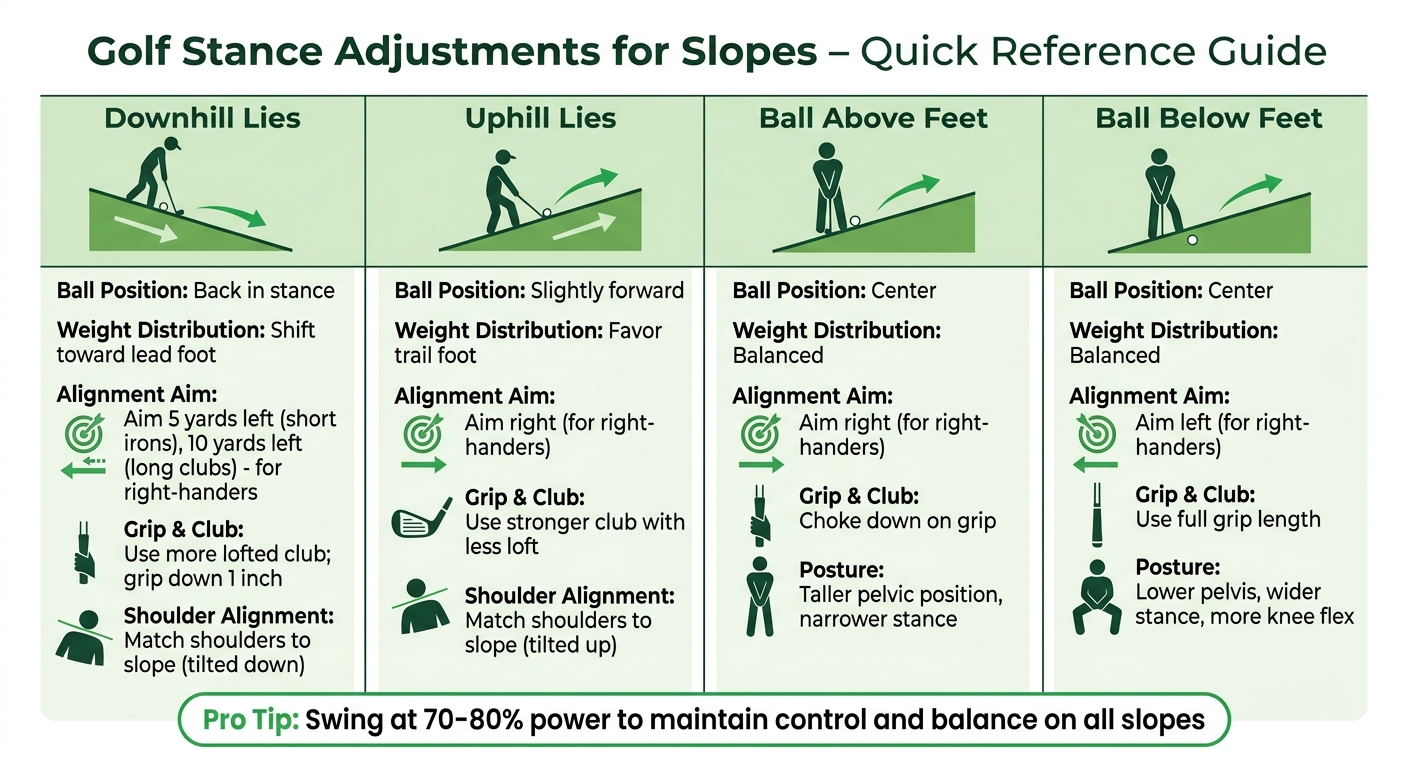
Golf Stance Adjustments for Slopes Quick Reference Guide
Slope Adjustment Comparison
Here’s a handy table to quickly outline the key adjustments needed for different slope types during play:
| Slope Type | Ball Position | Weight Distribution | Alignment Aim | Grip & Club Adjustments | Shoulder and Spine Alignment |
|---|---|---|---|---|---|
| Downhill | Back in stance | Shift toward lead foot | Aim 5 yards left with short irons, up to 10 yards left with long clubs (for right-handers) | Use more lofted club; grip down 1 inch | Match shoulders to the slope (tilted down) |
| Uphill | Slightly forward | Favor lead foot | Aim right (for right-handers) | Use stronger club with less loft | Match shoulders to the slope (tilted up) |
| Ball Above Feet | Center | Balanced | Aim right (for right-handers) | Choke down on the grip | Maintain a taller pelvic position with a narrower stance |
| Ball Below Feet | Center | Balanced | Aim left (for right-handers) | Use full grip length | Pelvis lower with wider stance and more knee flex |
This table condenses the detailed setups discussed earlier, making it easier to recall the right adjustments when you’re out on the course. Use it as a quick reference to fine-tune your strategy.
Coach Micah provides some valuable insights about slope play:
"This ball’s going to come out a lot lower and it’s going to come out a lot faster. So sometimes that might warrant you changing the club that you’re using or just clubbing down".
For uphill lies, he adds:
"On this up slope, the ball is going to launch a lot higher, but it’s going to tend to be shorter with that. So, there’s going to be more launch, more spin involved… you might have to get a stronger club".
Conclusion
Getting your stance right on slopes is key to hitting consistent shots and improving your score. By making the necessary adjustments before you swing, you eliminate the need to compensate mid-swing, simplifying the process and boosting your chances of success.

Slopes naturally affect where your club makes contact with the ground and how much loft you deliver at impact. Matching your shoulders to the slope, tweaking your ball position, and redistributing your weight allow you to work with the terrain instead of fighting against it. This approach leads to solid contact and dependable ball flights, even on tricky lies. Instead of forcing a vertical stance, let the slope guide your setup. These simple adjustments act as a reliable checklist for turning course challenges into scoring opportunities.
When practicing these techniques, focus on balance and clean contact by swinging at 70-80% effort. The more you rehearse, the more natural these setups will feel during your rounds. Building these skills creates a strong foundation for further improvement.
If you’re looking to refine these techniques, How To Break 80 offers drills and video lessons that can help. From perfecting your setup to fine-tuning your swing mechanics on uneven ground, these resources provide clear, step-by-step guidance to make these adjustments second nature.
FAQs
How do slopes change shot distance?
When playing on slopes, the terrain significantly impacts how far your ball will travel. On an uphill slope, gravity works against the ball, causing it to travel a shorter distance and reducing its roll after landing. On the other hand, a downhill slope allows gravity to work in the ball’s favor, leading to longer travel distances and increased roll. The direction and steepness of the slope play a key role in determining whether your shot will be extended or shortened.
How much should I aim off on sidehill lies?
When dealing with sidehill lies, there’s no universal rule for how much to adjust your aim – it all depends on the steepness of the slope. The key is to focus on your stance and alignment to keep your balance and maintain a solid swing path. For instance, if the ball is below your feet on a sidehill lie, adjust your body and clubface to account for the slope. This might mean aiming a bit left or right to ensure your shot stays on target.
What’s the best practice drill for uneven lies?
When tackling uneven lies, the key is to adjust your setup and stance to work with the slope. Here’s how to handle it effectively:
- Shift your stance slightly toward the target to maintain balance.
- Align your hips and shoulders with the slope to match its angle.
- Distribute more weight onto your front foot for stability.
- Adjust your ball position and aim to account for the slope’s influence on your shot.
Practicing these tweaks regularly can help you approach uneven lies with greater consistency and confidence.
Related Blog Posts
- Fix Common Balance Issues in Your Swing
- How Stance Affects Putting Alignment
- Lie vs. Stance: Key Short Game Adjustments
- Ultimate Guide to Shot Shaping on Uneven Lies
