
One bad shot does not ruin a round. Your next 30 to 45 seconds can.
If I want to stop one miss from turning into two or three, I do three things: reset my body, clean up my self-talk, and pick the simple next shot. That matters because stress after a bad shot can tighten muscles, narrow focus, and hurt tempo. In plain terms: the shot is over, but my reaction is still in play.
Here’s the article in one quick view:
- First: I give myself 1 to 2 seconds to react, then I move on.
- Next: I use one slow breath and one physical cue like resetting my grip, checking my golf stance, or brushing the grass.
- Then: I switch to a short process cue like “smooth tempo” or “commit to the target.”
- After that: I choose the safer recovery shot instead of trying to win everything back at once.
- Last: I keep my focus on only three things – the lie, the target, and the shot shape.
A lot of golfers make the same mistake after a poor shot: they replay it, get tense, think about score, and force the next swing. That loop is what does the damage. Not the first miss. The fix is short, simple, and something I can train on the range before I need it on the course.
| Part of recovery | What I do | Why it helps |
|---|---|---|
| Immediate reaction | Take 1 to 2 seconds | Stops the miss from taking over |
| Body reset | One breath + one cue | Lowers tension and settles tempo |
| Self-talk | Use one short process phrase | Keeps my mind on the next task |
| Shot choice | Take the simple play | Cuts down on forced errors |
| Focus | Stick to lie, target, shot shape | Keeps attention on the next swing |
Bottom line: if I can reset fast, talk to myself in a useful way, and choose the simple recovery, I give myself a much better shot at saving the hole and keeping the round steady.
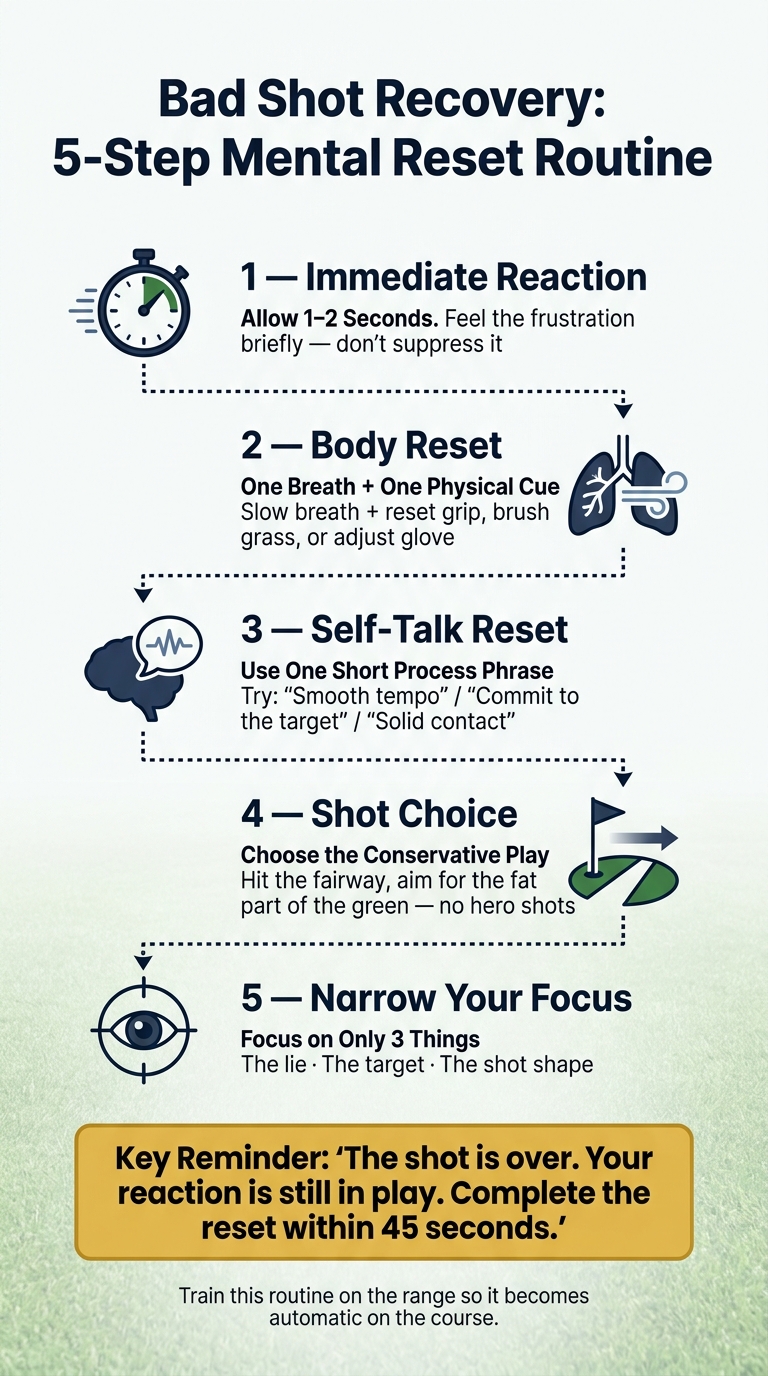
Bad Shot Recovery Routine: 5-Step Mental Reset for Golfers
Your Mindset After A Bad Shot Matters More
sbb-itb-bcd8bdd
What Happens in Your Head After a Bad Shot
Right after a bad shot, your brain can go into overdrive. In the next 30 seconds, that miss can feel like a threat to your score and your confidence. Your brain’s threat alarm may treat it like danger and kick off a stress response. The result? More tension, a narrower focus, and less feel. If you don’t reset, that reaction can carry straight into your next swing, making it harder to improve your golf game.
Negative Reactions That Hurt Your Next Swing
A lot of golfers replay the miss on a loop. Then that replay turns into frustration or self-criticism. When that happens, you’re adding pressure to the next shot before you even get to the ball.
How Tension and Score Thoughts Make Recovery Harder
Anger and embarrassment can take over the space your mind should use for the next shot. Score thoughts make it worse by adding tension and cutting into flexibility. One miss can start a negative loop that makes the next shot harder too.
Once you spot that pattern, you can break it with a reset routine.
A Simple Reset Routine to Use Between Shots
Use the next 45 seconds to shut down the last miss, settle your body, and pick the next shot. The goal is simple: don’t drag one bad swing into the next one.
Review, Recall, Replace, and Refocus
Start with a brief reaction – one or two seconds is enough. Let yourself feel the frustration instead of stuffing it down. Then use a physical reset trigger, like one deliberate breath, a grip change, or a set walking rhythm, to tell your body the last shot is done.
After that, get your posture back in place. Pull your shoulders back, lift your head, ease your grip, and commit to the next shot as its own event.
Use Breathing and a Physical Cue to Calm Down Fast
Use this reset right away. A bad shot can set off a stress response that adds tension and narrows your attention. One slow breath and one physical cue – brush the grass, adjust your glove, or reset your grip – can break that pattern.
Walk tall, keep your head up, and let your shoulders drop. It sounds small, but it gives your body a clear message: we’re moving on.
Practice Your Reset on the Range Before You Need It on the Course
Don’t wait until you’re on the course and annoyed. On the range, act out a bad shot and run the same reset again and again until it feels automatic. That’s the point. The golfer who bounces back well has trained that response ahead of time, using consistent golf tips to ensure letting go becomes the default.
Once your body settles, the next piece is managing the words in your head and the shot you choose.
Control Your Self-Talk and Pick the Right Next Shot
Once your body settles down, your brain still needs a job to do. What you say to yourself after a bad shot can shape the next one in a big way. A reset only helps if your inner voice is helping too. And that doesn’t mean forcing fake optimism. It means giving yourself something useful.
Replace Self-Criticism With Process-Based Phrases
"Overanalyzing your mistake to figure out what went wrong in the midst of your round is never a good idea. Neither is berating yourself over one lousy shot." – Rachel Bleier, Golf.com
Negative self-talk drags your attention away from the shot in front of you. A better move is to use one short cue that points to action: smooth tempo, commit to the target, solid contact. Keep it neutral. Keep it tied to something you can control. Save the swing review for later.
Choose the Conservative Shot When Emotions Are Running High
A calm cue should lead to a calm choice. When emotions run high, thinking gets tighter. That’s usually when golfers try to win the shot back at once instead of playing what’s there.
In that moment, the smart play is often the simple one: hit more fairways, aim for the fat part of the green, or take the easiest recovery route. Treat the next shot as its own decision, not payback for the last one.

Aggressive vs. Conservative Recovery Choices: A Side-by-Side Comparison
| Situation | Aggressive Choice | Conservative Choice | Result |
|---|---|---|---|
| Emotions are running high | Try to force a shot to make up for the miss | Play the next shot as its own event | Stops the spiral |
| Attention has narrowed | Go for a hero shot | Pick the safer option | Reduces compensation |
| You’re tempted to analyze mechanics | Fix the swing right away | Review the swing later | Protects focus |
Protect the score first. Sort out the swing later. Once the choice is simple, commit to it and move to the next shot.
Build Recovery Habits That Hold Up for a Full Round
The real test comes later, when you’re deep into the round and the pressure starts to creep in. A reset might feel easy on hole 2. Hole 16 is a different story.
That’s why the reset needs to become automatic. You don’t want to invent a fix in the moment. You want a simple routine you can fall back on when your swing, your score, or your nerves get shaky.
Stay Focused on One Shot at a Time
Once the reset becomes automatic, the next job is to protect it by keeping your attention on only the next shot.
After the reset, narrow your focus to what’s right in front of you:
- the lie
- the target
- the shot shape
That’s it.
If your mind starts drifting to the last mistake, the score, or what might happen next, bring it back. Go right back to the lie, the target, and the shot.
Conclusion: Short Reset, Smart Choice, Steady Round
Bad shots show up in every round. That part isn’t the problem.
What matters most is how fast you reset, how clearly you pick the next shot, and how well you stay with that process through all 18 holes. A short reset and a smart next decision can stop one bad swing from wrecking the card. Use the same reset every time, and it’s far more likely to hold up when the round gets tough.
FAQs
How do I reset after a bad shot fast?
Give yourself a brief moment to feel the frustration, then move on on purpose. Use a simple physical cue, like one steady breath or a small grip reset, to tell your mind it’s time to start over.
Next, change your body language. Stand tall, let your shoulders drop, and lift your head. Then give the next shot your full attention as its own separate event.
What should I say to myself after a miss?
After a miss, give yourself a short, controlled reaction, then reset.
Take one deliberate breath. Pull your shoulders back. Keep your head up. Then remind yourself that the next shot is a separate event.
These small mental and physical cues can help you move on and stay locked in.
When should I play safe instead of going aggressive?
Play it safe when the cost of a bad shot is higher than the upside of a great one, especially after a poor shot or when you’re dealing with a tough lie.
That approach helps you stay locked in and keeps one mistake from turning into two.
Related Blog Posts
- Golf Psychology: Recovering from a Bad Start
- How to Recover After a Bad Shot
- Mental Game Tips from Golf Biographies
- Ultimate Guide to Mental Resets on the Course
