
If I want to improve my golf game fast, I look at my short game first. Around the green, the main choice is simple: chip when I have room to roll the ball, and pitch when I need more carry and a softer stop. Since the short game can make up about 60% of shots in a round and save 2 to 4 strokes, this choice matters.
Here’s the article in plain English:
- A chip is a low shot that flies a little and rolls a lot.
- A pitch is a higher shot that flies more and stops sooner.
- For chips, I focus on:
- ball slightly back
- 60% to 80% of weight on the lead foot
- narrow stance
- quiet wrists
- landing spot first
- For pitches, I focus on:
- ball near center
- 50/50 to 60/40 weight
- shoulder-width stance
- some wrist hinge
- backswing length for distance
- The main drills are:
- Landing Spot Drill
- Gate Drill
- Distance Ladder Drill
- Carry Target Drill
- Landing-Zone Drill
- Trajectory Window Drill
- On the course, I chip with an open path and more green. I pitch when I must carry rough, sand, or water, or when I’m short-sided.
- For practice, the plan is simple:
- 2 chipping sessions
- 1 pitching session
- 20 to 30 minutes each
- track leave distance, up-and-down rate, and miss pattern
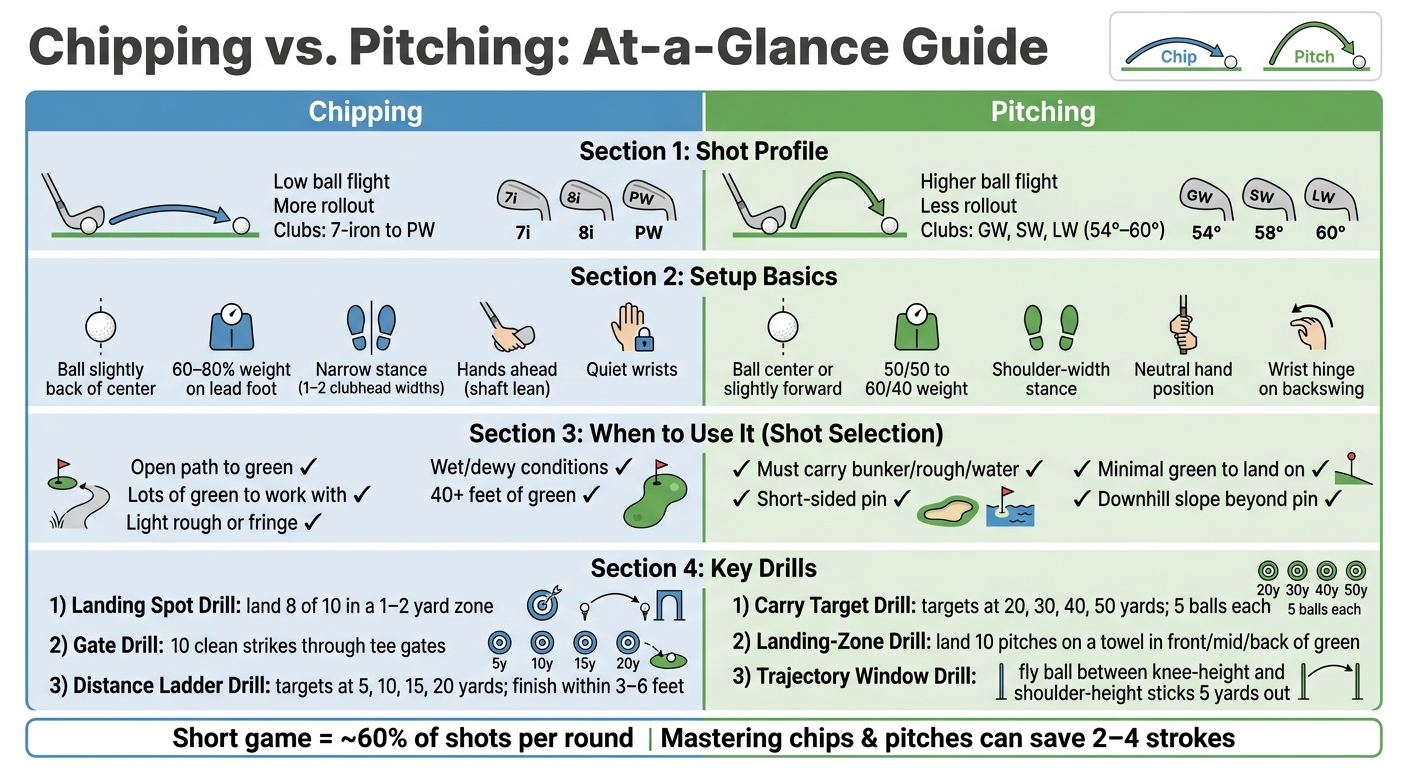
Chipping vs. Pitching: Setup, Shot Selection & Key Drills
Golf Chipping vs Pitching Drills – [3 KEY DIFFERENCES] to Improve Your Game!
sbb-itb-bcd8bdd
Quick Comparison
| Shot | Ball Flight | Rollout | Common Clubs | Best Use |
|---|---|---|---|---|
| Chip | Low | More roll | 7-iron to PW | Open path, lots of green |
| Pitch | Higher | Less roll | GW, SW, LW | Carry needed, less green |
The core idea: I want clean contact, repeatable landing spots, and predictable distance. That’s what this article helps me practice.
Chipping Fundamentals and Drills for Better Contact and Rollout
Setup Basics That Improve Low-Point Control
Good chipping starts before the club even moves. Put the ball just back of center, keep 60% to 80% of your weight on your lead foot, and add a slight shaft lean so your hands sit just ahead of the clubhead. That helps move the low point ahead of the ball, which leads to cleaner contact. Keep that weight forward through impact.
Your stance should be narrow, about one to two clubhead widths apart. That makes it easier to stay steady and cuts down on extra body movement. For club selection, use the lowest-lofted club that still gives you a landing spot and rollout you can trust.
The stroke should feel a lot like a putting motion. Let your shoulders and chest move together, keep your wrists quiet, and hold the lead wrist firm through impact. Don’t try to scoop the ball into the air. A firm lead wrist keeps the loft the same and helps you avoid fat and thin shots.
Once the setup is in place, focus on your short game strategy by picking a landing spot first. When that piece gets dialed in, rollout is much easier to judge.
3 Chipping Drills for Landing Spot and Distance Control
These three drills work on the parts of chipping that make it repeatable: where the ball lands, where the club bottoms out, and how far the ball rolls.
- Landing Spot Drill
Place two alignment sticks or towels 1 to 2 yards onto the green as targets. Hit 10 chip shots and try to land 8 of them in that area. This drill teaches you to choose a landing spot and stick with it. - Gate Drill
Push two tees into the ground just a little wider than your clubhead, right on the target line. Then chip shots without hitting either tee. If you’re chunking or thinning the ball, this drill will show it fast. Go for 10 clean strikes in a row. - Distance Ladder Drill
Set targets at 5, 10, 15, and 20 yards of rollout. Using the same club and the same motion, hit 5 balls to each target. Your goal is to finish within 3 to 6 feet of each marker.
Once your landing spot and rollout start to feel repeatable, carry control becomes the next thing to sharpen. After these chips get predictable, you can take the same precision mindset into pitch shots.
Pitching Fundamentals and Drills for Carry and Stopping Power
Setup Basics for Higher Flight and Softer Landing
Once your chip contact is repeatable, pitching becomes the next step. It gives you carry control and more stopping power. If a chip is your low-run shot, a pitch is the higher-flight option that can carry over trouble and stop faster.
Pitching needs a different setup and a different motion. Start with a shoulder-width stance so you have a stable base. That’s a bit wider than a chip setup. Put the ball in the center of your stance, or just a touch forward of center, so the club can use its full loft at impact. Keep your weight balanced at 50/50, or let it favor your lead foot slightly at about 60/40. Skip the heavy forward press you’d use for a chip. A pitch works better with a more neutral hand position so you don’t deloft the club at impact.
For club choice, go with a 54°, 56°, 58°, or 60° wedge based on how much height and spin you want. On tight lies, use less bounce. In thick rough, a higher-bounce sand wedge helps keep the club from digging.
The swing itself is compact, but it’s not a putting stroke. Let your wrists hinge on the way back, then turn your chest and hips through impact so the club keeps moving with speed. Keep the backswing short and accelerate through the ball. In pitching, backswing length controls distance much more than raw swing speed.
That setup is built to give you steady carry first. Then the drills below help you dial it in. You can also explore our library of golf articles for more advanced short-game strategies.
3 Pitching Drills for Carry Distance, Trajectory, and Spin
These drills work on the parts of pitching that matter most: how far the ball carries, where it lands, and what it does after it hits the green.
- Carry Target Drill
Set targets at 20, 30, 40, and 50 yards. Hit five balls to each target. Focus ONLY on landing the ball on the target and ignore rollout. Change your backswing length from station to station instead of changing swing speed. This helps you build carry control for each distance gap. - Landing-Zone Drill
Put a towel or alignment stick in the front, middle, or back third of a practice green. Hit 10 pitches and try to land the ball right on that spot. Then watch how it reacts – does it check or release? That feedback tells you a lot. - Trajectory Window Drill
Stick two alignment sticks upright in the ground about 5 yards in front of you. Set one at knee height and the other at shoulder height. Hit pitches that fly between them. This makes you control launch and trajectory, not just distance. Change the window height to work on both high and low pitch shots. Dry grooves help produce more predictable spin when the ball lands.
When to Chip and When to Pitch on the Course
Shot Selection by Lie, Obstacle, and Available Green
Once you understand how each shot behaves, the next job is picking the simpler play when the pressure kicks in.
Start with the first thing that matters: do you need to carry anything? If the path to the green is open, go with a chip. If a bunker, thick rough, or water sits in front of you, a pitch makes more sense because you need to fly the ball over the trouble.
A chip works best when you have space for the ball to roll out and nothing in the way. If you’re short-sided, with the pin close to the edge of the green, a pitch is usually the better call. It lets the ball land softer and stop faster.
Your lie and the course conditions matter too. On wet or dewy turf, moisture cuts friction, which makes pitch spin harder to predict. In that case, a chip often gives you a steadier result because you can count on the rollout a bit more. In heavy rough, spin also drops off, so a bump-and-run chip is often the safer play than trying to force a high-spin pitch.
Choose the shot that uses the fewest variables. Chipping gives you more room for error because the ball stays on the ground longer and acts more like a putt.

Common Short-Game Situations and the Right Shot Choice
Use those rules to match the shot to the lie, the obstacle, and how much green you have to work with.
| Scenario | Recommended Shot | Precision Priority |
|---|---|---|
| Front pin tucked behind a bunker | Pitch | Carry distance and soft landing |
| Back pin with 40+ feet of green | Chip | Landing spot and rollout prediction |
| Open path or light rough near the fringe | Chip (bump-and-run) | Clean contact and low-point control |
| Short on green with minimal room | Pitch | Maximum height and stopping power |
| Wet or dewy morning conditions | Chip | Predictable roll (spin is reduced) |
| Short on green with a downhill slope | High pitch | Maximum height to kill forward momentum |
Practice Plan and Resources for Short-Game Improvement
Sample Weekly Practice Split for Chips and Pitches
Once you know when to chip and when to pitch, the next step is simple: build a plan you can repeat.
A good weekly setup is two chipping sessions and one pitching session each week. Keep each one to 20 to 30 minutes. That’s enough time to work with intent without just beating balls for the sake of it.
Use this split to practice with purpose, not volume.
| Practice Block | Duration | Focus | Goal |
|---|---|---|---|
| Chipping Block | 10–15 mins | Landing spot and rollout control | Hit 5 of 6 balls into a 1–2-yard landing zone |
| Pitching Block | 10–15 mins | Carry distance with the Clock System | Land 8 of 10 balls in a 5-yard zone from 50 yards |
| Pressure Block | 5–10 mins | Up-and-Down Challenge | Drop a ball from a random lie, allow two shots to hole out, and record saves out of 10 |
On pitching day, use the Clock System to build distance control: 8 o’clock for about 20 yards, 9 o’clock for 40 yards, and 10 o’clock for 60 yards.
On chipping days, switch clubs and map how each one rolls out. That gives you a clear feel for your gaps, which matters a lot when you’re deciding whether the ball should carry a little or release more.
How to Track Results and Adjust Drills
After each session, track three numbers:
- Your average leave distance in feet
- Your up-and-down success rate out of 10 attempts
- Your miss pattern: short, long, left, or right
Those numbers make the next step pretty clear. If you keep missing short, for example, your carry control needs work. If the ball finishes left or right too often, start looking at strike and face control.
If your results are all over the place, step away from random practice for a bit. Go back to block practice, where you hit the same shot again and again, until your motion settles down. Once you start hitting your spot on a regular basis, make the drill tougher. Move from a clean fairway lie to a tight lie or light rough, or change the slope around your landing area.
For drills and practice structure, How To Break 80 offers eBooks, video courses, and free guides.
Conclusion: Practice Both Shots With a Plan to Build Precision
Once you’ve worked on mechanics, drills, and shot choice, the job gets pretty simple: use the shot that fits the moment. Chip when the ball has room to roll. Pitch when you need the ball to fly farther and stop sooner.
The biggest gains usually come from short, focused practice sessions. Take that same plan to the course, not just the practice area.
A few things make the biggest difference:
- Choose the shot that creates the fewest variables.
- Train landing spots first.
- Track up-and-down rate.
Better rollout control on chips and better carry control on pitches are the two results that matter most. Practice the right shot, track what happens, and your precision starts to show.
For drills and structured practice plans, How To Break 80 offers eBooks, video courses, and free guides.
FAQs
How do I know if I should chip or pitch?
Choose a chip when you’re close to the green, the path is clear, and you have enough green to let the ball roll out toward the hole.
Choose a pitch when you need to carry over a bunker or water, or when you’re short-sided and need the ball to land softly with very little rollout.
Which club should I use for a chip or pitch?
Use clubs based on the shot type.
For a chip – a lower shot that lands and then rolls – go with a 7-, 8-, or 9-iron. A hybrid can work too when you have a clear path to the hole.
For a pitch – the shot you use to get over rough, a bunker, or another obstacle – pick a lofted wedge in the 54- to 60-degree range, such as a gap, sand, or lob wedge.

How can I practice distance control around the green?
Prioritize speed control and repeatable mechanics.
For chipping, pick your landing spot first. Then use the ladder drill with targets at 5, 10, 15, and 20 yards to build steady roll-out and better distance control.
For pitches from 30 to 80 yards, use the clock system. Keep the same tempo every time, and change only your backswing length based on your lead arm position, such as 7, 9, or 10 o’clock.
Related Blog Posts
- Chipping vs. Pitching: When to Use Each Shot
- How To Pick the Right Shot Around the Green
- How to Hit a Flop Shot
- 5 Metrics to Track Short Game Spin
