By Jack Moorehouse
Choose a putter by your stroke first and its face second. If your stroke swings on an arc, look for toe hang. If it goes straight back and straight through, look for a face-balanced or center-shafted putter. Then check that the sole sits flat at address, the loft is about standard, the grip is straight and the weight suits your greens. Milled or insert is a feel decision, so test both on a real green with your own ball.
Which putter style fits my stroke?
Start with your posture and your stroke, then pick the putter. One of our older posts says to find a comfortable putting posture first and match the putter to it.
- Upright posture. Your arms and shoulders move around more than up and down, so the putter swings on an arc.
- Crouched posture. Your hands and arms hang more vertically, so there is little or no arc. Trying to swing a crouched stance on an arc means manipulating your hands and arms, and that makes misses more likely.
Once you know your stroke, match the putter to it. This cheat sheet comes from the same post:
| If this is your stroke or miss | Look for | What the post says |
|---|---|---|
| You miss right or left from aiming errors | Offset hosel | Offset hosels curb that tendency |
| Your backstroke goes to the outside | Toe hang | Promotes an in-to-in stroke |
| Your arc is larger than about four degrees and the face opens | Face-balanced head | Induces a straight-line stroke |
| You catch the toe or heel | Center-shafted head | Twists less than other putters on off-center hits |
Two more pairings from the posts:
- Arc stroke: a heel-shafted putter with a weighted flange, which helps the face open and close smoothly.
- Straight back and straight through: a center-shafted putter with a more crouched posture, which keeps the face from opening or closing. Many center-shafted putters are also face-balanced.
A center-shafted putter changes how you set up. The post’s tips are no forward press, eyes directly over the ball, hands over the ball, and the alignment mark to line up, since the shaft may hide the ball slightly.
An offset hosel has a second job, according to another post. It helps you set your forward eye over the ball with a good line of sight, and it helps keep your hands ahead of the ball.
What about blade, cavity-back and mallet heads?
One post gives a short guide to head shapes:
- Blade. A thin top line to view at address. It is harder to control than a cavity back or a mallet.
- Cavity back. A hollow area in the middle of the back creates a larger sweet spot.
- Mallet. Bigger than a traditional head, and the shape varies widely. The same post points to face-balanced and heel-toe-weighted mallets as promoting a straight stroke and minimizing mishits.
The same post also says to choose a putter with an alignment aid you feel confident with, and that there is no research showing one alignment system beats another.
Milled vs insert putters: what is the difference?
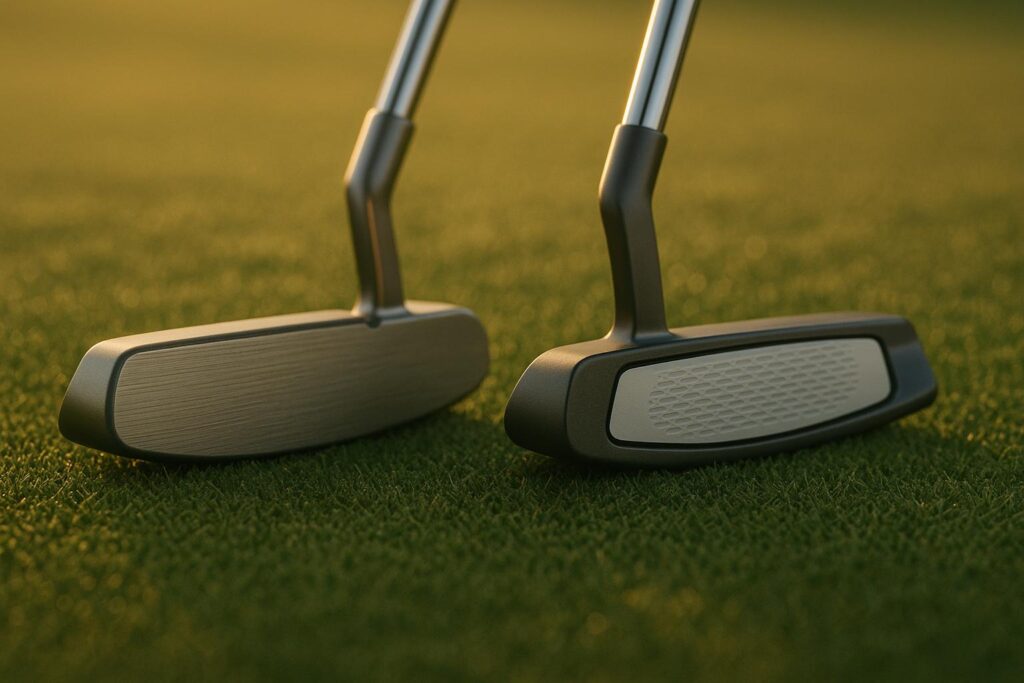
A milled putter is cut by CNC machine from a single block of metal. An insert putter has a softer face insert, made of materials such as urethane, polymer, aluminum or rubber, bonded to the head. That one difference in construction drives the feel, the sound and how much a mishit is softened.
| Milled putter | Insert putter | |
|---|---|---|
| How it is made | One-piece head cut from a single block of metal | Softer face insert bonded to the head |
| Feel | Firm, crisp, tactile | Soft, cushioned |
| Sound | Sharp, metallic “click” | Muted, softer “thud” |
| Feedback at impact | More: you can tell where on the face you struck the ball | Less: the face filters out some contact information |
| Help on off-center hits | Lower: mishits are more noticeable | Higher: keeps ball speed more even across the face |
| Often suits | A steady, consistent stroke and players who use feel to fine-tune distance | Players who miss the center now and then, and those who want a calmer feel |
Are insert putters more forgiving?
Yes, according to the posts we read. The softer insert helps keep ball speed more even on heel and toe strikes, so a putt hit slightly off-center still rolls closer to the planned distance. A milled face is less forgiving but tells you more about the strike.
Does an insert fix distance control?
Not by itself. One post says that marketing lines such as “automatic distance control” are more complicated than they sound. Distance control on centered putts mostly comes down to stroke consistency and proper fit, including length, lie angle and toe hang.
Ball choice matters too. The same post says a firm tour ball can make a soft insert sound and feel more clicky, and a low-compression ball can make it feel more muted.
How do I test milled against insert?
Test both on a practice green with the ball you play. Do not stop at a few short straight putts.
- Hit center strikes, then deliberate heel and toe misses.
- Hit a handful of long putts, including lag putts from 20 and 35 feet, and watch how the ball rolls out even when contact is not perfect.
- If long putts keep finishing well past the hole, a softer insert may fit your tempo better. If you want to feel exactly where the ball met the face, a milled putter may suit you more.
- If the head feels good but results are mixed, the issue may be fit, not face type.
How do loft, lie, length and weight matter?
The How To Break 80 putting lessons name four parts of a putter worth fitting to you: lie, loft, grip and weight. Lie comes first.
Lie: does the sole sit flat?
When you address the ball, the sole of the putter should rest flat on the ground. The lessons say that if you did nothing else with this topic, you should check the lie.
- Use your normal stance. Take your usual putting stance first, then see whether the sole is flat. Do not change your stance to suit the putter.
- Try the paper test. Have a friend slide a piece of paper under the toe after you address the ball. If it slides further than halfway, the putter was not built for you.
- Mind the length. The longer the putter, the further you stand from the ball for it to sole properly. The shorter the putter, the closer you stand.
A putter that does not fit forces you to adjust. A post on fitting says players compromise their setup to suit the putter and then compensate during the stroke. Another says the wrong lie forces unnatural adjustments and mis-hits, and that even small lie changes can alter where the ball starts.
If the lie is off, look at fixing it before you buy a new putter. The lessons say you can have your putter bent to the lie and loft that fit your stroke. A post on lie angle adds that not every putter can be adjusted, and that harder materials, such as those in some milled putters, can resist bending.
Loft: how much is right?
The standard loft the lessons give is four degrees, enough to get the ball slightly into the air and put a little backspin on it so it rolls true. They warn against more than four and against zero or one degree, which will not roll. If you have bent your putter, have someone check it.
A post on loft explains why. The right loft lifts the ball out of the slight depression it sits in and limits airtime, so the ball starts rolling quickly. Too much loft keeps the ball in the air longer, and too little extends the skid. The lessons add that if your putts come up short, you can have a little loft taken off.

Weight: does it suit your greens?
Weight is easy to get wrong in a shop. The lessons warn that a putter you love in the store may feel too heavy on light, fast greens, and that you may never get it soft enough. On very slow greens a putter can feel too light, and the lessons say lead tape fixes that. Another post agrees in direction: a heavier putter for slower greens, a lighter one for faster greens.
Putter length and long putters
Standard putters run 33 to 36 inches, according to one post. Mid-length putters run 38 to 45 inches and extra-long putters 46 to 52 inches or so. Both older posts say longer putters curb wrist action by anchoring the putter to your body, at the stomach or sternum, and both name distance control as the weakness: the belly putter makes it a problem, the long putter inhibits feel and distance control even more, and the extra-long putter lacks distance control. Check the rules for the events you play before you buy one.
Which grip should I use on the putter?
Two different things get called “grip” here. One is the putter’s grip itself, and the other is how you hold it.
The grip on the putter. The flat part of the grip should run straight down the center of the shaft, in line with the face. Grips wear and turn without you noticing, and a turned grip can leave the face slightly open or closed when you set the putter down. If the flat part is off center, get it re-gripped. A post on grip styles adds that grip size is part of fitting, and one answer in that post says smaller grips often pair with toe-flow putters and larger grips with face-balanced putters.
How you hold it. A post on grip styles covers four holds:
| Grip | What the post says it does | Who it suits |
|---|---|---|
| Conventional | Familiar, easy to pick up, supports a shoulder-led stroke | Beginners and players with arc-style strokes |
| Left-hand low | Reduces hand and wrist movement | Players with excessive hand action or left wrist breakdown |
| Claw | Limits wrist tension and encourages a shoulder-driven stroke | Players with an overactive right hand |
| Prayer | Palms face each other to cut down dominant-hand interference | Players for whom other grips have not worked |
For the grip taught in the putting DVDs, see the putter setup and stance guide.
Do I need a putter fitting?
A fitting is worth it if you are not sure which of these you need. The posts say a fitting can measure face angle at impact, path and tempo, and can set length, loft, lie angle and grip size to match your posture and stroke. Many retailers and courses also host demo days where you can try different styles on real greens.
You do not need a fitting to start. The putting lessons suggest two cheaper steps:
- Try putters on the course. Borrow a friend’s putter for a few holes and pay attention to length, feel, weight, lie and loft. A shop carpet is never the speed of your own greens, so a few made putts there prove little.
- Do not change putters all the time. The lessons say to work out how to make your current putter better, with a different lie or loft, before you run off and buy another.
A putter fits only as well as the stroke behind it. Once the putter fits, a putting training aid can show you what the stroke is doing, and a pre-putt checklist keeps your routine steady.
Frequently asked questions
Are insert putters more forgiving?
Yes. The softer face insert helps keep ball speed more even on heel and toe strikes, so slightly off-center putts roll closer to the planned distance. The trade-off is less feedback at impact, so mishits are harder to feel.
What is a milled putter?
A milled putter is cut by CNC machine from a single block of metal into a one-piece head. It tends to feel firm, sound like a sharp click and tell you more about where you struck the ball. It is less forgiving on off-center hits than an insert.
How do I know the putter fits me?
Check the sole, the grip and the weight. The sole should rest flat at address in your normal stance (a paper slid under the toe should not go past halfway). The flat part of the grip should run straight down the center of the shaft. The weight should feel right on your own greens, not only in the shop.
Do I need a putter fitting?
Not necessarily, but it helps. A fitting sets length, loft, lie angle and grip size to your posture and stroke, and lets you test milled and insert putters side by side. Without one, you can borrow putters, try them on the course and bend your current putter to fit before buying another.
Should I use a long putter?
Long putters curb wrist action by anchoring to your stomach or sternum, but the posts name distance control as their weakness. Check the rules for the events you play, and try several types before choosing one.
