
Your golf swing starts with posture. A proper stance improves rotation, energy transfer, and consistency while reducing injury risks. Here’s what you need to know:
- Neutral Spine: A straight spine supports better rotation and prevents "power leaks."
- Hip Hinge: Bend at the hips (not the waist) with knees slightly flexed.
- Weight Balance: Keep weight on the balls of your feet to maintain stability.
- Injury Prevention: Correct posture reduces strain on the lower back and improves oxygen flow.
Key stats: 70% of amateur golfers lose posture during swings, leading to inconsistent performance. Professionals maintain better spine angles, enabling smoother motion and higher clubhead speed. Want a better swing? Focus on alignment, balance, and drills like planks and hip hinges to build strength and stability.
Golf Posture – How to Stand at Address with your Knees, Hips and Spine Angle
How Posture Affects Swing Efficiency
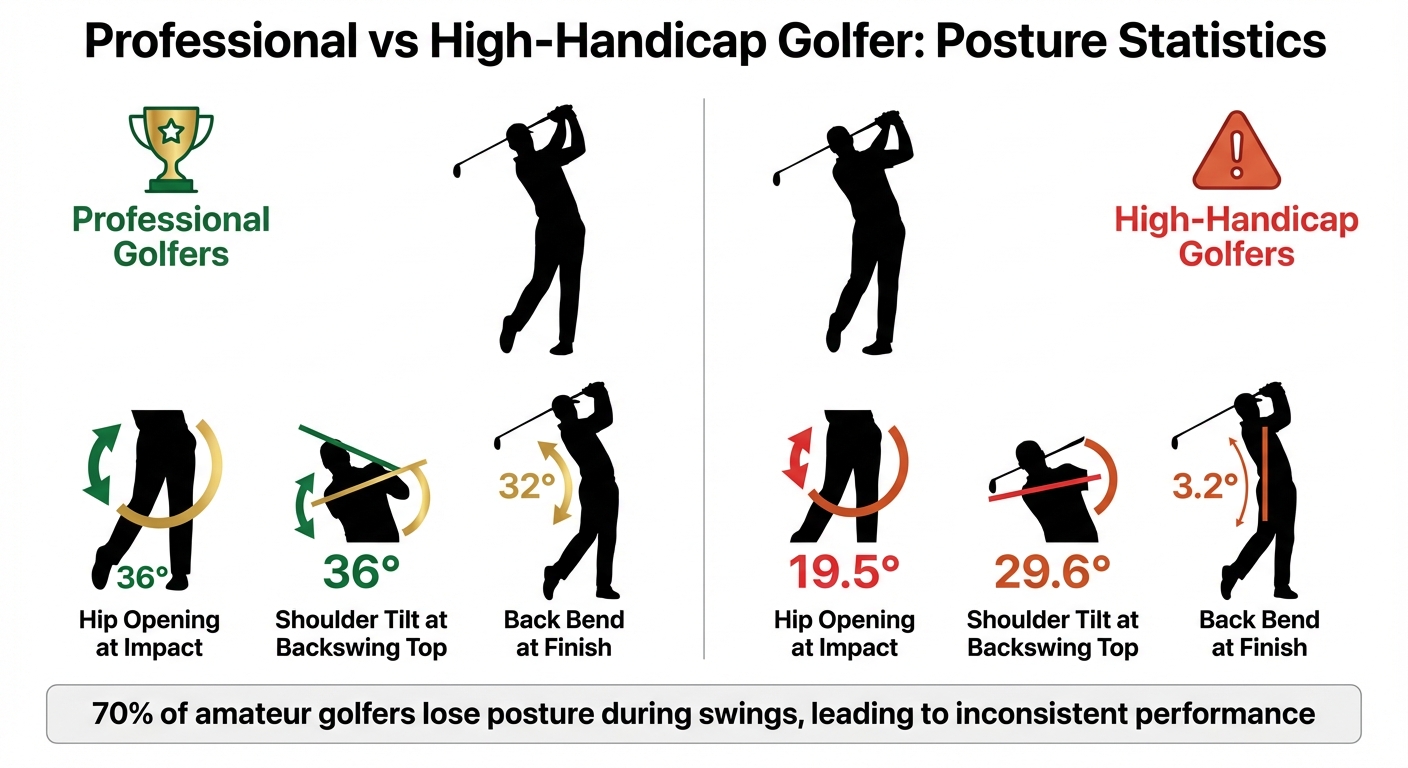
Professional vs Amateur Golfer Posture Statistics Comparison
Maintaining a neutral spine is key to transferring energy effectively during your swing. On the other hand, a rounded spine can create a "power leak", reducing both clubhead speed and consistency.
When it comes to impact, professional golfers open their hips to an average of 36°, nearly double the 19.5° seen in high-handicap players. This difference plays a crucial role in initiating the downswing correctly. Such efficiency not only boosts performance but also supports consistent mechanics and reduces the risk of injuries.
Biomechanical Benefits of Correct Posture
Good posture plays a big role in creating the "X-factor", a term researchers use to describe the separation between upper body and pelvis rotation. This separation is directly tied to higher ball velocity. Joseph Myers, a researcher at Duke University, highlights how this separation increases upper torso rotation speed during the downswing, ultimately leading to faster ball speeds.
Statistical data backs this up: professional golfers maintain a downward shoulder tilt of 36° at the top of their backswing, compared to 29.6° for high-handicap players. At the finish, pros average 32° of back bend (spine extension), while high-handicappers only manage 3.2°. Nick Clearwater, Vice President of Instruction at GolfTEC, explains the significance of these numbers:
"Longer, taller levers produce more speed".
Correct posture also helps prevent early extension, a common issue where the hips move toward the ball and the torso rises. This movement immobilizes the arms and club, reducing both power and accuracy.
How Posture Improves Swing Consistency
A stable posture is the foundation for a repeatable swing. Maintaining your spine angle throughout the swing helps keep your head at a consistent height, which is crucial for solid contact. Any vertical movement often signals a change in spine angle, leading to "thin" or "fat" shots.
Weight distribution is another critical factor. Keeping your weight balanced on the balls of your feet ensures stability through impact. If your weight shifts too far forward onto your toes, you risk hitting shanks; if it shifts to your heels, pulls and hooks become more likely. Additionally, the butt of your club should sit about 6 inches from your body at address to avoid feeling cramped or having to overreach.
Brendon Elliott, a PGA Professional, underscores the link between posture and swing consistency:
"Good golf posture is essential to making an efficient and repeatable swing. Having a solid base at setup allows your body to move correctly, which helps you to create consistency".
Beyond improving consistency, proper posture also plays a vital role in keeping your body injury-free.
How Posture Prevents Injuries
Lower back pain is one of the most common golf-related injuries, affecting about 25% of golfers and up to 58% of elite professionals.
A neutral spine helps evenly distribute the workload across your back muscles, reducing the strain caused by compensating for poor movement patterns. When your posture is correct, the muscles designed to support your swing can function properly, rather than forcing other muscles to pick up the slack.
Proper posture offers additional benefits beyond injury prevention. For instance, it can expand your chest cavity by about 30%, improving lung capacity and oxygen flow. This boost helps lower your heart rate and stress levels, enhancing both endurance and focus during your round.
Dr. Stephen Liu, an orthopedic surgeon, emphasizes the importance of posture:
"Bad posture is a chronic problem. It’s one of the single biggest changes people can make to improve their overall health. It’s why professional athletes spend so much time on their posture."
Key Posture Elements for Your Golf Swing
To improve your golf swing, focus on three essential posture elements: spinal alignment, knee flex with balanced weight distribution, and proper shoulder and head positioning. Each of these elements contributes to a consistent and effective swing.
Spinal Alignment and Tilt
Your spine is the central axis for your upper body’s rotation during a swing. The goal is to set your spine at a 45° tilt toward the ball. Hinge at your hips to keep your lower back flat.
Tilt your spine slightly to the right, as the lower right hand on the grip naturally raises the front shoulder. Shawn Callahan, a GOLF Top 100 Teacher, emphasizes the importance of this setup:
"Posture is one of the biggest keys to good ball-striking. But it’s also one of the most overlooked."
To check your alignment, stand sideways to a mirror and hold a club behind your back so it touches three points: your tailbone, the space between your shoulder blades, and the back of your head. This exercise helps you avoid excessive knee bending or rounding of the back, both of which can limit your ability to rotate smoothly.
Knee Flex and Weight Distribution
A slight knee flex is crucial for stability and a fluid swing. Avoid crouching too much – just bend enough so your arms can hang naturally without your knees getting in the way.

Distribute your weight over the balls of your feet. Leaning back on your heels restricts hip rotation, while leaning too far forward onto your toes can lead to thin shots. Dr. Jake Berman, a physical therapist with expertise in golf, highlights the importance of this balance:
"Proper posture ensures efficient rotation, power generation, and consistency in your game."
Keep your knee flex steady from your setup through impact. Many players tend to "stand up" during the swing, which disrupts consistency and reduces the transfer of energy from the lower to the upper body. Once your lower body is stable, you can focus on aligning your shoulders and head for a seamless swing path.
Shoulder and Head Positioning
The position of your shoulders and head directly affects your swing plane and rotation. Align your head, shoulder blades, and tailbone in a straight line. Pull your shoulder blades down and back to open up your chest, which can help with breathing and maintaining focus.
Keep your chin level – don’t tuck it into your chest or push it forward toward the ball. If your head juts out, it limits neck rotation and makes it harder to keep your eyes on the ball during the backswing. Allow your arms to hang naturally to find the ideal grip height.
Proper shoulder and head alignment supports your sightline and swing plane, reinforcing the foundation set by a well-aligned spine and stable lower body. Avoid rounded shoulders or a hunched back, as these can restrict your backswing and reduce your range of motion. By keeping your shoulders neutral, you’ll rotate more efficiently and reduce strain on your neck, shoulders, and lower back.
sbb-itb-bcd8bdd
Common Posture Mistakes and How to Fix Them
Good posture is the backbone of a solid golf swing. Without it, your swing mechanics and consistency can quickly fall apart. Research highlights that around 66% of golfers lose their posture during the swing, which often results in flat shoulder planes and inconsistent ball contact. Three common posture mistakes – slouching, overarching, and poor weight distribution – can wreak havoc on your game and even impact your physical health over time. Let’s break these down and tackle how to fix them.
Slouching or Hunching Over
C-posture, where your upper back rounds and shoulders slump forward, is a common issue caused by bending from the waist or stomach instead of the hips. This rounded spine limits your ability to rotate effectively, leading to mechanical problems throughout your swing.
Beyond the swing impact, slouching can compress your chest cavity, reducing your oxygen intake. Dr. Stephen Liu, an orthopedic surgeon, points out that improving this posture can boost lung capacity by as much as 30%. To check if you’re slouching, try a three-point club check: hold a golf club vertically against your back. It should touch your tailbone, the space between your shoulder blades, and the back of your head at the same time. If it doesn’t, you’re likely rounding your spine.
To correct this, practice the hip hinge technique. Stand tall with slightly bent knees, then slide your hips back a few inches instead of bending forward from your waist. This adjustment helps you maintain a strong, balanced position.
Overarching the Back
On the flip side of slouching is S-posture, where the lower back is excessively arched. This happens when you stick your tailbone out too far at address. S-posture disengages your core and places unnecessary stress on your lower back, often linked to "Lower Crossed Syndrome", a condition involving tight hip flexors and lower back muscles combined with weak abdominals and glutes.
To find a neutral spine position, try the "velcro" wall drill. Stand with your back against a wall and imagine your spine is velcroed to it. Peel your head, upper back, and middle back away from the wall while keeping your lower back and hips close to it. This helps you avoid overarching while maintaining a stable posture.
Strengthening your core is also key. Practice core bracing by engaging your abs and glutes during setup to stabilize your spine. Exercises like "cats and dogs" (cat-cow stretches) and supine pelvic tilts can improve lumbar mobility and help you find a neutral pelvic position.
Improper Weight Shift
Balanced weight distribution is another cornerstone of a consistent swing, but it’s easy to get this wrong. Many beginners either lean too far back onto their heels or too far forward onto their toes. Ideally, your hips should be positioned over your ankles or slightly toward the balls of your feet.
Brendon Elliott, a PGA professional, warns against excessive weight on your heels:
"Getting your hips and back down too much and behind your heels will get you into trouble."
Too much weight on your heels restricts hip rotation, while leaning too far forward onto your toes can lead to thin shots. Tyler Heal from Adept Golf explains the broader consequences:
"Loss of posture ultimately leads to several other swing faults such as flat shoulder plane, early extension, over the top and many other unwanted movements that lead to inconsistent contact."
To fix this, try mini deadlifts. Stand upright with a club, hinge forward from your hips while keeping your spine straight, then push through your feet to return upright. For added feedback, use video self-assessment. Record a side view of your swing and draw a line from your ear to your hip. If your ear rises above the line during your swing, it’s a sign you’re losing posture and balance.
Drills and Exercises to Improve Your Posture
Improving your posture doesn’t require hours of effort. Just 5–10 minutes of focused practice, 2–3 times a week, can make a noticeable difference. Here are some drills and exercises to help you lock in better posture.
Posture Alignment Drills
Start by checking your alignment in a mirror. Make sure your knees aren’t overly bent and your back stays straight. Once your setup looks good, try half-swings with a club placed across your shoulders. Focus on keeping your spine stable as you rotate. As Brendon Elliott, PGA Director of Instruction, explains:
"Imagine your spine as the axis around which your upper body rotates and try to keep that axis stable as you swing back and through".
If you’re ready for a more advanced challenge, give W turns a shot. Rest a club across your upper back and shoulders, hinge at your hips, and rotate to the top of your backswing and then through to your finish. The goal is to ensure the end of the club points toward the ground near the ball line, not out toward the horizon. This confirms that you’re maintaining your spine angle throughout the motion.
Core and Trunk Strengthening Exercises
Your core is the foundation of posture and stability. According to the Titleist Performance Institute:

"When it comes to spinal stabilization the core is the king. These muscles help keep your trunk forward flexed throughout your golf swing".
Without a strong core, even the best posture at address can break down mid-swing.
Plank variations are a great way to strengthen your core. Start with a standard plank, aligning your body from head to heels. If that’s too difficult, modify by using a chair for support until you build strength.
Mini deadlifts are another excellent exercise. They not only strengthen your core but also teach proper hip hinge mechanics. Hold a club close to your body, hinge at the hips, and keep your spine long. To increase the difficulty, try balancing on one leg while performing the movement.
You can also add the lunge stance one-arm incline row to your routine. This exercise builds separation between your upper and lower body, improves balance, and enhances shoulder turn stability – key factors for maintaining posture during dynamic swings.
Balance and Stability Training
Good balance is crucial for a stable and consistent swing. Start with a simple single-leg balance drill: stand on one leg with the other foot slightly off the ground for 20–30 seconds. This helps develop foundational stability.
To take it further, incorporate tools like a balance board or stability discs. These can help refine your weight shifts and mid-swing stability. For an extra challenge, try hitting balls while standing on these tools. Just be mindful of your stance width – too narrow can throw off your balance, while too wide can limit your rotation.
Conclusion
Posture is the backbone of a solid golf swing – quite literally. As Shawn Callahan, a GOLF Top 100 Teacher, explains:
"Posture is one of the biggest keys to good ball-striking. But it’s also one of the most overlooked".
By maintaining a spine tilt of around 45 degrees and ensuring proper knee flex, you establish a stable base that supports efficient rotation and helps keep your swing on plane. These small yet impactful adjustments, like hinging at the hips instead of rounding your shoulders, can lead to noticeable improvements in your backswing turn and weight transfer. Plus, keeping a neutral spine isn’t just about performance – it also helps ward off common injuries. And here’s a bonus: opening your chest through proper shoulder positioning could increase your lung capacity by up to 30%.
Consistency is the key to making these changes stick. As fitness trainer Kevin Duffy puts it:
"You can’t out-train the desk".
Set aside just 5–10 minutes, a couple of times a week, to work on the drills and exercises mentioned earlier, such as mirror checks, hip hinge practice, core strengthening, and balance work.
For even more guidance, check out How To Break 80‘s resources. Their eBooks, video courses, and free guides offer step-by-step drills to help you refine your swing mechanics and keep these posture fundamentals in play.
FAQs
How do I know if my golf posture is correct?
To evaluate your golf posture, stand in front of a full-length mirror where you can see your entire body. Take a golf club and position it behind your back so it touches three key points: your tailbone, the space between your shoulder blades, and the back of your head. If the club aligns with all these points and your chin stays level, your posture is likely in good shape.
Now, check if your ankles, knees, hips, shoulders, and ears line up vertically. Your spine should lean forward from your hips – not your shoulders. A simple way to verify this is by looking down the shaft of the club. If the club appears parallel to the ground, you’re set. If it tilts up or down, adjust your hip hinge until it levels out.
For a more detailed check, try a half-swing drill. Hold a club across your shoulders and mimic a swing motion. Use a mirror or record yourself to ensure your spine angle stays steady throughout. Make it a habit to reassess your posture regularly – it can go a long way in refining your swing mechanics.
What are the best exercises to improve my golf posture?
Improving your golf posture is key to achieving a consistent swing. Here are a few exercises you can incorporate into your routine to help:
- Neck Rotation Stretch: Slowly turn your head toward one shoulder, then gently lower your chin toward your collarbone. Hold for a few seconds before switching to the other side. This stretch helps release neck tension and encourages proper shoulder alignment.
- Lat Stretch: Stand with your back against a wall, raise one arm overhead, and lean slightly to the opposite side. This movement increases flexibility in your torso, making it easier to execute a fluid swing.
- Core Activation: Strengthen your core with exercises like planks (hold for 20–30 seconds) or bird-dogs (extend one arm and the opposite leg while keeping your torso steady). A strong core helps maintain a neutral spine during your swing.
- Glute Bridge: Lie on your back, bend your knees, and lift your hips while keeping your shoulders grounded. Hold for 2–3 seconds, then lower back down. This exercise engages your glutes, promoting proper pelvis alignment.
By adding these stretches to your daily routine and performing the strength exercises 2–3 times a week, you’ll develop better posture and enhance your swing mechanics over time.
How does my posture affect my golf swing and risk of injury?
Your posture is a game-changer when it comes to both improving your swing and preventing injuries. Starting with a neutral spine – where your hips are hinged forward, knees slightly bent, shoulders positioned over the ball, and the club aligned with your tailbone – sets the foundation. This stance ensures your core muscles carry the load evenly and lets your spine rotate smoothly. It also helps you steer clear of common posture mistakes like a rounded back ("C-posture") or an exaggerated arch ("S-posture"), both of which can put unnecessary strain on your lower back and increase the risk of injuries.
Slouching or rounding your upper back can severely limit your ability to rotate during your swing. When your rotation is restricted, you may rely too much on your arms and shoulders, which often leads to discomfort in your shoulders, neck, or lower back. On the flip side, maintaining a strong, athletic stance not only improves your balance but also reduces stress on your spine. This allows your larger muscle groups – like your hips and core – to take charge of your swing, delivering more power and control.
If you want to refine your posture and protect yourself from injuries, How To Break 80 offers practical drills and tips specifically designed to help beginners play better and stay pain-free.
Related Blog Posts
- 5 Balance Drills for a Steady Golf Swing
- Checklist: Perfect Golf Posture for Consistent Swings
- 8 Common Golf Posture Mistakes to Avoid
- Driver Impact: Spine Angle and Posture Guide
