
A mental performance assessment helps golfers identify the psychological factors affecting their game. It evaluates areas like focus, emotional control, routines, and mindset, often comparing your mental skills to those of Tour champions. The process typically includes a 15–20 minute online questionnaire with 111 multiple-choice questions, followed by a detailed 30–42-page report and a review session with a professional.
Key Takeaways:
- What It Measures: Focus, emotional control, routines, mindset, and strategic thinking.
- How It Works: Online questionnaire + professional analysis.
- Outcome: Personalized strategies to improve mental skills.
- Why It Matters: Mental lapses can cost 5–6 strokes per round, even at the pro level.
This tool provides clear, actionable steps to strengthen your mental game and improve performance on the course.
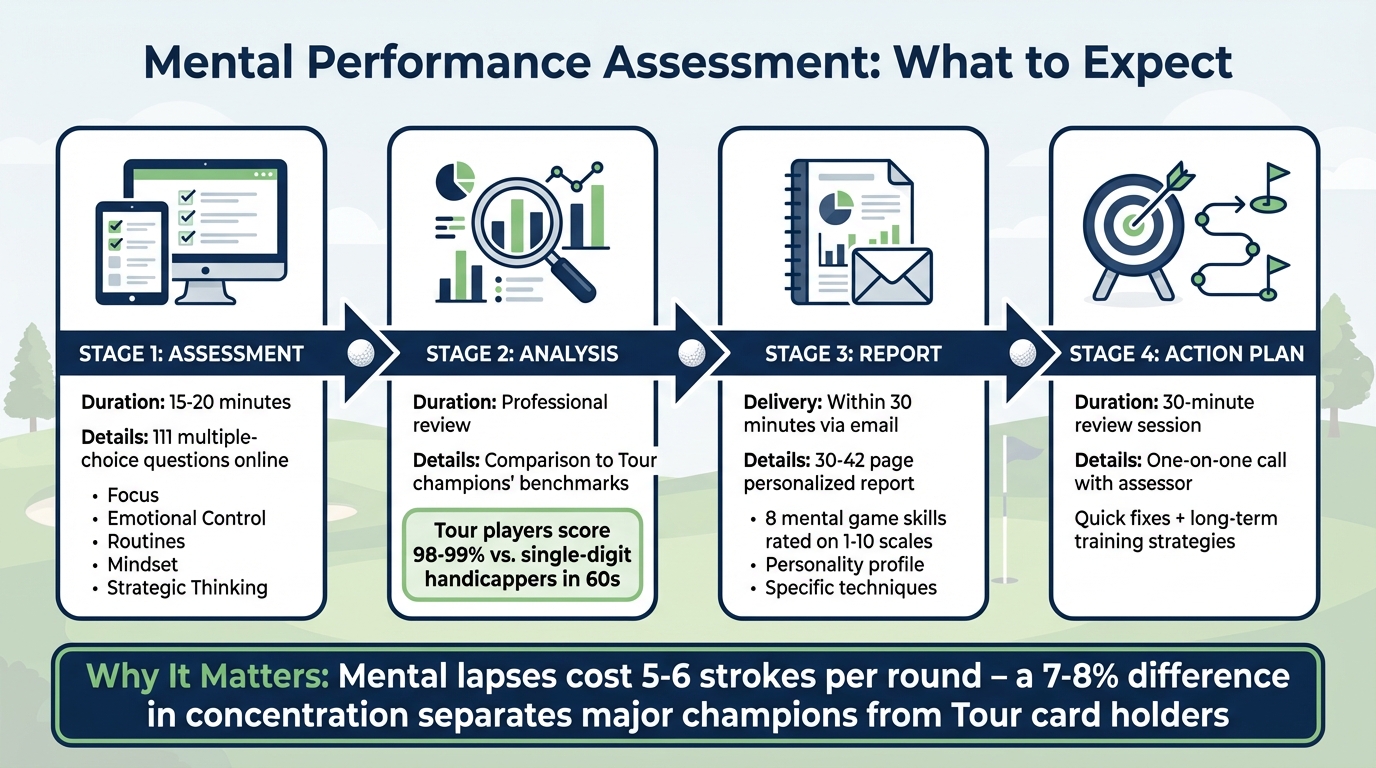
Mental Performance Assessment Process: From Questionnaire to Action Plan
Dr. Michael Lardon: How to Master Golf’s MENTAL GAME
How Mental Performance Assessments Work
Mental performance assessments are designed to fit effortlessly into your routine. Most evaluations involve a quick online questionnaire, making it easy to complete whether you’re relaxing at home or in between games. These questions focus on capturing your real-time reactions on the course rather than testing abstract concepts.
What Gets Evaluated
These assessments dig into the mental skills that set consistent players apart from those who struggle with performance. Key areas include focus and concentration, which measure your ability to stay present during a round and "switch off" between shots to conserve mental energy. Another critical factor is emotional control – evaluators look at how you handle bad shots, deal with pressure, and manage frustration or anger on the course.
Your routines are also examined closely. This includes whether you follow a consistent pre-shot routine, how you process shots afterward, and whether you stay focused on the process rather than being distracted by outcomes like your score. The assessment also evaluates strategic thinking, such as your club selection, course management, and ability to plan for "good misses" when your shots aren’t perfect.
Another important aspect is your mindset – whether you see mistakes as opportunities to learn (a growth mindset) or as fixed judgments of your ability (a fixed mindset). The evaluation also considers your commitment to goals, practice habits, and how effectively you warm up. Some assessments even compare your personality traits to the "8 Champion Personality Traits", which are based on research from PGA and LPGA Tour players who have won 31 Major Championships.
Assessment Tools and Methods
The process typically involves a golf-specific questionnaire with around 111 multiple-choice questions, alongside mental scorecards that track factors like routine consistency and self-talk. Designed specifically for golf scenarios, advanced assessments may also incorporate biofeedback tools, such as the Mind Meter Pro, to gather objective data on your mental state. Once the data is collected, a professional interprets the results and provides actionable insights.
The Assessor’s Role
After you complete the assessment, a trained professional steps in to review your results and turn them into practical strategies. This review, usually about 30 minutes long, takes place over the phone or via video call. The assessor identifies specific triggers that lead to lapses in focus or costly mistakes during competition. Your results are compared to benchmarks from Tour players, and you’re provided with a detailed 30- to 40-page report outlining your strengths and areas needing improvement.
Rather than offering generic advice, the assessor creates a personalized action plan tailored to your needs. This might include techniques like targeted breathing exercises, guided visualizations, or tweaks to your routines. They also guide you on how to incorporate these adjustments into your practice sessions and competitive play, making the changes both practical and effective.
How to Prepare for Your Assessment
Think of preparing for your assessment like warming up before a big tournament. The effort you put in beforehand will make your results more meaningful and actionable.
Review Your Game and Set Goals
Start by reflecting on your last five to ten rounds of golf – not just the scores but your thoughts and feelings during each game. What was going through your mind when you hit that perfect drive or nailed a tough putt under pressure? Look for patterns that connect your mental state to your best moments on the course.
Keep notes on key factors like how well you slept, what you ate, how you warmed up, and your overall mood. These details can help you spot trends in your mental game. During your next few rounds, rate yourself on a scale of 1–10 for mental skills like sticking to your pre-shot routine, visualizing your shots, and staying composed after a bad outcome.
At the highest levels of competition, mental focus can make all the difference. In fact, the gap between winning a major championship and just keeping a Tour card often comes down to a 7% to 8% difference in mental concentration – equivalent to about five or six shots per round where focus slips.
Before your assessment, set clear goals. Define a Dream Goal, a One-Year Goal, and Short-Term Goals (spanning 8–12 weeks) to guide your improvements.
"Instead of the question, ‘what did you shoot?’, I prefer the question, ‘what did you learn?’ Questions such as this get the player to look less at the result and more at what contributed to their success."
Bring Your Performance Records
Your personal reflections are important, but objective records can provide even more clarity. Gather your scorecards, practice notes, and any videos of your rounds. These materials can highlight recurring patterns, like specific moods or swing thoughts that show up during both your best and worst performances.
Don’t forget your mental scorecard. This tool helps track how consistently you followed your pre-shot routine, visualized your shots, and stayed emotionally steady on each hole.
"With the Mental Scorecard, you have a much more sensitive measuring tool for your game. Not only do you have a better idea of what to work on, but you also acquire a tool you can bring with you to the course no matter what shape your physical game is in."
Focus on process goals rather than just outcomes. Pay attention to how well you handled bad shots, your commitment to club choices, and your ability to mentally reset between shots. Also, take note of your best shots and the mindset you had during those moments. These insights can help you identify what drives your peak performance.
sbb-itb-bcd8bdd
What Happens After the Assessment
Once your assessment is complete, the process quickly shifts from evaluation to actionable steps. You’ll receive a clear plan outlining what to focus on and how to strengthen your mental game.
Your Mental Performance Report
Within 30 minutes of completing the assessment, you’ll get a personalized 30–42-page report sent straight to your email. This isn’t some cookie-cutter summary – it’s a deep dive into your specific responses and goals.

The report breaks down 8 key mental game skills, presenting your results on easy-to-read 1–10 scales. These scores are compared to scientific data from PGA and LPGA Tour champions, giving you a clear perspective on how you stack up against elite players.
Your report highlights areas where you excel under pressure while also pinpointing weaknesses that need attention. It goes a step further by providing tailored improvement strategies based on your age, handicap, and personal goals. Many reports also include a personality profile, comparing your temperament to the "8 Champion Personality Traits" commonly found in Tour winners.
But this isn’t just about identifying challenges – it’s about solving them. The report includes specific mental drills and techniques, such as the "Bubble Thought Control Technique" for tackling distractions and the "Four Questions Post Shot Recovery Method" to help you recover from mistakes.
"This Mental Skills Assessment and Report is invaluable for any player in need of fast, tailored answers." – Jon Stabler, GolfPsych Co-Founder and Golf Mental Coach
These insights lay the groundwork for a focused session with your assessor.
Review Session and Action Plan
Armed with your detailed report, the next step is a 30-minute one-on-one review call with your assessor. This session is all about turning insights into immediate, practical improvements.
During the call, your assessor will walk you through your results, explaining which mental skills need the most attention. You’ll also get "Quick Fixes" – simple, effective adjustments you can start using right away.
The session helps you build a long-term mental training plan, prioritizing key techniques tailored to your personality and playing style. Your assessor might suggest specific exercises, visualization methods, or stress management strategies to enhance your performance.
Some programs even offer access to online coaching tools, such as competition calendars, printable mental game scorecards, and periodization guides to help you stay on track. You might also receive post-round review questions to kickstart a mental game journal, allowing you to track your progress over time.
For added convenience, you can transfer key strategies to index cards to keep in your golf bag for quick reference before practice or rounds. Sharing your results with your swing coach or instructor can also help align your mental and physical training for maximum impact.
Using Your Assessment Results
Your personalized mental performance report is just the starting point. Transforming these insights into action is what truly elevates your mental game and leads to better results.
Build a Mental Training Schedule
Your assessment pinpoints the mental skills that need the most attention. Use this information to create a structured plan with three levels of goals: a Dream Goal (like winning your club championship), a one-year goal (such as lowering your scoring average to 78), and short-term 8–12-week goals (like improving greens in regulation).
Focus your efforts on drills that address your specific weaknesses. For example, if staying present is a challenge, incorporate daily meditation into your routine. If you struggle with tension, practice breathing exercises before each round. Dedicate just 10 minutes a day to visualization or self-talk to build habits that promote success.
To simulate tournament pressure, include "Competitive Skills Drills" in your physical practice. Create scenarios that mimic real competition and evaluate how well you stick to your routine rather than just focusing on where the ball lands. Set aside time each week – say, every Sunday – for a performance review. Use this time to reflect on your progress and make adjustments to your plan based on the challenges you’ve faced. Incorporating this schedule into your practice can lead to noticeable improvements.
Apply Feedback During Practice and Rounds
Your assessment offers two key types of guidance: "Quick Fixes" for immediate application and "Easy Lessons" for long-term growth. Start by shifting your focus during practice sessions from outcome-based goals to process-driven goals. For instance, instead of simply aiming to hit more greens in regulation, concentrate on completing your pre-shot routine for every shot.
Before stepping onto the course, try guided audio sessions or mental rehearsals to instill positive imagery. During your round, practice quieting your mind between shots to conserve energy for key moments. This approach has been used by top players like Phil Mickelson, who worked with Dr. Michael Lardon in 2011–2012. By focusing on a single mental image during his swing, Mickelson shot a 64 in one tournament round and went on to win the Shell Houston Open shortly after adopting this strategy.
Consistently reviewing and refining these techniques ensures steady progress over time.
Monitor Your Progress
Tracking your mental game requires a different approach than monitoring physical performance. After each round, take a moment to reflect by asking yourself two essential questions: What did I do well and why? and What didn’t go well, and how can I improve?
Maintain a performance journal to log your scores, sleep quality, nutrition, warm-up routines, and mood. Over time, patterns will emerge – perhaps you notice you perform better after a solid eight hours of sleep or that skipping your pre-round routine affects your focus. Rate yourself on specific mental skills like visualization clarity or staying present between shots to uncover areas for growth.
"Instead of the question, ‘what did you shoot?’, I prefer the question, ‘what did you learn?’" – Golf State of Mind
Many golfers also turn to online coaching platforms to stay organized. These tools can help you manage your competition calendar, track stats, and complete post-round quizzes on mental performance. Comparing your current progress to your short-term goals every 8–12 weeks ensures your training stays on track and your mental game keeps evolving.
Conclusion
Mental performance assessments provide a detailed look at the obstacles affecting your game. They uncover the beliefs, attitudes, and triggers that might be causing you to underperform when it matters most. Instead of relying on guesswork, these assessments use objective data to identify areas where your mental game needs improvement.

The key is to focus on mental processes you can control – like pre-shot routines, visualization, and managing emotions – rather than obsessing over the final score.
"The typical golfer plays bad and comes home and says, ‘I played bad,’ not ‘My physical game was bad, but mentally I was pretty good.’ With the Mental Scorecard, you have a much more sensitive measuring tool for your game." – Dr. Michael T. Lardon, Associate Clinical Professor of Psychiatry
This kind of precise benchmarking opens the door to targeted mental training. The data speaks for itself: professional Tour players often score between 98% and 99% on mental execution benchmarks, while single-digit handicappers tend to score in the 60s. That difference translates to about five to six shots per round.
FAQs
How should I prepare for a mental performance assessment?
Preparing for a mental performance assessment doesn’t have to be complicated, but it does take some careful thought. Start by identifying your goals. Are you looking to improve focus during high-pressure situations? Maybe you want to address specific challenges, like lowering your scores on tough holes. Clear objectives will give your assessment direction and meaning.
Take some time to review your recent performance. Look back at your last 5–10 rounds and pinpoint any patterns. Were there particular holes or situations where your concentration slipped? Noticing these trends can help you better understand where to focus your efforts during the assessment.
When you’re ready to begin, find a quiet, distraction-free space and dedicate 15–20 minutes to the process. Be honest with yourself – it’s not about passing or failing, but about gaining insight into your mental strengths and areas that could use improvement. Afterward, consider using tools like How To Break 80 to develop strategies and build habits that can elevate your game.
What mental skills are most important for improving your golf game?
Success in golf goes beyond perfecting your swing or improving your putting technique – it’s just as much about building strong mental skills. Setting clear goals and committing to them keeps you locked in on what you want to achieve, whether you’re practicing or competing. A solid mental approach to competition helps you stay confident, turn pressure into motivation, and keep a positive outlook. Equally important is mental and emotional control, which allows you to handle distractions, recover calmly from mistakes, and stop a single bad shot from ruining your entire round. And let’s not forget focus and concentration, which help you stay in the moment, block out distractions, and stick to your game plan.
Adding mental strategies like visualization, breathing techniques, and structured self-talk to your routine can make a noticeable impact on your game. If you’re looking to sharpen these skills, How To Break 80 provides a range of helpful tools, including eBooks, video lessons, and guides designed to strengthen your mental game and boost your overall performance.
How can a mental performance assessment improve my golf game?
A mental performance assessment digs into the mental and technical aspects that could be limiting your golf game. It takes a close look at things like your goals, mindset, pre-shot routine, course management, and even those subconscious habits you might not realize are affecting your performance.
The outcome? A customized plan packed with strategies and drills aimed at sharpening your focus, boosting your confidence, and improving your execution on the course. This targeted approach can help you shoot lower scores and bring more consistency to your game.
Related Blog Posts
- Corporate Golf Skills Assessment Tools
- Golf Psychology: Staying Cool Under Pressure
- How to Build Mental Toughness for Golf
- 10 Best Mental Game Golf Books
