
If you want to improve your putting, alignment tools can make a huge difference. These tools help golfers refine setup, stroke path, and accuracy, addressing common issues like poor alignment and inconsistent strokes. With putting accounting for 40-45% of total strokes in a round, even small improvements can lead to fewer three-putts and lower scores.
Key Takeaways:
- Alignment Tools Matter: 70% of amateur putting problems stem from poor alignment and stroke path. Tools like mirrors, gates, and arcs help correct these issues.
- Skill-Specific Options: Beginners benefit from mirrors for setup basics, while advanced players may prefer data-driven tools like sensors.
- Budget-Friendly Choices: Mirrors and alignment sticks ($25–$75) are effective for most golfers. High-tech options like wrist sensors ($150–$400) are ideal for advanced users.
- Practice with a Plan: Pair tools with structured drills to build consistency and confidence.
Whether you’re a beginner or a seasoned golfer, the right alignment tool can help you make more putts and shave strokes off your game. Let’s dive into how to pick the best one for your needs.
How Putting Alignment Tools Improve Your Game
Better Accuracy and Consistency
Putting alignment tools offer immediate feedback on the essential elements of your stroke. For example, alignment mirrors help ensure your eyes and shoulders are properly positioned along the target line, promoting a square stroke every time.
A square face angle is critical for consistent direction. Tools like gates and mirrors help you verify this by showing whether your putter face is aligned at impact. Gate drills, which use tees spaced slightly wider than your putter head, quickly expose any misalignment issues. Similarly, putting arcs guide your stroke along a natural path, reducing the risk of cutting across the ball. To develop a steady tempo – key for controlling distance – many golfers use metronomes, often set to around 77 beats per minute. Starting with straight putts allows you to build a solid mechanical foundation before progressing to reading breaks. This consistency in technique lays the groundwork for confidence on the green.
More Confidence on the Green
Once your technique is dialed in, confidence follows naturally. Tools like mirrors and gates remove doubts about your setup, giving you the assurance that you’re properly aligned. With alignment concerns out of the way, you can fully concentrate on the pace and speed of your putts – both critical for consistent performance.
"Knowing you’re aligned frees your focus for pace control."
- Matt, Golf Sidekick
With regular practice using alignment aids, your mindset can shift from hoping to hit your intended line to confidently expecting it. Pressure trainers are another great tool, simulating high-stakes situations to help you develop mental focus. When your eyes, brain, and body are in sync, you achieve what many instructors call "100% commitment" to your stroke. This level of commitment is where your putting transitions from being unpredictable to dependable.
What to Consider When Choosing a Putting Alignment Tool
Your Skill Level
The right putting alignment tool can make a big difference, but it’s important to choose one that matches your current skill level. Beginners should focus on mastering the basics, like eye position, shoulder alignment, and keeping the putter face square. A putting mirror is a great starting point because it allows you to check and adjust your setup without needing a coach. Tools with extended sightlines, such as "ball-width" features, can also help beginners improve their visual alignment and boost confidence.
If you’re an intermediate player, mechanical guides like putting arcs can help you develop a consistent stroke path. For advanced golfers, biometric sensors that track wrist angles and rotation are worth considering, especially since tour pros aim to limit wrist movement to less than 2 degrees. However, beginners should steer clear of complex, data-heavy tools – they often benefit more from simple visual feedback than from diving into detailed metrics, which can lead to overthinking.
Once you’ve identified a tool that suits your skill level, think about how it fits into your budget.
Your Budget
You don’t need to spend a fortune to see improvements. For most golfers, a setup of alignment sticks ($15–$25) and a basic putting mirror ($25–$40) is enough to build a solid foundation. Together, these essentials cost about $50–$75 and can solve the majority of setup issues without breaking the bank.
"A $30 putting mirror will fix more problems than a $300 putter." – Golfeaser Editorial
If you’re ready to invest a bit more, mid-range tools like putting arcs ($40–$90) or quality practice mats ($100–$150) can help you refine your stroke and improve distance control. High-end tools, such as Blast Motion sensors ($150–$250) or HackMotion wrist trackers ($300–$400), are better suited for players who’ve already nailed the basics and want to take their game to the next level. Multi-functional tools, like "The Putting Thing", which combines features like a mirror, stroke trainer, and alignment gate, can also offer great value.
Your Specific Needs and Goals
Your choice of putting alignment tool should also depend on the specific aspects of your game that need improvement. For example, if start-line accuracy is your biggest challenge, tools like putting gates or lasers are ideal, as face angle determines 90% of a putt’s start direction. If stroke path consistency is your focus, mechanical guides like the Putting Arc can help you develop a reliable geometric stroke path. Struggling with setup and posture? Alignment mirrors are the way to go. And for distance control issues, consider metronomes (set to 77 beats per minute) or pressure trainers like the PuttOut.
To get the most out of your investment, identify your specific problem area before purchasing. This ensures you won’t waste money on tools that don’t address your needs. Also, keep portability in mind – tools that are cumbersome to set up often end up collecting dust. Look for options that can easily fit in your golf bag or be used at home on a carpet.
5 BEST Putting Aids Reviewed by a +2 Handicap & Golf Writer
Types of Putting Alignment Tools and Product Recommendations
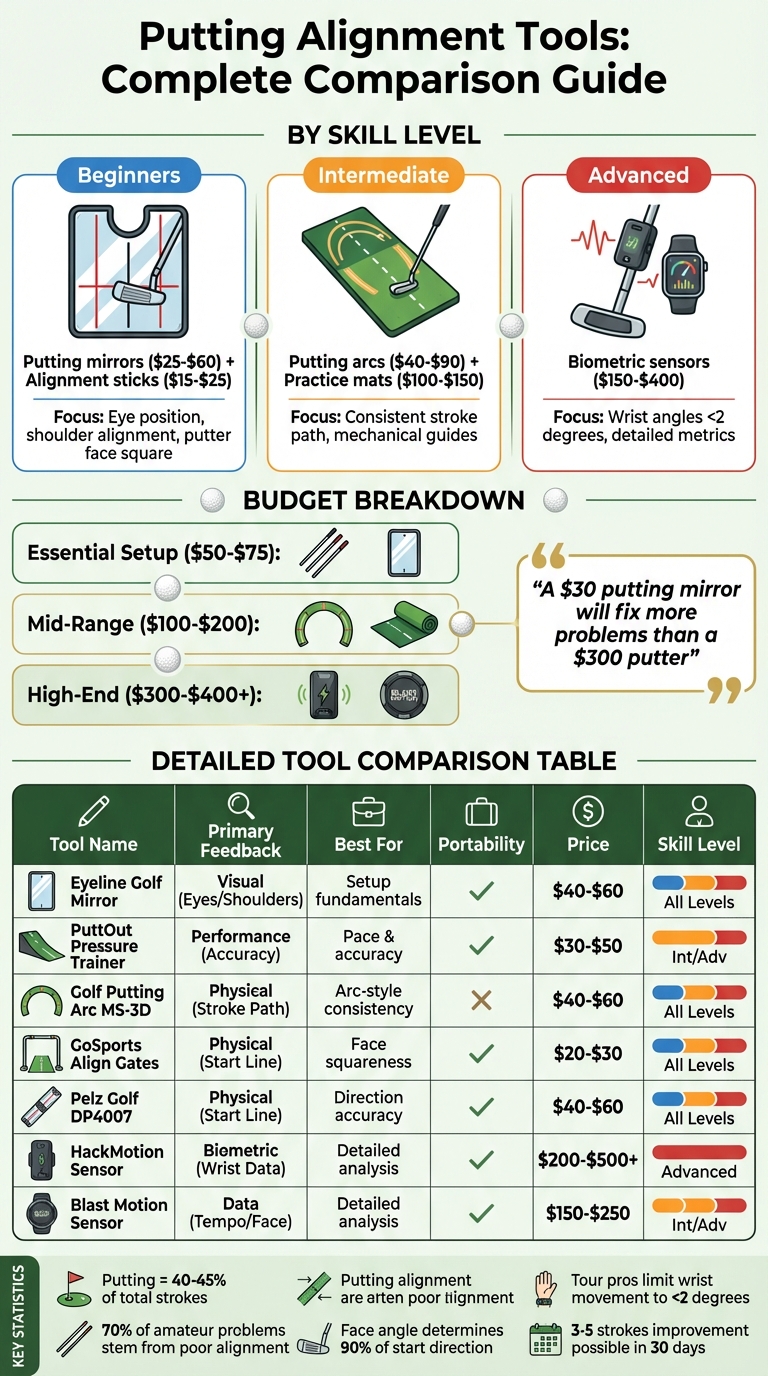
Putting Alignment Tools Comparison Guide by Skill Level and Budget
Now that you know what to look for in an alignment tool, let’s dive into some specific product recommendations. Whether you prefer simple visual aids or advanced tech, there’s something for every putting style and preference.
Best Putting Mirrors
Putting mirrors are a go-to tool for checking your setup. They help you ensure your eyes are over the ball, your shoulders are aligned, and your putter face is square. The Eyeline Golf Putting Alignment Mirror (around $40) is a favorite among tour pros thanks to its simple setup and clear visual feedback. Another solid pick is the PuttOUT Mirror, which costs between $25 and $40 and is compact enough to fit in your golf bag. To get the most out of a mirror, set it up for a straight 4-foot putt, aiming at the center of the hole. This helps verify your eye alignment. You can also use tees in the mirror’s slots to create a "gate" for your putter head, keeping your stroke on track.
If you’re more interested in tools that guide your stroke path, putting arcs and gates might be a better fit.
Top Putting Arcs and Gates
For golfers working on their stroke path and start-line accuracy, these tools are game-changers. The Golf Putting Arc MS-3D (priced between $40 and $60) offers a physical track that guides your putter along a consistent arc – perfect for players with an arc-style stroke. If start-line accuracy is your focus, the GoSports Align Putting Gates (costing $20–$30) are an affordable and highly rated option, with a 4.5-star average. These gates come in different widths: 2 inches for short putts (under 5 feet), 3 inches for mid-range putts (6–10 feet), and 4 inches for longer putts (up to 20 feet). For an extra challenge, try the Pelz Golf DP4007 Putting Tutor ($40–$60). It features adjustable marbles that fall off if your ball isn’t rolling on a perfectly square line – an endorsement-worthy tool used by pros like Phil Mickelson.
If you’re ready to take things up a notch, there are high-tech tools designed to provide detailed feedback on your putting mechanics.
High-Tech Alignment Tools
For advanced players looking for precise, data-driven feedback, high-tech tools are the way to go. The HackMotion Sensor ($300–$400) measures wrist angles and rotation, helping you keep wrist movement under 2 degrees – a critical factor for a stable stroke. Meanwhile, the Blast Motion Golf Sensor ($150–$250) connects to an app and provides real-time metrics on tempo, speed, and face angle. Laser tools like the Perfect Practice Laser Putting Guide and ACHIX Golf Putter Laser offer immediate visual feedback to fine-tune your alignment. These devices are ideal for players who’ve already mastered the basics and want to analyze the finer details of their stroke mechanics.
No matter your skill level or budget, there’s a tool out there to help you improve your putting game. From mirrors to high-tech gadgets, these products can make a noticeable difference in your performance.

sbb-itb-bcd8bdd
Putting Alignment Tools Comparison
When it comes to improving your putting game, choosing the right alignment tool can make all the difference. Here’s a breakdown of some popular putting alignment tools, highlighting their unique benefits and features.
Comparison Table
| Tool | Primary Feedback | Best For | Portability | Price Range | Skill Suitability |
|---|---|---|---|---|---|
| Eyeline Golf Putting Mirror | Visual (Eyes/Shoulders) | Setup fundamentals | High | $40 – $60 | All Levels |
| PuttOut Pressure Trainer | Performance (Accuracy) | Pace & accuracy | High | $30 – $50 | Intermediate/Advanced |
| Golf Putting Arc MS-3D | Physical (Stroke Path) | Arc-style stroke consistency | Low | $40 – $60 | All Levels |
| GoSports Align Putting Gates | Physical (Start Line) | Face squareness at impact | High | $20 – $30 | All Levels |
| Pelz Golf DP4007 Putting Tutor | Physical (Start Line) | Initial direction accuracy | High | $40 – $60 | All Levels |
| HackMotion Sensor | Biometric (Wrist Data) | Detailed stroke analysis | High | $200 – $500+ | Advanced |
| Blast Motion Golf Sensor | Data (Tempo/Face Angle) | Detailed stroke analysis | High | $150 – $250 | Intermediate/Advanced |
Each tool offers a distinct way to enhance your putting skills, tailored to different aspects of the game. Mirrors, like the Eyeline Golf Putting Mirror, are perfect for ensuring proper eye and shoulder alignment during setup. They’re especially useful for quick checks before you start a round. Tools like Golf Putting Arc MS-3D and GoSports Align Putting Gates provide physical feedback, helping you feel and correct misalignments in your stroke. Gates are particularly effective for improving start-line accuracy, while arcs are designed to refine the consistency of arc-style strokes.
For golfers looking for precision metrics, high-tech sensors such as the HackMotion Sensor and Blast Motion Golf Sensor offer detailed data on wrist angles, tempo, and face angle. These tools are ideal for advanced players who want measurable insights to fine-tune their performance.
The choice ultimately depends on the type of feedback you need. Visual tools, like mirrors, help with setup fundamentals. Physical tools, such as gates and arcs, provide immediate tactile feedback during the stroke to correct errors. Digital tools, like sensors, deliver in-depth analysis over time, making them invaluable for those aiming to elevate their game to the next level.
Most golfers find it beneficial to start with a mirror to build a solid foundation, move on to gates or arcs to improve stroke mechanics, and then incorporate sensors for advanced analytics. This progression ensures steady improvement, from mastering the basics to refining the finer details that can make a real difference on the green.
Using Alignment Tools with Structured Training Programs
Mindlessly repeating putts won’t take your game to the next level. Real progress happens when alignment tools are paired with structured drills that replace aimless practice. This method uses immediate feedback to spot and correct mistakes on the spot.
Tools like mirrors and gates are especially effective in structured drills because they allow you to identify and fix errors in real time. For example, a mirror can confirm your setup alignment, while gates help refine your stroke path and starting line.
In fact, amateur golfers who use targeted alignment aids and follow consistent training routines can shave 3 to 5 strokes off their putting average in as little as 30 days.
"You don’t need to do it for a long time, but the right drills each day can keep your stroke and your aim in good shape." – Phil Kenyon, PGA Professional Coach
Building on these strategies, a dedicated video course can walk you through the exact drills you need to improve.
Precision Putting Video Course Overview
To get the most out of alignment tools, pair them with expert-led drills. The Precision Putting Video Course from How To Break 80 ($49.00) is designed to do just that. This course offers a step-by-step approach, breaking down putting into specific techniques and exercises that work seamlessly with tools like mirrors and gates. You’ll learn how to verify your setup, refine your stroke path, and build the kind of consistency that breeds confidence on the green.
The course emphasizes a simple yet effective 10-minute daily routine:
- 2 minutes using a mirror to check your setup
- 3 minutes practicing gate drills for start-line accuracy
- 3 minutes working on distance control
- 2 minutes focusing on pressure training
This focused sequence transforms random practice into purposeful skill-building that directly translates to lower scores.
Conclusion
Getting your alignment right is the backbone of consistent putting. Without it, even the smoothest stroke won’t help you sink more putts. The right alignment tool can turn your practice sessions into purposeful training that directly lowers your scores. That’s why it’s so important to choose tools that fit your skill level and goals.
For beginners, straightforward tools like mirrors ($25–$60) and alignment balls ($10–$25) are excellent for nailing the basics of setup. Intermediate players can benefit from putting arcs and gates ($40–$90), which help refine stroke paths. Advanced golfers, on the other hand, might want to invest in high-tech sensors ($150–$250) for detailed feedback on tempo and face control.
Even small improvements in alignment can make a big difference on the scorecard. Since putting makes up a large chunk of your total strokes in a round, fine-tuning this area can have a noticeable impact on your game.
Start with the basics – a quick 5-minute session using a putting mirror can often address more issues than pricey gadgets. No matter your experience level, building a solid foundation in alignment is key.
The real game-changer is consistency. Whether you spend $10 or $250, regularly using alignment tools alongside structured drills will help you build muscle memory and confidence. With enough practice, you’ll find yourself expecting to hit your line every time – not just hoping for it.
FAQs
What are the best affordable putting alignment tools for beginners?
If you’re just starting out and need an affordable way to improve your putting alignment, there are plenty of simple tools to consider. Options like alignment gates and basic putting aids are not only easy to use but also budget-friendly, with many priced under $20. These tools can offer you a solid way to practice and fine-tune your stroke without spending a fortune.
When selecting a putting aid, pick something straightforward to set up and use. That way, you can dive into improving your skills right away without any hassle.
How can high-tech alignment tools improve your putting game?
High-tech putting alignment tools, like laser aids, offer clear visual guides to help you line up your putts with greater accuracy. Many of these devices also pair with apps through Bluetooth, delivering instant feedback on both your aim and stroke path.

Golfers who use these tools often notice a big improvement in their putting consistency. In fact, some report up to a 30% boost in accuracy and a noticeable reduction in three-putts. These tools are a great choice for players aiming to fine-tune their technique and build confidence on the green.
What are the best drills to use with putting alignment tools?
To maximize the benefits of your putting alignment tools, combine them with targeted drills designed to improve accuracy and consistency:
- Straight-Line Drill: Place an alignment stick or golf shaft on the ground to create a clear target line. Position the ball just ahead of the stick, align your eyes and shoulders with the line, and practice short putts while keeping the putter face square.
- Gate Drill: Set up two tees slightly wider than your putter head along the target line. Work on rolling the ball through the gate without hitting the tees, concentrating on maintaining proper alignment and a smooth, controlled stroke.
- Mirror Drill: Use a putting mirror to check the position of your eyes, shoulders, and putter face at address. Practice your stroke while following the guide lines on the mirror to ensure proper alignment and technique.
Dedicate 30 minutes to these drills during practice sessions to develop muscle memory, sharpen alignment skills, and boost your overall putting precision. Stay consistent, and tweak your approach based on your progress.
Related Blog Posts
- Top 7 Laser Putting Aids for 2025
- Top 5 Putting Mirrors for Better Alignment
- How to Improve Putting: Beginner’s Guide
- How to Use Putter Alignment Aids Effectively
