
Driver weights can change your shot shape, launch, spin, and miss pattern – but they won’t fix your swing. If you slice, move weight to the heel. If you hook, move it to the toe. If you hit it too low, move it back. If you spin it too much, move it forward.
Here’s the short version:
- Heel weight can help turn a slice into more of a draw
- Toe weight can help calm a hook and add fade bias
- Back weight can help launch the ball higher and add forgiveness
- Front weight can lower spin and flatten flight
- Rear weighting has been tied to up to 13% less dispersion
- Front-to-back moves can shift spin by about 300 RPM
- Side-to-side moves can shift shot shape by about 6 to 7 yards
If I wanted the simplest way to test a driver setting, I’d do this:
- Hit 5–10 shots with the current setup
- Change one weight setting
- Hit 5–10 more shots
- Watch the pattern, not one perfect drive
| Weight Position | Main Effect | Best For | Trade-off |
|---|---|---|---|
| Heel | More draw bias | Slice correction | Can bring in a hook |
| Toe | More fade bias | Hook correction | Harder to close the face |
| Front | Lower spin, lower flight | High spin | Less forgiveness |
| Back | Higher launch, more stability | Low flight, mishits | More spin |
| Neutral | Balanced flight | Baseline testing | No built-in correction |
Bottom line: I’d use adjustable weights to fine-tune ball flight, not to patch over swing faults.
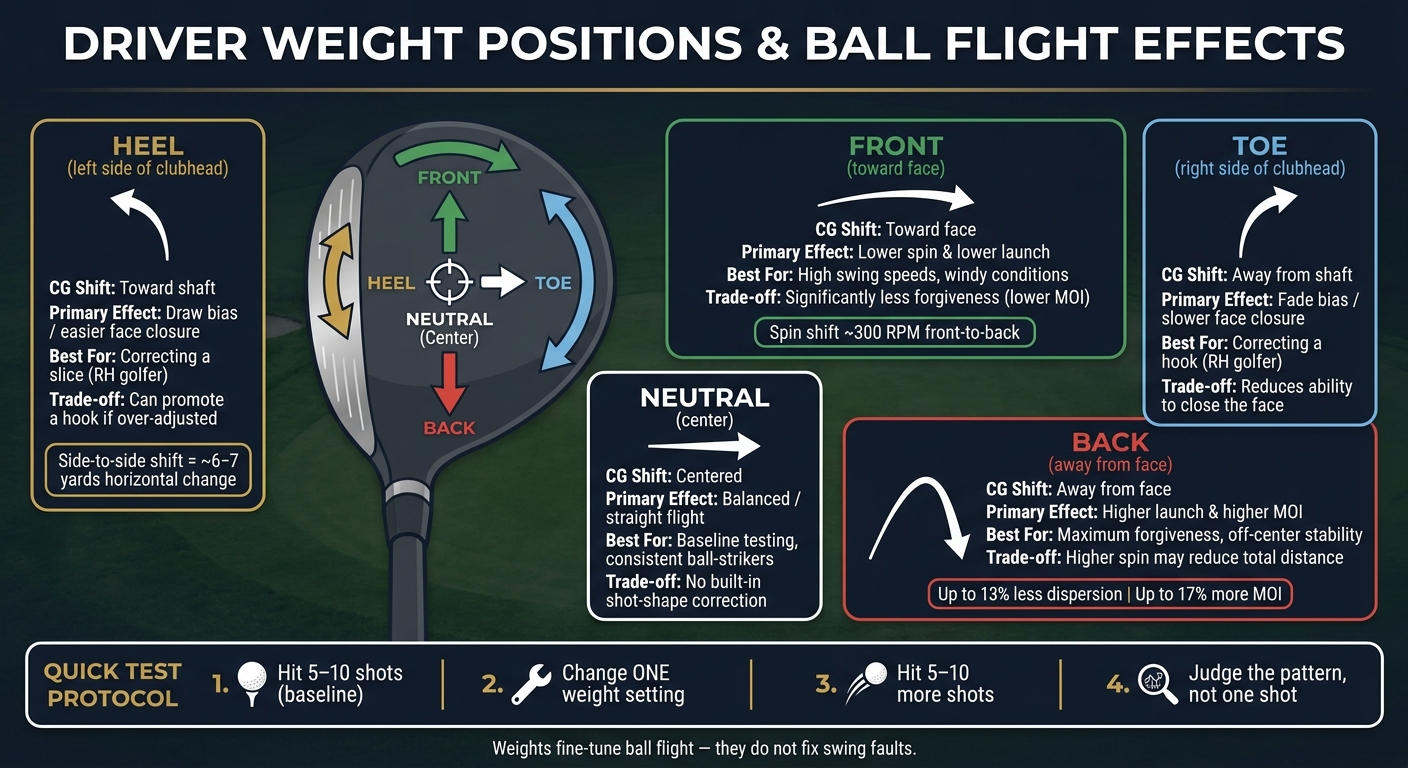
Driver Weight Positions: Ball Flight Effects at a Glance
How Driver Weights Affect Center of Gravity and Ball Flight
When you move a driver weight, you move the clubhead’s CG. That changes launch, spin, face rotation at impact, and how much the head fights twisting on mishits. That’s why heel, toe, front, and back settings can lead to different ball flights.
Rear weighting also bumps up MOI, which means the head twists less when you miss the center.
Heel and Toe Positions for Draw or Fade Bias
If you want to change shot shape, side-to-side weight movement matters most. Move weight toward the heel, and the CG shifts that way too. That helps the face close a bit more easily through impact. For a right-handed golfer, that can mean less slice spin and a more natural draw pattern.
Move weight to the toe, and you get the other effect. The face tends to close more slowly, which helps resist hooks and can promote a left-to-right fade. This side-to-side change can shift horizontal ball flight by 6 to 7 yards.
Front and Back Positions for Launch, Spin, and Forgiveness
For trajectory, front-to-back weight placement matters more than draw or fade bias. Front weighting pushes the CG closer to the face, which tends to produce lower launch and less spin. Back weighting helps launch the ball higher, adds spin, and increases MOI.
That’s the trade-off in plain English: front weighting fits players who want lower spin, while rear weighting fits players who need help launching the ball and want more forgiveness. Moving a standard 13-gram weight to the rear can cut dispersion by 13%.
Common Adjustable Weight Systems You May See
Not every driver uses the same setup, but most adjustable systems fall into two groups:
- Sliding tracks let you move a weight along a rail on the sole
- Fixed weight ports use set locations where you swap plugs with different masses
Sliding tracks give you finer control. Fixed ports keep things simpler with preset spots. Either way, the rule is the same: put the weight where it supports the ball flight you’re trying to hit.
sbb-itb-bcd8bdd
How To Adjust Driver Weights for Your Ball Flight
Start With a Baseline Before You Move Anything
Before you touch a weight, get a baseline. Hit 5 to 10 shots with your current setup and pay attention to the curve, launch height, and carry distance in yards. That gives you something solid to compare against.
One bad swing can throw you off, too. A heel or toe miss can hide what the weight change is doing.
Keep the session as consistent as you can. Use the same tee height, hit in the same conditions, and stick with the same ball if possible. If you have access to a launch monitor or a shot-tracking app, use it. Numbers make this a lot easier, and they help you judge each setup without guessing.
Once you see your current shot pattern, make your first change with a specific goal in mind. This systematic approach is one of the best ways to improve your golf game fast.
Best Weight Changes for a Slice, Hook, High Flight, or Low Flight
When you know the miss, change one thing at a time and test it before changing anything else. Otherwise, it gets messy fast.
| Shot Problem | Weight Move | What It Does |
|---|---|---|
| Slice (right-handed golfer) | Move weight to the heel | Promotes face closure and a draw bias |
| Hook (right-handed golfer) | Move weight to the toe | Promotes a fade bias and slows face closure |
| Flight too low | Move weight to the back | Increases launch and adds forgiveness |
| Too high / too much spin | Move weight to the front | Reduces spin for a flatter, more penetrating flight |
The key is to match the move to your actual miss. If you move the weight the wrong way, you’ll make the problem worse instead of fixing it.
How To Move Weights Safely and Test the Result
Use the torque wrench that came from the manufacturer to loosen and tighten the weight. Turn it until you feel or hear the click, then stop. That’s your sign the weight is locked in place.
After that, hit another 5 to 10 shots in the same conditions. Don’t chase one perfect drive. Look at the overall pattern. Is the ball starting in a better spot? Is the curve smaller? Is the flight closer to what you want?

That broader pattern is what matters. In some cases, moving a standard 13-gram weight to the rear portion of a driver can reduce dispersion by 13% compared with previous models.
Use that test data to pick the setup that lines up with your goal.
Best Weight Setups for Common Goals
Setup Guide for Draw, Fade, Low Spin, or Maximum Forgiveness
Once you know your common miss, you can match the weight setting to the job you want it to do. Think of these as starting points, not final answers. Make the change, hit a few shots, and compare the ball flight to your baseline.
Fixing a slice: Move the weight to the heel. That helps the face close more easily and can help a slice turn over.
Reducing a hook: Move the weight to the toe. This slows face closure and can help calm down a hook.
Reducing a high-spin flight: Move the weight to the front. That tends to lower spin and produce a lower, more penetrating flight.
For maximum forgiveness: Move the weight back. This bumps up MOI and helps steady the clubhead on off-center hits.
Weight Position and Expected Ball Flight: Comparison Table
Here’s the same guidance in a quick-reference table.
| Weight Position | CG Shift | Primary Ball Flight Effect | Best Use Case | Typical Trade-off |
|---|---|---|---|---|
| Heel | Toward shaft | Draw bias / easier face closure | Correcting a right miss (RH golfer) | Can promote a hook if over-adjusted |
| Toe | Away from shaft | Fade bias / slower face closure | Correcting a left miss (RH golfer) | Reduces ability to close the face |
| Front | Toward face | Lower spin & lower launch | High swing speeds; windy conditions | Significantly less forgiveness (lower MOI) |
| Back | Away from face | Higher launch & higher MOI | Maximum forgiveness; off-center stability | Higher spin may reduce total distance |
| Neutral | Centered | Straight / balanced flight | Baseline testing; consistent ball-strikers | No specific shot-shape correction |
Conclusion: Use Weights To Fine-Tune, Not Replace Good Swings
Once you’ve picked a heel, toe, front, or back setting, the last step is simple: test it on the range.
Adjustable weights can fine-tune ball flight, but they won’t fix a poor swing. Rearward weight can increase MOI by as much as 17%.
That’s how fitters use these settings. They match the club to the swing you already have; they don’t use weights to rebuild it. If a weight tweak stops helping, the problem usually isn’t the club. It’s the swing.
Key Takeaways To Remember on the Range
Use the simplest test possible:
- Make one change at a time
- Start with one baseline
- Look for one clear pattern
Begin from a neutral setting so you get a clean baseline. Then identify your usual miss – not your ugliest shot, but the one that shows up most often. Make one adjustment and judge it over 5–10 swings.
Equipment can optimize what your swing already does, but you still need to play consistent golf. Better mechanics are what change the swing itself.
FAQs
Can driver weights fix a slice?
Yes, driver weights can help with a slice by shifting the club’s center of gravity.
If you move more weight toward the heel, the club can produce more of a draw bias. That can help offset shots that curve too far to the right for a right-handed golfer.
It’s not magic, but it can make a noticeable difference. The best move is to test a few settings and see how your ball flight changes.
Which weight setting adds the most forgiveness?
In most cases, putting more weight in the back of the driver head gives you the most forgiveness.
That shifts the center of gravity farther from the face, bumps up MOI, and makes the club more stable. The payoff is simple: you tend to lose less distance when you miss the center of the face.
How do I know if a weight change is actually helping?
Check your ball flight and consistency after you make the change. The best way to do this is to test a few settings with a fitter or by tracking your results over time.

Watch for a better launch angle, spin rate, and more steady shot shape. If your dispersion gets tighter, or the adjustment helps calm a slice or hook, you’re on the right track.
Related Blog Posts
- 5 Essential Driver Setup Tips for Longer, Straighter Shots
- How Club Choice Affects Shot Shape
- Ideal Launch Angles for Maximum Driver Distance
- How to Shorten a Driver Shaft at Home
