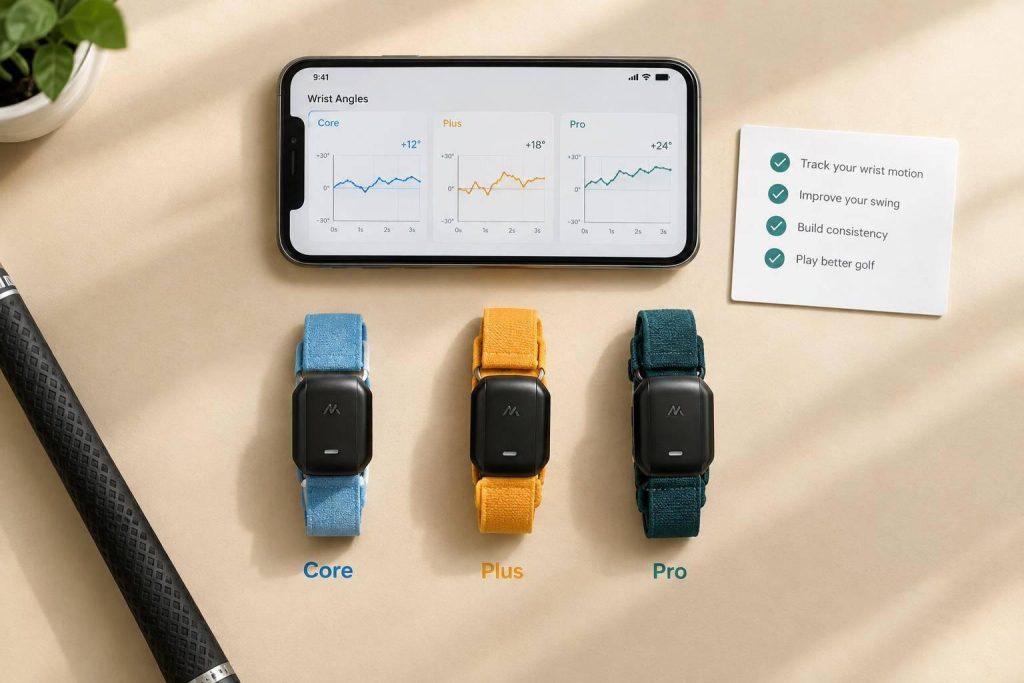
I’d choose the lowest-priced HackMotion package that covers the wrist issue you’re working on – not pay for tools you won’t use. Before buying, confirm the included drills, putting access, and total U.S. cost.
I compare Core, Plus, and Pro on wrist measurements, practice feedback, putting tools, and price. This is a source-based review, not a hands-on test. Comfort, connection reliability, sensor accuracy, and score gains remain unverified here.
Quick Comparison
| Package | Wrist measurements | Practice feedback | Putting access | Total U.S. cost |
|---|---|---|---|---|
| Core | Lead-wrist flexion and extension confirmed | Live feedback and golf tips and wrist drills | Not confirmed | Not verified |
| Plus | Flexion, extension, and putting rotation described | Audio cues, graphs, and target ranges | Rotation, timing, and ratio drills described | Not verified |
| Pro | Pro-only measurements not confirmed | Personalized drill suggestions described | Metronome and ratio tools described | Not verified |
My takeaway: wrist data makes more sense when golf lessons have identified a specific fault. HackMotion reports analyzing more than 1,000,000 swings, but that claim does not prove accuracy or lower scores.
<u>Get the package details and full price in writing.</u> Then judge your practice by contact, ball flight, and scoring – not just the app’s numbers.
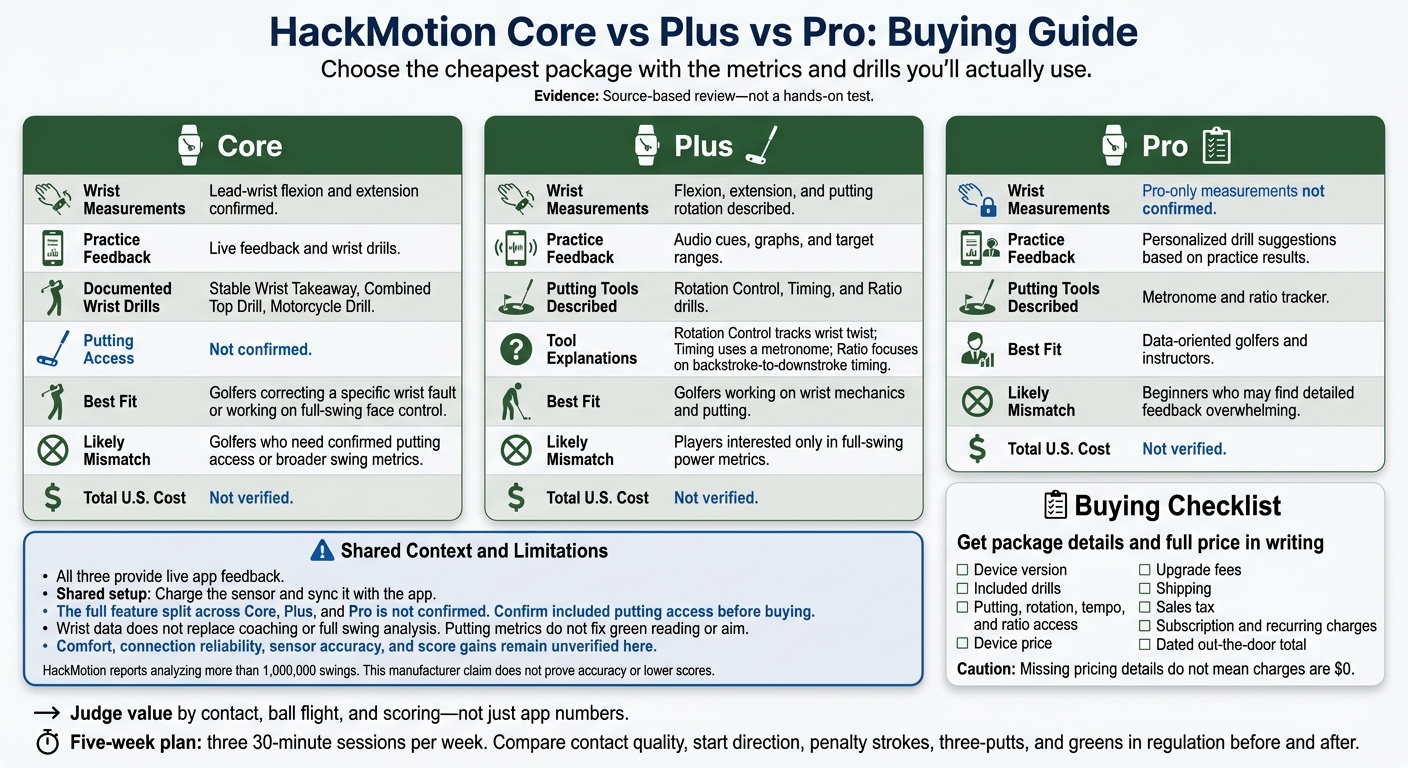
HackMotion Core vs Plus vs Pro: Buying Guide
1. HackMotion Core
Wrist Metrics
Core appears to cover basic wrist data, but the sources provide limited detail. They don’t clearly separate Core-only metrics from app-wide features. Only lead-wrist flexion and extension tracking is confirmed here.
Practice Feedback
Core provides live feedback through the app.
Documented wrist drills include Stable Wrist Takeaway, Combined Top Drill, and Motorcycle Drill.
This makes Core useful for improving your golf game, though the sources don’t describe its full feature set. The app’s putting tools are documented separately.
Putting Support
The app lists putting drills, but the sources don’t confirm whether Core includes them.
Total Cost
The supplied sources don’t disclose Core’s U.S. price, subscription cost, shipping, taxes, or upgrade fees.
sbb-itb-bcd8bdd
2. HackMotion Plus
Wrist Metrics
Plus adds putting rotation to the lead-wrist data Core tracks. Sources confirm lead-wrist flexion/extension and putting rotation, but they don’t specify degree limits or clearly explain how these metrics differ from Pro.
Practice Feedback
Audio cues, live graphs, and green-zone indicators show whether your wrist stays within range. Audio feedback lets you practice without watching the screen. The sensor also supports rehearsals without a ball.
Putting Support
Plus includes Rotation Control, Timing, and Ratio putting drills for putting control. Rotation Control tracks wrist twist, Timing uses a metronome, and Ratio focuses on backstroke-to-downstroke timing.
Total Cost
Sources don’t establish Plus’s total U.S. cost. Check the device price, any Core-to-Plus upgrade fee, subscription charges, shipping, and sales tax. Missing pricing details don’t mean those charges are $0. These cost differences matter most when comparing Plus with Core and Pro.
3. HackMotion Pro
Wrist Metrics
Pro’s main draw isn’t new sensor terminology – it’s the strongest coaching output. Sources confirm tools for putting rotation, tempo, and ratio, but don’t identify any Pro-only metrics.
Practice Feedback
Pro’s clearest documented extra is personalized golf drill suggestions based on practice results. That makes price the next factor to weigh.
Putting Support
Pro includes a metronome and ratio tracker for putting drills focused on distance control.
Total Cost
The sources don’t list a confirmed U.S. Pro price or shipping, tax, or software charges. Before buying, request a dated quote that includes the device price, upgrade fee, shipping, tax, subscription charge, and full out-the-door total.
Comparing Features, Performance, and Cost
Wrist Measurements and Their Limits
With the models outlined, the next step is checking what the system can – and cannot – show in practice. The key isn’t what HackMotion measures, but which measurements each package includes. The supplied material does not confirm the full feature split across Core, Plus, and Pro.
The sensor helps golfers track wrist movement and practice with feedback. But it cannot replace coaching that connects those readings to the rest of the swing. The data can help, but it isn’t enough on its own to judge value or fit.

Setup and Practice Feedback
The next check is how the app turns those measurements into practice. It provides real-time feedback and drill prompts. These help golfers measure their practice, but the sources do not show that one package is easier to use than another.
Putting Tools and Their Limits
For putting, included access matters more than whether a tool exists. The sources describe wrist rotation, tempo, and backstroke-to-downstroke ratio tools for the system overall. Buyers considering the putting features described under Plus and Pro should confirm which tools each package includes. These metrics do not fix green reading or aim, though studying instruction books on putting can help with those fundamentals.
U.S. Prices, Upgrades, and Other Charges
Feature differences are hard to weigh without a confirmed out-the-door price. The supplied sources do not support a verified cost comparison. Before buying, confirm the full price, including shipping, tax, and any recurring charges.
Unbiased HackMotion Sensor Review
Pros, Cons, and User Experiences
Pricing is still unclear, so this comparison focuses on measurement detail, drills, setup, and who each package suits. All three provide live app feedback.
The deciding factor isn’t which model has the most features. It’s which one matches the wrist issue you’re working on.
Shared setup: Charge the sensor and sync it with the app.
| Package | Measurement detail and advantages | Drills and putting access described | Setup and limitations | Best fit / likely mismatch |
|---|---|---|---|---|
| HackMotion Core | Measures lead-wrist flexion/extension at key swing points. | Wrist-position drills; putting access isn’t confirmed in the supplied material. | Wrist data doesn’t replace full swing analysis. | Fit: Golfers correcting a specific wrist fault or working on full-swing face control. Mismatch: Golfers who need confirmed putting access or broader swing metrics. |
| HackMotion Plus | Measures flexion/extension and putting-specific metrics. | Core drills plus putting rotation, timing, and ratio drills. | Putting practice requires a putting mat or flat practice surface. | Fit: Golfers working on wrist mechanics and putting. Mismatch: Players interested only in full-swing power metrics. |
| HackMotion Pro | Offers the lineup’s most detailed coaching output; Pro-only metrics aren’t confirmed. | Personalized drill suggestions. | Requires more detailed review sessions. | Fit: Data-oriented golfers and instructors. Mismatch: Beginners who may find detailed feedback overwhelming. |
Feature lists tell only part of the story. How these packages work in everyday practice still needs testing.
Independent Reviews vs. Manufacturer Testimonials
The supplied material includes a golf writer citation and manufacturer statements, but no independent hands-on test. Comfort, calibration, connection reliability, and everyday usability remain unverified here.
The manufacturer’s swing-analysis claim doesn’t independently prove sensor accuracy or better scores. The material provides no accuracy-test results or evidence of long-term improvement. Treat improvement claims as individual experiences, not expected outcomes.
That missing evidence matters when deciding whether the sensor can help with a specific swing fault – or simply give you more data.
Who HackMotion Fits – and Who It May Not
A diagnosed wrist issue gives the numbers a purpose. Golfers working on excessive cupping or flipping, along with instructors tracking those movements, have a clearer reason to use HackMotion than someone looking for an unspecified swing fix.
Beginners learning grip, stance, and movement basics may find wrist numbers distracting. Golfers expecting hip, shoulder, or full-body analysis will also be disappointed.
A flatter wrist isn’t the right goal for every shot. Pitch shots and bunker shots may need more extension. Judge changes by contact and ball flight, not just whether the app shows a preferred range.
Final Verdict and Buying Checklist
Keep the feature differences and cost limits in mind before buying. Choose the cheapest package with the metrics and drills you’ll actually use. Get written confirmation of the device version; included access to putting, rotation, tempo, and ratio tools; and the current U.S. price, shipping, tax, upgrade fees, and recurring charges.
After buying, judge the trainer by ball flight and scoring trends, not just app data. Set one measurable goal: finish a five-week plan with three 30-minute sessions per week. Then compare contact quality, start direction, penalty strokes, three-putts, and greens in regulation before and after the plan. Check whether the changes improve contact and start direction.
Use How To Break 80 to structure your drills during the five-week plan.
FAQs
How do I find my ideal wrist target range?
Use the HackMotion app to track your wrist angles during practice. Numerical readouts, color-coded cues, a live graph, and audio feedback let you test different wrist positions and see what feels and works best for your swing.
Then set your target ranges and adjust the tolerances for specific positions, such as your backswing. The app will notify you when your swing meets those targets.
Can I use HackMotion without a coach?
Yes, you can use HackMotion for solo practice. Its real-time biofeedback lets you track progress and work on your swing without an instructor. Built-in drills, including Stable Wrist Takeaway and Combined Top Drill, give you clear checkpoints, along with visual or audio cues to guide each session.
Professional instruction can still help, but HackMotion gives you precise swing data to connect what you feel with what actually happens – and build a swing you can repeat more consistently.

How can I tell if my practice gains transfer to the course?
Use measurable data, not just feel. During practice, track your wrist angles, tempo, and symmetry with Hackmotion. This gives you a baseline to compare against your on-course performance.
Log your data over time and review trends in the app to see whether your mechanics hold steady under pressure. If your impact consistency or start direction slips on the course, check whether your wrist angles still fall within your established target ranges.
Related Blog Posts
- Wearable Swing Analyzers: Are They Worth It?
- Top 7 Portable Putting Stroke Trainers
- How Real-Time Feedback Wearables Improve Your Swing
- Latest Research on Impact Feedback Wearables
