Golfers are now using data to improve their game and equipment like never before. By analyzing swing metrics such as club speed, ball speed, spin rate, and launch angle, players can make informed decisions to enhance performance. Tools like TrackMan and GCQuad provide real-time insights, helping golfers identify inefficiencies, fine-tune their clubs, and improve consistency.
Key takeaways:
- Launch monitors measure metrics like ball speed, smash factor, and carry distance to diagnose swing issues.
- AI-powered club fitting systems, like Club Champion‘s Co-Pilot, use swing data to recommend optimal club setups in less time.
- Visualization tools (e.g., heatmaps, trajectory charts) simplify swing data, showing patterns like shot dispersion and spin rate.
- Strokes gained analysis highlights where specific clubs impact your score, helping identify gaps or redundancies.
The 5 Launch Monitor Metrics That Will Change Your Golf Game
sbb-itb-bcd8bdd
Key Metrics for Club Performance Analysis
Golf Club Performance Metrics: Ideal Launch Angles, Spin Rates, and Smash Factors by Club Type
Metrics take the guesswork out of golf. They help explain why your 7-iron might cover 135 yards one day and 150 the next. With these numbers, you can determine if your clubs fit you well, if you’re striking the ball cleanly, and where you can improve your golf game the most.
Launch Monitor Measurements
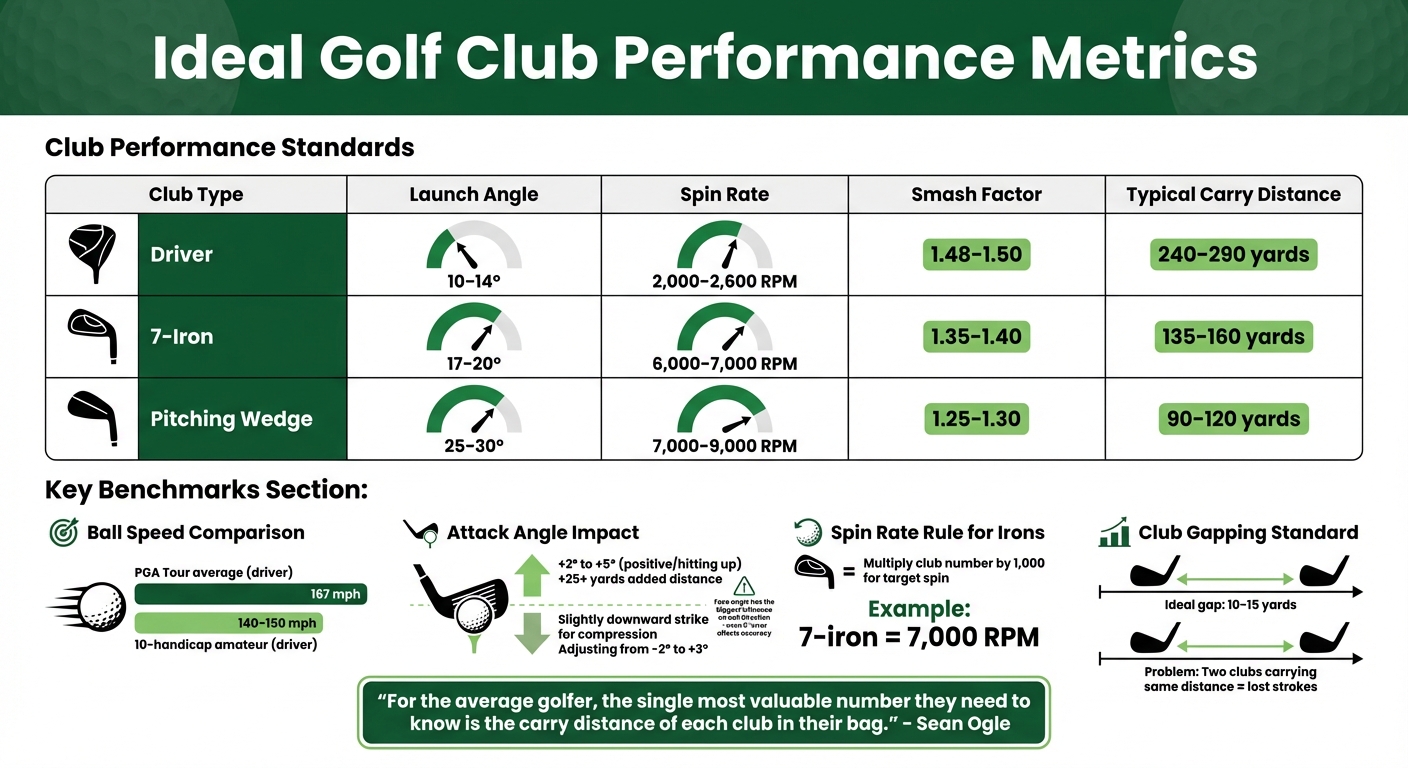
Ball speed, which measures how fast the ball moves right after impact, is a major factor in determining shot distance. For reference, PGA Tour players average about 167 mph with their drivers, while a 10-handicap amateur typically falls between 140–150 mph.
Smash factor gauges how efficiently energy transfers from the club to the ball. It’s calculated by dividing ball speed by clubhead speed. For drivers, the ideal smash factor is between 1.48 and 1.50. For a 7-iron, this range drops to 1.35–1.40.
"For the average golfer, the single most valuable number they need to know is the carry distance of each club in their bag." – Sean Ogle, Founder, Breaking Eighty
Launch angle and spin rate work together to shape ball flight. For drivers, a launch angle between 10° and 14° combined with a spin rate of 2,000–2,600 RPM is ideal. For irons, the general rule is to multiply the club number by 1,000 to estimate the spin rate. For example, a 7-iron should spin around 7,000 RPM.
Carry distance is especially important because it measures how far the ball travels through the air, independent of ground roll. Ensuring consistent gaps of 10–15 yards between clubs is critical. If your 7-iron and 8-iron both carry 145 yards, you’re likely losing strokes due to poor gapping.
Attack angle refers to whether you’re hitting up or down on the ball. With a driver, a positive attack angle of +2° to +5° can boost distance by increasing launch and reducing spin. For irons, a slightly downward strike is better for compressing the ball. For instance, PGA Tour players achieve an average dynamic loft of about 20.2° with a 6-iron, even though the club’s static loft is around 30–31°.
Face angle and club path dictate the ball’s initial direction and curvature. Face angle has the biggest influence on where the ball starts, and even a 2° error can throw off your accuracy. As Martin Du Toit from ATX Golf Performance explains:
"Face angle is king. You could have a perfect path, but if your face is 5° open, the ball is gone."
Here’s a quick breakdown of ideal numbers for common clubs:
| Club | Ideal Launch (°) | Ideal Spin (RPM) | Ideal Smash Factor | Typical Carry (yd) |
|---|---|---|---|---|
| Driver | 10–14 | 2,000–2,600 | 1.48–1.50 | 240–290 |
| 7‑Iron | 17–20 | 6,000–7,000 | 1.35–1.40 | 135–160 |
| Pitching Wedge | 25–30 | 7,000–9,000 | 1.25–1.30 | 90–120 |
Strokes Gained Analysis
Strokes gained metrics go beyond basic stats, showing how each club impacts your score. Instead of just knowing your 7-iron carries 150 yards, strokes gained analysis can reveal whether that distance is helping or hurting compared to a scratch golfer.
Identifying your "worst clubs" – those with the widest dispersion patterns – is essential. Tracking the standard deviation of carry distances and starting points can pinpoint clubs with the largest "80 percent cone", which signals where you’re losing strokes. For example, if your 5-iron produces much more scattered shots than your 7-iron, it might need adjustments in fitting or extra practice.
This analysis also highlights club gapping problems. If two clubs hit nearly the same distance, you’re likely carrying redundant equipment. On the flip side, gaps that are too large – like 25 yards – can leave you with tricky shots. Addressing these issues can lead to more consistent play and fewer wasted strokes.
These metrics lay the groundwork for the advanced analytics covered next.
Advanced Analytics Methods for Club Optimization
Modern technology has transformed club optimization from guesswork into a precise science. By leveraging advanced analytics, golfers can now fine-tune their equipment based on detailed swing data, creating setups tailored specifically to their unique playing style.
AI and Machine Learning for Club Fitting
Artificial intelligence has reshaped the way clubs are fitted, analyzing millions of swing patterns to recommend the best club and shaft combinations. This approach minimizes human bias and ensures data-backed decisions for each golfer.
Take Club Champion’s "Co-Pilot" system as an example. Launched in July 2023 across more than 110 locations, this system processes nearly 1 million swings monthly. During a test session in Manhattan, Master Fitter Zach Weber used the AI to analyze just 10 swings from golfer Mike Stachura. The result? A recommended club setup that added 19 yards of distance and tightened dispersion by 75% – all in under an hour.
"AI is more of a behind-the-scenes data wizard… It knows what combinations have worked for players like you, and it can spot patterns and outliers faster than any human can."
– Kris McCormack, VP of Tour and Education, True Spec Golf
This technology also saves time. AI-driven fittings can trim a typical 90-minute session down to 60 minutes or reduce a full-bag fitting from 3.5 hours to just 2.5 hours. Wilson‘s Fit AI system, introduced in January 2024, offers even faster results. Using a Blast Motion sensor, it collects 12,000 data points in just five swings and delivers iron recommendations in about 10 minutes.
These systems work by quickly narrowing down thousands of potential combinations to a select few based on your initial swings. However, the process doesn’t stop there. As Nick Sherburne, Co-founder of Club Champion, puts it:
"It’s not about eliminating human intelligence in the fitting process, it’s about enhancing it… that’s why it’s called Co-Pilot."
While AI provides data-driven recommendations, your personal preferences – like how the club feels, sounds, or looks – remain crucial. After identifying the top three configurations, trust your instincts to make the final choice.

| AI Fitting System | Key Technology | Data Points per Swing | Primary Benefit |
|---|---|---|---|
| Club Champion Co-Pilot | Trackman + Machine Learning | Millions (Database) | Reduces fitting time by 30% |
| Wilson Fit AI | Blast Motion Sensor | 12,000 | 10-minute iron fitting |
| SwingFitAI | Motion Capture + Launch Monitor | 30,000+ | Focus on center-face ball striking |
Next, let’s explore how analyzing energy transfer and club speed profiling can further refine your performance.
Energy Transfer and Club Speed Profiling
AI recommendations are just the start. To maximize your performance, understanding energy transfer and club speed profiling is essential. Smash factor – a key metric – measures how efficiently energy transfers from the club to the ball. Even a small improvement in smash factor, such as increasing it by 0.10, can add 15–20 yards to your drives without requiring more swing speed.
Club speed profiling takes this analysis further by tracking how your clubhead accelerates throughout the swing. Advanced systems monitor the clubhead’s speed at its sweet spot before and after impact, identifying power losses caused by premature deceleration. For instance, an early release of the club can lead to speed loss just before impact, reducing overall distance.
Attack angle is another critical factor. Research shows that adjusting a driver’s attack angle from -2° (hitting down) to +3° (hitting up) can add over 25 yards of distance with improved driving techniques. This adjustment increases the launch angle while minimizing spin. Tools like FlightScope, which use fusion tracking technology (radar and camera data), provide detailed acceleration profiles. These profiles highlight where speed fluctuations occur, helping you identify and address power leaks in your swing.
The takeaway? Focus on hitting the ball squarely rather than just swinging harder. A centered strike can instantly add 5–10 mph of ball speed. Use a launch monitor to track your smash factor across multiple swings, and when making adjustments, only change one variable at a time – like grip pressure, ball position, or shaft flex. This approach ensures you can clearly see what works best for your swing.
Data Visualization for Club Performance
Turning raw metrics into meaningful insights is where data visualization shines. While launch monitors provide detailed numbers, those figures alone can be overwhelming. Visual tools simplify the data, revealing patterns and trends that can help you master your swing and optimize club performance.
Instead of poring over endless spreadsheets, visualization tools like heatmaps and trajectory charts present your swing data in a way that’s easy to understand. From shot dispersion to spin rates, these tools give you actionable insights for improving your game.
Heatmaps for Shot Dispersion
Heatmaps are an excellent way to visualize shot dispersion by plotting lateral deviation against carry distance. They highlight dominant miss directions and inconsistencies in performance. For example, interactive dispersion plots use color coding to show reliable clubs and areas that need work. To get meaningful results, you’ll need at least 20 swings per club.
If your heatmap shows a cluster of shots consistently veering to the right, you can adjust your strategy – like aiming down the left side of the fairway. Filtering out outliers using methods like medians or "trimmed means" (removing the top and bottom 10% of shots) ensures a more stable baseline.
While heatmaps focus on where your shots land, trajectory charts reveal the mechanics behind those results.
Trajectory and Spin Rate Charts
Trajectory charts examine how launch angle and spin rate influence ball flight. These charts are particularly useful for optimizing your driver setup. For instance, an ideal driver shot usually combines a high launch angle (12–16°) with low spin (2,000–2,800 RPM). If your shots fall outside these ranges, the charts make it easy to spot the issue.
High launch with too much spin (ballooning) robs you of distance, while low launch with low spin (knuckleballs) shortens carry. Trajectory visualizations help you see where your shots fall on the efficiency spectrum.
"Finding the right combination [of launch and spin] is the secret to unlocking your maximum distance for your swing speed."
– Spencer Lanoue, Caddie HQ
Advanced systems like Trackman Performance Studio take this a step further with graphic overlays that display full ball trajectories, including peak height and descent angle. For approach shots, achieving a steeper descent angle (45–50° for irons) ensures the ball stops quickly on the green. These charts help you determine whether your shots have the necessary height and spin to hold greens effectively.
Trend line visualizations allow you to monitor changes in launch and spin over time, showing whether your practice adjustments are paying off. Platforms like clubdata.io even convert simulator data into confidence intervals and rollout predictions, giving you a comprehensive view of your performance.
| Visualization Tool | Primary Metric Tracked | Actionable Insight |
|---|---|---|
| Dispersion Plot | Lateral vs. Carry Distance | Highlights accuracy and "miss" patterns |
| Gapping Chart | Carry Distance per Club | Identifies yardage gaps or redundant clubs |
| Optimizer Grid | Spin vs. Launch vs. Carry | Helps fine-tune driver setup (loft/tee height) |
| Trajectory Ladder | Peak Height & Descent Angle | Enhances ability to hold greens with irons |
| Trend Line | Metrics over Time | Tracks progress and validates adjustments |
How to Implement Club Optimization
Now that you’re familiar with the metrics and visualization tools, it’s time to take action. The goal here is to transform raw data into measurable improvements on the course through better strategy. By making data-driven adjustments, you can fine-tune your equipment for better performance.
Collecting and Analyzing Data
Start by establishing a baseline. Hit 10–12 consistent shots with each club to get a clear picture of your performance trends – not just your best swings. Be sure to use your actual course ball, as range balls can skew spin and launch data.
Proper hardware setup is crucial. Position radar units 6–8 feet behind the ball and camera systems 2–7 feet to the side, using alignment sticks to ensure accuracy. Adjust for factors like temperature, altitude, and wind to keep your data consistent across sessions. When evaluating your results, focus on medians or trimmed means by excluding the top and bottom 10% of shots. This helps filter out outliers and mishits.
"Feel is a liar. Numbers don’t lie."
– Fit My Golf Clubs
When comparing configurations, look for meaningful differences. For example, a carry distance change of more than 5 yards or a noticeable reduction in dispersion is worth keeping. Smaller changes may just reflect normal shot-to-shot variability rather than actual improvement.
Once you’ve gathered consistent data, you can move on to systematic testing and fine-tuning.
Testing and Adjusting Clubs
With your baseline metrics in place, it’s time to test and tweak. Use your initial data as a guide, and make adjustments one step at a time to address specific inconsistencies.

Follow the Optimization Loop: Baseline (record median results), Experiment (adjust one variable), and Optimize (keep changes that improve averages and dispersion). Changing only one factor at a time – like tee height, ball position, grip, or loft – is essential. Making multiple changes simultaneously can muddy the results and make it hard to pinpoint what’s working.
Use foot spray or face tape to track where the ball strikes the clubface. For example, high strikes on a driver reduce spin and increase launch, while low strikes do the opposite. If your spin is too high, try raising your impact point by increasing tee height or moving the ball forward in your stance. For launch angles that are too low, consider adding loft or checking for excessive forward shaft lean at impact.
For wedges, create a precise yardage matrix by recording carry distances for full, three-quarter, and half swings. This approach eliminates guesswork within 120 yards and ensures consistent 10–15 yard gaps between clubs.
If you don’t have access to your own simulator, consider renting time at an indoor golf facility, which typically costs $30–$50 per hour. Alternatively, professional fitting studios offer in-depth sessions for $300–$500. While there’s an upfront cost, the payoff is clear: you’ll eliminate clubs that don’t match your swing and optimize the ones that do.
Case Studies: Club Optimization in Practice
Real-world examples highlight how data-driven club adjustments can lead to measurable improvements for golfers at all skill levels. These stories bring earlier analytics discussions to life, showing how data transforms club performance on the course.
Example Scenario
In spring 2021, Scottie Scheffler faced challenges with his iron play, ranking outside the top 75 in Strokes Gained: Approach. After analyzing his equipment, he discovered his irons were longer than ideal and had a heavy D6 swing weight. By shortening his clubs by 0.75 inches and reducing the swing weight to D4, Scheffler saw a dramatic improvement, climbing to No. 1 in Strokes Gained: Approach – a position he held consistently for three years.
Another standout case involves Cameron Tringale. During the 2018–2019 season, Tringale worked with the Titleist Performance Institute to address a swing inefficiency. Data revealed he was starting his downswing with his arms instead of his hips. Adjusting his technique based on this analysis led to an 8.6 mph increase in clubhead speed, jumping from 111.3 mph to 119.9 mph. This marked the largest year-over-year improvement on Tour since 2007. For the first time, his driving average surpassed 300 yards, and he ranked No. 1 on Tour for the increase in Strokes Gained: Off-the-Tee.
Even amateur golfers can benefit from data-driven insights. In October 2025, Keith Muir used the Tangent app to evaluate 250 rounds of play. By examining his Strokes Gained: Putting data and make percentages by distance, he identified that the SeeMore Mini Giant FGP putter provided the best start-line consistency. Pairing this discovery with AimPoint Express training, Muir improved his putting performance by nearly a full stroke per round.
On the technical side, a PGA Academy Australia student used Trackman data to address a steep angle of attack with a 6-iron, measured at –8°. By adjusting to a shallower attack angle of –1.7° and refining face-to-path alignment, the student achieved a 7 mph increase in ball speed and added 19 yards of carry distance, even with a slight reduction in swing speed.
Using How To Break 80 Resources
Once you’ve identified performance gaps through analytics, the next step is turning that data into consistent improvements. Advanced tools can highlight metrics like spin rate, launch angle, and smash factor, giving you a clear picture of your club performance. But they often fall short of showing you how to fix the issues. That’s where structured instructional resources come in – they bridge the gap between diagnosing problems and making real, measurable progress.
How To Break 80 offers a range of resources – eBooks, video courses, and drills – that help transform launch monitor data into actionable swing improvements. For instance, if your analytics reveal a smash factor below 1.3 for mid-irons (a sign of poor energy transfer), the Center Contact Gate Drill can help you achieve consistent center-face strikes while providing instant feedback. Similarly, if your data shows inconsistent clubface angles at impact – responsible for about 85% of your ball’s starting direction – their video courses on wrist mechanics offer the technical know-how to better control your clubface.
These drills don’t just address swing mechanics – they also tackle common issues like gapping. Take the Wedge Matrix Method, for example: this drill involves hitting partial swings at 50%, 75%, and 90% power with every wedge, while tracking carry distances and spin rates. By doing this, you’ll identify whether your wedge lofts create even distance gaps or if adjustments are needed. Similarly, the Club Gapping Audit involves hitting 5–10 shots with each club to spot overlaps, like a 6-iron and 7-iron carrying the same distance. This could indicate a need for equipment changes.
"Technology like this is only helpful if you know how to apply it to your game." – Sean Ogle, Founder, Breaking Eighty
For those ready to take action, the How To Break 80 eBook ($29.00) and the Maximum Distance Video Course ($49.00) offer structured 5-week plans designed to apply these data-driven insights to your game. Instead of focusing on chasing birdies – which only increase slightly from 0.72 to 1.26 per round when moving from a 10 to a 5 handicap – these programs prioritize eliminating double bogeys, the real scoring killer.
Conclusion
Advanced analytics transform club optimization into a precise and methodical process. They provide clear, objective insights into your swing dynamics, uncovering inefficiencies that might otherwise go unnoticed. For example, a negative attack angle could cut your carry distance by as much as 18 yards.
Rather than chasing the elusive "perfect" swing, channel these insights into building consistency. Think of the data as a diagnostic tool, not just a performance score. Focus on the average results from 8 to 10 shots instead of fixating on a single standout swing. Follow a structured optimization loop: start with a baseline, adjust one variable at a time – like tee height, ball position, or loft setting – and keep only the changes that tighten your shot dispersion and enhance your median performance. This approach emphasizes consistency over raw distance, as predictable carry distances and tighter shot patterns often yield better scoring outcomes than the occasional long drive.
"The golfers who are breaking through plateaus aren’t replacing their instincts with algorithms. They’re using data to validate their instincts and identify blind spots they never knew existed." – Brendon Elliott, PGA Professional, Method Golf Co.
Your ideal launch and spin settings depend on factors like swing speed and attack angle. For instance, while a Tour player averages 167 mph ball speed with a driver, a 10-handicap golfer typically falls between 140–150 mph. Even small gains in club efficiency can lead to noticeable improvements, all without needing to swing harder. This incremental, data-driven approach is the foundation of effective club optimization.
Start with the basics: hit 10 shots with each club to create a personal yardage chart and identify any gapping issues – situations where two clubs carry the same distance. Then, zero in on one key metric per practice session, whether it’s strike location, launch angle, or spin. By sticking to these principles, you can steadily refine your game and achieve sharper, more consistent results. Data becomes your ally in honing your skills.
FAQs
Which 3 launch monitor numbers should I focus on first?
The three main launch monitor numbers to pay attention to are clubhead speed, ball spin, and attack angle. These figures offer valuable insights into how your swing works and how the ball travels, making it easier to spot areas that need work and fine-tune your game.
How many shots per club are needed for reliable data?
Collecting data on at least 30 shots per club is typically recommended for a reliable analysis. In certain situations, analyzing 20 to 30 shots might be enough to spot patterns and make informed decisions. This range provides a solid foundation for evaluating performance and fine-tuning your game.
When should I get an AI-powered club fitting?
When you’re looking for a quicker, more precise, and tailored way to get fitted for golf clubs, an AI-powered club fitting might be the way to go. These systems analyze your swing data, skill level, and personal goals to recommend the right equipment in no time. It’s a great option if you want to save time, avoid the exhaustion of trial-and-error testing, and fine-tune your clubs using in-depth analytics for a setup that matches your unique playing style.
Related Blog Posts
- Top AI Tools for Custom Golf Club Fitting
- AI Golf Clubs: 3 Ways They Improve Your Game
- AI Golf Club Fitting with Launch Monitors
- How Launch Monitor Data Improves Golf Swing Analysis
