
Group golf lessons are a great way to learn the basics of golf in a fun, social setting. They focus on core skills like grip, setup, swing mechanics, and short-game techniques, all under the guidance of a certified instructor. These sessions are affordable, typically ranging from $29 to $99, and are perfect for beginners or casual players. You’ll not only get personal feedback but also learn by observing others in the group.
Key Takeaways:
- Who it’s for: Beginners, casual players, or those returning to golf.
- What you’ll learn: Grip, stance, swing basics, putting, and chipping.
- Cost: More budget-friendly than private lessons, starting as low as $29/hour.
- Group size: Typically 4–8 players per session.
- Benefits: Social environment, shared learning, and practical drills.
Whether you’re looking to improve your game or just starting, group lessons offer a relaxed way to build skills while enjoying the game. Arrive early, stay engaged, and practice consistently to see progress.
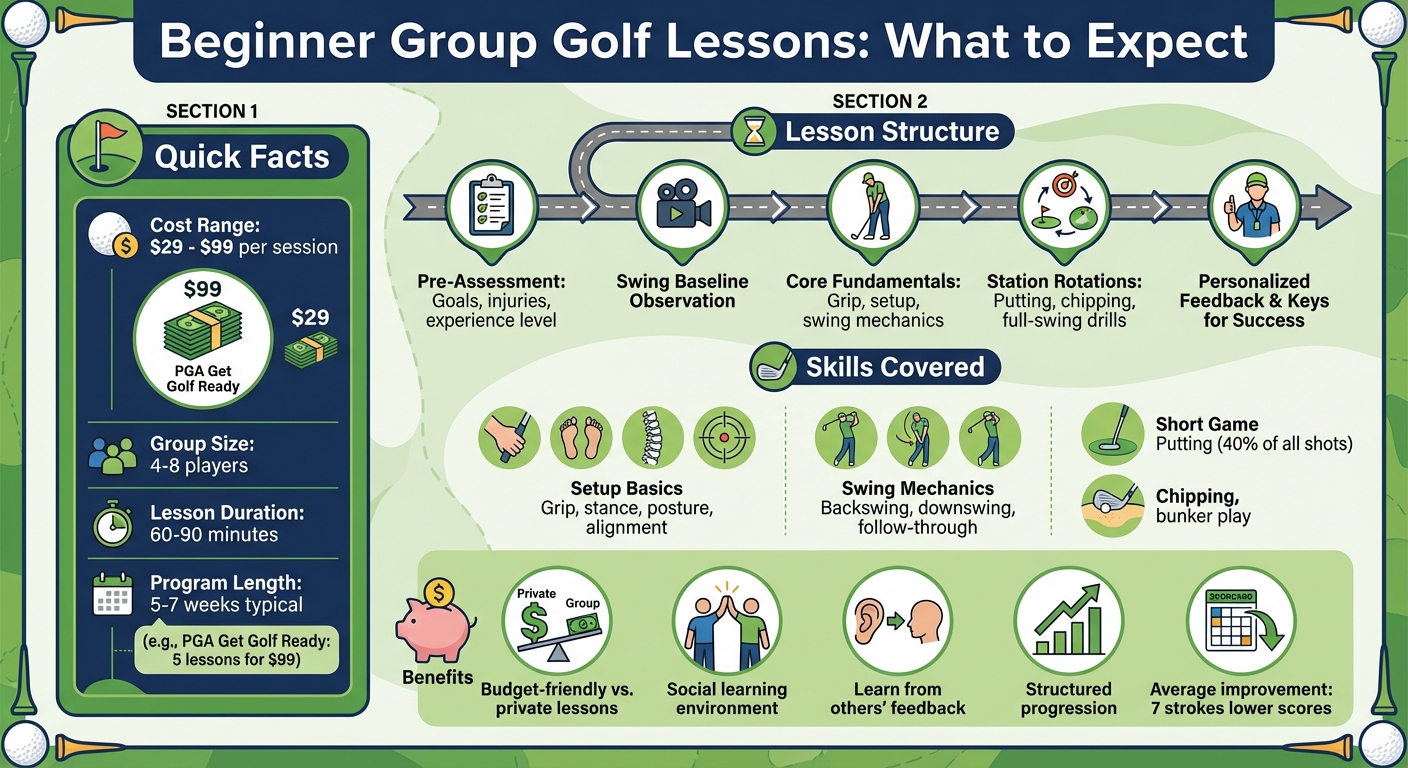
Beginner Group Golf Lessons Overview: Cost, Structure, and Key Skills
What Happens During a Group Lesson
How Lessons Are Structured
Beginner group lessons usually last between 60 and 90 minutes, following a structured routine designed to help players ease into the game. The session often begins with the instructor gathering some basic information – your goals, any past injuries or surgeries, and your experience level. Once that’s covered, the instructor observes your swing to establish a baseline for technical feedback. From there, the lesson typically moves through the essentials: grip, setup, and swing mechanics, finishing with guided drills. Some programs add variety by incorporating station rotations, focusing on putting, chipping, and full-swing drills. After these drills, the attention shifts to more personalized guidance tailored to each participant.
How Instructors Work with Groups
Instructors skillfully balance their attention across the group, offering individual feedback that benefits everyone. As Keely Levins from Golf Digest points out:
You’ll meet new people, with different issues in their golf games. You can pick up unexpected tips as you listen to an instructor pinpoint an opportunity for improvement in another player.
This method turns one-on-one corrections into shared learning experiences. Instructors also adapt their teaching style to suit each student, whether you’re a verbal, visual, or hands-on learner. Hank Johnson, a PGA National Teacher of the Year, highlights the importance of adjusting the pace of instruction to match how much information each person can process. Throughout the session, instructors keep an eye on energy levels, encouraging everyone to pace themselves. At the end of each drill or station, you’ll often leave with personalized "keys for success" to help guide your practice.
Lesson Length and Group Size
Group lessons typically include 4 to 8 players, with many programs running over several weeks. For example, First Tee – Tampa Bay offers a seven-week program, while the PGA’s "Get Golf Ready" program provides five lessons for around $99. These formats ensure sessions stay engaging and efficient. To make the most of your lesson, plan to arrive at least 10 minutes early to warm up and ensure the session starts smoothly.
Golf Lesson Guide: FAQs with Marcus Yado, PGA

Skills and Techniques Covered
These lessons are designed to build upon a structured routine, diving deeper into the essential skills and techniques every golfer needs.
Setup Basics
The first lesson focuses on the address position, which serves as the foundation for every shot. After a quick evaluation of your swing, the instructor will guide you through technical fundamentals. This starts with learning the proper grip – firm yet relaxed – and progresses to establishing a solid stance. Expect to stand with your feet shoulder-width apart, maintain good posture by bending slightly at the hips while keeping your back straight, and align your body with the target.
Basic Swing Mechanics
The swing is broken down into three phases – backswing, downswing, and follow-through. The emphasis here is on rhythm and balance rather than sheer power. As Elite Golf Schools of Colorado explains:
"The swing – it’s not about power, but rhythm and balance. Remember, practice the swing step by step".
You’ll also learn the "turn-hinge-swing" method, where your body rotates around your core while your hands hinge the club vertically. The focus is on achieving clean contact with a smooth tempo, shifting your weight from the back foot to the front, and finishing with your body facing the target. Repetition is key, as it helps build muscle memory. Once your full swing becomes more consistent, the lessons move on to refining your short game.
Short-Game Basics
The short game – putting, chipping, and bunker play – is another major focus of group lessons. For putting, you’ll work on creating a steady stroke and learning how to judge distances across the green. Chipping instruction follows a simple rule of thumb: putt when you can, chip when you can’t putt, and pitch only when absolutely necessary . A go-to shot you’ll practice is the "chip and run", a low-trajectory strike that rolls like a putt.
During these lessons, you’ll work on a setup with a narrow stance (about 4 inches wide), placing 60% to 70% of your weight on your front foot, and positioning the ball either in the middle or slightly back in your stance. Instructors will emphasize keeping your wrists out of the motion, relying instead on a pendulum-like stroke powered by your shoulders. To start, you’ll use a 7-, 8-, or 9-iron for chipping, as these clubs provide more forgiveness compared to high-lofted wedges.
Drills and Practice Activities
Group lessons often rely on drills to transform theory into muscle memory, helping players gain confidence through focused repetition. These exercises are designed to reinforce key elements like proper setup, swing mechanics, and short-game techniques, all while keeping practice purposeful.
Full-Swing Drills
To refine your swing mechanics, try alignment stick drills. These help ensure your feet and ball are properly aligned, reducing setup mistakes. Daniel Guest, a Titleist Certified Golf Instructor at IMAGEN Golf, emphasizes the importance of structured practice:
Simply going to the driving range without a plan and banging out a bucket of balls will do you more harm than good.
Another helpful exercise is the headcover drill. Place a headcover under your trailing arm during the swing to maintain proper arm connection and control. For a smoother swing, rhythm and tempo drills can help you develop a consistent backswing and a controlled downswing.
Short-Game Drills
For putting, ladder drills work wonders. Start close to the hole and only increase the distance after making consecutive successful putts. Grant Shafranski, Director of Instruction, explains:
It’s basically a ladder drill. You start up close, putt it into that box, then move back a step and putt again. You want to see how many you can make in a row without missing.
Another option is the box drill, where you aim for a marked square around the hole to sharpen your distance control.
When practicing chipping, begin with low shots using an 8-iron, then progress to higher shots with a sand wedge. To get immediate feedback on your impact, spray foot powder on the clubface – it shows exactly where the ball makes contact.
Station Rotations
Group lessons often include station rotations, moving between putting greens, chipping areas, and the driving range. This approach keeps participants engaged with a variety of drills and allows instructors to offer more personalized feedback at each station. It also helps avoid fatigue from over-practicing a single skill. Debbie Doniger, a highly regarded instructor, suggests:

At the end of each station, take notes that resonate with you in order to remember the keys for your own success.
These stations focus on specific skills, ensuring well-rounded practice that prepares you for further improvement.
sbb-itb-bcd8bdd
How to Get the Most from Your Group Lesson
How to Prepare for Your Lesson
Show up a few minutes early, dressed in proper golf attire, including your shoes, glove, and any essential gear. This helps replicate the conditions you’ll face on the course, making the lesson more effective.
Take some time beforehand to think about your recent rounds. Are there specific shots that make you nervous? Any physical limitations you’ve noticed? As Mike Bender, PGA National Teacher of the Year, puts it:
The best way to prepare is to reflect on your experiences and your patterns out on the course and be able to describe them. That includes situations that make you nervous, particular shots that psych you out.
Also, bring along a notebook. Jotting down key takeaways during the session will help you retain important tips. Share your goals with the instructor at the start so they can focus on what matters most to you. With these steps, you’ll set yourself up to get the most out of your lesson.
How to Participate Effectively
Good preparation is just the start – how you engage during the lesson can make all the difference. Be upfront about any injuries or problem areas in your game so your instructor can give you tailored advice. Let them know how you learn best, whether it’s by listening, watching, or feeling things out.
While waiting for your turn, pay attention to the feedback others receive. You might discover useful tips that apply to your swing too. And if you start to feel tired, don’t hesitate to speak up – this allows you to pace yourself effectively. Debbie Doniger, LPGA Professional and Golf Digest Best Teacher, highlights how important it is to manage your energy during lessons.
Etiquette and Expectations
Safety is non-negotiable. Never swing if there’s even a slight chance of hitting someone, and if your ball is heading toward another person, yell "Fore" immediately. Keep in mind that actions like yelling or throwing clubs are not only unsafe but also disrespectful.
When it’s your turn, be ready to go. Stay quiet while others are practicing, avoid stepping on putting lines, and take care of the course by replacing divots and raking bunkers. These small acts of etiquette not only ensure a productive lesson but also show respect for your fellow players and the game itself. By following these guidelines, you’ll create a positive learning environment and set yourself up for steady improvement.
How to Keep Improving After Group Lessons
How to Practice on Your Own
Practicing on your own after group lessons can make all the difference in your game. Take the drills you worked on during your lesson and incorporate them into your solo practice sessions. These drills can often be done in simple spaces like your basement, garage, or backyard, making it easy to stay consistent.
Short, focused sessions – just 10 to 15 minutes, two or three times a week – can lead to noticeable progress. The key is to focus on specific areas rather than aimlessly hitting balls. For instance, if you’re struggling with short putts, try the Three-Footer Streak drill: aim to sink five consecutive three-foot putts, and once you’ve mastered that, push yourself to make ten in a row. This builds confidence and consistency under pressure. Or, if your driving accuracy needs work, try the Davis Love III Target Drill: start by hitting your driver toward a target 100 yards away, then gradually increase the distance in 25-yard increments. This helps refine both your swing tempo and path.
Since putting accounts for about 40% of all golf shots, improving your short game can have a bigger impact on your score than spending hours at the driving range. Practice on the green whenever possible, and if weather is an issue, an indoor putting mat can help you keep up daily practice. For lag putting, try the Safe-Zone Drill: aim long putts (40–60 feet) into a 34-inch circle around the hole. This can significantly reduce the risk of three-putting.
How to Track Your Progress
Once you’ve established a practice routine, tracking your progress is just as important as the drills themselves. Improvement comes from measuring your performance and adjusting as needed. Instead of focusing solely on your total strokes, track specific stats that reveal where you’re gaining or losing ground. For example, note whether you hit each fairway, the club you used, and your total number of putts per round. Aiming for 26–30 putts per round is a solid milestone if you’re working to break 80.
Another way to track progress is by determining your average club distances. Hit 10 shots with each club, record the distances, and calculate the average. This gives you a more realistic sense of your range, rather than relying on your longest-ever shot. For context, a 15-handicap golfer typically hits about 39% of fairways (around 5.5 per 18 holes), while scratch golfers average 8 or more.
Learning More with How To Break 80

If you’re looking to take your game even further, check out additional resources like How To Break 80. This guide builds on your group lessons and provides practical advice for independent improvement. The How To Break 80 & Shoot Like the Pros eBook ($29) simplifies the "4 Keys of Golf", covering essentials like posture, pre-shot routines, and shot-shaping techniques. One golfer, Karl K., shared that his handicap dropped from 10.5 to 8.1 in just a month after applying tips from this eBook.
For more specialized training, consider the Precision Putting System video course ($49), which focuses on turning beginners into consistent putters. If adding distance to your drives is your goal, the Maximum Distance Video Course ($49) can help you add 30–50 yards off the tee. Drew M., for example, shot his first round under 80 (a 77 with 12 pars, 1 birdie, 4 bogeys, and 1 double bogey) after focusing on hitting fairways and greens using strategies from these guides.
Conclusion
Group golf lessons are a fantastic way for beginners to dive into the sport without breaking the bank. Led by certified PGA or LPGA instructors, these lessons help you master the essentials – like grip, setup, and swing mechanics – while steering clear of common mistakes often passed along by well-meaning friends. The added bonus? Learning alongside others creates a supportive and energetic environment where you can absorb valuable tips by simply observing and listening to the instructor’s feedback.
From a financial perspective, group lessons are much easier on the wallet compared to private instruction, offering quality guidance at a fraction of the cost. Plus, structured programs have been shown to lower scores significantly, with some participants seeing an average improvement of 7 strokes.
As PGA National Teacher of the Year Hank Johnson wisely says:
Golf is not a game of knowing something, it’s a game of doing something. The only tool you have to use to change your physical habits is a large number of correct repetitions.
Once you’ve built a strong foundation through group lessons, you can take your game to the next level with advanced resources. For instance, the How To Break 80 & Shoot Like the Pros eBook, priced at $29, simplifies complex techniques into easy-to-understand strategies. It focuses on areas where most golfers lose strokes – within 40 yards of the hole – and has helped many players achieve significant handicap improvements.
Group lessons lay the groundwork, but consistent practice is what drives progress. Show up ready to learn, jot down key takeaways, and remember: improvement comes from action, not just knowledge.

FAQs
What do I need to bring to my first group golf lesson?
For your first group golf lesson, a little preparation goes a long way in making sure you can focus on learning and enjoying yourself. If you own golf clubs, bring them along. But don’t stress if you don’t have any – most lessons provide clubs for beginners. Dress comfortably in golf-appropriate attire, such as a collared shirt, shorts or pants, and clean sneakers. Steer clear of jeans, sandals, or high heels, as these are generally not permitted on the course.
Plan to arrive about 10 minutes early. This gives you time to check in, meet your instructor, and settle in before the lesson starts. Be ready to share details about your current skill level, what you hope to achieve, and any physical limitations you might have. This helps your instructor customize the lesson to suit your needs, making the experience both productive and enjoyable.
What’s the best way to keep improving after group golf lessons?
To complement what you’ve gained from group lessons, it’s important to establish a steady practice routine. Start by solidifying the fundamentals – focus on your swing tempo, grip, and stance. Simple exercises can make a big difference, like counting the rhythm of your backswing and downswing or switching between clubs to maintain a steady tempo. These drills are great for boosting both accuracy and power.
Set specific goals for each practice session and keep track of your progress. Record your scores and take videos of your swing to analyze what’s working and what needs attention. Being honest about your strengths and areas that need work will help you zero in on the skills that need the most practice.
Dedicate yourself to a regular schedule – around three hours of focused practice each week is a good starting point. Break this time into smaller, manageable sessions. Combining consistent practice with resources like guides or video tutorials can help you improve steadily without relying on constant instruction.
What are the benefits of learning golf in a group setting compared to private lessons?
Learning golf in a group setting offers more than just professional instruction – it brings a lively, social dynamic to the experience. Group lessons create a relaxed and enjoyable environment where you can meet other beginners, form connections, and feel less intimidated about stepping onto the course for the first time. The shared journey can make the learning process feel less daunting and more enjoyable.
One of the standout perks is the chance to learn from others. When the instructor provides feedback to different participants, you gain access to a variety of insights and tips that can enhance your understanding of crucial concepts like swing mechanics or course strategy. Watching your peers practice drills can also serve as a helpful visual guide, reinforcing proper techniques and keeping you motivated to improve.
Group lessons also come with a built-in support system. Everyone in the group is working toward a common goal, which fosters a positive and encouraging atmosphere. This mix of expert guidance, shared learning experiences, and camaraderie makes group lessons a fantastic option for beginners eager to build their skills while enjoying the process.
Related Blog Posts
- Golf Practice Checklist: 8 Drills for Weekend Warriors
- Corporate Golf Clinics for Driving Accuracy
- Group vs Private Golf Lessons: Cost Comparison
- Top 5 Driving Clinics for Distance Gains
