
When your putts miss the mark, the problem often lies in your setup. Two critical factors – stance and alignment – determine your success. Understanding how they differ and work together can help you improve your putting consistency and accuracy.
- Stance: Refers to your body’s position over the ball, including foot width, posture, ball placement, and weight distribution. A stable stance ensures smooth strokes and consistent contact.
- Alignment: Focuses on aiming your putter face and body (feet, hips, shoulders, eyes) parallel to the target line. Proper alignment ensures the ball starts on the correct path.
Quick Takeaways:
- Misaligned putter face accounts for 90% of missed putts.
- A ball position too far forward or back can disrupt your stroke and alignment.
- Recreational golfers can lower their scores by focusing on these basics.
To improve, use drills like alignment stick setups and ball-position checks. Combine a solid stance with accurate alignment, and you’ll see more putts drop.
Dial In Your Alignment To Make More Putts
What Is Stance in Putting?
Your putting stance is your setup before making a stroke. Think of it as the base for your putting motion – if it’s unstable, you’ll likely rely too much on your hands, which can hurt your consistency.
A solid putting stance should be balanced, relaxed, and repeatable. When you’re stable and not overly tense, the putter can move freely along its intended path. With this foundation, you can focus on reading the green and controlling speed rather than worrying about clean contact.
Main Parts of Your Putting Stance
Foot Width
A hip-width stance is a reliable choice to maintain balance and avoid swaying. A simple way to gauge this is to match the width of your 7-iron stance or align your feet with your hips.
Ball Position
The ball is usually positioned around the center of your stance or just slightly forward of center. This helps you strike the ball on a slight upstroke, promoting a smoother roll. If the ball is too far forward, your shoulders and hips may open, causing pulls or inconsistent strikes (especially for right-handed golfers). On the other hand, placing the ball too far back can close your shoulders and hips, leading to a steep stroke that might cause the ball to skid or bounce.
Posture
Bend from your hips, not your waist, to keep your back relatively straight while tilting your chest over the ball. Let your arms hang naturally from your shoulders, allowing the putter to swing freely without tension. Avoid hinging your wrists to simplify your stroke.
Weight Distribution
Distribute your weight evenly – about 50/50 between both feet – or slightly favor your lead foot. This balance helps keep the low point of your stroke consistent, just behind the ball, leading to cleaner contact.
Eye Position
Many instructors recommend placing your eyes directly over the ball or slightly inside the target line. This alignment allows you to accurately trace the line of your putt. Misaligned eyes can cause parallax error, where what you see from behind the ball differs from what you see over it. Using a mirror or alignment aid during practice can help you find the right positioning to match your aim with your vision.
By understanding these components, you can see how small adjustments in your stance directly impact the outcome of your stroke.
How Stance Changes Your Putting
A well-executed stance doesn’t just look good – it directly affects your stroke’s consistency and quality of contact.
Your stance determines the arc of your stroke and helps centralize contact on the putter face. When your balance and ball position are on point, the putter strikes the ball on a shallow, upward path, promoting a smooth roll.
On fast U.S. greens, even minor mishits can leave you several feet short or long. With a hole measuring just 4.25 inches wide and a ball diameter of 1.68 inches, there’s little room for error. A stable stance is key to consistently finding the sweet spot on your putter, making it easier to control both direction and distance.
Your stance also plays a huge role in maintaining stroke consistency. Putting coach Daniel R. Gray emphasizes this point:
about 90% of starting a putt on line is face alignment
This alignment heavily depends on your setup, including your posture and grip. Elite putters often keep their forearms and putter shaft on the same plane, position their chest more over the ball, and minimize wrist action. When your stance is stable and well-aligned, the putter naturally squares up without needing excessive hand adjustments.
What Is Alignment in Putting?
While having a stable stance is the backbone of a good putt, alignment is what sharpens your aim. It’s all about lining up your putter face and body squarely with your chosen target line – setting everything in sync with where you want the ball to go.
The putter face plays the starring role here. Studies reveal that roughly 90% of a putt’s starting direction depends on where the face is pointing at impact. Even a tiny one-degree misalignment can throw the ball off course. As putting coach Daniel R. Gray puts it:
90% of starting a putt on line is face alignment
Your body alignment is just as important. When your feet, knees, hips, and shoulders are aligned parallel to the target line, your stroke naturally follows that path without needing awkward mid-swing adjustments. Picture it like railroad tracks: the ball travels along the outer rail (your target line), while your body lines up on the inner rail, helping you deliver a smooth, consistent stroke.
But here’s the kicker – many golfers think they’re aligned perfectly when they’re actually a few degrees off. Alignment tools or video analysis often reveal these hidden errors. And on fast greens, like those in the U.S. that often measure 10–12 on the Stimpmeter, even small mistakes are amplified. For instance, a straight 10-foot putt can tolerate only a 1.0° face-angle error before missing. That’s a razor-thin margin for error!
Main Parts of Putting Alignment
Putter Face Aim
Start with the putter face. Aim it squarely to your intended start line, which isn’t always directly at the hole. Many golfers use a line on the ball or focus on an intermediate spot a few inches ahead to help square the face. This step is crucial – if the putter face isn’t aligned properly, the rest doesn’t matter.

Body Alignment (Feet, Knees, Hips, Shoulders)
Once your putter face is set, align your body around it. Your feet, knees, hips, and shoulders should be parallel to the target line, creating those “railroad tracks” mentioned earlier. For right-handed players, this means your body lines will aim slightly left of the target. Misaligned shoulders – whether open or closed – can throw off your stroke, causing the ball to veer off course unless you overcompensate.
Eye Line Positioning
Your eyes should be directly over the ball or just inside the target line when you look down. This positioning helps your brain judge the line correctly. If your eyes are too far inside, the target will appear more to the right, leading to pushes. If they’re too far outside, the target will look left, causing pulls. Many players use a mirror or drop a ball from the bridge of their nose during practice to ensure their eye position is spot-on.
When these elements are misaligned, your stroke won’t flow as it should.
What Happens When Alignment Is Off
Knowing the basics is one thing, but what happens when alignment goes wrong? Poor alignment forces you to make compensations during your stroke, and those adjustments are tough to repeat under pressure. For example, if your putter face is off at address, you might subconsciously tweak your hand position or stroke path to compensate. While this might occasionally work, it’s far from reliable.
Misaligned body lines can also wreak havoc. If your shoulders are open while your feet are square, your stroke will naturally follow the shoulder line, sending the ball off target. This often leaves you second-guessing whether you misread the break or simply aimed poorly. Over time, these alignment issues lead to inconsistent strokes, streaky putting, and difficulty controlling distance. On American greens, where speed and slope play a significant role, these problems can make putts behave unpredictably, adding strokes – and frustration – to your game.
Stance vs. Alignment: How They Differ
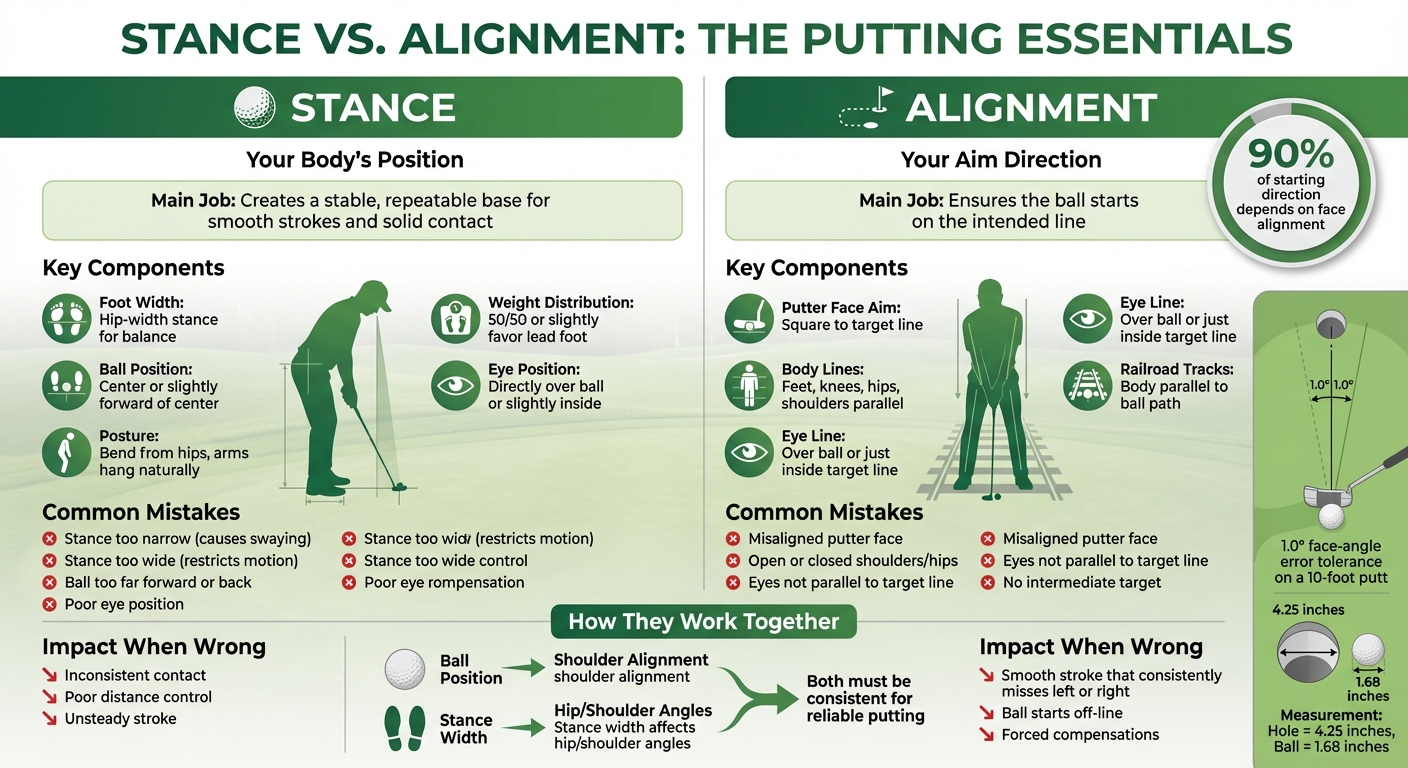
Stance vs Alignment in Putting: Key Differences and Components
Stance refers to how you position your body to create a stable base, while alignment focuses on aiming your putt accurately. To achieve consistent putting, both need to work seamlessly together.
Side-by-Side Comparison
| Aspect | Stance | Alignment |
|---|---|---|
| What it is | Your body’s position over the ball – foot width, posture, ball placement, and weight balance | The direction of your putter face and body lines (feet, knees, hips, shoulders, and eyes) relative to the target line |
| Main job | Creates a stable, repeatable base for smooth strokes and solid contact | Ensures the ball starts on the intended line |
| What you check | Foot width, ball position, knee flex, spine tilt, eye placement, and weight distribution | Putter face direction, body parallel to the target line, eye line over or inside the ball, and intermediate target reference |
| Common mistakes | Stance too narrow (causing swaying) or too wide (restricting motion); ball placed too far forward or back; poor eye position | Misaligned putter face; open or closed shoulders or hips; eyes not parallel to the target line |
| How mistakes appear | Inconsistent contact, poor distance control, or an unsteady stroke | A smooth stroke that consistently misses left or right |
This table shows how stance and alignment each affect your putting. Stance impacts the stability and quality of contact, while alignment determines if your ball follows the intended path.
How Stance and Alignment Work Together
Stance and alignment are closely connected, and even small adjustments to one can influence the other. Let’s look at how they interact.
For instance, moving the ball forward in your stance can open your shoulders and shift your aim left. Conversely, moving it back can close your shoulders and shift your aim right. Even subtle changes in ball position can influence your upper-body alignment.
Similarly, altering your stance width can affect your hip and shoulder angles, throwing off your alignment. Because of this, skilled putters prioritize a consistent stance – maintaining the same foot width and a ball position slightly forward of center. After setting up their stance, they double-check alignment to ensure their feet, knees, hips, and shoulders stay parallel to the target line. When stance and alignment are in sync, your putting stroke becomes more consistent and dependable, even under pressure.
sbb-itb-bcd8bdd
Drills to Improve Stance and Alignment
Now that you know how stance and alignment complement each other, it’s time to practice. These drills use simple tools – like alignment sticks, spare clubs, or tees – and can be done in just 10–15 minutes on the practice green.
Drills for Better Stance
Start with the feet-width stick drill. Lay an alignment stick on the ground at shoulder width to match your usual stance. Align your feet with this mark for every putt. This drill helps you internalize what a stable, consistent base feels like, removing any guesswork.
Next, try the ball-position checkpoint drill. Place a stick or club perpendicular to your toe line to mark the center of your stance. Position the ball slightly forward of this line – ideally near your lead eye for most putters. Hit 10–15 putts, tweaking only the ball’s position until your roll feels steady and smooth. Even small adjustments, like moving the ball an inch, can impact shoulder alignment, so finding your sweet spot is key.
For a quick setup review, use the mirror or smartphone drill. Stand in front of a mirror or record yourself from both face-on and down-the-line perspectives. Check that the ball is consistently forward of center – not too far forward or back, as that can throw off your shoulder and hip alignment. Visual feedback often reveals subtle setup issues you might not notice otherwise.
Once your stance feels solid, move on to alignment drills to fine-tune your target line.
Drills for Better Alignment
The stick-and-body-line drill is a classic for alignment practice. Lay one alignment stick on your target line and a second stick parallel to it under your toes. Align your putter face directly at the target-line stick, then square your feet, knees, hips, and shoulders parallel to the toe-line stick. Hit 20–30 short putts, resetting your alignment each time. This builds muscle memory for a square setup.
For added precision, try the gate drill. Place two tees or coin markers just slightly wider than your putter head, about 3–6 feet from the hole. Your putter must pass cleanly between them without touching. To test your accuracy further, add two more tees just ahead of the ball, spaced slightly wider than the ball itself. If the ball clips a tee, your face angle or stroke path is off. This drill sharpens your ability to start putts on line.
Finally, use the club-across-hips and shoulders check as a pre-putt routine. After setting up, lay a spare club across your hips, then across your shoulders, and note where it points relative to your target line. Adjust until both are parallel, ensuring you’re not aiming left or right. This simple check keeps your body alignment consistent on the course.
Building Your Pre-Putt Routine
A reliable pre-putt routine links your stance and alignment into a consistent, repeatable process. Whether you’re lining up a short 3-foot putt or a lengthy 30-footer, sticking to the same sequence removes uncertainty and helps you stay composed under pressure.
Steps for Your Pre-Putt Routine
Start by reading the green thoroughly. Look at the putt from behind the ball and, if needed, from the low side to better understand the slope. Decide on a specific starting point for your putt – not just "toward the hole", but an exact spot or even a dimple on the green. Skipping this crucial step can lead to poor alignment and missed putts.

Next, focus on aligning the putter face before setting your feet. The putter face should be square to your chosen starting line or an alignment mark on the ball. Studies reveal that the face angle determines about 83–90% of the putt’s initial direction, making this step a game-changer. Once the putter face is set, position your feet. Aim for a stance that’s shoulder-width apart, with the ball placed near the middle (or slightly forward) of your stance and your weight evenly distributed. Ensure your shoulders, hips, and feet are all parallel to the target line – think of your body as resembling railroad tracks running alongside your intended path.
Finally, take one or two practice strokes to get a feel for the tempo. Afterward, make a final check of your target before executing the putt. By following this routine, you combine stance and alignment into a seamless process. The entire sequence should take around 20–30 seconds and remain consistent, no matter the putt’s length or difficulty.
How to Practice Your Routine
Practicing this routine reinforces the alignment and stance skills you’ve worked on. On the practice green, go through your full routine for every putt, even the short ones. Resist the urge to hit putts back-to-back without resetting. Use tools like an alignment stick or a chalk line to confirm that your setup is square. Alternate between short putts (3–6 feet) and longer ones (20–40 feet), maintaining the same timing and steps for each. Over time, this repetition builds muscle memory, making the routine second nature.
To simulate on-course pressure, try consequence drills. For example, commit to completing your full routine and sinking three consecutive 4-foot putts before leaving the green. At home, you can lay painter’s tape on the floor to mimic a target line. Practice aligning your putter face and body to that line. You might also use a metronome or count aloud (e.g., "1–2–3") from your final look to the stroke to ensure a smooth, consistent rhythm. The goal is to make your routine so automatic that when you’re on the course, your focus shifts entirely to execution – not mechanics or score.
Conclusion
You’ve practiced your routine and fine-tuned both stance and alignment – now it’s time to put everything together.
Stance is your foundation. It’s all about how you position your feet, knees, and the ball. Alignment, on the other hand, is your guide – it determines where your putter face and body are aimed in relation to the target line. Both are critical, but they serve different purposes. Stance mistakes can throw off your posture and stroke, making it tough to control speed and achieve clean contact. Alignment errors, meanwhile, can push the ball off course, even if you’ve read the green perfectly. When your putter face and body aren’t aligned with the target, you may unconsciously adjust with your hands, which can lead to excessive face rotation and a lower chance of squaring the putter at impact.
By focusing on both stance and alignment, you’ll create a reliable setup that promotes consistent start lines and solid contact. Your pre-putt routine is the glue that holds these elements together, allowing you to step onto the course without overthinking the mechanics. Spend just 15 minutes on the putting green before your next round, using alignment aids to ensure your body and putter face are square. Incorporating these basics into your routine can lead to noticeable improvements in your putting game.
If you’re looking for more structured help, How To Break 80‘s Precision Putting course ($49.00) offers video lessons and drills designed to help you build a dependable setup.
What’s next? Pick one stance checkpoint and one alignment checkpoint from earlier in this guide, and try them out during your next practice session or round. The goal is to make your routine second nature. As it becomes automatic, you’ll notice a boost in confidence – and lower scores on the greens.
FAQs
How do I know if my putting alignment is correct?
To fine-tune your putting alignment, pay attention to three main factors: your eyes, shoulders, and clubface. Use a mirror or record yourself to check if your eyes are positioned directly over the ball, your shoulders are aligned parallel to the target line, and the clubface is square to your intended path. Additionally, maintaining a consistent and comfortable stance plays a big role in achieving accurate alignment.
What are the most common stance mistakes in putting?
Some typical errors in putting stance include:
- Standing too straight or slouching, which can throw off your balance and control.
- Improper foot placement, like having your feet too close together or too far apart, leading to instability.
- Feet and shoulders out of alignment with the target line, resulting in inaccurate putts.
To refine your stance, aim for a relaxed, balanced posture. Keep your feet about shoulder-width apart and ensure they’re aligned with your target line. Even minor tweaks can significantly enhance your putting consistency.
What’s the difference between stance and alignment in putting, and how do they impact accuracy?
Stance and alignment are two key factors that can make or break your putting accuracy. Stance gives you the balance and stability needed for a smooth, consistent stroke. Meanwhile, alignment ensures your putter face is aimed in the right direction, setting the ball on course toward your target.
When you combine a steady stance with proper alignment, you’ll minimize missed putts and bring more consistency to your game. Spending time to refine both can lead to noticeable improvements in your performance on the green.
Related Blog Posts
- 7 Common Putting Mistakes Beginners Make (And How to Fix Them)
- How Stance Affects Putting Alignment
- Body Alignment Tips for Better Putting
- Ultimate Guide to Putter Setup for All Stances
