
If your golf swing feels restricted or you’re dealing with aches, flexibility training might be your solution. Aging reduces muscle pliability and mobility, which can limit your swing and increase injury risk. Regular stretching improves range of motion, boosts swing power, and reduces back strain – key for senior golfers.
Key Takeaways:
- Why it matters: Limited flexibility affects shoulder turn, clubhead speed, and accuracy. Tight hips and a stiff spine can lead to injuries, especially in the lower back.
- Target areas: Focus on the thoracic spine, hips, hamstrings, and shoulders to improve rotation, posture, and follow-through.
- Warm-up tips: Use dynamic stretches (like leg swings or torso rotations) before playing to prepare muscles. Save static stretches (like hamstring stretches) for after your round.
- Daily routine: Just 10–15 minutes of focused flexibility exercises can make a difference in your game and reduce injury risks.
Flexibility training isn’t just about better performance – it’s about enjoying golf pain-free for years to come.
Golf Stretches for Senior Golfers | Physical Therapist Approved
Why Senior Golfers Need Flexibility Training
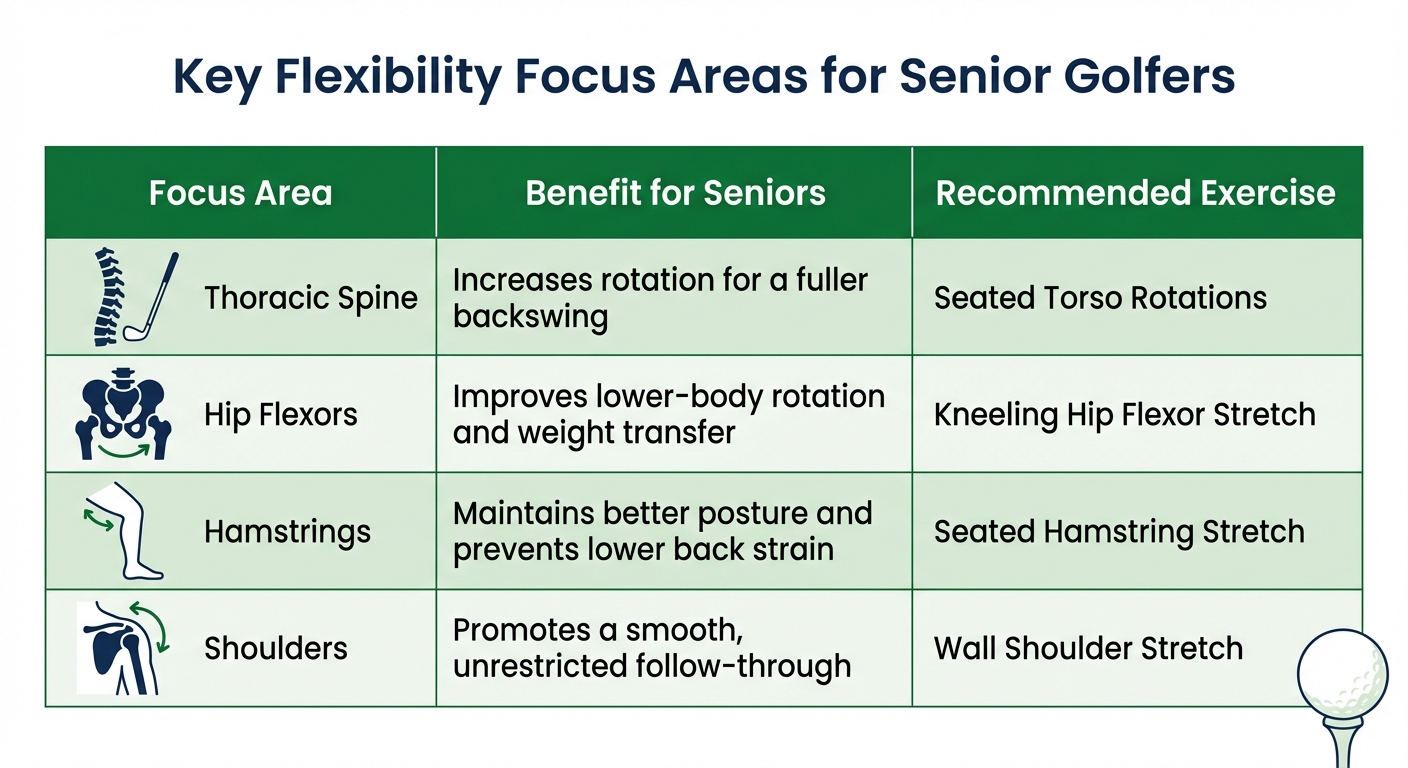
Key Flexibility Focus Areas for Senior Golfers: Benefits and Exercises
As we age, muscles naturally lose mass and become less pliable, which limits both range of motion and power. For senior golfers, this means that maintaining mobility requires intentional effort – something younger players may not need to worry about as much.
Golf’s physical demands don’t change with age, but your body’s ability to meet them does. Years spent at a desk or in sedentary positions often result in C-Posture, where rounded shoulders restrict thoracic rotation. Add in tight hip flexors and limited shoulder mobility, and you’ve got a recipe for a shortened swing and reduced accuracy.
Flexibility training can help counteract these challenges. By focusing on what experts call the "Big Four" – mobility, flexibility, strength, and stability – you can maintain a consistent swing and reduce the likelihood of injuries. Even dedicating just 10–15 minutes a day to targeted stretching can significantly improve your range of motion.
Let’s take a closer look at how flexibility directly impacts your golf swing.
How Flexibility Affects Your Swing
Flexibility plays a huge role in improving your golf swing. When your thoracic spine, shoulders, and hips move more freely, you can achieve a fuller backswing and a smoother follow-through. This not only boosts your clubhead speed but also helps you hit the ball farther off the tee.
On the flip side, limited flexibility forces your body to compensate with inefficient movements, like hip swaying or sliding. These compensations can drain both power and accuracy from your swing.
As Dave Phillips, coach to Jon Rahm, explains:
"The core, which I consider the glue that holds the swing together, transmits force from the lower body into the upper body and helps you rotate your torso."
- Dave Phillips
The benefits of flexibility training are echoed by golfers like Tim Pickford, a 59-year-old who has seen remarkable improvements:
"I’ve been golfing for nearly 50 years and Jon has given me a new lease of life in the game. Aches & pains are much reduced, I’ve regained distance off the tee, and I’m also able to play 36 holes per day when required."
Below is a quick guide to key areas seniors should focus on, along with the benefits and exercises that can help.
| Focus Area | Benefit for Seniors | Recommended Exercise |
|---|---|---|
| Thoracic Spine | Increases rotation for a fuller backswing | Seated Torso Rotations |
| Hip Flexors | Improves lower-body rotation and weight transfer | Kneeling Hip Flexor Stretch |
| Hamstrings | Maintains better posture and prevents lower back strain | Seated Hamstring Stretch |
| Shoulders | Promotes a smooth, unrestricted follow-through | Wall Shoulder Stretch |
Improving flexibility doesn’t just enhance performance – it also helps keep injuries at bay.
Preventing Common Golf Injuries
Flexibility training is key to avoiding common golf injuries. Tight hips and limited spinal mobility often lead to lower back pain during the swing. Regular stretching can ease this tension and protect your lumbar spine from the stress of repetitive movements.
Interestingly, amateur golfers tend to suffer injuries more often than professionals. Why? Many skip essential warm-ups and stretching routines.
Incorporating balance exercises into your flexibility training can cut your injury risk by 45%. Since balance naturally declines with age, stability drills not only help prevent falls on uneven terrain but also improve your swing foundation. This combination of flexibility and stability training can also address muscle imbalances, such as tight chest muscles paired with a weak mid-back. These imbalances often lead to rounded shoulders, which place extra strain on stabilizing muscles like the rotator cuff.
Warm-Up Routines Before Stretching
Getting your body ready before stretching is a crucial step for an effective flexibility routine. Skipping a warm-up is a common mistake that can leave you more prone to injuries. For example, a golf swing puts strain on your lower back, making a proper warm-up essential to avoid unnecessary tension.
Think of it like starting a car – you wouldn’t drive off without first turning on the engine. Similarly, a few minutes of light movement gets your blood flowing, lubricates your joints, and prepares your muscles for stretching. Spend 3 to 5 minutes on activities like brisk walking, arm swings, or marching in place to get your body ready.
Dynamic Stretching vs. Static Stretching
Knowing the difference between dynamic and static stretching can make a big difference in your warm-up routine. Dynamic stretching involves active movements that take your joints through their full range of motion, such as leg swings or torso rotations. Static stretching, on the other hand, is about holding a position – like reaching for your toes – for 20 to 45 seconds.
For warming up, dynamic stretching is the better choice. It raises muscle temperature, reduces stiffness, and preps your body for the rotational demands of a golf swing. Static stretching, while useful for improving long-term flexibility, can temporarily decrease muscle responsiveness if done before activity. Physical therapist Andrew Renaud, DPT, CSCS, explains:
"Performing large amounts of static stretching prior to an activity can actually reduce muscle warmth and lead to less efficient muscle contractions."
Here’s a quick comparison to clarify when to use each method:

| Feature | Dynamic Stretching | Static Stretching |
|---|---|---|
| Method | Active, functional movements | Holding a stretch for 20–45 seconds |
| Primary Goal | Increase muscle temperature and agility | Improve long-term flexibility |
| Timing | Before activity (warm-up) | After activity (cool-down) |
| Impact | Boosts swing speed and accuracy | May temporarily reduce power |
With this in mind, let’s explore some warm-up exercises to get you fully prepared.
Best Warm-Up Exercises
Focus on three key areas – the thoracic spine (upper back), hips, and shoulders – to enhance flexibility and performance. These exercises are especially helpful for senior golfers:
- Standing Arm Circles: Stretch your arms out and make 10 slow, controlled circles in each direction. This improves shoulder mobility and helps with your backswing range.
- Leg Swings: Use a golf cart or wall for balance. Swing one leg forward and backward for 10 to 15 repetitions, then switch to side-to-side swings. This loosens up your hip flexors and hamstrings.
- Torso Rotations: Hold a golf club across your shoulders and rotate your torso side-to-side 10 times on each side. Focus on moving through your hips rather than forcing your spine, which increases thoracic spine mobility.
- Hip Circles: Perform 8 rotations in each direction to prepare your pelvis for the rotational movements of your swing.
To wrap it up, activate your hips and legs with 2 sets of 8–12 glute bridges and finish with 1 set of 8 chair-assisted squats. These final moves help ensure your lower body is ready to support your swing.
Best Flexibility Exercises for Senior Golfers
If you’re looking to improve your golf game, focusing on flexibility exercises for your hips, spine, and shoulders is a great place to start. These areas are key to enhancing your swing, as they help with backswing depth, rotation speed, and follow-through power. The exercises below are designed to address common limitations and restore the range of motion you need for a better game.
Hip Flexor Stretch
Tight hip flexors can restrict your swing and put you at a higher risk of injury. Stretching this area helps open up the front of your hips, allowing for a smoother and more complete follow-through.
How to perform it:
Start by kneeling on your right knee with your left foot forward, forming a 90-degree angle at both knees. Gently tuck your pelvis and press your hips forward without arching your lower back. You should feel a stretch at the front of your right hip. Hold this position for 20 to 30 seconds, then switch sides. If needed, place a cushion under your knee and use a nearby surface for balance. This stretch not only improves your follow-through but also helps prevent strain in your lower back.
Spinal Twist
The thoracic spine plays a big role in the rotation needed for your swing. When mobility in this area is limited, your lower back often compensates, which can lead to pain and inconsistent ball striking. In fact, research shows that up to 54% of golf injuries are back-related. Keeping your spine flexible is essential for preventing these issues.
How to perform it:
Sit on the floor with your legs extended. Bend your right knee and place your right foot outside your left thigh. Twist your torso to the right, using your left arm against your right knee for gentle leverage. Focus on rotating from your mid-back and ribs while keeping your hips steady. Hold for 20 to 30 seconds, then repeat on the other side. If sitting on the floor is uncomfortable, you can perform this stretch while seated in a chair. This exercise boosts rotational power and reduces lower back strain during your swing.
Chest Opener
Rounded shoulders can get in the way of a powerful backswing. By loosening tight chest muscles, this stretch helps improve your posture and allows for a fuller shoulder turn. As Keith Sobkowiak, a Doctor of Physical Therapy, points out:
"The new club technology is designed to eliminate your slice or hook, but if you had the flexibility and strength to perform the proper golf movement, you could solve it without spending a fortune".
How to perform it:
Stand with your feet shoulder-width apart. Clasp your hands behind your back and lift them while squeezing your shoulder blades together. Keep your chest lifted, and avoid overarching your lower back or pushing your chin forward. Hold this stretch for 20 to 30 seconds. If clasping your hands is difficult, use a towel to bridge the gap. This stretch not only improves your setup posture but also allows for greater backswing depth.
sbb-itb-bcd8bdd
Adding Flexibility Training to Your Golf Schedule
Improving flexibility doesn’t require hours of effort. A simple 10–15 minute daily mobility routine, practiced 5–7 days a week, can make a noticeable difference . These exercises are specifically tailored for senior golfers, targeting common physical limitations while enhancing overall performance.
The American College of Sports Medicine suggests that even three sessions per week, each lasting 10–15 minutes, can lead to measurable progress. Start small – try one mobility drill and one strength exercise. As you see improvements in your swing, gradually increase the frequency. Over time, it can become as natural as brushing your teeth . Below, we’ll outline routines you can incorporate into your daily schedule and before hitting the course.
10-Minute Daily Flexibility Routine
A daily routine should focus on static stretching to address muscle imbalances and improve tissue flexibility over time. The ideal times for these exercises are in the morning, to prepare your body for the day, or in the evening, to aid recovery . Combining static and dynamic stretches, these exercises are designed to support your swing mechanics.
Here’s a simple sequence to get started:
- Thoracic Rotations: Sit in a chair with a club or broomstick across your shoulders. Twist gently from your mid-back to improve upper body mobility.
- Hip Flexor Lunges: Kneel on one knee with a slight pelvic tuck to release tight hips.
- Seated Hamstring Stretches: Use a strap or towel for leverage to stretch the back of your legs.
- Glute Bridges: Lie on your back, lift your hips, and engage your glutes to strengthen your lower back.
Hold each static stretch for 20–30 seconds and repeat 3–4 times, as recommended by the ACSM. To maximize the stretch, exhale as you move into each position, allowing your muscles to relax and extend their range.
Once your daily routine is in place, it’s time to explore a pre-round warm-up to get your body ready for the course.
Pre-Round Stretching Plan
Before a round, focus on dynamic movements to elevate your heart rate and prepare your muscles for action . These exercises build on the flexibility work from your daily routine, incorporating movements that boost blood flow and enhance swing mechanics.
Start with 2–15 minutes of light activity, such as marching in place or arm swings. Then, move on to dynamic drills like:
- Shoulder Circles: Perform 10 reps in each direction to loosen your shoulders.
- Hip Circles: Complete 8 rotations each way to improve hip mobility.
- 4-Way Leg Swings: Swing each leg 10 times in all directions for better lower-body flexibility.
- Torso Rotations: Mimic your golf posture and rotate your upper body to activate your core.
- Chair Squats: Perform a few squats to warm up your legs and knees.
This quick warm-up increases circulation and ensures your body is ready for the rotational demands of golf. For safety, use a stable support if needed during dynamic movements.
| Routine Type | Best Time | Focus | Duration |
|---|---|---|---|
| Daily Home Routine | Morning or evening | Static stretching for flexibility | 10–15 minutes |
| Pre-Round Warm-Up | Before teeing off | Dynamic movements for mobility | 2–15 minutes |
| Post-Round Cool Down | After your round | Recovery and reducing soreness | 5–8 minutes |
Common Flexibility Training Mistakes to Avoid
Senior golfers often undermine their flexibility efforts – or even risk injury – by using improper techniques. A frequent misstep is ballistic stretching, which involves bouncing during stretches. This movement activates the stretch reflex, increasing the likelihood of muscle tears. Instead, aim to hold each static stretch steady for 20–30 seconds to safely lengthen the muscles and tissues.

Timing also plays a crucial role in stretching. Long, static stretches are best saved for after your round. As Andrew Renaud, DPT, CSCS, GFS, points out:
"Performing large amounts of static stretching prior to an activity can actually reduce muscle warmth and lead to less efficient muscle contractions".
For your pre-game warm-up, focus on dynamic movements to prepare your muscles for action.
Another common issue is ignoring muscle imbalances. Tight chest muscles paired with a weak mid-back can lead to C-Posture, limiting your thoracic rotation. Similarly, a lack of internal hip rotation often forces the lower back to compensate, increasing the likelihood of pain. Alarmingly, up to 54% of all golf injuries are related to the back. These imbalances not only restrict your swing but also elevate your risk of injury.
Many golfers also focus heavily on strength while neglecting core stability. While core strength helps generate power, stability – your ability to resist force – protects your lower back during the swing. Consider this: the average male amateur golfer places compressive forces on the lower back equivalent to 8 times their body weight during a swing. Without stability training, your spine is left vulnerable.
Lastly, avoid jumping into overspeed training without a solid foundation. Using weighted clubs to increase swing speed can be dangerous if you lack the necessary mobility and stability. Golf fitness expert Jon Hodgkinson cautions:
"If your body isn’t prepared to handle that stress [overspeed training], then your risk of sustaining a serious injury skyrockets".
Before adding speed drills to your routine, address mobility, flexibility, and posture. Studies show that balance training alone can reduce injury risk by 45%. Once you’ve built a solid base of flexibility and stability, you can gradually introduce speed-enhancing exercises.
Golf Improvement Resources: How To Break 80

Flexibility plays a crucial role in achieving a powerful, injury-free swing. How To Break 80 builds on this idea by offering targeted resources to help golfers improve their game.
What How To Break 80 Offers
How To Break 80 is packed with practical tools for golfers who want straightforward, actionable advice. Jack Moorehouse’s eBook, How to Break 80 & Shoot Like the Pros, has already sold tens of thousands of copies and is now available for $29 (originally $99). This guide focuses on the essentials – like mastering mechanics, sharpening your short game, and developing mental toughness – all explained in simple, relatable terms by Moorehouse, who describes himself as an "Average Joe", not a professional golfer.
The platform also features the Ultimate Distance Master Class, a free video series designed to help golfers add 30–50 yards to their drives by tapping into hidden power in their swings. For senior golfers, the program emphasizes "Perfect Posture", which reduces strain on the back and legs while promoting a consistent swing. The resources include step-by-step photos, diagrams for proper setups and swing paths, and six quick practice drills you can do at home in just 10–15 minutes – no driving range required. These tools not only focus on the technical side of golf but also highlight the importance of flexibility in achieving peak performance.
How Flexibility Training Helps You Break 80
Flexibility training is the foundation for unlocking your full potential on the course. Without adequate mobility in your hips and thoracic spine, it’s nearly impossible to generate the rotational torque needed for a full 90° shoulder turn and optimal club positioning. By improving flexibility, you create the conditions for better performance across all areas of your game.
The program also ties flexibility to putting success, aiming for 26–30 putts per round. This holistic approach helps you maintain consistency throughout your game. For example, weekend golfer Karl K. saw his handicap drop from 10.5 to 8.1 in just one month by applying these strategies.
Whether you’re working on your swing or your short game, these resources show how flexibility can be a game-changer.
Conclusion: Flexibility Training for Long-Term Golf Success
Flexibility training plays a crucial role in developing a stronger, safer swing while reducing the risk of repetitive strain injuries. Considering that a significant number of golf-related injuries involve the back, it’s essential to address the compressive forces amateur swings place on the lower spine. Regular mobility exercises not only help minimize these risks but also enhance the rotational power in your thoracic spine and hips – key elements for driving both distance and accuracy.
The benefits of consistent flexibility training are clear. For example, at 59, Tim Pickford regained lost driving distance and now comfortably plays 36 holes a day. Achieving this kind of endurance doesn’t require hours of effort – just 10 to 15 minutes of focused flexibility work each day can make a noticeable difference.
To get started, prioritize exercises targeting your thoracic spine, hips, and shoulders – areas where rotational mobility tends to decline with age. These exercises form the foundation of a routine designed to improve performance and reduce the risk of injury. Incorporate dynamic stretches before your round to prepare your muscles and nervous system for action, and use static stretches afterward to aid recovery and ease post-game stiffness.
The results can be surprisingly quick. By the third hole, you might notice better balance and a smoother swing, setting the tone for enhanced performance and long-term success on the course.
FAQs
What are the best flexibility exercises for senior golfers to improve their swing?
Flexibility plays a crucial role in achieving a smooth and effective golf swing, particularly for senior golfers. As we grow older, areas like the hamstrings, hips, shoulders, and thoracic spine often become less flexible, which can limit movement and impact performance. Luckily, adding a few specific stretches to your routine can help loosen these areas and improve your game.
Here are some stretches worth trying:
- Straight-Leg Hamstring Stretch: Stand with your feet shoulder-width apart, keep your back straight, and bend forward to stretch your hamstrings. This stretch enhances hip mobility, helping you maintain a solid and stable stance.
- Hip Rotator Stretch: Get into a kneeling lunge position, extend your back leg, and gently rotate your torso toward your front leg. This movement boosts rotational flexibility, which is essential for generating swing power.
- Thoracic Spine Twist: Whether seated or standing, place your hands behind your head and rotate your upper back. This exercise helps align your shoulders and improves torso rotation.
- Wall Chest Stretch: Rest your forearm against a wall and slowly turn your body away to stretch your chest and shoulders. This stretch helps restore the range of motion needed for a full backswing.
To complement these stretches, consider adding Glute Bridges and Core Rotations to your routine. These exercises build strength and stability, supporting better posture and balance during your swing. The best part? You can complete this entire set of movements in just 10 minutes, either as a warm-up before a round or as part of your regular fitness routine.
For more detailed guidance on flexibility drills and how they tie into your swing mechanics, check out How To Break 80, which offers resources specifically designed for senior golfers.

How often should senior golfers practice flexibility exercises to improve their game?
Senior golfers should try to include flexibility exercises in their routine every day or at least 4-5 times a week to see real progress. Staying consistent is essential – regular stretching can help keep you mobile, reduce the risk of injuries, and boost your performance out on the course.
You don’t need to spend hours doing this. Even a quick 10-15 minute session can have a noticeable impact. Prioritize stretches that work on the shoulders, hips, and lower back, as these areas play a key role in achieving a smooth and powerful golf swing.
Why is it better to do dynamic stretches instead of static stretches before playing golf?
Dynamic stretching works wonders before a round of golf. It gets your muscles warmed up, boosts blood circulation, and increases joint mobility – all key for handling the swift, full-range movements of a solid golf swing.
On the other hand, static stretching – where you hold a stretch for a while – might actually lower muscle power temporarily and doesn’t do much to prepare your body for the explosive actions golf demands. Dynamic stretches keep you flexible, help ward off injuries, and set you up for better performance on the course.
Related Blog Posts
- 5 Stretches After Golf for Faster Recovery
- Stretching vs. Dynamic Warm-Ups: What Works Best?
- How Hip Mobility Boosts Swing Power
- Full-Body Stretching Routine for Golfers
