
Matching the loft of your driver to your swing is critical for improving distance, accuracy, and consistency. Driver loft impacts how high the ball launches, how much spin it generates, and how far it travels. Here’s how to determine the right loft for your game:
- Swing Speed Determines Loft:
- Slow swings (under 90 mph): Use higher lofts (12°–15°) for more lift and carry.
- Moderate swings (90–104 mph): 10.5°–12° loft balances distance and control.
- Fast swings (105+ mph): Lower lofts (8.5°–10°) reduce spin, increasing roll.
- Ball Flight Adjustments:
- Low shots: Increase loft to boost launch angle.
- Ballooning shots: Lower loft to reduce spin.
- Slices: Higher loft adds backspin, straightening the shot.
- Hooks: Lower loft opens the face to counteract hooks.
- Attack Angle Matters:
- Positive (upward) attack angles benefit from higher lofts.
- Negative (downward) attack angles often require lower lofts to avoid excess spin.
- Test and Fine-Tune:
Use adjustable drivers to test loft settings on the course. Small changes (±1°) can make a big difference.
For the best results, consider a professional fitting with a launch monitor to analyze swing speed, spin rates, and attack angle. Properly matched loft improves both distance and accuracy off the tee.
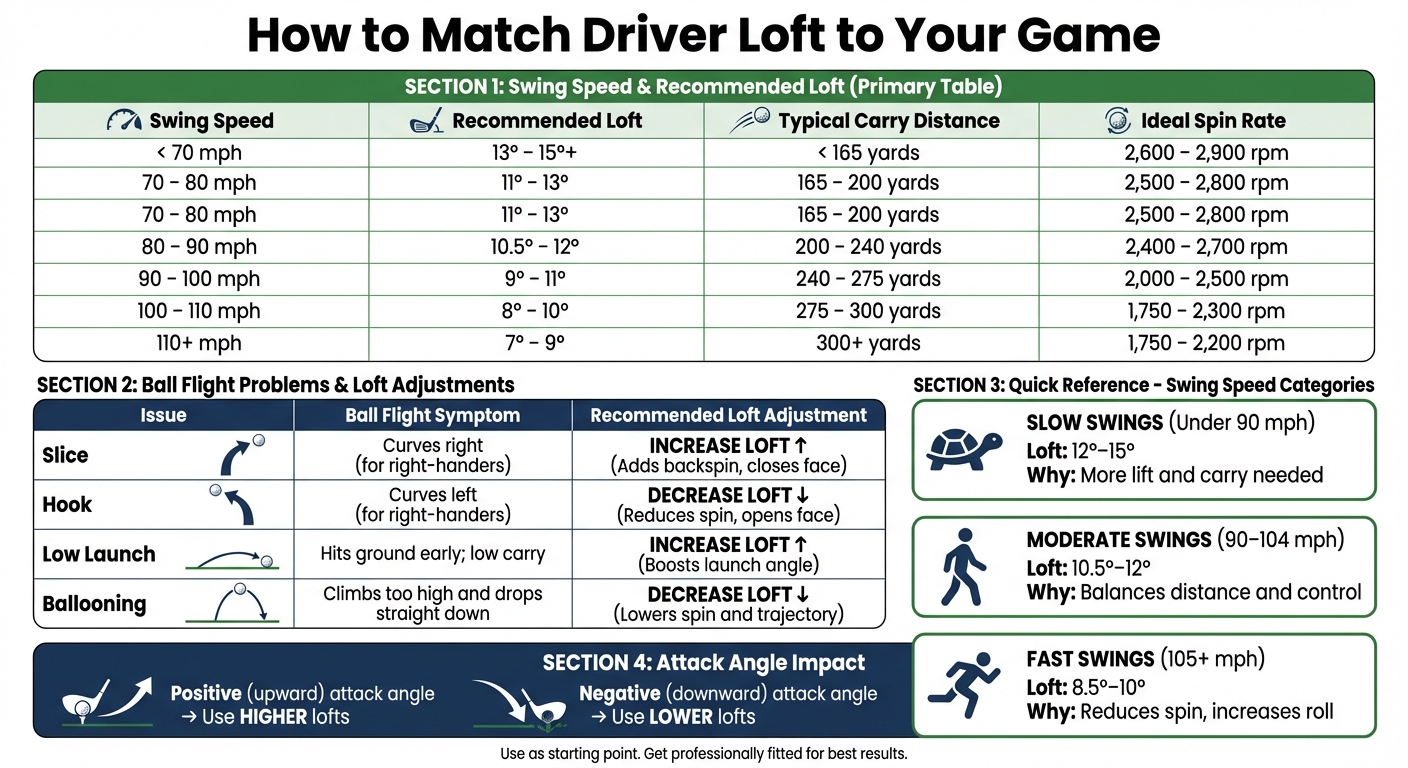
Driver Loft Selection Guide by Swing Speed and Ball Flight
GOLF: What Driver Loft Should You Use?? (80% get this wrong!)
Measure Your Swing Speed
Your swing speed plays a key role in determining the best driver loft for your game. Getting an accurate measurement is vital to make the right choice.
Professional launch monitors are the gold standard for measuring swing speed. They provide detailed data on clubhead speed, ball speed, and the smash factor (the ratio of ball speed to clubhead speed, with a theoretical max of 1.50). If you’re on a budget, radar devices or calibrated smartphone apps can give you a general idea, though they’re less precise.
You can also estimate your swing speed based on the club you use for a 150-yard shot. For instance:
- If you hit a 7-iron, your driver speed is likely between 95 and 104 mph.
- Using a 6-iron suggests a swing speed of 84 to 95 mph.
- Hitting an 8- or 9-iron points to speeds between 105 and 115 mph.
Swing speed doesn’t just affect distance – it also impacts how the ball launches and spins. Slower swing speeds need higher lofts to generate lift, while faster speeds require lower lofts to prevent the ball from climbing too much. Even with identical swing speeds, golfers can see a distance gap of 15–20 yards depending on how efficiently they strike the ball.
Swing Speed Ranges and Recommended Lofts
Matching your driver loft to your swing speed is essential for optimal performance. Here’s a general breakdown:
- Slow swing speeds (under 90 mph): Higher lofts (12° or more) help create lift and maximize carry.
- Moderate swing speeds (90–104 mph): A loft around 10.5° provides a balanced launch.
- Fast swing speeds (over 105 mph): Lower lofts (8.5° to 10°) produce a penetrating ball flight with more roll.
| Swing Speed (mph) | Recommended Driver Loft | Typical Driving Distance (yards) |
|---|---|---|
| Under 90 mph | 12° to 15°+ | Under 200 |
| 90–104 mph | 10.5° to 12° | 200–250 |
| 105+ mph | 8.5° to 10° | 275+ |
A simple guideline is to use 10 degrees of loft for every 100 mph of swing speed, then fine-tune based on your ball flight and attack angle. If you’re struggling with inconsistent hits or a two-way miss, adding 0.5° to 1.5° of loft beyond your optimal range can help improve forgiveness.
How to Increase Your Swing Speed
After figuring out your swing speed and ideal loft, you might want to work on increasing your speed to further enhance your game.
One effective method is to focus on hitting up on the ball with a positive angle of attack (between +1 and +7 degrees). This adjustment helps launch the ball higher while reducing spin. Making this change – shifting from a negative to a positive attack angle – can add over 15 yards to your drives without increasing ball speed.
To improve your contact at home, try using foot spray or impact tape on the clubface to check if you’re consistently striking the center. Adjusting your ball position can also make a difference. Position the ball slightly forward in your stance (closer to your lead heel) and add a slight spine tilt away from the target to increase your launch angle without changing the loft.
For those looking to take their swing speed and distance to the next level, you might consider the How To Break 80 Maximum Distance Video Course ($49.00). This course includes drills and strategies to boost clubhead speed and optimize launch conditions, covering everything from sequencing your swing to building power through targeted exercises.
Analyze Your Ball Flight and Attack Angle
Your attack angle – the vertical path your clubhead takes through impact – has a big influence on choosing the right driver loft. If your attack angle is positive, it means you’re striking the ball on an upward path. A negative attack angle, on the other hand, indicates you’re hitting downward.
Why does this matter? Because dynamic loft – the loft your clubface actually presents at impact – is different from the static loft printed on your driver. Your attack angle works with the club’s loft to shape the launch conditions you see on the course. For example, a positive attack angle increases launch angle and reduces backspin, allowing you to get more carry and roll. Golfers with an upward strike can often use higher lofted drivers, as the reduced "spin loft" helps the ball stay in the air longer and with less drag.
If you’re hitting down on the ball with a negative attack angle, the story changes. A downward strike creates high spin loft, which often leads to excessive backspin. This can cause the ball to balloon and lose distance, making a lower-lofted driver a better fit.
To figure out your attack angle at home, try the "empty box" test. Place an empty golf ball sleeve about one grip length in front of your ball. If your club hits the box during your swing, it means your attack angle is downward. You can also observe your ball flight. If your shots drop steeply, like a helicopter, you might have too much loft for your swing. If they fly flat and struggle to stay airborne, you likely need more loft.
"A positive attack angle increases launch angle and reduces spin for a given clubhead speed thus creating more carry AND roll." – Dan Sueltz, True Fit Clubs
Next, let’s explore how adjusting your driver loft can help fix common ball flight problems.
Fix Common Ball Flight Problems with Loft Adjustments
Tweaking your driver loft can address several ball flight issues. For example, if your drives are too low and hit the ground too early, it’s likely you’re striking down on the ball. Increasing your driver loft or adjusting your setup – such as tilting your spine slightly away from the target – can encourage an upward strike.
If your shots are ballooning – flying too high and dropping straight down with little roll – you’re dealing with too much backspin. Lower the loft on your adjustable driver or work on flattening your attack angle to bring the flight back under control. For optimal distance, aim for a launch angle between 12 and 16 degrees and a spin rate between 2,200 and 2,800 rpm.
Struggling with a slice? Increasing your loft from 9° to 11° can help straighten your ball flight. Higher loft adds backspin, which reduces sidespin and can slightly close the clubface. On the flip side, if you’re battling a hook, lowering the loft can help. A lower loft tends to open the clubface, which can counteract the hook.

| Issue | Ball Flight Symptom | Recommended Loft Adjustment |
|---|---|---|
| Slice | Curves right (for right-handers) | Increase Loft (Adds backspin, closes face) |
| Hook | Curves left (for right-handers) | Decrease Loft (Reduces spin, opens face) |
| Low Launch | Hits ground early; low carry | Increase Loft (Boosts launch angle) |
| Ballooning | Climbs too high and drops straight down | Decrease Loft (Lowers spin and trajectory) |
One easy way to encourage a better attack angle is to adjust your setup. Make sure your trail shoulder sits slightly lower than your lead shoulder at address. This small tweak helps you naturally deliver the upward strike that modern drivers are designed for.
sbb-itb-bcd8bdd
Driver Loft Chart by Swing Speed
Here’s a handy driver loft chart to help you pair your swing speed with the ideal loft settings. The table below outlines recommended lofts, typical carry distances, and ideal spin rates based on swing speed:
| Swing Speed (mph) | Recommended Loft (°) | Typical Carry Distance (yds) | Ideal Spin Rate (rpm) |
|---|---|---|---|
| < 70 | 13° – 15°+ | < 165 | 2,600 – 2,900 |
| 70 – 80 | 11° – 13° | 165 – 200 | 2,500 – 2,800 |
| 80 – 90 | 10.5° – 12° | 200 – 240 | 2,400 – 2,700 |
| 90 – 100 | 9° – 11° | 240 – 275 | 2,000 – 2,500 |
| 100 – 110 | 8° – 10° | 275 – 300 | 1,750 – 2,300 |
| 110+ | 7° – 9° | 300+ | 1,750 – 2,200 |
This chart offers a baseline guide based on swing speed, attack angle, and playing conditions. For instance, golfers with slower swing speeds (under 70 mph) benefit from higher lofts (13°–15°+) to help launch the ball higher. On the other hand, faster swingers (110+ mph) need lower lofts (7°–9°) to avoid excessive spin and ballooning .
If your shots tend to spread out by 25–35 yards, adding 0.5°–1.5° of loft can reduce sidespin and tighten your shot dispersion, offering better control and forgiveness.
"Typically, players with a slower swing speed will benefit from a higher lofted driver, which will help get the ball in the air more easily. The result is a higher trajectory, longer carry and more distance" – TaylorMade Golf
Use this chart as a starting point to dial in your driver loft. From there, adjust based on your ball flight tendencies and the tips discussed earlier. Finally, test these settings on the course to see how they perform in real-world conditions.
Test Your Driver Loft and Get Professionally Fitted
How to Test Different Lofts on the Course
Modern drivers come with adjustable hosels, letting you tweak loft settings in 1° increments (usually ranging from -1° to +2°). This feature makes it easy to experiment without needing multiple clubs.
Start by using your current loft setting as a baseline. From there, adjust the loft by just 1 degree at a time and observe how it affects your ball flight. Pay close attention to the descent angle. If the ball drops too steeply, you’re likely using too much loft. On the other hand, if the ball flies too flat and struggles to stay in the air, you probably need more loft. The ideal trajectory should resemble a smooth, shallow landing – like an airplane touching down on a runway.
Before making adjustments, ensure you’re hitting up on the ball at impact. Performing the "empty box" test can help confirm a positive attack angle, which is critical for accurate loft testing.
Keep in mind that changing the loft also affects the face angle. Lowering the loft can open the face, increasing the chance of a slice, while increasing the loft can close the face, potentially leading to a draw. To get reliable results, hit 8–10 shots per loft setting and average the outcomes.
These small adjustments can help fine-tune your launch conditions, complementing earlier discussions on swing speed and ball flight. For the most precise adjustments, consider professional club fitting.
Benefits of Professional Club Fitting
A professional club fitting takes the guesswork out of the equation. Using advanced launch monitors like TrackMan, fitters can provide detailed data on key metrics like ball speed, spin rate, launch angle, and attack angle – insights that aren’t visible to the naked eye.
The results speak for themselves. Research from PING‘s Innovation and Fitting Science Department found that golfers who underwent professional fittings gained an average of 11 yards in total distance and 9.5 yards in carry distance. Even more impressive, their shot dispersion – the area where their shots landed – shrank by 25% on average. Erik Henrikson, Manager of Innovation and Fitting Science at PING, highlights a common mistake in the fitting process:
"More times than not, a fitting focuses too much on comparing the BEST shot with one driver to the BEST shot with another. This is incomplete, at best, and in many cases will add strokes to your game rather than eliminate them."
Professional fitters take a holistic approach, analyzing not just loft but also factors like shaft flex, club length, grip size, and the club’s center of mass. These elements all influence how the loft performs during impact. For instance, increasing loft by 1 degree typically results in a 0.7-degree rise in launch angle and a 220 rpm boost in spin rate. Fitters use this data to fine-tune your setup for the best possible launch conditions.
When you go for a fitting, bring your current driver as a baseline. Focus on the average performance of your shot groupings, rather than just the longest shot. Many fitting centers offer special deals – for example, Club Champion often provides discounts like $50 for a single club fitting when paired with a custom equipment purchase. The investment can pay off in a big way, helping you hit more fairways and add real distance to your drives.
Conclusion
To wrap up your driver loft setup, focus on the strategies for fitting and testing discussed earlier. The right driver loft plays a key role in controlling launch angle and backspin, which directly impacts both distance and accuracy. Start by understanding your swing speed and attack angle. If you have a slower swing speed, you’ll usually need a higher loft – around 12° or more – to help get the ball airborne. On the other hand, faster swing speeds often pair better with lower lofts, around 9° or less, to reduce unnecessary spin. For those hitting down on the ball, additional loft may be necessary to balance things out.
Using a low-lofted driver without the swing speed or upward attack to support it can actually hurt your distance. As Spencer Lanoue from CaddieHQ explains:
"Unless you have elite-level swing speed and an upward angle of attack, a low-lofted driver is robbing you of distance".
Take advantage of your adjustable hosel to fine-tune your loft in 1° increments. Watch how the ball lands – if it descends smoothly like an airplane, you’re likely on the right track. For the most precise setup, consider a professional fitting session with a launch monitor.
Keep testing and refining your adjustments to strike the perfect balance between distance and accuracy off the tee.
FAQs
How does my swing speed determine the right driver loft?
Your swing speed is a crucial factor when it comes to choosing the right driver loft for better distance and accuracy. If your swing speed is above 105 mph, a lower loft – around 9–10° – is usually ideal. This helps manage spin and creates the perfect launch angle. On the flip side, if your swing speed is below 85 mph, a higher loft – around 11–12° – can provide the extra lift needed for more carry distance.
Not sure about your swing speed or how to decide on the right loft? Resources like How To Break 80 offer helpful tips and guides to refine your game and make smarter equipment decisions.

How can I adjust my driver if my shots are flying too low?
If your drives are flying too low, there are a few adjustments you can make to get more height. Start by increasing your driver loft – going from a 9° loft to something like 10° or 10.5° can make a noticeable difference. Another tweak is to position the ball slightly farther forward in your stance and tee it up a bit higher. This setup encourages a higher launch angle.
You might also want to focus on your swing mechanics. Creating a more upward angle of attack can help, and a simple trick is to lower your trailing shoulder slightly at impact. Lastly, check your driver shaft – if it’s too stiff, it could be holding you back from achieving the launch height you’re aiming for.
Why should I get professionally fitted to choose the right driver loft?
Getting a professional fitting for your driver loft can make a huge difference in your game. By examining details like your swing speed, launch angle, spin rate, and angle of attack, a fitter can pinpoint the ideal loft to help you hit longer and straighter shots.
This customized process aligns your driver with your swing and playing goals, giving you a better shot at improving your performance on the course.
Related Blog Posts
- 5 Essential Driver Setup Tips for Longer, Straighter Shots
- Ideal Launch Angles for Maximum Driver Distance
- Checklist for Improving Launch Angle Control
- How Shaft Flex Affects Ball Flight