
Golfers often skip warm-ups or settle for a few swings, but this can hurt performance and lead to injuries. A proper warm-up boosts mobility, activates muscles, and sharpens focus, helping you hit longer drives, improve swing consistency, and avoid stiffness on the course. This guide covers quick routines, dynamic vs. static stretches, and pro-level strategies to prepare both body and mind.
Key Takeaways:
- Dynamic stretches (e.g., squats, lunges) before play can add up to 44.5 yards to your drive.
- Resistance band exercises improve power and carry distance.
- Even a 2-minute routine (e.g., cross-crawls, squats, shoulder punches) is better than nothing.
- Static stretches should be done post-round to aid recovery, not before play.
- Mental warm-ups like visualization and focus drills sharpen your game-day mindset.
Warm-ups don’t need to be long – just 5 to 15 minutes of targeted exercises can make a noticeable difference in your game. Start small, stay consistent, and focus on activating key muscles for better results.
5 Minute Golf Warm Up – Do This Before Every Round Play Your Best Golf
How Warm-Ups Improve Your Golf Performance
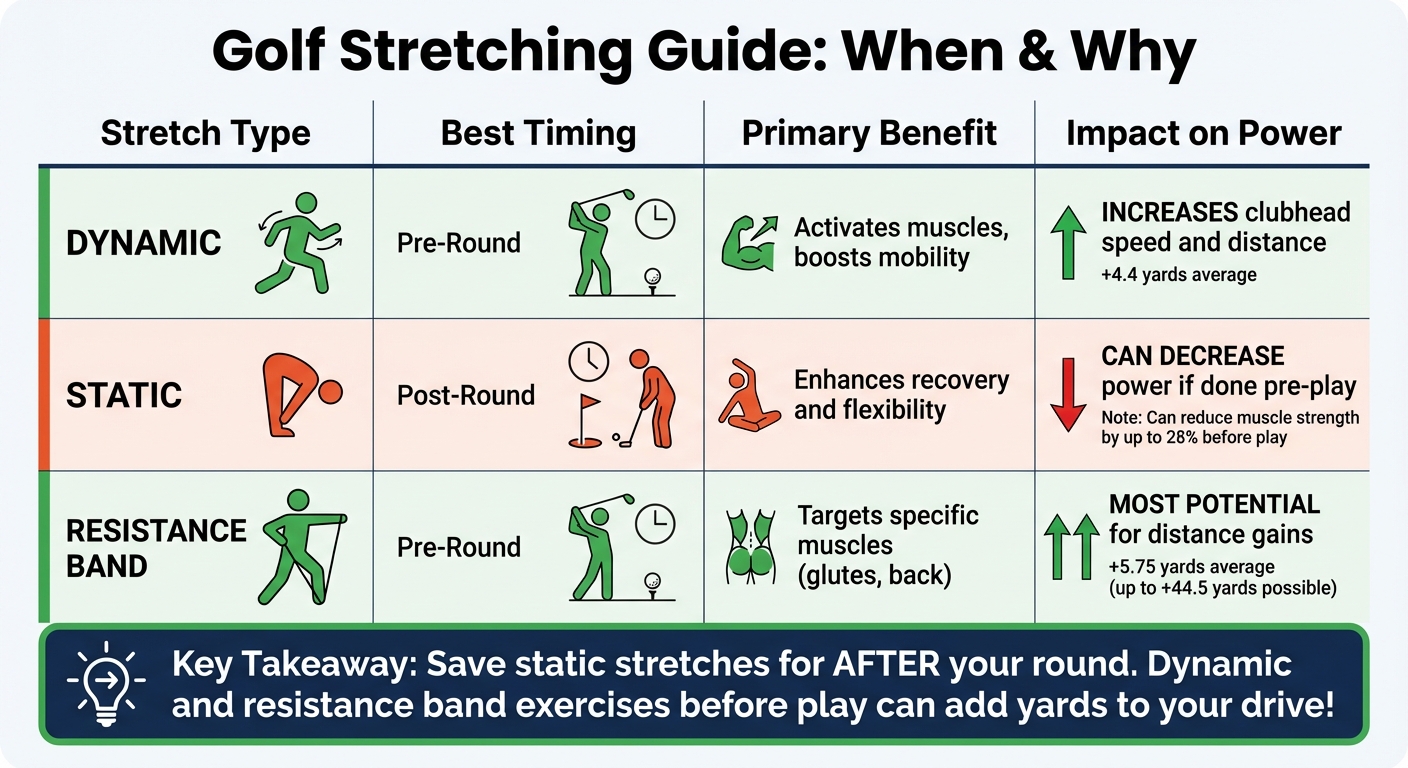
Golf Stretching Types: Dynamic vs Static Timing and Benefits
A proper warm-up primes your body for peak performance on the course. By raising your core temperature, you boost blood flow and oxygen delivery to your muscles, ensuring they’re ready to generate the power needed for your swing. Without this preparation, key muscles like the glutes might not engage as effectively, which can hinder your performance.
Dynamic movements are especially beneficial, as they guide your joints, tendons, and ligaments through their full range of motion. This is essential for the speed and rotation required in a golf swing. Enhanced mobility in areas like your shoulders, thoracic spine, and hips allows for smoother rotation and better control. A 2018 study by golf biomechanists Ben Langdown, PhD, and Jack Wells, PhD, found that golfers who performed dynamic warm-ups, such as squats and lunges, added an average of 4.4 yards to their drive carry distance. Those who incorporated resistance band exercises like speed skaters and spinal rotations saw even greater gains, averaging 5.75 yards, with one participant adding an impressive 44.5 yards to their drive.
But it’s not just about physical readiness. A good warm-up also sharpens your mental focus. Tom Hemmings, a Golf Digest Top Fitness Trainer, emphasizes the neurological aspect of warming up:
"The last bit of that warm-up has to be kind of neurologically stimulating… I always look at someone’s pupils. Are they, are they dilated by the time they finish? Because if they are, their focus is up".
This combination of physical and mental preparation helps you step onto the first tee with confidence and a clear mind, ready to perform without overthinking your mechanics.
Dynamic vs. Static Stretching
Timing matters when it comes to stretching. Dynamic stretching, which involves active and controlled movements like bodyweight squats, knee hugs, and spinal twists, is perfect for your pre-round routine. These movements enhance muscle activation, speed, and agility, setting the stage for better performance. On the other hand, static stretching – holding a position for 30 seconds or more – should be reserved for post-round recovery. While it improves flexibility, doing it before play can actually reduce power output.
Here’s a quick breakdown of how different types of stretching fit into your golf routine:
| Stretch Type | Best Timing | Primary Benefit | Impact on Power |
|---|---|---|---|
| Dynamic | Pre-Round | Activates muscles, boosts mobility | Increases clubhead speed and distance |
| Static | Post-Round | Enhances recovery and flexibility | Can decrease power if done pre-play |
| Resistance Band | Pre-Round | Targets specific muscles (glutes, back) | Offers the most potential for distance gains |
Incorporating these stretches into your routine not only preps your muscles but also builds a solid foundation for a consistent swing.
How Warm-Ups Improve Swing Consistency
Beyond mobility, a proper warm-up directly impacts your swing mechanics. By loosening tight muscles, you gain better control over your swing. When key muscles like your core, glutes, quads, and back are activated and ready, they provide the stability needed to handle the explosive forces of your swing. This stability is critical for generating rotational torque, which drives both power and consistency. Without adequate rotational range, you risk losing both power and precision.
Preparing your body for full-range movement ensures proper swing sequencing and more repeatable shots. Deb Ryan, a Titleist Performance Institute Certified Coach, highlights the importance of activation:
"Taking the time to turn on the muscles you’ll be using in your golf swing… can both increase performance and prevent injury".
2-Minute Golf Warm-Up Routine
Even if you’re pressed for time, a quick two-minute warm-up can get your body ready for the course. Dr. Luke Benoit, PGA Director of Instruction, emphasizes the importance of warming up: "If you’re stiff on the first tee shot, it’ll take your body at least a few holes to warm up and be at full power." A short sequence of movements can boost circulation and activate the muscles you’ll rely on during your swing.
The secret is to keep moving – flow from one exercise to the next without stopping. As Karen Jansen, Master LPGA Professional, explains, "If you start swinging and your muscles are tight, your swing is going to be short and choppy and then you start to make swing compensations." Here’s a quick routine to get you loosened up and ready to play:
Basic Movements for Quick Activation
These simple exercises need no equipment and can be done right by your cart. Start with cross-crawls: march in place while swinging your arms in circles to get your heart rate up. Next, do 5 bodyweight squats to engage your lower body and core. Follow this with 5 hip swings on each leg and 5 cross-body shoulder punches on each side to wake up your lower body, core, and upper back.
Finish with a quick hamstring stretch: point your toe upward and lean forward with each leg. This stretch helps maintain good posture throughout your swing.
Using a Golf Club for Warm-Up
Once you’ve activated your muscles, grab a club from your bag to focus on golf-specific movements. Start by holding the club overhead at shoulder width and doing 5 thoracic spine side bends, alternating sides. Then, try the posture primer: lift the club overhead and bring it down to tap the tops of your shoulders, repeating for 8–10 reps to engage your chest and shoulders.
Wrap up with the core rotator: loop the club behind your back at shoulder height and perform a full pivot, keeping your balance. Begin slowly and gradually pick up speed as your muscles loosen. These golf-specific movements ensure you’re ready to swing with ease – all in under two minutes.
5-15 Minute Golf Warm-Up Routine
Extending your warm-up routine can do wonders for both your physical readiness and swing accuracy. Studies show that a well-structured warm-up not only boosts drive distance but also helps shave strokes off your game. In fact, golfers who commit to dynamic warm-ups save an average of 1.5 strokes per round. Plus, a single session can increase your clubhead speed by 12.8%, with consistent practice pushing that improvement to 24% over time.
The key is to follow a sequence: warm up your body, activate key muscle groups, and then shift to drills and ball striking. Tyler Campbell, Head Trainer at the Golf Performance Center, breaks it down:

"A proper dynamic warm-up wakes up your nervous system and allows the brain to talk to the body and respond favorably to the demands being asked of it".
Here’s how to put that into action.
Full-Body Activation Exercises
Start with light aerobic activity to raise your core temperature, then focus on exercises that target the muscles you’ll use during your swing. Begin with deep squats while holding a club overhead. Stand with your feet shoulder-width apart, hold the club above your head, and lower your hips while keeping your chest upright. This move fires up your glutes and quads.
Next, try reverse lunges with a torso twist. Step back into a lunge while holding a club horizontally, then rotate your torso over your front leg. This combines core strength and lower-body activation.
For your upper body, integrate resistance band pull-aparts. Hold a resistance band at chest height and pull it apart, squeezing your shoulder blades together. Aim for 10-15 reps. These exercises are proven to improve drive distance. Wrap up the activation phase with thoracic rotations. Use a split stance (one foot back) and rotate your torso, which helps improve the separation between your hips and spine.
Progressive Club Drills and Ball Striking
Once your body is primed, transition into drills designed to sharpen your swing mechanics. Start with the Line Drill. Draw or spray a line on the grass, then make mini-swings with a wedge, focusing on brushing the turf just after the line. This helps train your low point control.
Next, work through a 15-ball progressive routine:
- Balls 1-5: Use a wedge and make hip-high to hip-high swings to focus on clean contact.
- Balls 6-10: Switch to a mid-iron (like a 7-iron). Use half or three-quarter swings, gradually increasing your speed.
- Balls 11-15: Move to your driver. Rehearse the exact shot you’ll need on the first tee, visualizing the hole and your target.
As Tony Ruggiero, a Golf Digest Top 50 Teacher, explains:
"I think players hitting balls for an hour and trying to work on your swing before you play is a waste of time… a warm-up is all about [getting ready]".
This warm-up isn’t about fixing your swing. It’s about preparing your body and mind to perform at your best when you step onto the course.
sbb-itb-bcd8bdd
Stretching and Flexibility for Golfers
Pairing your activation drills with targeted stretching can do wonders for both your golf performance and recovery. Yet, flexibility is often overlooked by golfers, and timing plays a key role. Dynamic stretching before a round gets your body ready for the explosive power needed during play, while static stretching afterward aids recovery and improves long-term flexibility. Studies reveal that static stretching before a game can cut muscle strength by up to 28% – definitely not ideal when you’re stepping up to the tee.
Static stretching is best reserved for post-play. As Dr. Ben Langdown points out:
"Static stretching is not useful for a warm-up routine as it can reduce power output! This is surely a physical attribute that all golfers want to maintain as high as possible for their driving and long game!"
Here are some specific stretches – dynamic for pre-play and static for post-play – to incorporate into your routine.
Pre-Play Dynamic Stretches
Dynamic stretches are all about warming up your body without losing the explosive power critical for your swing. Before hitting the course, focus on movements that activate key muscle groups. Start with the Standing Cat-Camel to loosen up your spine. Stand with your feet hip-width apart, curl your spine forward by tucking your chin to your chest, then reverse the motion by leaning back and opening your chest. Repeat for 30–45 seconds.
Follow this with Thoracic Rotations – 10 reps per side. Stand in a split stance with your arms straight, rotating your upper body to engage the spine and shoulders. Then, move into Reverse Lunges with Reach, performing 10 reps per side to activate your hips, core, and shoulders.
Wrap up with the Hip Hinge to target your hamstrings. With a slight bend in your knees, hinge forward at the hips until you feel a stretch along the back of your legs, then return to standing. Complete 10 repetitions. These stretches not only get your blood flowing but also prepare your nervous system for the explosive demands of your golf swing.
Post-Play Static Stretches
After your round, switch to static stretches to help your muscles relax and improve flexibility. Start with the Elevated Child’s Pose to ease lower back tension. Hold your driver with both hands, bend at the hips, and lower your head between your arms. Stay in this position for at least 45 seconds.
For your hamstrings, try a Toe Touch Hold or a seated hamstring stretch, holding each for 30–60 seconds. Add a Cross-Body Arm Stretch by pulling one arm across your chest and holding for 30 seconds on each side. Finally, finish with a Deep Squat Hold to open up your hips and groin. Hold this position for 45–60 seconds.
These post-round stretches can help reduce muscle soreness and set you up for quicker recovery, so you’re ready to take on your next game.
Professional Golfer Warm-Up Strategies
Tour pros take a deliberate approach to warming up. Jordan Spieth sums it up well:
"There’s a way to get the body and mind primed to play, and then there’s digging holes beating balls. Hard practice has its place, but never before a round".
Instead of trying to fix mechanical issues, professionals use their warm-up time to figure out what’s working for them that day.
One method Spieth uses is called bracketing extremes. On the range, he intentionally hits exaggerated slices and hooks to find his "middle ground" for the day. This technique helps him stay relaxed and shifts his focus from overanalyzing mechanics to feeling the shot.

Short-game drills also play a big role. For instance, the "Walk the Dog" drill is a favorite: hit a pitch shot 20 yards, then aim for that landing spot as your next target. This drill trains your brain to respond to targets rather than obsess over swing mechanics, which mirrors the mindset needed during a round.
To wrap up, pros often visualize the first few holes and simulate the pace of play. Putting is a major focus – since it accounts for roughly 50% of all strokes in a typical round (about 36 putts on average), many pros dedicate more than half their warm-up time to the putting green.
Adapting Professional Routines for Amateur Golfers
You don’t need hours or a personal trainer to benefit from tour-level warm-up strategies. Even Phil Mickelson has a streamlined 30-minute routine that includes resistance bands and core activation. For amateurs, a 15-ball warm-up can do the trick: hit 5 wedges to dial in contact, 5 mid-irons to build confidence, and 5 tee shots to prepare for your opening drive. Always hit from perfect lies during your warm-up – save tricky lies for dedicated practice sessions.
Spieth emphasizes:
"The thing about warming up properly is that it doesn’t require any extra skill, only the discipline to commit to it".
Professional coach Cameron McCormick advises keeping it simple:
"It’s OK to check one or two mechanical elements in a warm-up, but no more".
Use the range to understand the swing you have that day, not to overhaul it. A structured 20-minute warm-up could look like this: 6 minutes of stretching, 6 minutes on the putting green, and 8 minutes on the range, incorporating visualization.
Mental Warm-Ups and Visualization
Mental preparation starts as soon as you step onto the course. These mental exercises complement your physical warm-up, ensuring you’re ready to play your best. Sports psychologist Dr. Bhrett McCabe suggests the 78-22 Rule:
"Instead of focusing on the 22% of your game that isn’t going right, take a glass half full approach. Appreciate the 78% of your game that is working for you that day".
This mindset shift keeps you from fixating on minor flaws.
You can also try mental routines like the 20/20/20 Rule and the 5-Second Rule to focus on instinctive play. The 20/20/20 Rule breaks your practice into three parts: 20 slow-motion swings focusing on mechanics, 20 exaggerated rehearsals, and 20 full pre-shot routine shots without swing thoughts. The 5-Second Rule encourages balance and focus – hold your follow-through for five seconds on drives or keep your head down for five seconds after putts.
Visualization is another powerful tool. During your final driver swings, imagine the fairway, hazards, and landing zones of the first hole. This mental rehearsal gets your mind ready to perform under pressure, turning your warm-up into a preview of the round ahead. These expert strategies can help you craft a warm-up routine that sets you up for success.
How To Break 80: Golf Improvement Resources

Once you’ve got your warm-up routine down, it’s time to focus on resources that can sharpen your core golf skills. A good warm-up becomes even more effective when paired with strong fundamentals. That’s where How To Break 80 steps in, offering tools to enhance your swing, putting, and driving – key areas that can elevate your game before you even hit the first tee.
One standout resource is the eBook, How to Break 80 & Shoot Like the Pros by Jack Moorehouse. Priced at just $29 (a steep discount from the original $99), this guide covers the "4 Keys of Golf" and introduces a 5-step pre-shot routine designed to bring consistency to your game. Think of it as a mental safety net before each shot. The putting section is particularly detailed, offering a step-by-step plan (complete with color photos) to help golfers aim for 26–30 putts per round. Drew M., a user of the book, shared his success:
"The book simple as it is, is the only thing that I did differently this year than I did in years past."
His results? A drop in his handicap from 10.5 to 8.1 in just one month.
Beyond the eBook, How To Break 80 offers additional resources, including free video courses. The Ultimate Distance Master Class is one such course, featuring advice from top instructors on how to add 30–50 yards to your drives. One tip from Claude Brousseau’s "letting go" drill emphasizes 80% power swings with a relaxed trailing hand, helping to reduce overcontrol during impact.
The platform also includes quick, effective drills that you can complete in just 10–15 minutes. For example, the "Perfect Pendulum" drill helps with chunk-free chipping, while the "Correct Putting Stance Drill" refines your putting setup. These drills are easy to integrate into your warm-up routine and require little space, making them perfect for pre-round preparation.
Building Your Perfect Warm-Up Routine
Your warm-up should fit your schedule, fitness level, and skills. Using the activation drills mentioned earlier, you can adapt your routine to suit your available time and physical needs. If you’ve only got 5 minutes, prioritize stretches like golf cart-supported quad and lat stretches, along with simple joint rotations such as ankle circles and arm swings. With 10–15 minutes to spare, start with a brisk walk to raise your core temperature, then move into dynamic movements like squats and spinal twists. Finish by hitting 15 focused balls on the range. If you have 30 minutes or more, take it up a notch with resistance band exercises for shoulder activation and practice wedge shots at various distances (30, 45, 60, 75, and 90 yards) to refine your short game. These routines not only prepare your body but also reinforce better swing mechanics and mental readiness.
Consistency beats complexity. Even a simple dynamic routine – like squats and lunges – can make a noticeable difference. Golfers who stuck to such basics saw an average carry distance increase of 4.4 yards, while those incorporating resistance bands gained 5.75 yards. The key takeaway? A straightforward routine, done regularly, can yield measurable improvements.
Experts recommend using warm-ups to gauge your swing for the day, not to make major changes. Save mechanical adjustments for practice sessions. Before your round, focus on how your body feels, fine-tune your putting with lag putts, and visualize your first tee shot.
Adapt your warm-up to your physical condition. If needed, use a golf club or cart for balance during stretches. Always work both sides of your body to maintain balance and avoid injury. The ultimate goal? Activate your muscles and sharpen your focus for the game ahead.
FAQs
Why should you do dynamic stretches instead of static stretches before playing golf?
Dynamic stretches are a great way to prep your body before hitting the golf course. These movements get your blood flowing, warm up your muscles, and engage them through controlled, full-range motions. The result? Improved power, speed, and flexibility – key ingredients for a strong, effective golf swing.

On the other hand, static stretches, where you hold a position for a prolonged period, can overly relax your muscles. This might actually lower your explosiveness and reaction time. By sticking to dynamic stretches, you’ll set yourself up for the rotational and explosive movements that golf demands.
How do resistance band exercises improve my golf swing?
Resistance band exercises are an excellent way to fine-tune your golf swing by targeting the muscles that matter most while keeping your mobility intact. These bands let you move through a full range of motion, helping to improve shoulder stability, hip rotation, and core strength – all key ingredients for a strong and controlled swing. They also prep your muscles, lowering the chance of injuries and boosting your clubhead speed to drive the ball farther.
Some go-to resistance band drills for golfers include:
- Band pull-aparts: Great for strengthening your shoulders and upper back.
- Lateral band walks: Perfect for activating and stabilizing your hips.
- Lunge twists with a band: Ideal for building rotational power.
Spending just 30–60 seconds on each of these exercises before you hit the course can improve blood flow, warm up your muscles, and get your body ready for the dynamic movements of your game.
If you’re looking to make resistance bands a regular part of your warm-up, there are plenty of guides and eBooks out there with detailed drills and techniques tailored for golfers. Incorporating these exercises into your routine could mean better control, added distance, and a more reliable swing.
What mental exercises can help me focus better during my golf warm-up?
Adding mental exercises to your warm-up can fine-tune your focus and set the stage for a strong performance. Start with visualization: close your eyes for about 30 seconds and imagine the perfect shot. Picture the ball’s flight, its landing spot, and how it rolls. This mental rehearsal boosts confidence and prepares your mind for success.
Follow this with a breathing exercise to steady both your mind and body. Take a deep breath in for a count of three, then exhale for three counts. While doing this, try syncing your breath with your swing. For example, think "one-thousand-one" during your backswing and "strike" as you swing through. This simple rhythm helps you stay in the moment and avoid distractions.
Lastly, incorporate a positive mantra into your practice swings. Phrases like "smooth and steady" or "balanced swing" can keep your thoughts focused and push negativity aside. Repeating these words reinforces your mental clarity and sets a confident tone for your game. These easy steps can help you stay calm, composed, and ready to play your best.
Related Blog Posts
- 10 Pre-Round Warm-Up Exercises for Better Golf Performance
- Golf Practice Checklist: 8 Drills for Weekend Warriors
- Stretching vs. Dynamic Warm-Ups: What Works Best?
- How to Warm Up for a Golf Tournament
