
Shaft flex directly impacts how your golf ball flies. It influences launch angle, spin, trajectory, and shot shape. Matching your shaft flex to your swing speed is key for better distance and accuracy. Here’s what you need to know:
- Softer shafts: Ideal for slower swing speeds (under 85 mph). They produce higher launches and more spin, helping with carry distance but can cause ballooning or hooks.
- Stiffer shafts: Better for faster swing speeds (above 100 mph). They deliver a lower, penetrating flight with less spin, offering control but may feel harsh or lead to slices if too stiff.
Use launch monitors to analyze your ball flight and confirm the right flex. A properly matched shaft ensures consistent shots, tighter dispersion, and optimized performance on the course.
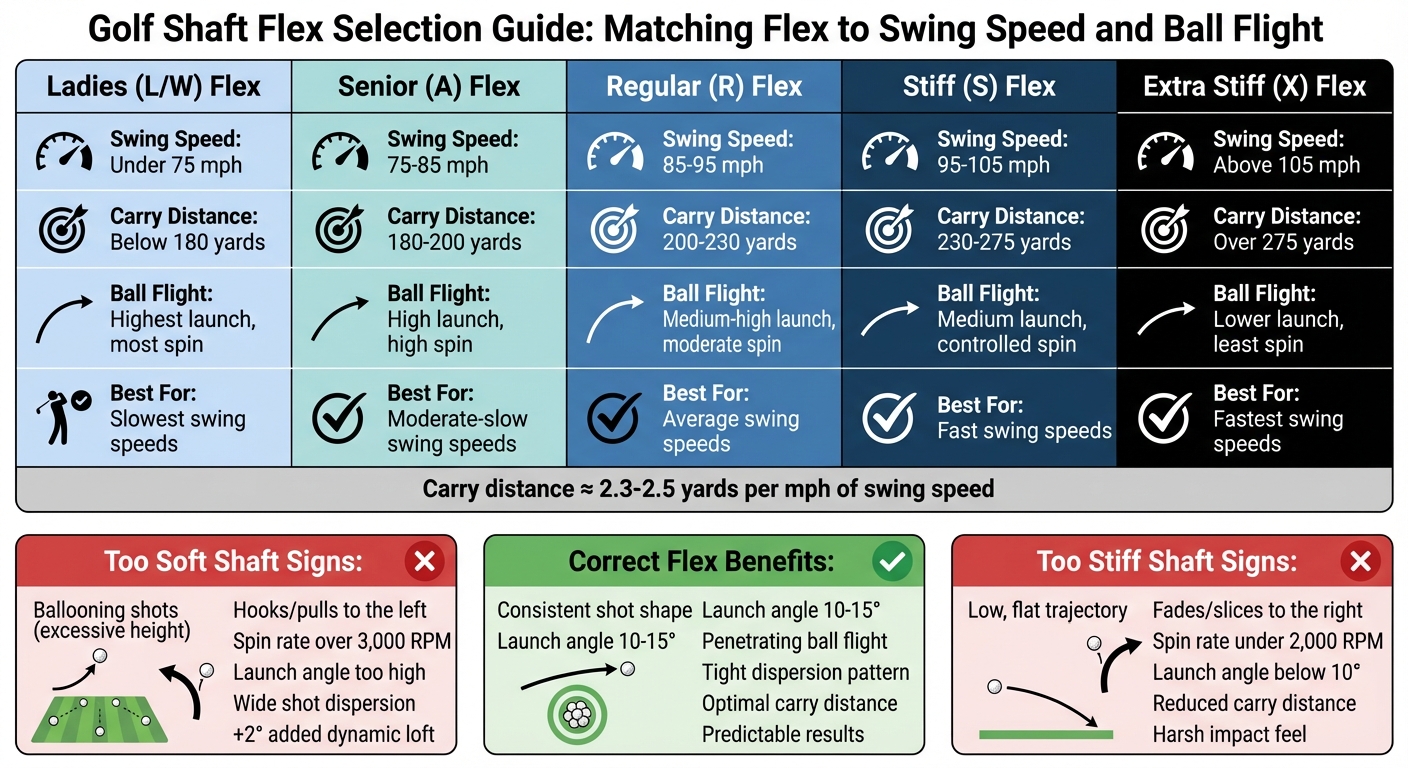
Golf Shaft Flex Guide: Matching Swing Speed to Flex Type
What Shaft Flex Is and How It Affects Ball Flight
Common Shaft Flex Types
Shaft flex is categorized using a standard labeling system, but the actual stiffness can vary slightly between manufacturers. The five main categories are Ladies (L or W), Senior (A), Regular (R), Stiff (S), and Extra Stiff (X). These labels correspond to swing speeds and typical carry distances. For instance, Ladies/W flex is generally suited for swing speeds under 75 mph with carry distances below 180 yards, while Extra Stiff/X is designed for swing speeds over 105 mph and carries exceeding 275 yards.
While these ranges provide a helpful starting point, factors like swing tempo and release timing also play a role in determining the best flex for each golfer. Understanding these classifications is key to grasping how different flex levels impact ball flight.
How Shaft Flex Changes Ball Flight
The flexibility of a shaft directly influences how the ball launches and spins. Softer shafts bend more during the swing, increasing the dynamic loft at impact. This results in a higher launch angle and more backspin, which can help lift the ball into the air. On the other hand, stiffer shafts bend less, producing a lower, more penetrating trajectory with reduced spin.
For example, a test comparing shafts found that an R-flex shaft added 2° of loft compared to a stiffer option. This led to a higher launch angle, a steeper landing angle, and about 11 extra yards of carry. Interestingly, despite a slight 1-mph drop in ball speed, the softer shaft delivered tighter shot dispersion. This highlights how choosing the right flex can improve both distance and accuracy by fine-tuning launch conditions.
Golfers with slower tempos often benefit from softer shafts, which help elevate the ball more easily. Conversely, players with faster, more aggressive swings typically need stiffer shafts to maintain control and avoid generating too much spin.
How Shaft Flex Affects Trajectory, Spin, and Shot Shape
When Your Shaft Is Too Soft
If your shaft is too soft for your swing speed, it tends to bend excessively during the downswing. This extra flex increases the effective loft at impact, adding up to about 2° of dynamic loft. The result? A higher launch angle that can lead to a ballooning ball flight, especially problematic in windy conditions where it could cost you distance. On top of that, the extra bending often causes the clubface to close at impact, producing hooks or pulls to the left for right-handed golfers. This inconsistent deflection can make your shot patterns unpredictable. While softer shafts might offer more carry distance, they often come at the expense of control, leading to wider dispersion and reduced accuracy.
When Your Shaft Is Too Stiff
On the flip side, a shaft that’s too stiff doesn’t flex enough during your swing. This lack of flex means the shaft doesn’t load properly, which reduces dynamic loft and lowers the launch angle. Pair that with insufficient spin, and you’re looking at a flatter trajectory with less carry distance. Additionally, a stiff shaft can leave the clubface slightly open at impact, which for right-handed golfers typically results in fades or slices. This is especially challenging for players with moderate swing speeds (around 85–95 mph), as they may struggle to generate the force needed to load the shaft. Without proper loading, energy transfer suffers, leading to slower clubhead speeds and reduced overall performance.
Benefits of the Right Shaft Flex
Choosing a shaft flex that matches your swing speed is key to achieving optimal launch and spin. When the shaft flexes and releases correctly, it promotes a penetrating ball flight with excellent carry and a steeper descent angle, which improves stopping power on the green. Another major perk of the right flex is tighter shot dispersion. Testing shows that properly matched R-flex shafts produce much tighter groupings compared to mismatched, stiffer shafts. This consistency helps eliminate the erratic hooks caused by overly soft shafts and the pushes or slices that come from shafts that are too stiff. By analyzing your ball flight patterns, you can pinpoint whether your shaft flex is helping – or hurting – your game.
Using Ball Flight to Identify Flex Problems
Ball Flight Patterns to Watch
The way your ball flies can give you important clues about whether your shaft flex matches your swing. For example, if you see ballooning shots – balls that climb too high, hang in the air, and then fall short – you might be using a shaft that’s too soft. For right-handed golfers, these shots often have a noticeable leftward curve.
On the other hand, if your shots are low and flat with little height, your shaft might be too stiff. Right-handed golfers with stiff shafts often struggle with fades or slices because the clubface doesn’t square up properly at impact. These shots can feel harsh and typically result in less carry distance.
When your shaft flex is just right, your shots will have consistent and predictable shapes, like a slight draw or fade. The trajectory will be moderate and penetrating, and your dispersion – how far your shots spread out – will be tighter. This means even mishits are more controllable, and your carry distances remain steady.
Using Launch Monitor Data
To get a clearer picture of your shaft flex needs, pair your visual observations with launch monitor data. Start by looking at your launch angle. For most golfers, a driver launch angle between 10° and 15° is ideal. If your launch angle is too high and your spin rate exceeds 3,000 RPM, it’s likely your shaft is too soft, which could explain ballooning shots. On the flip side, if your launch angle is below 10° and your spin rate is under 2,000 RPM, your shaft might be too stiff.
Another key metric is your dispersion pattern over 8–10 shots. For instance, MyGolfSpy testing showed that switching to a softer R-flex shaft gave one golfer an extra 11 yards of carry distance, 7 more yards of total distance, and a tighter dispersion pattern.
You should also assess your shot’s vertical profile for more insights. Look at the peak height and descent angle of your shots. If your shots peak too high and land steeply (with a descent angle over 45°), your shaft may be too soft, which can limit roll. On the other hand, a shallow peak with a flat descent suggests your shaft could be too stiff. In that case, trying a softer flex might help you achieve a better launch and overall performance.
sbb-itb-bcd8bdd
How to Select and Test the Right Shaft Flex
Step 1: Measure Your Swing Speed or Estimate from Carry Distance
When it comes to picking the right shaft flex, your driver swing speed is a great place to start. To get an accurate reading, visit a golf retailer, teaching pro, or fitting studio equipped with a launch monitor like TrackMan or FlightScope. Take 10–15 swings to establish your average speed – consistency is key here.
If you don’t have access to a launch monitor, you can estimate your swing speed based on your carry distance. On average, a well-struck drive produces about 2.3–2.5 yards of carry per mph of clubhead speed. For instance, if your drives carry around 200 yards, your swing speed is likely in the 85–90 mph range. A carry distance of 230 yards usually corresponds to a swing speed of 95–100 mph. Use these general guidelines to match your swing speed to a shaft flex:
- Under 75 mph: Ladies (L) flex
- 75–85 mph: Senior (A) flex
- 85–95 mph: Regular (R) flex
- 95–105 mph: Stiff (S) flex
- Above 105 mph: Extra-stiff (X) flex
However, swing speed isn’t the only factor to consider. Your tempo and transition – how you move from backswing to downswing – play a big role too. If you have a smooth tempo, you might perform better with a softer flex. But if your swing is quick and aggressive, a stiffer shaft can help you maintain control and keep the clubface square. Once you’ve got a good idea of your swing speed, it’s time to test different flex options.
Step 2: Test Different Flex Options
Armed with your swing speed estimate, start testing various shaft flexes. Whether you’re on the range or at a fitting studio with a launch monitor, hit 5–8 balls per shaft – for example, try R, S, and X flex in rotation. This approach helps ensure fatigue doesn’t skew your results. Take short breaks between sets, aim at the same target, and use the golf ball you typically play to keep the conditions consistent.

Pay close attention to launch height, shot shape, and dispersion. A shaft that’s too soft often results in high, ballooning shots that curve left (for right-handed players) and scatter widely. On the flip side, a shaft that’s too stiff can produce low, flat shots that fade or block to the right, often with a harsh feel. The ideal shaft flex will give you a medium-to-high launch, a consistent shot shape (like a small draw or fade), and tight dispersion around your target.
To zero in on the best option, track the data from 8–10 solid strikes with each flex. For example, MyGolfSpy testing showed one golfer gained 11 yards of carry and an additional 7 yards total by switching from a stiff shaft to an R-flex that matched his swing better. Not only did his distance improve, but his dispersion tightened as well. Remember, the goal is to find the flex that balances distance and consistency – not just raw yardage.
Step 3: Confirm Your Flex Choice on the Course
Once you’ve narrowed down your options on the range, test your chosen shaft flex during actual rounds. Playing 3–5 rounds with the new shaft will give you a better sense of how it performs under real-world conditions. Keep track of simple stats like fairways hit, your typical miss (left, right, high, or low), and average approach distances on familiar holes. Compare these results to your previous shaft to see if you’re ending up in better positions more often.
Also, pay attention to how your ball flight reacts in windy conditions. If your drives climb too high and get knocked offline or lose distance in the wind, your shaft might be too soft or creating excessive spin. Conversely, if you’re struggling to get the ball airborne or hold greens, the shaft could be too stiff. GPS-enabled golf apps can help track your carry distances and provide a clearer picture of your on-course performance.
If you’re still encountering issues after several rounds – like a consistent miss in one direction, trouble controlling trajectory, or poor wind performance – it may be time to revisit your fitter. A follow-up session can fine-tune your flex, weight, or even loft settings. Many fitters offer these sessions to help you lock in the perfect setup. And if you’re serious about improving your scores, pairing a properly fitted shaft with structured practice (check out resources like How To Break 80) can make a big difference by aligning your equipment and technique seamlessly.
Driver Shaft Testing & How It Affects Ball Flight & Distance
Summary and Final Guidelines
Choosing the right shaft flex comes down to matching it with your swing speed and the ball flight you’re aiming for. If your swing speed is on the slower side – typically under 85 mph – a softer flex like Regular or Senior can help you achieve better launch and spin, maximizing carry distance. On the other hand, faster swingers generally benefit from stiffer flexes, such as Stiff or X-flex, which provide greater control and a lower, more piercing trajectory. When the flex is properly matched, you’ll notice a consistent ball flight and tighter dispersion – critical for hitting more fairways and setting up easier approach shots.
However, even the best equipment can’t make up for inconsistent swing fundamentals. Pairing the right flex with solid mechanics is essential. If your fundamentals – like avoiding an early release or maintaining clubface control through impact – are off, the results won’t be what you’re hoping for. Resources like How To Break 80 offer drills that focus on improving your swing tempo, mechanics, and clubface control, helping you get the most out of your setup.
If you’re still struggling, consider revisiting your club fitter for additional adjustments. The ultimate goal is a swing that delivers controlled, repeatable distance. When your shaft flex, swing technique, and practice routine all align, you’ll see noticeable improvements in your ball flight and overall performance on the course.
FAQs
How can I find the right shaft flex without using a launch monitor?
To find the right shaft flex for your swing, try out several options during practice sessions. Observe how each one impacts your ball flight – things like trajectory and spin. The goal is to select a shaft that delivers consistent, accurate shots with the flight pattern you’re aiming for.
How can I tell if my shaft flex is hurting my performance?
If the shaft flex of your golf club doesn’t match your swing, you might experience inconsistent ball flight, trouble controlling your shots, or even a drop in distance. Other telltale signs include too much spin or a ball trajectory that’s either excessively high or too low for the shot you’re aiming for.
Getting the right shaft flex can significantly improve your performance on the course. Not sure where to start? A professional club fitter can guide you, or you can try out different flex options to discover what suits your swing speed and playing style best.
How does your swing tempo affect the right shaft flex for your game?
Your swing tempo is a crucial factor when it comes to picking the right shaft flex. If your swing tempo is on the faster side, a stiffer shaft can provide better control and accuracy by minimizing unnecessary bending during your swing. Conversely, if your swing tempo is slower, a more flexible shaft can help you generate extra power and improve ball flight, giving you a boost in distance.
The right shaft flex ensures your club works in harmony with your swing, enhancing consistency and helping you perform better on the course.
Related Blog Posts
- How Club Choice Affects Shot Shape
- Ideal Launch Angles for Maximum Driver Distance
- Shaft Flex Types: Beginner vs. Advanced
- Temperature Changes and Shaft Flex Performance
