
Golfers often rely on instinct for their short game, but tracking specific metrics can dramatically improve your chipping accuracy. Here are six key metrics to focus on:
- Proximity to Hole: Measure how close your chips land to the hole. Closer chips lead to easier putts and better chances of saving par.
- Up-and-Down Percentage: Tracks how often you recover from a missed green with one chip and one putt.
- Fractional Distance to Target (FRL): Evaluates how far your chip lands as a percentage of the total shot distance, helping refine distance control.
- Distance Error Magnitude: Measures the absolute distance between your chip’s landing spot and the hole, highlighting precision gaps.
- Directional Error Standard Deviation (σ(α)): Analyzes shot dispersion to identify consistent directional biases or random variability.
- Awful Chip Percentage: Tracks your worst chips – those that fail to reach the green or leave you without a realistic par-saving opportunity.
Start tracking these metrics using simple tools like a scorecard or advanced systems like Arccos for deeper insights. Focus first on proximity and up-and-down percentage to see immediate improvements in your short game.
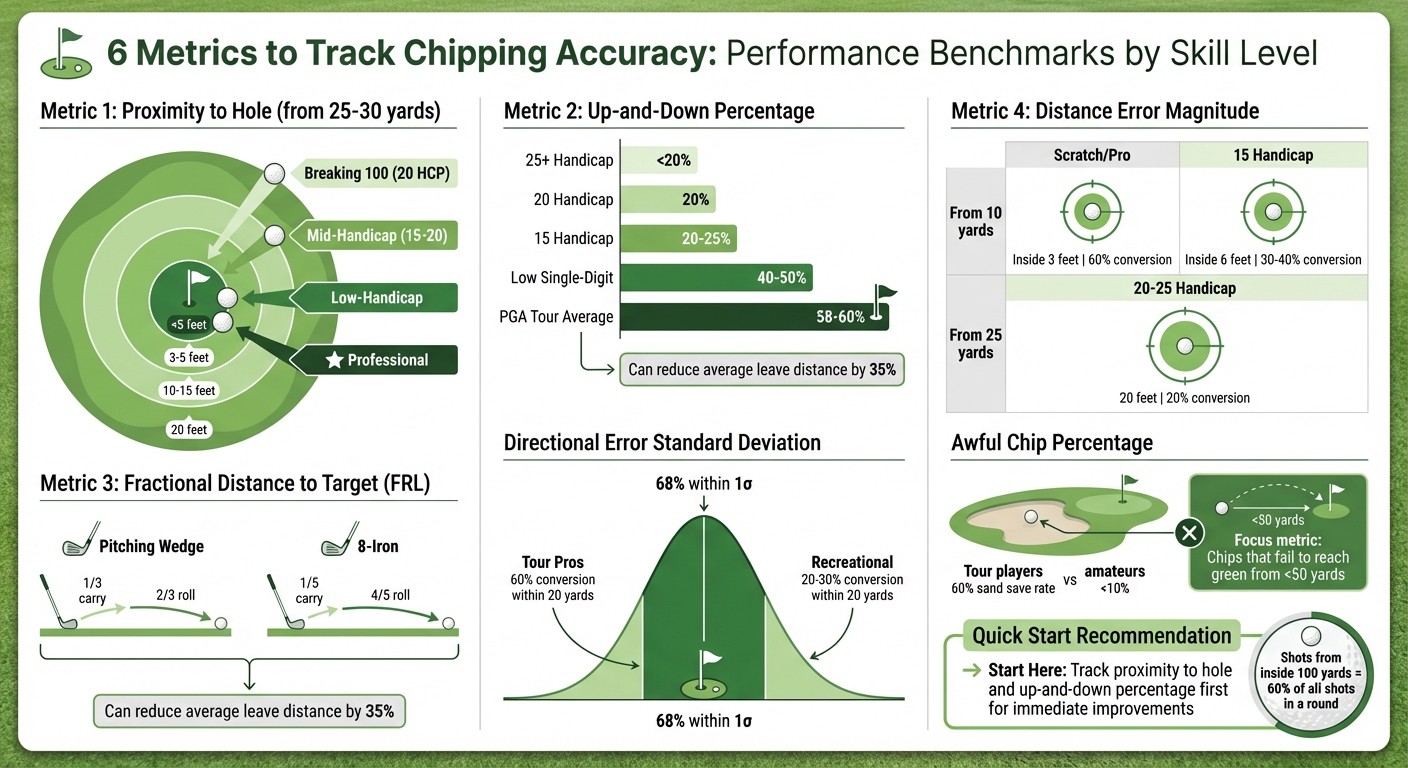
Golf Chipping Accuracy Benchmarks by Skill Level
1. Proximity to Hole
Why It Matters for Chipping Accuracy
Proximity to the hole is a key metric for evaluating your chipping skills. Simply put, how close you get the ball to the hole directly impacts how tough your next putt will be. Bradley Turner, Director of Online Golf Instruction at Keiser University, explains it best:
"The essence of the short game is the skill of getting the ball to stop as close to the hole as possible".
The statistics are clear: PGA Tour players sink about 50% of their putts from 8 feet, but that number plummets to 15% from 20 feet and just 5% from 35 feet. Every extra foot closer to the hole significantly improves your chances of saving par.
Simple to Track, Easy to Measure
Unlike the complex data you’d get from a launch monitor, tracking proximity is straightforward. All it takes is measuring the distance from your ball to the hole after each chip. You can jot down these distances on your scorecard or use a note-taking app on your phone.
For a practical approach, try using a standard club length (around 3 feet) as your measuring tool. For example, the Five Ball Drill challenges you to land at least three out of five balls within one club length of the hole. This method not only gives you immediate feedback but also helps you measure progress against professional standards.
Setting Goals Based on Skill Level
Tracking your proximity to the hole also lets you compare your performance to benchmarks for different skill levels:
| Skill Level | Distance from Hole | Target Proximity |
|---|---|---|
| Breaking 100 (20 HCP) | Within 25 Yards | 20 Feet |
| Mid-Handicap (15-20) | 30 Yards | 10-15 Feet |
| Low-Handicap | 30 Yards | 3-5 Feet |
| Professional | 30 Yards | < 5 Feet |
For a 20-handicap golfer, who misses the green about 80% of the time, measuring proximity highlights exactly where strokes are being lost. By focusing on this metric, you can set clear, measurable goals to sharpen your chipping game.
2. Up-and-Down Percentage
Relevance to Improving Chipping Accuracy
Chipping accuracy isn’t just about getting the ball close to the hole – it’s about how effectively you recover when you miss the green. That’s where the up-and-down percentage comes in. This stat measures how often you can recover by holing out in two shots after missing the green. Brendon Elliott, PGA, explains it clearly:
"An ‘Up and Down’ is taking just two shots (or less with a hole out) to hole out on a missed green in regulation: one chip and one putt".
This metric shows how well your chips set up makeable putts. Considering that shots from inside 100 yards account for about 60% of all shots in a round, improving your up-and-down percentage can quickly lower your scores. It’s a simple yet powerful way to see how your short game impacts your overall performance.
Practicality for Amateur Golfers
For amateur golfers, especially those with higher handicaps, focusing on this stat can make a noticeable difference. A 20-handicap player, for example, misses the green roughly 80% of the time, giving them around 15 chances per round to recover. Just converting a few of these opportunities could save 4–8 strokes per round.
On the professional side, Brian Harman led the scrambling category during the 2023 season through the 3M Championship. Out of 448 missed greens, he successfully made par or better 300 times, achieving an impressive 66.96% up-and-down rate. While amateurs won’t match that level, it shows the value of strong recovery skills.
Alignment with Professional Benchmarks or Standards
Your target up-and-down percentage depends on your skill level. Here’s a breakdown of what to aim for:
| Skill Level | Target Rate |
|---|---|
| PGA Tour Average | 58% – 60% |
| Low Single-Digit Handicap | 40% – 50% |
| 15-Handicap | 20% – 25% |
| 20-Handicap (Breaking 100) | 20% |
| 25+ Handicap | <20% |
These benchmarks give you something to work toward, no matter your current level.
Ease of Tracking and Measurement
Tracking your up-and-down percentage is straightforward. Start by counting how many greens you miss and how many times you recover in two shots. Divide your successful recoveries by your total chances to calculate the percentage.
For practice, try this drill: Pick 3 to 9 spots around a practice green and play 18 "holes." Chip from each spot and putt out, keeping track of how many times you finish in two shots. This will give you a baseline to measure your progress.
3. Fractional Distance to Target (FRL)
Relevance to Improving Chipping Accuracy
Fractional Distance to Target (FRL) measures how far off your chip shot lands as a percentage of the total shot distance. Instead of focusing solely on raw proximity, this metric adjusts for the varying lengths of shots. For instance, missing by 8 feet on a 10-yard chip is not the same as missing by 8 feet on a 45-yard pitch – it’s all about context.
This metric helps pinpoint patterns in your distance control. If you notice inconsistencies at certain distances or with specific clubs, FRL can guide your practice sessions. Since controlling distance is a critical skill, especially for high-handicap players, monitoring FRL offers a clear way to track progress. It connects your theoretical accuracy with how you perform on the course.
Practicality for Amateur Golfers
FRL also sheds light on your flight-to-roll ratio, showing how much of your shot is in the air versus how much rolls on the ground. Understanding these ratios can lead to practical improvements in your game.
Fine-tuning your flight-to-roll ratios can significantly sharpen your chipping accuracy. In fact, it could reduce your average leave distance by up to 35% and help lower your scores. For example, a 20-handicap golfer should aim for an average proximity of about 20 feet on chip shots from 25 yards or less. By tracking FRL, you can figure out if you’re consistently short or long and adjust your carry-to-roll ratios. A pitching wedge, for instance, might carry one-third of the total distance, while an 8-iron might carry only one-fifth, with the rest rolling out.

Ease of Tracking and Measurement
Tracking FRL is surprisingly simple. On the course, you can use basic tools like a 20–30 yard tape measure with 5-yard interval markings. To measure your final proximity, use a putter – one putter length equals roughly 3 feet, and two lengths equal about 6 feet. Alternatively, you can estimate distances by taking five long steps, which is approximately 5 yards. This straightforward approach makes it easy to incorporate FRL into your practice routine.
4. Distance Error Magnitude
Relevance to Improving Chipping Accuracy
Distance Error Magnitude refers to the absolute distance between where your ball stops and the hole. For instance, if you’re chipping from 15 yards and the ball ends up 8 feet from the hole, your error is 8 feet. Mastering distance control is what sets reliable chippers apart from those who struggle.
"Distance control is the make-or-break skill around the greens. It’s not enough to just make clean contact." – Foy Golf Academy
Professional golfers excel by consistently leaving their ball within 3 feet from 10 yards, converting over 90% of those putts. In contrast, a 20-handicap golfer might leave their ball 20 feet away from 25 yards, sinking only 20–30% of such attempts. This gap in precision has a direct impact on short-game performance.
Practicality for Amateur Golfers
Tracking your Distance Error Magnitude can reveal whether you tend to leave shots short or long. This insight allows you to adjust your carry-to-roll ratios depending on the club you use. For example:
- A pitching wedge typically carries one-third of the total distance and rolls two-thirds.
- An 8-iron carries about one-fifth and rolls four-fifths.
Understanding these patterns can reduce your average leave distance by 35%, potentially gaining you around 0.4 strokes per round.
The good news? You don’t need fancy equipment to track this. Use your putter as a simple measuring tool – one putter length is approximately 3 feet, and two lengths are about 6 feet. A practical drill is to place a towel at your target landing spot and measure how far your shots land from it. This exercise focuses on distance control and quickly highlights your tendencies.
Ease of Tracking and Measurement
To improve, record details for each chip: the club used, swing length, and where the ball finishes. After hitting 10–15 shots per club, you’ll start to see patterns. Another helpful practice is the 3-Ball Ladder Drill. Hit three shots at varying distances with the same club and tempo. This drill not only tests your consistency but also helps refine your strategy.
| Handicap Level | Proximity Target | Up-and-Down Benchmark |
|---|---|---|
| Scratch/Pro | Inside 3 feet (from 10 yards) | 60% |
| 15 Handicap | Inside 6 feet (from 10 yards) | 30-40% |
| 20-25 Handicap | 20 feet (from 25 yards) | 20% |
sbb-itb-bcd8bdd
5. Directional Error Standard Deviation (σ(α))
Relevance to Improving Chipping Accuracy
Directional Error Standard Deviation (σ(α)) measures how much chip shots vary from side to side in relation to the target line. A lower σ(α) means your shots are tightly grouped, while a higher value indicates more erratic dispersion. This metric is essential because it helps differentiate between a consistent directional bias – like always missing a few feet to the right, which can be corrected by adjusting your aim – and random, unpredictable shot scattering. Statistically, about 68% of your shots should land within one standard deviation, and 95% within two standard deviations. Understanding this can help you identify whether your misses are due to a fixed bias or inconsistent control.
Practicality for Amateur Golfers
For amateur golfers, tracking σ(α) can turn practice sessions into opportunities for measurable improvement. A simple drill involves hitting 10–20 chip shots from the same spot and noting whether each shot misses to the left or right. This can quickly highlight whether you have a consistent bias or if your shots are all over the place. High variability often leads to occasional wild misses, even if your average proximity to the hole is decent. To put this into perspective, tour professionals convert about 60% of greenside chances inside 20 yards, while recreational golfers manage only 20–30%. Tightening your directional spread is a practical step toward improving your short game and lowering your scores.
Ease of Tracking and Measurement
Measuring σ(α) has become more accessible thanks to technology. Advanced tools like Trackman 4 provide precise data, while mobile apps such as Shot Tracer offer a more affordable option for amateur players. A notable example comes from PGA Teaching Professional Andrea Zanardelli, who conducted a study in March 2021 at Campodoglio Golf Club in Italy. Over three weeks, he hit 6,000 chip shots using a Trackman 4 and Titleist Pro V1 balls. By analyzing launch angles and directional data across eight clubs, he developed the "4x3x5" method to improve short-game consistency. For a simpler approach, focus on maintaining a neutral swing path, a technique often used by players like Phil Mickelson and Jordan Spieth, to naturally reduce directional errors.
6. Awful Chip Percentage
Why It Matters for Chipping Accuracy
Tracking your worst chips might not sound fun, but it’s one of the most effective ways to improve your short game. Awful Chip Percentage focuses on your poorest chips – those that fail to reach the green or leave you without a realistic chance to save par. While it’s satisfying to track your best shots, identifying and addressing your worst ones can have a bigger impact on lowering your scores.
A Game-Changer for Amateur Golfers
This metric is especially relevant for golfers who often miss the green. The key question to ask yourself is simple: Did the chip land and stay on the green? Start by tracking how often you fail to hit the green from within 50 yards during your rounds. After a few weeks, patterns will emerge. Maybe you struggle with chunking chips from tight lies or blading them out of fluffy rough. These insights point directly to areas in need of improvement, helping you focus on fixing specific technical issues. By zeroing in on your worst chips, you’ll have a clear and actionable path to improving your short game.
Simple to Track, Big on Insights
Tracking your Awful Chip Percentage is straightforward. During your round, simply tally how often your chips from within 50 yards fail to reach the green. This approach isolates your chipping performance, keeping it separate from putting outcomes, so lucky long putts don’t skew your results. For practice, try the Five Ball Drill: chip five balls from just off the green and aim to get at least three of them within one club length (about three feet) of the hole. This drill helps build consistency and reduces those frustrating misses, all while offering immediate feedback on your progress.
How Amateurs Compare to the Pros
The gap between pros and amateurs in short-game performance is massive. Tour players convert about 60% of greenside opportunities within 20 yards, while most club golfers manage only 20–30%. The difference is even more pronounced in bunkers, where amateurs get up-and-down less than 10% of the time compared to the PGA Tour’s 60% sand save rate. By focusing on eliminating your worst chips – those that don’t even make it onto the green – you’ll lay the groundwork for a more reliable short game, setting the stage for tackling advanced stats like proximity to the hole.
How to Track These Metrics
You don’t need fancy gadgets to start tracking your chipping performance – just grab a scorecard and a pen. Use these tools to jot down simple stats like how close your chips land to the hole or your up-and-down percentage. For example, mark each chip that ends up within three feet on your scorecard. After your round, transfer this data into a spreadsheet to identify patterns over time, such as a tendency to miss short, long, left, or right. This straightforward method provides a solid foundation for analyzing your game later on.
When you’re ready to take it up a notch, advanced tracking tools can offer even more precise insights. Systems like Arccos are a great option for automatic data collection. These sensors attach to your club grips and sync with devices like the Arccos Link Pro or Apple Watch, so you don’t have to carry your phone around the course. On average, new Arccos users improve by 5.71 strokes in their first year. Plus, the system delivers detailed Strokes Gained Around the Green stats. Trillium Rose, Director of Instruction at Woodmont CC, highlights the value of this kind of data:
"The on-course data Arccos generates presents an entirely different story. It’s telling me what you are doing when it counts – when you have one chance".
For even deeper analysis, consider tools like HackMotion sensors to monitor wrist movement or launch monitors like Trackman 4 to measure spin, launch, and carry distance. Use these tools to document how each club performs, including landing spots and roll-out distances, to create a personalized calibration chart .
If you’re looking to refine your mechanics, the Precision Putting Video Course from How To Break 80 might be worth checking out. At $49.00, it includes drills and video lessons to address issues with posture, balance, and swing, complementing the data you’ve been tracking.
Start small with a scorecard, and gradually incorporate technology as you become more comfortable. Track your stats for a month on your home course to establish a baseline and pinpoint areas where you can improve.
Conclusion
You now have six key metrics to help measure your chipping accuracy: proximity to hole, up-and-down percentage, fractional distance to target, distance error magnitude, directional error standard deviation, and awful chip percentage. Don’t feel pressured to track them all at once. Start simple – focus on one or two, like proximity to the hole or up-and-down percentage, especially if your goal is to break 100. These are the most practical benchmarks to begin with.

Your top priority should be identifying and reducing critical mistakes, such as missing the green from within 50 yards. Spend about a month tracking these errors to establish a baseline. Once you’ve got that down, you can gradually incorporate more detailed metrics to fine-tune your performance.
By focusing on these metrics, you’ll build a solid foundation for improving your short game. If you’re eager to take things further, How To Break 80 offers tools to support your journey. The Precision Putting Video Course ($49.00) provides drills and video lessons focused on posture, balance, and swing mechanics. For a more comprehensive guide, the How to Break 80 eBook ($29.00) delivers strategies to elevate every part of your game.
Start tracking, practice with purpose, and watch your scores improve.
FAQs
What’s the easiest way to start tracking my chipping accuracy?
To start tracking your chipping accuracy, you only need a few essentials: some golf balls, a target (like a flag or a towel), and a way to record your results. A straightforward scoring drill can help you gauge your progress. Here’s how it works: set up 10 balls about 10 feet from your target, and stick with the same club for every shot to keep things consistent. Then, score your chips based on where they land: 4 points if the ball is holed, 2 points if it ends up within 3 feet, and 1 point if it’s within 6 feet. Once you’ve chipped all 10 balls, total up your score.
Keep track of your results in a notebook or an app, and make it a weekly routine to see how you’re improving. Use these benchmarks as a guide: beginners should aim for 8 points, intermediate players for 16, and advanced golfers for 24. Over time, this simple drill will give you a clear picture of your chipping accuracy and help you fine-tune your practice sessions. For more drills and advice to sharpen your short game, check out How To Break 80.
What’s the best metric to focus on for quickly improving my chipping accuracy?
The percentage of chips landing within 6 feet of the hole is the key metric to focus on. Why? Because being within this range dramatically boosts your odds of sinking the next putt, which can save strokes and improve your overall score.
By keeping a close eye on this stat, you can spot trends in your short game and make the necessary tweaks to sharpen your accuracy and control.
How does chipping accuracy differ between professional and amateur golfers?
Professional golfers have a knack for consistently outperforming amateurs when it comes to chipping accuracy and precision. For instance, while a 20-handicap golfer might aim to keep their chip shots within 20 feet of the hole and manage an up-and-down success rate of roughly 20%, the pros take it to a whole new level. They routinely land their chips much closer – often within 10 feet – and convert more than 50% into successful up-and-downs.
Take PGA Tour players, for example. Their ability to place shots with remarkable consistency, even on longer wedge shots, is impressive. The difference is clear when compared to amateurs, who often struggle with controlling distance. This lack of control directly affects how close they can get to the hole and their overall success on the green.
If you’re aiming to sharpen your chipping skills, How To Break 80 provides drills, video lessons, and detailed guides designed to help you improve your short game. With the right practice, you can start closing the gap between amateur and professional-level performance.
Related Blog Posts
- How To Pick the Right Shot Around the Green
- 5 Metrics to Track Short Game Spin
- 5 Metrics To Track Golf Practice Effectiveness
- How to Use Stats to Improve After a Tournament
