
Parent-child golf clinics are transforming how young players learn the game. These sessions combine skill-building with family bonding, creating a supportive environment where juniors can grow their abilities alongside their parents. Here’s what makes these clinics stand out:
- Shared Learning: Parents and kids practice together, making golf a fun, collaborative experience.
- Confidence Building: Clinics emphasize encouragement over criticism, helping kids feel supported and motivated.
- Skill Development: From swing mechanics to course management, juniors learn the fundamentals through engaging activities like putting games and scaled course experiences.
- Family Bonding: Formats like parent-child scrambles strengthen relationships while fostering teamwork.
- Practical Lessons: Parents reinforce clinic teachings at home, turning practice into quality time.
This approach not only helps juniors improve their golf skills but also instills values like patience, resilience, and sportsmanship. With more families taking up golf, these clinics are shaping the next generation of players while creating lasting memories.
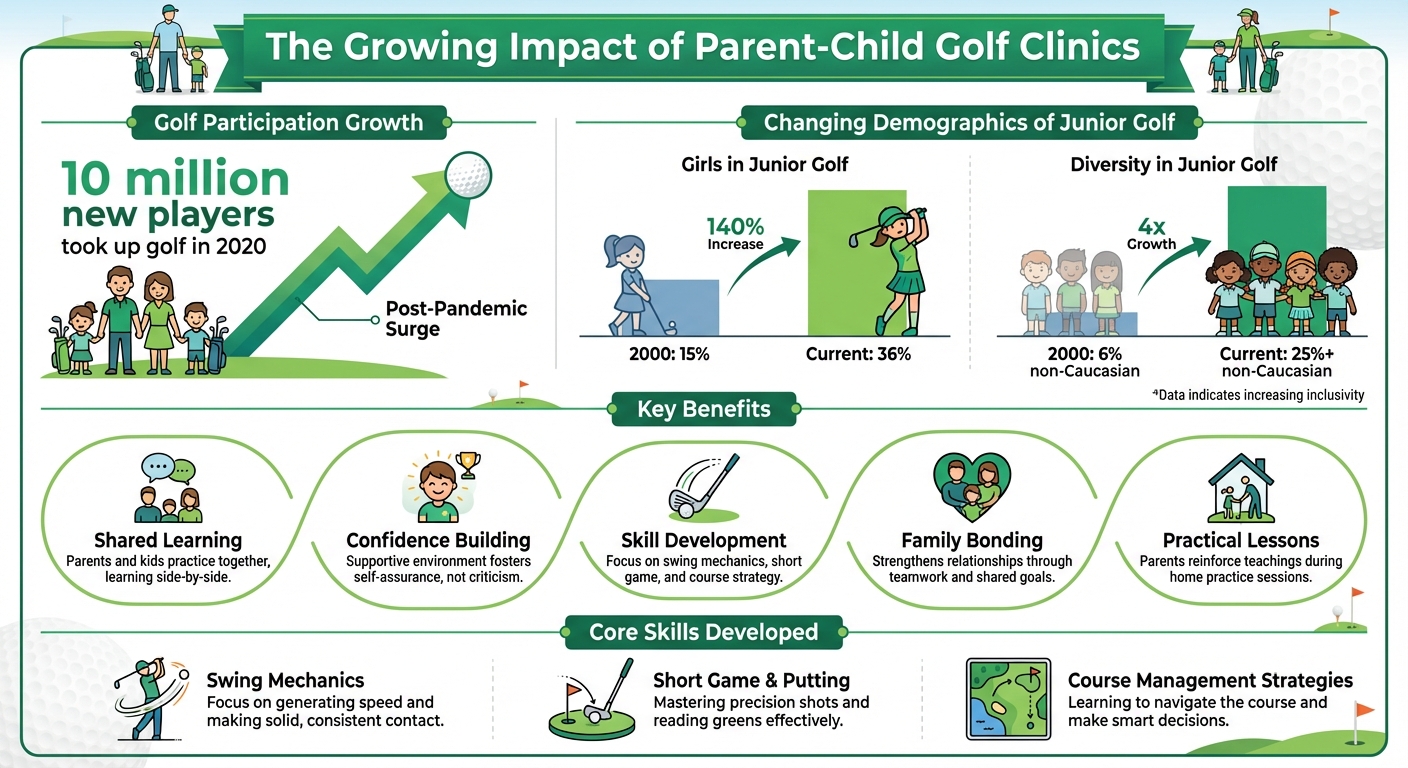
Parent-Child Golf Clinics Impact on Junior Golf Development Statistics
Benefits of Parent-Child Golf Clinics for Junior Golfers
Strengthening Parent-Child Relationships Through Golf
Parent-child golf clinics offer a unique way for families to bond through shared learning experiences. Picture this: parents and kids working on their swings together, celebrating successes, and laughing off the occasional mishit. It’s about more than just golf – it’s about creating memories that last. With 10 million new players taking up the game in 2020, more families are now hitting the course together than ever before.
These clinics often feature formats like parent-child scrambles, which focus on teamwork instead of competition. Parents are right there to cheer on great shots and share in the fun, helping juniors feel supported as they navigate the challenges of learning the game.
"For those parents who also play golf, try working on your own game by playing with your kids. You will both enjoy the journey together, and can form a lifelong bond over the love of the game." – Grayson Zacker, Director of Instruction, Jim McLean Golf Schools
The emphasis here is on emotional support rather than technical pressure. Mike Thomas, a PGA Master Professional, highlights the importance of positivity: "Every poor parent-child relationship I see is based on negative feedback. Any feedback that is not positive, or encouraging, is non-productive and must be avoided". By removing the stress of performance and focusing on fun, families can make golf a source of quality time and shared joy.
Building Confidence and Motivation in Young Golfers
These clinics don’t just strengthen family bonds – they also help young golfers build confidence. The supportive atmosphere lets kids learn without the fear of failure, fostering resilience and self-belief. As PGA Professional Brendon Elliott puts it, "the casual and supportive environment helps alleviate the pressure and anxiety often associated with the game".
A big focus is on developing a growth mindset, where mistakes are seen as stepping stones rather than setbacks. Parents play a crucial role in shaping this perspective. Instead of obsessing over scores, they’re encouraged to praise effort and persistence. Chris Finn, Founder of P4S Golf, explains: "Mistakes should be viewed as opportunities to learn and grow, not failures. Parents and coaches play a pivotal role in shaping a growth mindset in a junior".
To keep things engaging, many clinics use gamified activities like putting tic-tac-toe or "bowling" on the green. These games teach technical skills in a fun, low-pressure way, keeping kids motivated and eager to return for the next session.
This nurturing environment creates a strong emotional foundation, setting juniors up for success both on and off the course.
Learning the Basics in a Supportive Setting
Parent-child clinics are also a great way for juniors to build a solid grasp of golf fundamentals. Key skills like grip, stance, alignment, and posture are taught in a hands-on, approachable way. Coaches often prioritize "speed and contact" to help beginners get a feel for proper impact before diving into the finer details of technique.
Kids naturally pick up on their parents’ habits, making side-by-side learning especially effective. Watching their parents practice reinforces proper techniques in a way that isolated instruction simply can’t match.
Many programs also use scaled course experiences to set juniors up for early success. For example, the Longleaf Tee System, a collaboration between the American Society of Golf Course Architects and U.S. Kids Golf, adjusts course yardage based on a child’s driving distance. Starting just 10–50 yards from the green ensures that juniors experience small victories early on, building their confidence and enthusiasm for the game.
With these basics in place, young golfers are well-prepared to refine their skills and take their game to the next level.
Skills Juniors Develop at Parent-Child Golf Clinics
Improving Swing Mechanics
Parent-child golf clinics place a strong emphasis on building solid swing mechanics. According to PGA coaches, the foundation lies in two key elements: speed and contact. As they explain, "The two most important building blocks are speed and contact. Players need to learn how to swing the club and generate speed".
Rather than fixating on specific arm or elbow positions, coaches encourage juniors to focus on the club’s movement. This approach helps young golfers develop fluid, balanced swings. Juniors are taught to swing freely while maintaining balance, which naturally enhances their swing smoothness over time. Practicing alongside their parents reinforces these lessons, as children often learn effectively through observation.
Once juniors achieve a smoother swing, they’re ready to dive into the details of their short game.
Developing Short Game and Putting Skills
Short game instruction at these clinics adds an element of fun to learning. Through games and contests, juniors practice chipping and putting in an engaging way. For instance, instructors may challenge kids to chip 10 balls within three feet of the hole, helping them build precision and a competitive edge.
When it comes to putting, alignment takes center stage. Kellie Stenzel, a Top 100 Teacher, emphasizes the importance of putterface alignment:
"Where you aim your putterface has to be a huge priority if you want to make your short putts, because the ball will travel where your putterface is pointed at impact".
Drills like the 3-6-9 drill – a progression where juniors must sink a 3-foot putt before moving on to 6 and 9 feet – further develop their accuracy.
For chipping, clinics encourage juniors to focus on landing zones instead of aiming directly at the hole. This approach helps them build a feel for green slopes and improve distance control. PGA Professional Justin Blazer highlights the importance of this skill:

"A golfer understands the reason to spend quality time practicing chipping or bunker play once they’re faced with those challenges on the golf course".
Learning Course Management Strategies
Beyond technical skills, these clinics introduce juniors to the strategic side of golf. They learn to evaluate factors like wind direction, ball lie, and distance before choosing a club. This helps them weigh the risks and rewards of different shots, such as opting for a safer layup instead of attempting a risky long shot.
Parents play a key role in this learning process by asking open-ended questions rather than giving direct instructions. Questions like "What do you think about this shot?" or "How would you adjust your strategy here?" encourage juniors to think critically and make their own decisions.
To simplify strategic practice, many clinics modify the course. For example, juniors might start rounds from 50 yards out, focusing on scoring and club selection at manageable distances. As their skills improve, they gradually move back to 100 and then 150 yards. This "backward" approach – starting closer to the green and working back to the tee – not only builds confidence but also teaches valuable course management strategies.
How Parental Involvement Speeds Up Junior Golf Development
Creating a Collaborative Learning Environment
Parents play a crucial role in speeding up their child’s golf development by actively participating in the learning process. Clinics that encourage parents to engage alongside their kids create a shared environment where learning becomes a family effort. Grayson Zacker, Director of Instruction at Jim McLean Golf Schools, highlights this dynamic:
"Kids are great visual learners, and they learn so much in life from watching their parents".
By modeling good sportsmanship and a positive attitude, parents teach their children that effort and perseverance are more important than hitting the perfect shot. For example, when a parent stays calm after a bad shot or celebrates effort over results, kids naturally pick up on these behaviors. Eric Alpenfels, Director of the Pinehurst Golf Academy, underscores the importance of clearly defined roles:
"The most important thing is that the parent realize their role is more as the parent than as the coach. It’s hard to do both".
When parents focus on being supportive rather than taking on a coaching role, it allows professional instructors to handle the technical aspects, creating a more effective learning environment.
Providing Consistent Encouragement and Feedback
Encouragement is most effective when it focuses on the process rather than just the outcome. Psychologists often recommend one simple yet powerful phrase for parents:
"I love to watch you play".
Mike Thomas, a PGA Master Professional and father of pro golfer Justin Thomas, stresses the importance of positive reinforcement:
"Any feedback that is not positive, or encouraging, is non-productive and must be avoided".
This approach leaves technical critiques to the coach while parents focus on emotional support. Chris Finn, Founder of P4S Golf, adds:
"Mistakes should be viewed as opportunities to learn and grow, not failures. Parents and coaches play a pivotal role in shaping a growth mindset in a junior".
This steady encouragement helps kids stay motivated and builds resilience, which often carries over into practice sessions at home.
Practicing Clinic Lessons at Home
The encouragement kids receive from parents can be further reinforced through home practice. At home, parents can help their children focus on fundamentals like grip, posture, and alignment. Incorporating games into practice – such as putting contests, chipping challenges, or full-swing competitions – can make practice more engaging and foster a healthy competitive spirit.
Erika Larkin, a Golf Digest 50 Best Teacher, offers advice on keeping practice sessions enjoyable:
"Leave while everyone is having fun. If you wait until your child gets tired, the attitude toward golf sours".
Ending practice on a high note ensures that kids associate golf with fun rather than frustration. Additionally, giving kids the space to work through mistakes on their own builds independence, a critical skill for tournament play. As Mike Thomas points out:
"If you have to tell them to practice, they will look at it more as work".
sbb-itb-bcd8bdd
Using Online Resources to Complement Parent-Child Clinics
How To Break 80 eBooks and Videos for Junior Golf Improvement

Blending online tools with parent-child golf clinics can make lessons stick and encourage regular practice at home. Platforms like How To Break 80 offer resources that reinforce the fundamentals taught in clinics, giving juniors the tools they need to improve their game. For instance, the Ultimate Distance Master Class – a free video course – teaches juniors how to maximize their swing potential. It’s especially helpful for young golfers looking to add distance without depending on size or strength. One standout tip from the course reportedly helped a student increase their drives by 60 yards.
When it comes to putting, the platform includes guides on using portable stroke trainers such as gate aids, mirrors, and wrist sensors. These tools help juniors refine their alignment and stroke path at home. Additionally, augmented reality (AR) systems are covered, offering features like contour maps and aim lines to simplify green reading and improve speed control using visual cues.
These digital resources act as a bridge, connecting clinic-based lessons with at-home practice. Parents can also invest in tools like the Precision Putting and Maximum Distance video courses, priced at $49.00 each, which align closely with drills taught in clinics. For a more comprehensive approach, the Essential Golf Improvement eBook Bundle ($19.00) provides practical advice on swing mechanics, putting, and driving skills.
Comparison of How To Break 80 Resources for Parent-Child Practice
Here’s a quick look at how different How To Break 80 tools address the needs of junior golfers:
| Plan Name | Price | Description | Relevance to Junior Skills |
|---|---|---|---|
| Essential Golf Improvement eBook Bundle | $19.00 | A detailed eBook collection for skill improvement | Offers drills for swing, putting, and driving |
| Fix Your Slice & Hit a Draw Video Course | $99.00 | Step-by-step video course to correct slicing and hit draws | Ideal for juniors working on shot consistency |
| How to Break 80 eBook | $29.00 | A guide to improving scores and breaking 80 | Features techniques adaptable for junior players |
| Maximum Distance Video Course | $49.00 | Focused on driving distance techniques | Perfect for juniors aiming to improve power and accuracy |
| Precision Putting Video Course | $49.00 | Drills for putting precision and accuracy | Tailored guidance for better performance on the green |
These resources are excellent for extending the benefits of professional instruction into the home, providing juniors with the tools they need to keep improving. While they don’t replace in-person coaching, they’re a valuable addition to any young golfer’s training routine.
How to Teach Grit and Resilience in Junior Golf – Jeff Leishman
Conclusion: The Long-Term Impact of Parent-Child Golf Clinics on Junior Golfers
Parent-child golf clinics lay a foundation that stretches far beyond the practice range. The growth of junior golf continues to rise, with more families recognizing the value of learning and playing together.
One of the most powerful aspects of these clinics is the role of visual learning. Young players often emulate their parents – not just because of genetics, but by observing their techniques and behaviors firsthand. This natural imitation, paired with emotional encouragement, creates an environment that fosters growth like no other.

These clinics also reframe the role of parents, shifting them from technical critics to emotional supporters. When parents focus on encouragement rather than critique, young golfers build confidence that lasts. As PGA Master Professional Mike Thomas explains:
"Every poor parent-child relationship I see is based on negative feedback. Any feedback that is not positive, or encouraging, is non-productive and must be avoided".
This approach to positive reinforcement helps young golfers develop the resilience needed to improve over time. It’s a lesson that benefits them not just on the course but in other areas of life as well.
Beyond skills and confidence, these clinics are helping to make golf more inclusive. Participation demographics are changing – 36% of junior golfers are now girls, compared to just 15% in 2000, and over 25% of juniors are non-Caucasian, up from 6% two decades ago. These shifts highlight how family involvement can make the game more accessible to everyone. Paired with resources like How To Break 80 video courses and eBooks, parent-child clinics provide a solid starting point for a lifelong love of golf.
FAQs
How do parent-child golf clinics strengthen family connections while improving junior skills?
Parent-child golf clinics offer a welcoming and enjoyable setting where families can learn and connect through the game of golf. These sessions are designed to let kids practice at their own pace, free from pressure, while parents provide encouragement, constructive feedback, and plenty of cheers. Fun activities like putting contests or team challenges bring a playful edge to the lessons, helping young players sharpen their skills while creating moments of teamwork and laughter.
But it’s not just about improving technique. These clinics give parents the opportunity to demonstrate sportsmanship and offer emotional support, which can build a child’s confidence and perseverance. The shared experiences – whether it’s celebrating a perfectly executed shot or laughing off a missed putt – transform practice into treasured family time. For those wanting to take their sessions up a notch, How To Break 80 provides kid-friendly drills and swing tips that are easy to integrate into practice, keeping things fun while focusing on growth.
What skills do juniors develop at parent-child golf clinics?
At parent-child golf clinics, young players learn the fundamentals of the game, such as how to grip the club correctly, establishing a solid stance, mastering swing mechanics, and honing short-game skills like putting and chipping. But these clinics offer more than just technical training – they help kids develop confidence, resilience, and a sense of sportsmanship. Plus, they create a fun and encouraging space where families can bond and share the experience together.
How can parents help their kids improve at golf while keeping it fun?
Parents have a special role in helping young golfers grow their skills while keeping the game enjoyable. The best way to support your child is by creating a fun, low-pressure atmosphere. Celebrate their effort and progress rather than fixating on scores, and steer clear of overanalyzing their mistakes – leave the technical coaching to the professionals. Instead, focus on building their confidence and sharing in the joy of the game.
One great option is to join parent-child golf clinics, which blend expert instruction with quality family time. These sessions not only sharpen skills but also create lasting memories on the course. At home, keep practice light and entertaining with games like tic-tac-toe putting or closest-to-the-pin challenges. Also, ensure your child’s clubs are properly fitted to their size and strength – this is key to developing strong fundamentals.
For extra tips and drills, check out How To Break 80, which offers free guides, video lessons, and eBooks for golfers at any level. These resources can complement clinic lessons and help families build a consistent, enjoyable practice routine that promotes improvement while strengthening family bonds.
Related Blog Posts
- Top 5 Regional Junior Golf Clinics
- Parent-Coach Roles in Junior Golf Clinics
- Ultimate Guide to Junior Golf Plans
- Benefits of One-on-One Junior Golf Lessons
