
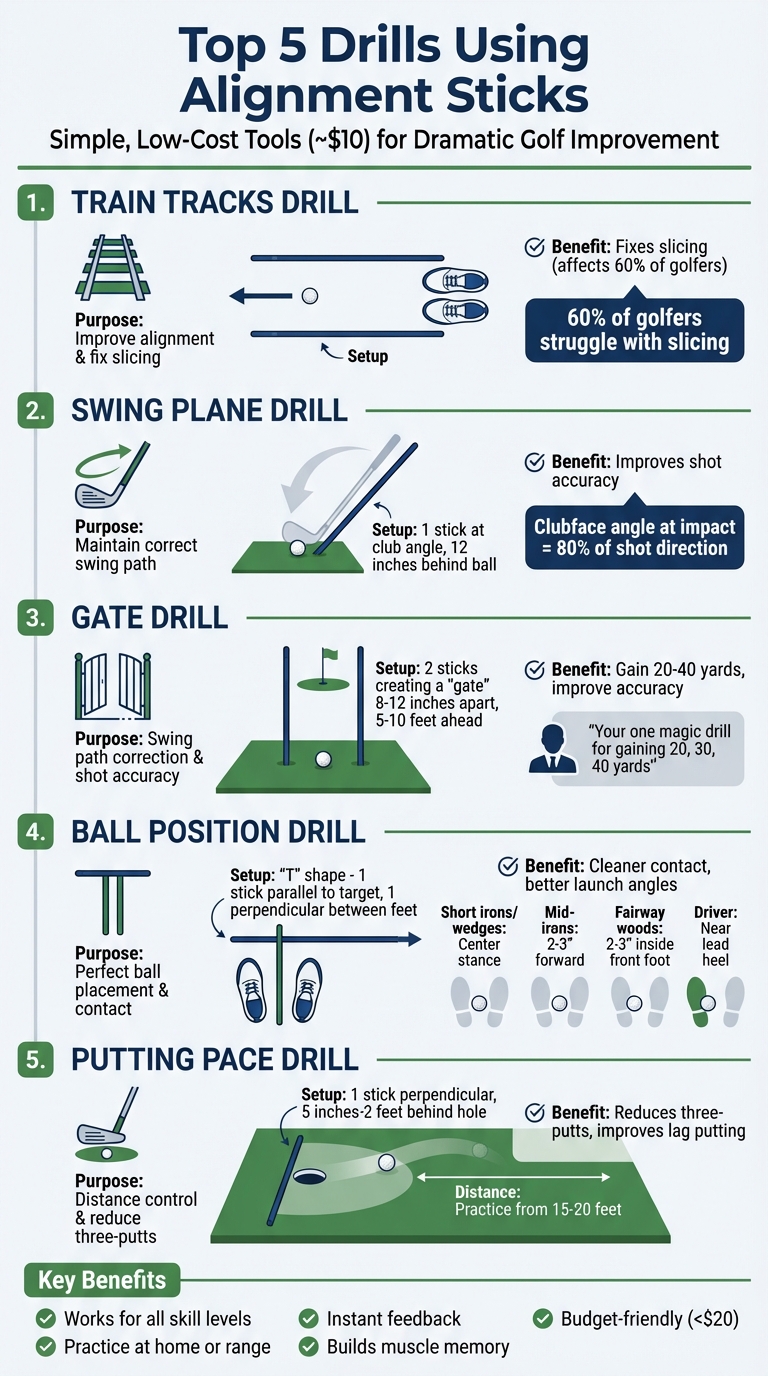
Alignment sticks are a simple, low-cost tool that can dramatically improve your golf game. Priced around $10, they help refine alignment, swing path, ball position, and even putting. Here’s a quick look at five drills that can elevate your skills:
- Train Tracks Drill: Align two sticks parallel to your target to practice a square stance and correct slicing.
- Swing Plane Drill: Position a stick as a guide for your swing path to prevent flat or steep swings.
- Gate Drill: Create a "gate" with sticks for swing path correction or shot accuracy.
- Ball Position Drill: Use a "T" setup to perfect ball placement and improve contact.
- Putting Pace Drill: Place a stick behind the hole to master distance control and reduce three-putts.
Each drill offers instant feedback, helping golfers of all levels build muscle memory and consistency. Whether you’re at the range or practicing at home, alignment sticks are an excellent addition to your training routine.
5 Essential Golf Alignment Stick Drills for Better Performance
5 SIMPLE GOLF DRILLS WITH ALIGNMENT STICKS TO IMPROVE YOUR ACCURACY!
1. Train Tracks Drill
The Train Tracks Drill is a simple yet effective way to guide your club’s swing path and improve alignment. Start by placing two alignment sticks on the ground, parallel to each other, aimed directly at your target. Position one stick about 1–2 inches outside the golf ball along the target line, and the other near your toes. This setup creates a "train track" visual, helping you understand and practice a square stance.
"The Train Tracks drill will help train your brain to know what a square stance looks like and how you should be lining up every single shot." – Ryan William, Golf Authority
Here’s how to make the most of this drill:
Take slow, controlled swings, keeping the clubhead within the "track." This method targets one of the most common issues in golf – slicing. In fact, around 60% of golfers struggle with this problem. If your swing path veers off, the alignment sticks will make it immediately noticeable, allowing for quick corrections.
For added precision, adjust the spacing between the sticks to about 4 inches. You can also place a third stick perpendicular to the others, positioned between your legs, to ensure consistent ball placement for different clubs.
"No matter how good your swing and compression of the golf ball are, you are unlikely to get the golf ball close to the target without proper alignment." – Nick Lomas, Founder of GolfSpan
After hitting a few shots, examine your divots. Ideally, they should run parallel to the alignment sticks, confirming that your swing path is on point. This simple check reinforces good habits and ensures your practice translates to better results on the course.
2. Swing Plane Drill
The Swing Plane Drill is a fantastic way to use an alignment stick to visualize and maintain the correct swing path. Here’s how to get started: position an alignment stick at the same angle as your club, roughly 12 inches behind the ball. This inclined stick acts as a guide for your swing path, helping you stay on track.
The goal is to keep your club parallel to the alignment stick throughout your swing. If your club dips too low or rises too sharply, you’ll notice it veering off the intended path. PGA Professional Brendon Elliott highlights a common issue many golfers face:
"The biggest mistake I see is golfers getting ‘flat’ at the top and then ‘steep’ coming down. Focus on maintaining that parallel relationship between your swing plane and the alignment stick throughout your swing."
Begin with slow, controlled swings at about 25% of your usual speed to build muscle memory for the correct swing plane. Gradually work your way up to full-speed swings. For golfers who struggle with slicing, you can tweak the stick’s position so that an over-the-top swing would cause your club to hit it. This adjustment encourages an inside-to-out swing path, which can help correct slicing tendencies. For more experienced players, this drill is also a great way to fine-tune your mechanics during practice.
Whether you’re just starting out or have years of experience, this drill is a valuable tool. It not only improves your alignment but also polishes the finer details of your swing. Considering that the clubface angle at impact influences 80% of a shot’s direction, using this drill can significantly enhance your shot accuracy and consistency.
3. Gate Drill
The Gate Drill is a handy alignment stick exercise that provides instant feedback on your swing path and clubface control. By creating a visual "gate" for your club or ball to pass through, it helps you refine either your swing path or shot accuracy, depending on how you set it up.
For swing path correction, place two alignment sticks diagonally around the ball. Position one stick about a foot behind the ball and slightly outside your target line, and the other about a foot in front of the ball and slightly inside the target line. This setup promotes an inside-to-out swing path, making it especially useful for golfers struggling with a slice. Tyler Ferrell, a Golf Digest Best Young Teacher, emphasizes its impact:
"This could be your one magic drill for gaining that 20, 30, 40 yards".
For shot accuracy and starting direction, insert two alignment sticks vertically into the ground, spacing them 8 to 12 inches apart. Place these sticks roughly 4 paces (or 5–10 feet) ahead of the ball, aligned with your target line. The goal is simple: hit shots that pass cleanly between the sticks. According to PGA Professional James Standhardt from GolfTec Naperville:
"If your main focus is simply to make as many balls as possible start between the sticks you’ll be amazed at how intuitive it is and how accurate you become in a short amount of time".
Since the clubface angle at impact determines about 80% of a shot’s starting direction, this drill zeroes in on one of the most critical aspects of accuracy.
To get started, use a wider gate and practice with slower swings. As your consistency improves, narrow the gap for a greater challenge. If your club or ball hits a stick, you’ll know right away that your swing path or clubface angle needs adjustment – no guessing involved.
This drill is effective for golfers of all skill levels, whether you’re a beginner learning to hit straight shots or an experienced player fine-tuning your control over ball flight.
sbb-itb-bcd8bdd
4. Ball Position and Angle of Attack Drill
The Ball Position and Angle of Attack Drill relies on a simple yet effective tool: alignment sticks. By forming a "T" shape with one stick parallel to your target line and another perpendicular between your feet, you can pinpoint the exact position of the ball. This setup takes the guesswork out of ball placement and highlights how its position affects your contact with the club.
Here’s why this works: your swing naturally creates an arc, with the lowest point typically aligning with your center of gravity. The ball’s position relative to this arc determines the type of strike you achieve – whether it’s compressing the ball with irons, sweeping with fairway woods, or catching the driver on the upswing. PGA Professional Pete Styles emphasizes the importance of this:
"One of the most important points, that influences a golfer’s consistency in striking the ball well, is the position of the golf ball in between the feet at the set up position".
To practice a proper downward strike with irons, place an alignment stick on the ground about an inch behind the ball, perpendicular to your target line. The goal is to hit the ball cleanly without touching the stick. If your club makes contact with the stick first, it signals early ground contact. This real-time feedback helps you refine your swing for ball-first contact and better compression. As Performance Golf explains:

"Proper ball position leads to cleaner contact, better launch angles, and more consistent distance control".
Keep in mind, ball position varies by club. For short irons and wedges, position the ball in the center of your stance. For mid-irons, move it 2–3 inches forward. Fairway woods require placement 2–3 inches inside your front foot, while drivers should be positioned near your lead heel. The perpendicular stick in your "T" setup acts as a reliable checkpoint, ensuring consistency as you switch between clubs.
This drill isn’t just for beginners learning the basics – it’s also a valuable tool for seasoned players, helping them fine-tune their precision and elevate their ball-striking to the next level.
5. Putting Pace Drill
Fine-tune your distance control with the Putting Pace Drill, a simple exercise designed to improve your putting speed. Here’s how to set it up: place an alignment stick on the green, positioned perpendicular to your target line, about 5 inches to 2 feet behind the hole. From a distance of 15 to 20 feet, practice putting so the ball reaches the cup without hitting the stick if it misses. This setup gives you immediate feedback on whether your stroke pace needs adjusting.
This drill is a great way to reduce three-putts by teaching you how to "lag" the ball into a safe zone near the hole. If your putt hits the stick, it means your pace is too aggressive. If it falls short, you’ll know to add a bit more speed. The stick acts as a physical checkpoint, helping you refine your touch and adapt to different distances and speeds.
Begin with the stick 2 feet behind the hole. As your control improves, move it closer – up to 5 inches – or try placing it 2 feet in front of the hole to challenge yourself further. This variation encourages you to putt more assertively while still maintaining precision.
The best part? This drill works on any type of slope – uphill, downhill, or flat – making it versatile for different green conditions. Use it as part of your pre-round warmup to get a feel for the day’s green speeds and sharpen your touch before heading out. It’s a practical and effective way to improve one of the most important aspects of your game.
Conclusion
Alignment sticks are a straightforward and effective tool for improving your golf game. They help fine-tune key fundamentals like alignment, swing path, and ball positioning. And the best part? They’re budget-friendly, often costing less than $20. As PGA Professional Brendon Elliott explains, "What you feel in your swing and what’s actually happening are often completely different… alignment sticks provide the visual boundaries that groove proper movements".
The drills outlined earlier are designed to reinforce these fundamentals. By focusing on alignment, swing path, ball position, and distance control, these exercises address common challenges like slices or inconsistent body rotation. Over time, they help you develop muscle memory that translates seamlessly to the course.
One of the best things about alignment stick drills is their flexibility. You can use them for full swings, short game practice, and even putting. Many of these drills don’t even require hitting a ball, making them perfect for at-home practice during the off-season or whenever you’re unable to get to the course.
FAQs
How can alignment sticks help fix a golf slice?
Alignment sticks are an easy-to-use tool that can make a big difference in fixing a slice. By placing them as visual guides, they encourage you to swing on an inside-out path while keeping the clubface square to your target. This setup helps eliminate the over-the-top motion that’s often behind slicing.
Using alignment sticks regularly helps you build better swing habits, which can lead to straighter and more accurate shots with practice.
How can alignment sticks help improve putting accuracy?
Using alignment sticks to enhance your putting accuracy is both straightforward and effective. One popular drill involves creating a narrow gate to help you develop a straighter, more consistent stroke. Here’s how you can set it up:
- Lay two alignment sticks on the ground, parallel to your target line, spaced about 4–6 inches apart. Ensure they’re aimed directly at the hole.
- Place the ball in the center of this "gate", keeping it equidistant from both sticks.
- Adjust your stance so your feet, hips, and shoulders are aligned squarely with the target line.
- Practice stroking the ball, focusing on keeping the putter head and the ball’s path within the "tunnel" formed by the sticks.
This drill not only helps you groove a consistent stroke but also gives you a clear visual of the target line. It’s a simple way to build confidence and accuracy on the green.
Can you practice alignment stick drills without hitting a golf ball?
Alignment stick drills can work wonders for fine-tuning the basics of your golf game, such as posture, rotation, weight transfer, and swing path. The best part? You don’t even need to hit a ball to practice these. Whether you’re at home, at the range, or even out in your backyard, these drills help sharpen your technique and develop muscle memory for a more consistent swing.
Related Blog Posts
- 5 Balance Drills for a Steady Golf Swing
- 5 Steps to Align for Accurate Drives
- Ultimate Guide to Using Alignment Sticks
- 5 Putting Drills for Beginners
