
Golfers often practice for hours yet see little improvement. Why? Lack of structure. A progressive practice routine can fix this by focusing on measurable goals and targeted drills. Here’s how:
- Track Your Stats: Identify weaknesses like putts per round or fairways hit.
- Focus on Key Areas: Spend 50% of practice time on short game (65% of shots happen within 100 yards).
- Practice Smarter: Use drills with clear goals, like sinking 20 putts in a row or hitting targets at increasing distances.
- Set Realistic Goals: Work on 1–3 weaknesses depending on your available time.
- Consistency Matters: Practice 3–4 times a week for 60–90 minutes.
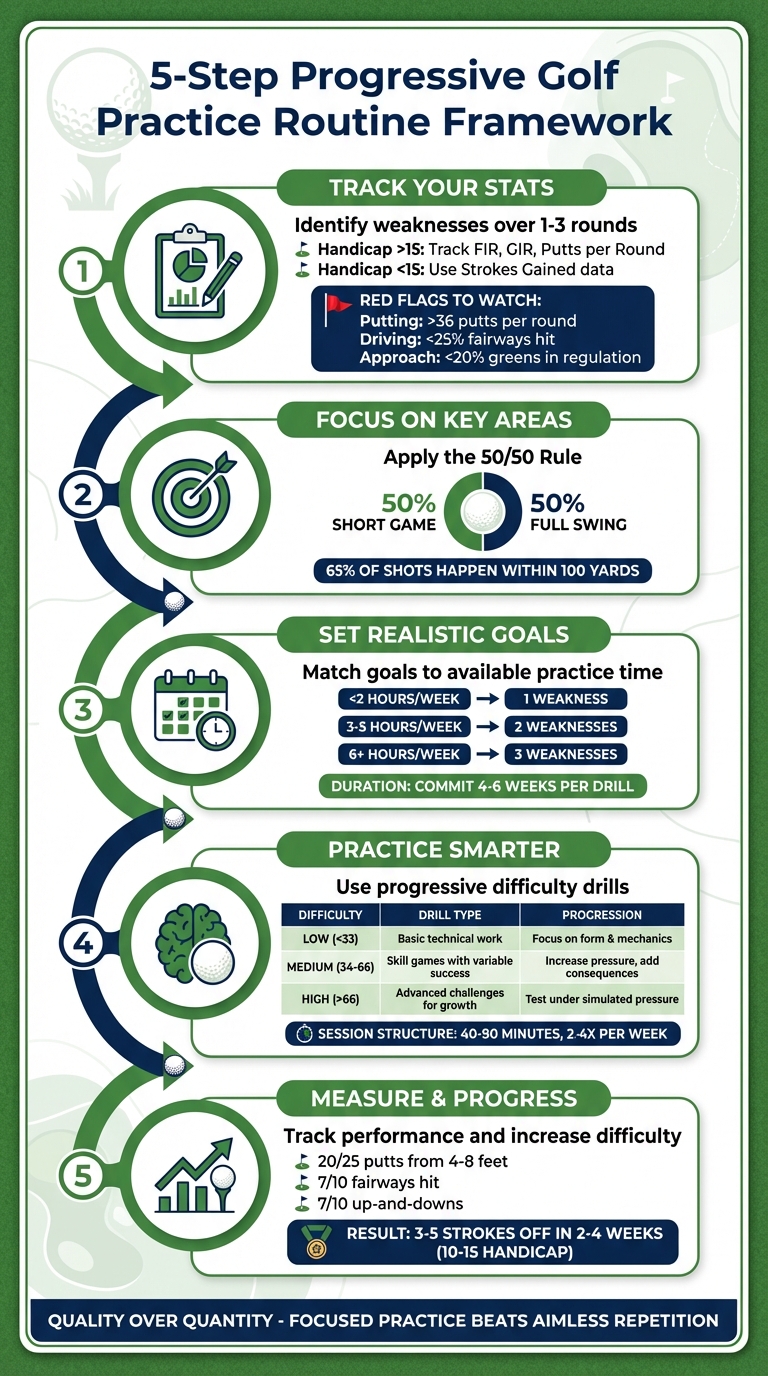
5-Step Progressive Golf Practice Routine Framework
The Basics of Progressive Practice
What Progressive Practice Means
Progressive practice is all about identifying and fixing specific weaknesses in your game using data from your playing stats. Instead of aimlessly hitting balls at the range, you focus on skill-specific drills and games that give you immediate feedback.
Think of traditional practice as a bit of a guessing game – you hit balls for an hour and hope something improves. Progressive practice takes a different approach. It’s precise and deliberate. You pinpoint exactly where your game needs work, whether it’s putting, driving accuracy, or wedge control, and then use drills designed to address those areas with real-time results. As Will Shaw, PhD, MSc, PGA Pro, explains:
"Great practice needs to be laser-focused on the areas you need to improve."
This method uses a tiered difficulty system, meaning you only move to harder challenges once you’ve nailed the basics or hit specific performance goals. For example, if you’re working on driving accuracy, you might start by aiming for a target 100 yards away. Once you consistently hit that target, you increase the distance by 25-yard increments. This approach forces you to slow down, refine your control, and build a solid foundation before taking on more advanced tasks.
This structured way of practicing lays the groundwork for the core principles explained in the next section.
Core Principles to Follow
With progressive practice, sticking to a systematic approach is key. Here are the main principles to guide your efforts:
1. Start with data. Keep track of your stats over 1–3 rounds to identify which part of your game is costing you the most strokes. If your handicap is under 15, use "Strokes Gained" data. For higher handicaps, stick to simpler stats like fairways hit or putts per round. This helps you focus your practice time on what matters most.
2. Master the basics first. Before diving into advanced drills, make sure your grip, stance, and posture are correct. Skipping these fundamentals can lead to bad habits that are hard to undo.
3. Commit to consistent practice. Spend 4–6 weeks on each drill to build muscle memory. Just like a workout routine, repetition over time is what leads to lasting improvement.
4. Use a prioritized to-do list. Instead of rigidly sticking to a practice schedule, create a list of tasks ranked by importance. This way, even if life gets in the way – bad weather, a late workday, or low energy – you can still make the most of a short session by focusing on your biggest weakness first. Research from the 2024 golf season shows that prioritizing relevant tasks is one of the best ways to quickly lower your handicap.
To organize your drills effectively, break them down by difficulty level:
Difficulty Levels:
| Practice Difficulty Level | Score Range | Description |
|---|---|---|
| Low | < 33 | Basic technical work or easy tasks you can always complete. |
| Medium | 34–66 | Skill games that challenge you some days but not others. |
| Hard | > 66 | Advanced challenges requiring high accuracy and consistency; essential for growth. |
Source:
Shaw also emphasizes that even short, focused practice sessions – just 10–15 minutes, 2–3 times a week – can lead to noticeable improvements.
Evaluating Your Current Skill Level
How to Evaluate Your Skills
To get a clear picture of your game, start by tracking your performance over 1–3 rounds using a scorecard. This will help establish your baseline.
If your handicap is above 15, focus on straightforward metrics like Fairways in Regulation (FIR), Greens in Regulation (GIR), Up and Down percentage, and Putts per Round. For those with a handicap under 15, diving into Strokes Gained data can give you a more detailed understanding of where you’re losing strokes.
Once you’ve collected this data, rank your skills. The weakest area – the one with the lowest percentages or poorest results – should become your top priority for improvement. Watch for these red flags:
- Putting: Averaging more than 36 putts per round.
- Driving: Hitting fewer than 25% of fairways or losing 2 or more golf balls per round.
- Approach Shots: Hitting fewer than 20% of greens in regulation.
You can also assess your skills outside of full rounds with specific drills. For example, test your short game using the "Par 18" challenge: play 9 holes on a chipping green, treating each hole as a Par 2 (one chip and one putt). A score above 18 signals a need to sharpen your short game. To check driving accuracy, hit 10 drives at a 20-yard wide target and count how many land inside the zone.
With this data in hand, you’ll have a clear roadmap to focus your practice efforts.
Setting Achievable Goals
Now that you’ve identified your strengths and weaknesses, use that information to set realistic and focused goals. Tailor your targets to the time you can dedicate to practice. For example:

- 2 hours or less per week: Focus on your single biggest weakness.
- 3–5 hours per week: Work on your two weakest areas.
- 6 or more hours per week: Address up to three areas.
The key is to keep your goals simple and manageable. Overly complicated plans often fall apart within a few weeks. A practical routine might involve 40–90 minutes of focused practice each week. As Golf Insider HQ wisely states:
"What gets measured, gets improved."
Set specific, measurable targets based on your current stats. For example, if your putting or approach shots need work, decide on a realistic improvement goal for the next 4–6 weeks. These small, incremental gains will not only improve your game but also keep you motivated to keep progressing.
Building Your Weekly Practice Schedule
Dividing Time Between Skill Areas
A well-rounded practice plan starts with the 50/50 Rule: divide your time equally between the full swing (long game) and the short game (putting and chipping). This might seem surprising, especially since many golfers spend over 75% of their practice time focusing on the full swing. However, most strokes are lost within 40 yards of the hole.
Tailor your practice time to your specific weaknesses. If you have less than 2 hours, focus entirely on one area. With 3–5 hours, you can target two areas, and with 6 or more hours, you can address three areas. As Will Shaw, PhD, MSc, PGA Pro, explains:
"You really do not need much practice if it is targeted at the right areas and focused on skill development".
Stick to the same drills for 4–6 weeks – or until you’ve completed each one 4–10 times – to see measurable progress. This consistency builds a strong foundation for structuring your practice sessions effectively.
How Often and How Long to Practice
Once you’ve allocated your practice time, focus on how often and how long to practice to maintain steady growth. Aim for at least two focused practice sessions per week, with each session lasting 40–90 minutes. Consistency and focus are key to reinforcing your targeted approach.
For a 60-minute session, consider this breakdown: 10 minutes of putting, 5 minutes of chipping, 30 minutes on the full swing, then finish with 10 more minutes of chipping and 5 minutes of putting. The emphasis should always be on quality over quantity – slow down, focus on making deliberate, high-quality swings, and avoid rushing through a bucket of balls.
If you’re aiming to break 80, plan to dedicate about 9 hours per week to practice – roughly 5 hours on the course and 3.5 hours divided between the range and practice greens. Even completing 60–70% of your weekly plan can lead to noticeable improvement. Short sessions, as little as 10–15 minutes, 2–3 times per week, can also make a difference. For perspective, professional golfers often practice 16–28 hours weekly when they’re not competing.
Adding Progressive Drills to Your Routine
Putting Drills That Build on Each Other
Start with the 20 In A Row drill to sharpen your start-line accuracy and simulate the pressure of real play. As Will Shaw, PhD, MSc, PGA Pro, explains:
"If you can’t start your putts on line then you’ll never be a consistent putter".
Position yourself 3 feet from the hole and aim to sink 20 putts in a row. Miss one? Reset your count to zero. This format forces you to focus and perform under pressure.
Once you’ve nailed the basics, move on to the 3-6-9 Drill. Begin by making one putt each from 3, 6, and 9 feet. To add a challenge, require two or three consecutive makes at each distance before progressing. Miss a putt? Reset to the 3-foot mark and start over.
For mid-range putting, practice from 10 to 20 feet. After every three attempts, move back 1 foot. Use a "medal play" scoring system to track your progress: a 1-putt counts as a birdie, 2-putts as par, and 3-putts as bogey.
The Ladder Drill is another great addition to your routine. Set two markers 3–6 paces apart to create a zone. Starting with one ball, aim to stack 10 consecutive putts within the zone, with each putt slightly farther than the last. This drill helps you fine-tune distance control. Kellie Stenzel, a Top 100 Teacher, highlights the importance of this skill:
"The length of your backstroke should be your primary distance controller".
These putting drills progressively challenge your skills. Once you’ve built confidence here, it’s time to shift focus to short game and full swing drills for a well-rounded practice routine.
Short Game and Full Swing Drills
After improving your putting, it’s time to tackle your short game and full swing. Start your short game practice on flat lies, then gradually introduce more challenging scenarios like thick rough, sloped lies, and bunker shots. A great way to simulate on-course conditions is the Par 18 Scoring Game. Place a ball in 9 to 18 different positions around the practice green. Chip or pitch each ball, then putt out. Keep track of your total strokes and aim to beat your personal best each session.
For full swing practice, begin with small, controlled movements and work your way up to full-speed swings. Start with 20-yard wedge shots, then progress to 40-yard and 80-yard swings before moving on to full-swing irons. A structured 30–45 minute session could look like this:
- Warm-up: Spend 10–15 minutes on half-swing wedges, focusing on balance and tempo.
- Block practice: Use 10–15 minutes to work on a specific priority with a single iron, like an 8-iron.
- Transfer training: Rotate through clubs (driver, 6-iron, wedge) while using a full pre-shot routine to mimic real-game situations.
This progression mirrors the challenges you’ll face on the course, helping you solidify your foundational skills and prepare for the variability of real play.
Measuring Progress and Breaking Through Plateaus
Tracking Your Performance Numbers
Keeping track of your performance is key to improving your game. A great place to start is by focusing on your scoring zone – the area within 100 yards of the green, where about 65% of all golf shots take place.
Use an app or a notebook to log stats like fairways hit, greens in regulation (GIR), and putts per round. For driving accuracy, track fairway hit percentages. As a reference, the average 15-handicap golfer hits about 39% of fairways (around 5.5 per 18 holes), while scratch golfers hit eight or more. Set a goal to hit 7 out of 10 fairways.
Before increasing the difficulty of your drills, establish benchmarks. For example, aim to sink 20 out of 25 putts from 4–8 feet or complete 7 out of 10 up-and-downs from different lies. Review your progress weekly to identify weaker areas that need more attention. These benchmarks will guide you on when to push yourself further.

When and How to Increase Difficulty
Once your performance numbers level out, it’s time to step up the challenge. Plateaus often occur when scores stop improving despite steady practice. Golf pro Britt Olizarowicz explains:
"Most plateaus aren’t about talent or effort. They’re about how you practice".
When progress stalls, it’s a sign to tweak your practice routine.
Think of your drills in three levels of difficulty: Low (easy to complete), Medium (manageable on some days), and Hard (rarely completed). Your practice sessions should include a mix of all three. If a drill becomes too easy, move it to medium difficulty to keep pushing yourself. For example, if a chipping drill feels routine, narrow the target area to improve precision.
With a structured practice plan focused on specific drills, a 10–15 handicap golfer could shave 3–5 strokes off their game in just 2–4 weeks. Take Karl K., who lowered his handicap from 10.5 to 8.1 in about a month by following the structured drills and tips from the How to Break 80 program. The secret lies in tracking your stats, setting clear goals, and increasing the difficulty as you consistently hit your benchmarks.
sbb-itb-bcd8bdd
Adding Physical Training to Your Practice
Exercises for Strength and Flexibility
Pairing your practice drills with focused physical training can do wonders for your swing mechanics. A strong and flexible body not only reduces the risk of injury but also lays the groundwork for a more powerful and efficient swing.
Key areas to target include hip mobility, core stability, glute strength, and rotational power. These exercises align with the same progressive approach you use in your practice drills, helping to reinforce and optimize your swing. PGA professional Brendon Elliott explains the sequence of power in a swing:
"Real power in your swing doesn’t start at your core. It begins with your feet, travels through your hips, and only then engages your core and upper body."
To improve mobility, start with exercises like the 90/90 hip stretch and the World’s Greatest Stretch. These moves help loosen tight hips, which can otherwise lead to issues such as sliding, swaying, or early extension during your swing. When it comes to core training, skip the crunches and focus on stability exercises like dead bugs, bird dogs, and anti-rotation holds with resistance bands (hold for 20 seconds).
Don’t overlook your glutes – they’re essential for maintaining posture and generating power throughout your swing. Elliott calls them "the engine room of your golf swing." Incorporate exercises like glute bridges (3 sets of 15 reps) and lateral band walks into your routine. For rotational power, try medicine ball slams with a twist – 3 sets of 8 reps per side, twice a week, should do the trick. No medicine ball? A light pillow can work for rotational throwing drills at home.
Before hitting the course, warm up dynamically with exercises like arm circles, quarter squats, lateral lunges, and hip circles. Spend 30 seconds to a minute on each move. Save static stretching, foam rolling, and chest openers for post-round recovery to improve blood flow and ease muscle soreness.
While these exercises build strength and flexibility, recovery and managing fatigue are just as important for long-term success.
Avoiding Fatigue and Injury
Building strength is crucial, but managing fatigue plays an equally important role in preventing injuries. Lower back pain, for instance, is the most common complaint among golfers and can often be avoided with smart training. Practicing while fatigued can lead to ingrained swing flaws rather than improvements.
PGA professional Frank Mantua highlights the importance of the right training approach:
"The golfer’s goal is not bulk. The goal is to develop lean and toned muscles. More repetitions, at least 12 to 15, with lighter weights will get you strong, but also keep you lean."
To find balance in your weekly routine, aim for three strength sessions: one for lower body, one for upper body, and one full-body workout. Follow a 5-week progression plan, using the fifth week as a deload period where you reduce weights to about 50% of the previous week’s load.
Cardiovascular fitness is another key component. Try walking 9 holes twice a week instead of using a cart to build endurance for longer rounds. Adding a 30-minute cardio session to your week can also help you stay mentally sharp through all 18 holes. Mantua emphasizes this point for college golfers, who often walk 36 holes in a day:
"Performing well on the last 9 holes on these long days comes down to fitness, not talent."
When fatigue creeps in during practice, switch to lighter tools to avoid overexertion. For instance, use a wooden dowel rod to practice swing motions at home – this allows you to focus on form without the strain of full-speed swings. You can also work on balance by standing on one leg while brushing your teeth, which strengthens stabilizer muscles.
Using Resources to Support Your Practice
How To Break 80

Having a clear plan can make all the difference when it comes to improving your golf game, and How To Break 80 provides just that. This platform offers a practical system built around the same principles you’re likely already applying during your practice sessions – but with added structure and focus.
At the heart of their offerings is the "How to Break 80 & Shoot Like the Pros" eBook, available for $29.00 (a steep discount from its original $99.00). This guide is packed with actionable strategies, including a detailed approach to fixing five common swing flaws and a step-by-step putting guide designed to shave 3–8 strokes off your game. Real-life success stories highlight its effectiveness: Karl K., a weekend golfer, reduced his handicap from 10.5 to 8.1 in just a month, while Drew M. achieved his first sub-80 round with a score of 77, attributing his success to the eBook’s straightforward advice on focusing on fairways and greens. The combination of written instructions and visual aids ensures a well-rounded learning experience.
In addition to the eBook, How To Break 80 offers video courses that target specific areas of your game. The "Ultimate Distance Master Class", a free resource, shares techniques to add 30–50 yards to your drives, while paid courses like the "Precision Putting Video Course" and "Maximum Distance Video Course" (each priced at $49.00) provide progressive drills to refine your skills. These courses emphasize short, focused practice sessions – just 10–15 minutes, 2–3 times a week – making them manageable for even the busiest schedules.
What sets this platform apart is its focus on measurable progress and clear feedback. Complex swing mechanics are broken down into simple, easy-to-understand steps, avoiding unnecessary technical jargon. Each drill includes specific performance goals, helping you track your progress and know when to step up the challenge. Plus, with a 30-day money-back guarantee, you can explore their structured approach without any risk. With these resources, every aspect of your game is tackled in a methodical and results-driven way.
Golf Swing Speed Training – 8 Week Programme – Part 1
Conclusion
Building an effective practice routine requires a mix of structure, dedication, and progress tracking. Start by setting SMART goals to give your practice sessions a clear direction. Allocate 40% to 50% of your time to the short game, as nearly 65% of golf shots happen within 100 yards of the green. Balance technical drills with performance-focused exercises that mimic real course scenarios, and keep track of your improvements along the way.

Once your goals are set and your practice routine is organized, consistency becomes the cornerstone of success. Stick with each drill for 4–6 weeks, as repeated focus leads to lasting improvement. On average, it takes about 2 to 3 months of committed practice to notice consistent results. Instead of chasing big changes, focus on small wins, like reducing three-putts or improving your up-and-down percentages. Remember, a focused 30-minute session with a clear objective is far more productive than two hours of aimless practice.
Adapt your routine to fit your schedule and skill level. Rather than following a rigid calendar, use a prioritized to-do list to stay flexible when life gets in the way. Aim to complete 60% to 70% of your weekly plan. This adaptable approach allows your routine to grow alongside your skills. Keep track of performance stats, gradually increase difficulty, and integrate physical training to enhance your swing mechanics and reduce the risk of injury. With a structured plan and consistent effort, steady progress is within reach.
FAQs
How can I figure out which parts of my golf game need the most work?
To figure out where you can sharpen your skills, start by keeping tabs on key performance stats like fairways hit, greens in regulation, putts per round, and strokes gained across various categories. Then, stack your numbers against standard benchmarks to highlight the areas where you’re struggling the most. With a clear picture of your weaknesses, you can zero in on those specific parts of your game during practice, giving yourself the best chance to improve.
What’s the most effective way to create a practice routine that helps me improve consistently?
To create a practice routine that actually works, focus on structure and purpose. Start by setting specific, measurable goals for each session. For example, you might aim to improve your putting accuracy or lower your average putts per round. Use your recent playing stats – like fairways hit or greens in regulation – to pinpoint weak spots and make those the focus of your drills.
Break your practice time into three parts: technical, skill-building, and performance. Spend time on the basics like grip and posture (technical), work on shot control and distance (skill-building), and simulate real-game situations (performance). A good balance might look like 20% technical, 30% skill-building, and 50% performance. To make the most of your time, try high-impact drills, such as the short-game exercises from How To Break 80.
End each session with a pressure-filled challenge, like recreating a high-stakes final-hole scenario. Afterward, review your performance and note what still needs work. Remember, steady progress comes from consistent, high-quality practice – not just putting in hours.
How can I track my progress and know when to make my drills more challenging?
To track your progress and determine when it’s time to raise the challenge level of your drills, begin by setting specific, measurable goals for each practice activity. For instance, you might aim to sink 8 out of 10 putts from 3 feet or maintain a steady swing tempo throughout your session. Before diving in, log your baseline performance, and then keep a simple record of your results after each practice. Over time, watch for patterns of improvement, such as increased accuracy or greater consistency.
When you consistently meet your goals – for example, hitting your swing tempo or achieving 80% putting accuracy over several sessions – you can gradually step up the difficulty. This could involve increasing your putting distance, slightly reducing your swing time, or introducing more challenging elements to your drills. Keep revisiting your stats to ensure you’re progressing, and pay attention to how these gains impact your overall game, such as lowering your scores or hitting more fairways. By sticking to this methodical approach, you’ll pave the way for steady, noticeable growth in your performance.
Related Blog Posts
- Golf Practice Checklist: 8 Drills for Weekend Warriors
- How To Plan A 1-Hour Golf Practice Session
- How Pros Divide Practice Time for Putting and Full Swing
- 20/20/20 Practice Routine for Golfers
