
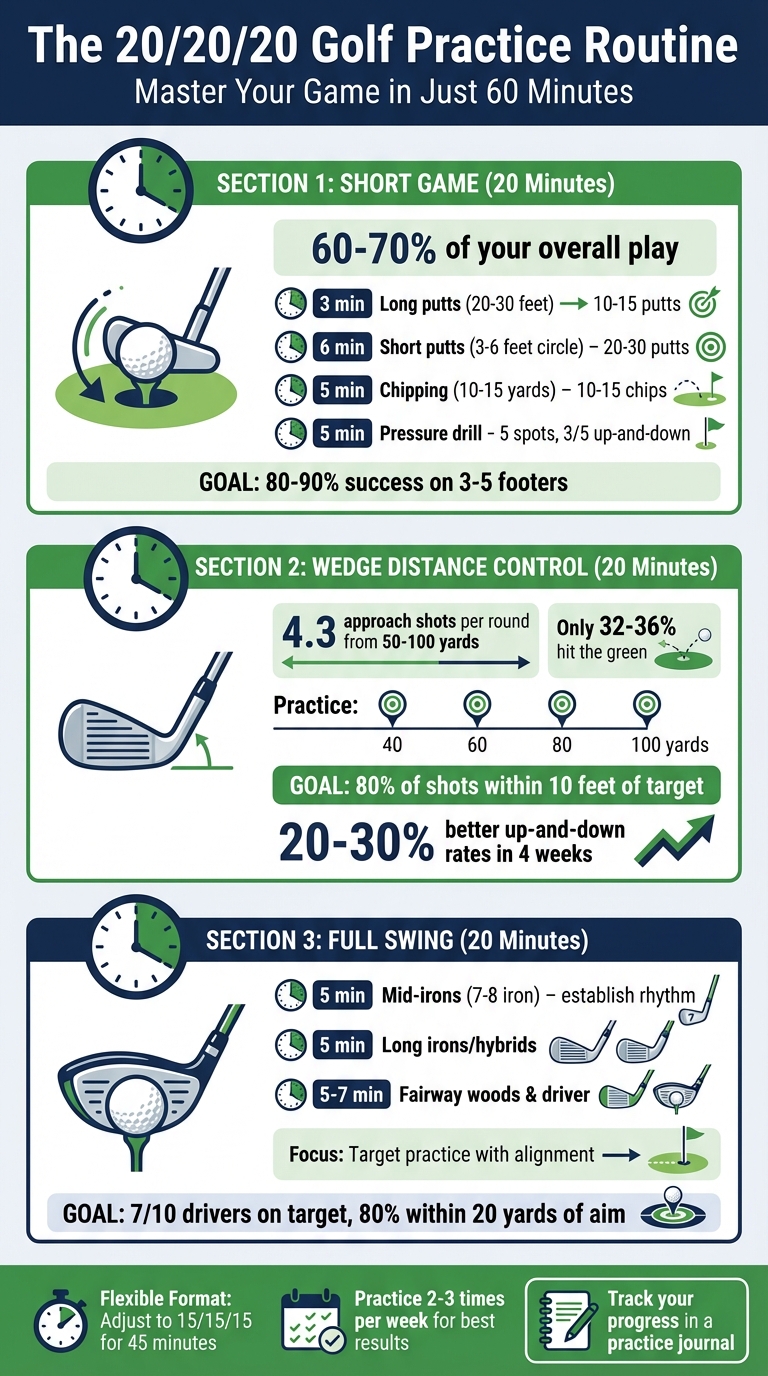
The 20/20/20 practice routine is a simple, structured way to improve your golf game in just one hour. It divides your practice into three 20-minute sessions, focusing on:
- Short Game: Work on putting and chipping to sharpen accuracy and consistency.
- Wedge Distance Control: Practice hitting wedges to specific distances (e.g., 40, 60, 80 yards) to improve precision.
- Full Swing: Focus on mid-irons, long irons, and drivers, aiming at clear targets to simulate real-game scenarios.
This method ensures you cover all important aspects of your game without wasting time. By tracking progress and setting measurable goals, you can see steady improvement in your scores. Even with less time, you can adjust the routine (e.g., 15/15/15 for 45 minutes) to fit your schedule while staying effective.
20/20/20 Golf Practice Routine: One-Hour Structured Training Guide
Segment 1: Short Game Practice
Why Start With the Short Game
Focusing on putting and chipping at the start of your practice session helps ease into the game with low-intensity movements, while sharpening your focus on the shots that matter most. These critical short-game shots – like 5-foot putts and chip shots – can account for 60–70% of your overall play. Tackling them when you’re fresh can help you lock in on the details that save strokes. Here’s how to structure this part of your practice effectively.
Chipping and Putting Drills
A well-organized 20-minute short game routine can make a big difference. Here’s a breakdown:
- 3 minutes: Start with 10–15 putts from 20–30 feet, focusing on solid contact and distance control.
- 6 minutes: Move to short putts. Arrange 6–8 tees in a circle at 3–6 feet and aim for 20–30 putts. This drill builds consistency and confidence.
- 5 minutes: Practice chipping 10–15 times from 10–15 yards, targeting clean contact and precise landing spots.
- 5 minutes: End with a pressure drill. Select 5 chipping spots and try to get up-and-down at least 3 out of 5 times. This simulates real-game pressure and challenges your focus.
By breaking your practice into these manageable segments, you’ll not only stay focused but also prepare for the kinds of high-pressure situations you’ll face on the course. After finishing, take a moment to reflect on your performance and identify areas to improve in future sessions.
Tracking Your Short Game Progress
Keeping track of your practice results is key to turning effort into improvement. Use a notebook or a tracking app to record metrics like, “Made 18/25 from 5 feet in the circle drill” or “12/15 putts from 25 feet ended within 3 feet”. Include details such as the date, practice location, green speed (slow, medium, fast), and weather conditions. Over time, these notes can reveal patterns – like struggling with putts from 6–8 feet or chips from tight lies – that help you pinpoint areas needing more attention.
Set clear goals as you progress. For example, aim to sink 80–90% of your 3–5 footers in circle drills or achieve a 50–60% success rate on chips landing within 6 feet. Tracking and working toward these benchmarks will give your practice sessions direction and purpose.
Segment 2: Wedge Distance Control
Why Wedge Play Matters
This 20-minute block is dedicated to wedge shots from 30–100 yards – a range where many golfers can shave strokes off their score. For mid-handicappers, this distance often presents a challenge. On average, you’ll face 4.3 approach shots per round from 50–100 yards, but only about 32–36% of those shots actually hit the green. Struggling with distance control in this range can cost you 3–5 strokes per round. Why? Misjudged shots lead to tough chips, three-putts, and bogeys that add up quickly. Dialing in your wedge play means more greens in regulation, simpler up-and-downs, and lower scores – all without needing to overhaul your swing.
The key is focused practice to sharpen your distance control.
Distance Control Drills
Use this 20-minute wedge session to zero in on specific yardages, not random targets. Start by hitting 5 shots from 50 yards to warm up and establish solid contact. Then, work on four key distances: 40, 60, 80, and 100 yards. For each, hit sets of balls using your pitching wedge, gap wedge, and sand wedge. Your goal? Get 80% of your shots within 10 feet of the target. Keep track of your results in a notebook: for example, "7/10 from 60 yards landed on the green, average 12 feet from the hole."
To refine your control, try the clock system: use a 9:00 swing for shorter shots, 10:30 for mid-range, and a full swing for longer distances. Record the carry distance for each combination so you know exactly how far each swing goes. Wrap up with a pressure drill – alternate between targets from 30–90 yards, aiming to keep your average distance under 15 feet from the hole across 10 shots.
Building Consistency With Wedges
Consistent wedge practice, focused on targets and tempo, directly improves your performance on the course. Pay attention to maintaining a steady tempo during every partial swing – decelerating can lead to fat or thin shots. By dedicating 20 minutes to structured wedge drills, you can improve your up-and-down rates by 20–30% in just four weeks. After each session, review your performance: note proximity averages, the percentage of greens hit, and one area to refine next time. This habit transforms aimless range sessions into measurable progress, building confidence for those critical 75-yard approach shots when your scorecard is on the line. Over time, this focused practice strengthens your overall game and boosts consistency across the board.
Segment 3: Full Swing Practice
Working From Mid-Irons to Driver
After honing your short game and wedge skills, it’s time to dedicate the final 20 minutes to your full swing. Start with mid-irons to establish rhythm, then gradually transition to longer clubs. Begin with a 7- or 8-iron for about 5 minutes, focusing on smooth, consistent contact. Next, spend 5 minutes working with longer irons or hybrids, and wrap up with 5–7 minutes on fairway woods and your driver. Pay special attention to your spine tilt and forward ball position when hitting with the driver.
Use an alignment stick on the ground to ensure your feet, hips, and shoulders stay square to your target line – this helps prevent bad habits that can creep in during range sessions. Once you’ve got a solid rhythm with your mid-irons, carry that same tempo into your longer clubs. To simulate on-course pressure, visualize a fairway between two markers and aim for it. This will help you practice both accuracy and shot shape control under realistic conditions.
Combining Technical and Performance Practice
The key to effective full-swing practice is balancing technical adjustments with performance-focused reps. For each segment, start with 5–6 technical swings where you focus on a single aspect, like swing path, grip pressure, or posture. Then, shift to performance shots by picking a specific target and going through a full pre-shot routine. Only count shots that would be playable on the course – this keeps your practice purposeful.
For example, after working on your driver’s swing path, simulate a tee shot by aiming for a 250-yard target within a 30-yard wide “fairway.” Change clubs and targets every few shots to mimic the decision-making you’ll face during a round. To add pressure, set consequences for missed targets – if you miss the fairway twice in a row, step back and do 10 slow-motion technical swings before resuming. This mix of technical focus and simulated pressure builds both skill and confidence.
Using How To Break 80 Drills

To sharpen your full-swing performance even further, incorporate drills from the How To Break 80 program. If slicing is a recurring issue, spend 5 minutes on drills from the Fix Your Slice & Hit a Draw Video Course. Exercises like the closed-stance drill or alignment-stick gate can help you groove an inside-out swing path for straighter shots. If distance is your main concern, try progressions from the Maximum Distance Video Course. Techniques like the step-through drill or experimenting with tee height can optimize your driver’s launch angle and maximize carry.
Track your progress by recording key metrics during your session. For example, aim to hit 7 out of 10 drivers between your target markers or keep 80% of your shots within 20 yards of your intended aim point. These measurable goals not only confirm your mechanics are improving but also help you fine-tune your next practice session. Together with your short game and wedge work, this structured approach ensures every part of your game gets the attention it deserves.
sbb-itb-bcd8bdd
Customizing the Routine for Your Game
Adjusting Time Based on Your Weaknesses
The 20/20/20 structure is a solid foundation, but to really improve your game, you need to tailor your practice to address your specific weaknesses. Start by tracking your rounds to pinpoint where you’re losing strokes. For example, if you struggle with three-putting or inconsistent chip shots, shift your focus. Spend more time on your short game – maybe 30 minutes – while trimming down full-swing practice to 10 minutes. The idea is to focus on what will make the biggest difference for your game.
Use your stats to guide these adjustments. A good rule of thumb is to dedicate about 50% of your practice time to your main weakness, 25–30% to maintaining your overall skills, and 15–20% to pressure drills that mimic real-game scenarios. This way, you’re not just practicing aimlessly – you’re building on the skills you need most.

Keeping a Practice Journal
A practice journal can be a game-changer. Use it to track the details of every session – date, duration, drills, and key metrics. For example, if you notice a pattern of missing 30-yard wedge shots or struggling with three-putts, jot it down. These notes will help you plan your next session more effectively.
Set specific goals in your journal to stay focused. For instance, you might aim to "land 80% of 30-yard wedge shots within 5 feet over the next two weeks." Review your entries weekly to monitor your progress. Remember, quality beats quantity every time. A sharp, goal-oriented 45-minute session can be far more productive than two hours of unfocused practice. In fact, just three focused sessions of 30 to 60 minutes each week can lead to faster improvements than practicing aimlessly every day. Your journal becomes your roadmap for smarter, more targeted practice.
Using How To Break 80 Resources
Once you’ve identified your weaknesses, leverage the resources from How To Break 80 to address them. For example, if your journal shows a high rate of three-putts, dive into the Precision Putting Video Course during your short game practice. Struggling with wedge distances? Use drills from the platform’s eBooks to zero in on those problem yardages. And if a slice is still haunting your full swing, the Fix Your Slice & Hit a Draw Video Course provides step-by-step solutions to help you straighten it out.
Even when you’re short on time, make it count. A focused 15-minute session on 30-yard chips, where you emphasize center contact and proper technique, can be far more effective than an hour of mindless practice. Incorporate pre-shot routines and give yourself immediate feedback to ensure every repetition matters. Prioritizing quality over quantity will help you see real results.
The 90-Minute Practice Plan That Will Actually Make You Better
Conclusion: Building a Consistent Practice Habit
The 20/20/20 routine works because it’s grounded in three core ideas: focus, balance, and consistency. Each 20-minute segment hones in on a specific skill, ensuring no area is neglected while avoiding overloading any single aspect of your game. Practicing this routine just two or three times a week, even for 45- to 60-minute sessions, can deliver better results than occasional, lengthy practice sessions.
If your schedule is tight, you can still make progress with a shorter session. For example, breaking 30 minutes into three 10-minute blocks can be just as effective. The secret isn’t about nailing it perfectly from the start – it’s about committing to a regular, structured practice. Track your performance and celebrate small improvements week by week. That steady progress will keep you motivated, even when it feels like gains are slow.
To make the most of your sessions, lean on proven drills to sharpen your skills. Tools like How To Break 80 drills are perfect for targeting key areas of your game. Whether you’re diving into the Precision Putting Video Course during your short game block or working on wedge distance drills from the platform’s eBooks, these resources can help you refine your technique. The practical, score-focused approach of these drills fits seamlessly into the 20/20/20 routine, turning consistent practice into real results on the course.
As seen in the short game, wedge, and full-swing segments, deliberate and focused practice leads to meaningful improvement. The 20/20/20 routine is about building real skills through repetition and structure. Even brief, focused sessions can show measurable progress when done regularly. Stick to the structure, tweak the time blocks as your skills develop, and trust that small, consistent gains in each area will add up to lower scores over time.
FAQs
How can I adjust the 20/20/20 practice routine to focus on my weaknesses?
If you want to get the most out of the 20/20/20 routine, focus each 20-minute segment on the areas that need the most attention in your game. For instance, if putting tends to trip you up, dedicate one segment to putting drills. Use the remaining segments to work on driving accuracy or sharpening your iron shots – whatever aligns with your personal goals.
By zeroing in on your specific challenges, you’ll start to notice real progress in your overall performance.
What are the best drills to improve distance control with wedges?
To sharpen your wedge distance control, try incorporating drills like the ladder drill into your practice routine. This involves targeting specific spots at progressively longer distances, helping you fine-tune accuracy and consistency. Another helpful exercise is the chip and hold drill, which emphasizes controlling your swing length and follow-through to maintain steady results.
Focus on making smooth, deliberate swings while visualizing the exact distance you’re aiming for. Consistent practice with these drills can significantly improve your touch and precision with wedges.
Why is tracking your progress important for improving your golf game?
Keeping track of your progress is a key part of improving your game. It allows you to pinpoint areas where you’re excelling and those that need a bit more attention – whether it’s your putting, driving, or swing mechanics.
When you monitor your performance consistently, it becomes easier to set realistic goals and stay motivated as you watch your efforts pay off. This kind of focus ensures your practice sessions are purposeful and aligned with your needs, paving the way for noticeable improvements on the course.
Related Blog Posts
- 10 Pre-Round Warm-Up Exercises for Better Golf Performance
- Golf Practice Checklist: 8 Drills for Weekend Warriors
- How To Plan A 1-Hour Golf Practice Session
- How Pros Divide Practice Time for Putting and Full Swing
