
The 3:1 tempo ratio in golf means your backswing should take three times as long as your downswing. For most players, this translates to a 0.75-second backswing and a 0.25-second downswing, totaling one second per swing. This timing is key for consistent, powerful, and controlled shots, as it ensures smooth transitions and proper sequencing of body movements.
Professionals like Tiger Woods, Ernie Els, and Jon Rahm consistently maintain this ratio, regardless of their swing speed or style. Amateurs often struggle with slower tempos, like 4:1 or 5:1, which can disrupt rhythm and lead to poor ball striking. Practicing drills like the "One-Two Counting Drill" and recording your swing can help you achieve this ideal tempo.
Key Takeaways:
- What it is: A 3:1 ratio of backswing to downswing time (e.g., 0.75s back, 0.25s down).
- Why it matters: Ensures smooth rhythm, consistent ball contact, and better control.
- How to practice: Use verbal cues like "one-and-two" or drills to refine your timing.
The 3:1 tempo isn’t about speed – it’s about balance and repeatability, helping golfers of all levels improve their game.
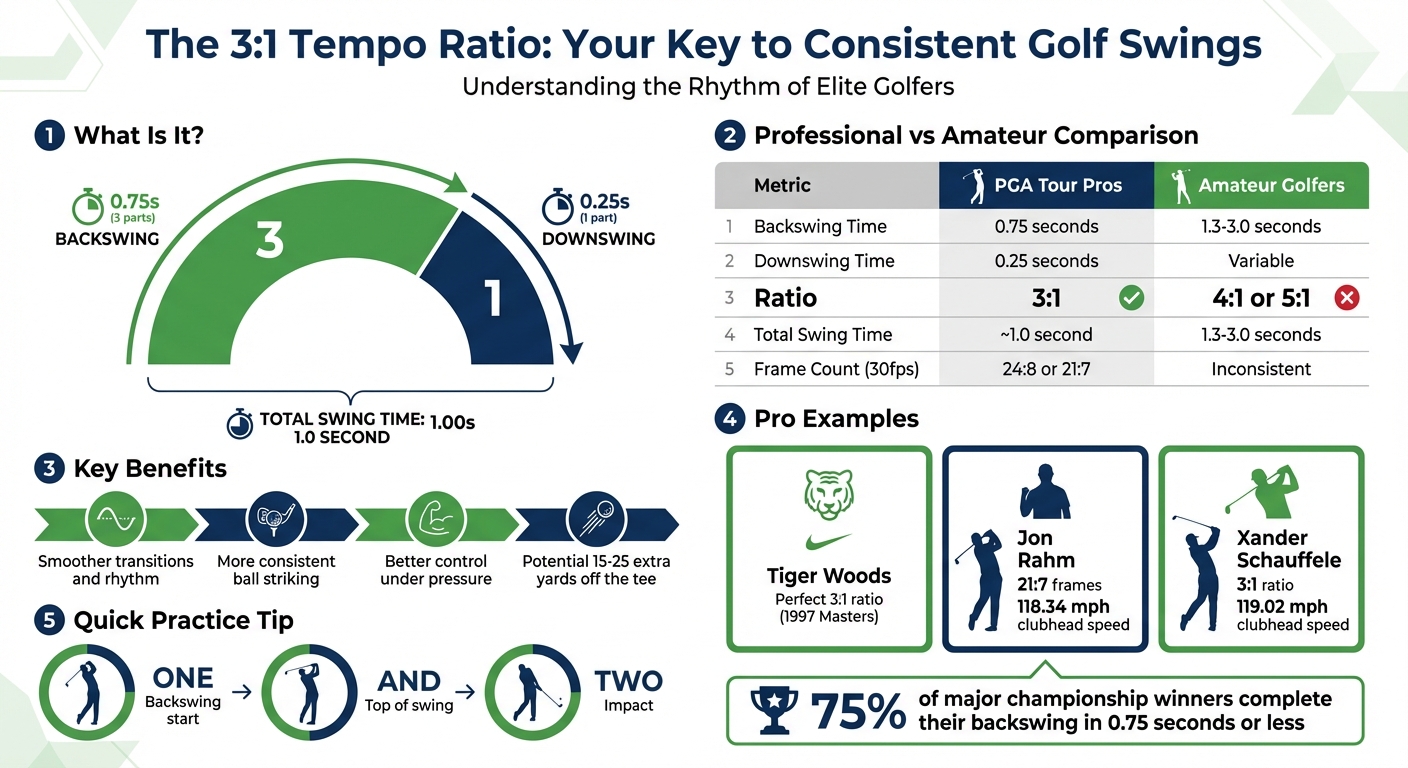
Golf Swing 3:1 Tempo Ratio Guide – Professional vs Amateur Timing
Benefits of the 3:1 Tempo Ratio
Smoother Transitions and Rhythm
A swing that’s too slow, like a 4:1 or 5:1 ratio, often leads to an abrupt and jarring transition at the top. The 3:1 ratio, however, keeps your swing flowing smoothly, avoiding that sudden change. It helps your shoulders, arms, and lower body move together, creating a unified motion rather than working against each other. Studies show that professional golfers rely on a sort of "biomechanical clock" to maintain a steady, almost hypnotic rhythm, rather than forcing their movements. This natural timing includes a brief pause at the top of the backswing, making it easier to channel energy into the downswing. Using a simple mental count like "one-and-two" can help you stay calm and focused. This synchronization lays the groundwork for consistent ball striking.
More Consistent Ball Striking
A smooth transition combined with a steady tempo leads to cleaner, more reliable contact. When your swing tempo is off, it disrupts the sequence of movements. The 3:1 ratio gives you just the right amount of time to complete the backswing and transition properly – from the lower body to the torso, and finally to the arms – ensuring the clubface is square at impact for maximum power. It also promotes a seamless flow through the kinetic chain, keeping the clubface aligned. Back in 2001, researcher John Novosel studied video footage of Tiger Woods and later expanded his findings in the 2004 book Tour Tempo. His research on hundreds of PGA and LPGA players revealed that legends like Jack Nicklaus, Arnold Palmer, and Tom Watson all shared this consistent 3:1 tempo. Additionally, this efficient motion minimizes body misalignment, potentially adding 15–25 extra yards off the tee.
Better Control Under Pressure
Pressure situations – like hitting a tricky shot near a hazard – can cause golfers to rush their swings. Focusing on a tempo cue, such as "one and two", can help quiet your mind and block out distractions. The 3:1 ratio ensures that your lower body has enough time to initiate a controlled movement, even under stress. As PGA Professional Brendon Elliott puts it:
"The magic isn’t in how fast or slow you go – it’s in keeping that 3:1 ratio consistent. That’s where the repeatability lives."
This ratio works across all swing speeds, ensuring dependable timing for every golfer. Whether you’re watching Ernie Els with his famously smooth swing or Jon Rahm with his quicker backswing, both demonstrate that different styles can still adhere to the 3:1 rhythm for consistent results.
3:1 Tempo in Professional Golf
PGA Tour Averages
On the PGA Tour, precision is everything, and tempo plays a huge role in that. The average player takes 0.75 seconds for their backswing and 0.25 seconds for the downswing, completing the entire swing in about one second. When filmed at 30 frames per second, their swings consistently show a 3:1 ratio – typically 24 frames for the backswing and 8 for the downswing, or 21:7.
A deep dive into the last 100 major championship winners revealed that 75% completed their backswings in 0.75 seconds or less, with most finishing the entire swing in under 1.2 seconds. GOLF Top 100 Teacher Tim Cooke highlighted this consistency:
"With the help of the research from John Novosel at Tour Tempo, we know that the vast majority of pros swing at a tempo of 3:1".
This level of precision is what separates professionals from amateurs. For comparison, amateur golfers typically take 1.3 to 3.0 seconds to complete their swings, often falling into a 4:1 or even 5:1 ratio. These slower tempos not only reduce potential clubhead speed but also disrupt the natural sequencing of the swing.
Player-Specific Examples
How does this 3:1 tempo play out in the swings of top players? Let’s take a closer look.
Jon Rahm, known for his short backswing and quick tempo, typically measures 21 frames back and 7 frames down when filmed at 30fps. On the other hand, Xander Schauffele has a longer backswing and a slightly slower tempo. Despite these differences, both players maintain the 3:1 ratio and generate impressive clubhead speeds – 119.02 mph for Schauffele and 118.34 mph for Rahm. As PGA Professional Bradley Turner explains:
"A slow tempo does not equate to slow club head speed".
Even legends of the game have adhered to this rhythm. During his iconic 1997 Masters win, Tiger Woods maintained a perfect 3:1 tempo, a discovery that helped John Novosel confirm this pattern as a hallmark of champions. Historical analysis of players like Jack Nicklaus and Arnold Palmer further revealed they consistently followed the same ratio throughout their careers.
These examples highlight why the 3:1 tempo is so effective – it ensures smooth transitions, consistent ball striking, and the ability to generate speed without sacrificing control.
Drills to Achieve the 3:1 Tempo
One-Two Counting Drill
A straightforward way to practice the 3:1 rhythm is by using verbal cues. As you start your takeaway, say "one" during your backswing, "and" when you reach the top, and "two" at impact. This method helps you synchronize your timing and prevents a rushed downswing.
Moving Start Drill
If the verbal counting technique doesn’t smooth out your tempo, give this drill a try. For a less jerky takeaway, begin with the clubhead positioned 2 to 3 feet ahead of the ball (closer to the target). From there, flow directly into your backswing without pausing. This continuous motion promotes a gradual increase in pace and maintains better control of the clubface, avoiding a stiff or mechanical feel. Together, these drills lay the groundwork for understanding how tempo changes depending on the club you’re using, as outlined below.
Tempo Table for Different Clubs
While the 3:1 ratio applies to full swings, the overall swing time can vary. For instance, a faster tempo might follow a 21:7 pattern, while a smoother swing could be closer to 27:9 (measured at 30 frames per second). In the short game, the tempo typically shifts to a 2:1 ratio for chips and partial wedge shots.
| Club Category | Swing Type | Target Ratio | Common Frame Counts (at 30 fps) |
|---|---|---|---|
| Driver | Full Swing | 3:1 | 21:7, 24:8 |
| Mid-Irons (e.g., 7-Iron) | Full Swing | 3:1 | 24:8, 27:9 |
| Wedges | Full Swing | 3:1 | 27:9 |
| Wedges / Chips | Short Game | 2:1 | 18:9, 20:10 |
To evaluate your tempo, record your swing at 30 frames per second. Count the frames from the start of your takeaway to the top of your backswing, and then from the transition to impact. If your ratio is 4:1 or 5:1, it means your backswing is too slow.
sbb-itb-bcd8bdd
Golf Swing Tempo Explained | Find Your Perfect 3:1 Rhythm
How How To Break 80 Can Help Improve Your Swing Tempo

Building on the drills mentioned earlier, How To Break 80 provides tools and resources to fine-tune your 3:1 swing tempo with ease.

Swing Mechanics Video Courses
The Maximum Distance Video Course ($49.00) and Fix Your Slice & Hit a Draw Video Course ($99.00) deliver clear, visual lessons on mastering the 3:1 tempo. These courses highlight how smooth energy transfer creates a "whip" effect, allowing energy to flow sequentially rather than relying on brute force. The slice-fixing course is particularly useful for addressing rushed movements at the top of the swing, which often lead to inconsistent ball striking.
For those seeking free options, the Ultimate Distance Master Class offers expert tips from top instructors on maintaining a powerful, fluid swing. These techniques could potentially add 30 to 50 yards to your drives.
If you’re someone who enjoys diving into detailed written instructions, their eBooks can provide even more insights into perfecting your swing timing.
EBooks for Game Improvement
The How to Break 80 eBook ($29.00) features a section called "The Sneaky Timing Trap" (page 32), which breaks down step-by-step instructions for achieving an ideal tempo. This popular guide includes six practice drills, complete with diagrams, designed for short 10–15 minute sessions, two to three times a week.
Beyond just swing mechanics, the eBook also offers mental strategies and a 5-step pre-shot routine to help you maintain your rhythm, even under pressure. Weekend golfer Terry V. shared his experience:
"How to break 80 is the backbone of my current success."
Additionally, its putting roadmap can shave 3 to 8 strokes off your game, improving not only your tempo but also your overall performance on the course.
Conclusion
The 3:1 tempo ratio acts as a steady metronome for your golf swing, ensuring consistency, power, and precision. As Nick Faldo aptly put it, "Tempo is the glue that sticks all the elements of a golf swing together". Whether you’re watching Ernie Els’ smooth rhythm or Jon Rahm’s compact power, tour professionals consistently follow this timing framework – typically a 0.75-second backswing paired with a 0.25-second downswing. These principles underpin every drill and tip we’ve discussed.
To truly master your tempo, focused and deliberate practice is key. The drills and techniques outlined earlier can help pinpoint and fix timing issues, such as an off-balance 4:1 or 5:1 ratio.
How To Break 80 provides tools to make the 3:1 tempo feel natural and automatic. By incorporating these strategies into your routine, you can lock in this timing and elevate your game.
Start small: pick one drill, record your swing, and analyze the frames to check your tempo. Even minor tweaks can lead to significant gains, like adding 15–25 yards to your drives and improving accuracy.
FAQs
How can I check if my swing has the correct 3:1 tempo ratio?
To measure your swing tempo, start by recording a video of your swing. Use a smartphone or camera that can capture at least 60 frames per second for better accuracy. Pay attention to three key moments: when your backswing begins, when it reaches the top, and when the club makes contact with the ball. Calculate the time it takes for both the backswing and the downswing, then divide the backswing time by the downswing time. Ideally, you’re aiming for a ratio close to 3:1 (e.g., between 2.8 and 3.2), which reflects a smooth and balanced tempo.
For a simpler, real-time approach, you can count “one-thousand-one” during your backswing and say “strike” at the downswing. If you’re looking for even more precision, tempo sensors can provide detailed feedback. By practicing regularly and keeping track of your tempo, you’ll improve your consistency and make cleaner, more reliable contact with the ball.
What are the best drills to improve my swing tempo and achieve a 3:1 ratio?
To develop the ideal 3:1 swing tempo, try incorporating these practical drills into your practice routine:
- Counting Drill: During your practice swings, count "one-thousand-one" as you move through your backswing, then say "strike" at the moment of impact. This method slows down your backswing and naturally establishes the 3:1 rhythm.
- Mental Cue Drill: Use the phrase "one-and-two" to guide your swing. Think "one" for the backswing, "and" for the transition at the top of the swing, and "two" for the downswing. This simple cue helps you lock in the correct timing.
- Alternate-Club Drill: Practice switching between a shorter club, like a wedge, and a driver while keeping the same tempo. This trains you to maintain the 3:1 rhythm regardless of the club you’re using.
Begin with the Counting Drill to set a foundation, then add the Mental Cue and Alternate-Club drills to fine-tune your timing. With consistent practice, you’ll develop a smoother and more controlled swing tempo.
What is the 3:1 tempo ratio, and why do golfers like Tiger Woods use it?
The 3:1 tempo ratio in golf describes the timing of a golfer’s swing, where the backswing lasts three times longer than the downswing. This rhythm promotes a smooth, controlled swing, which can lead to better energy transfer, greater accuracy, and more consistent ball striking.
Top players like Tiger Woods use this tempo to balance power with precision, even in high-pressure situations. By practicing this ratio, golfers at any skill level can work toward a more balanced and efficient swing.
Related Blog Posts
- 3 Simple Drills to Improve Your Golf Swing Tempo
- 5 Balance Drills for a Steady Golf Swing
- Ultimate Guide to Swing Tempo for Beginners
- 5 Drills for Wedge Distance Control
