
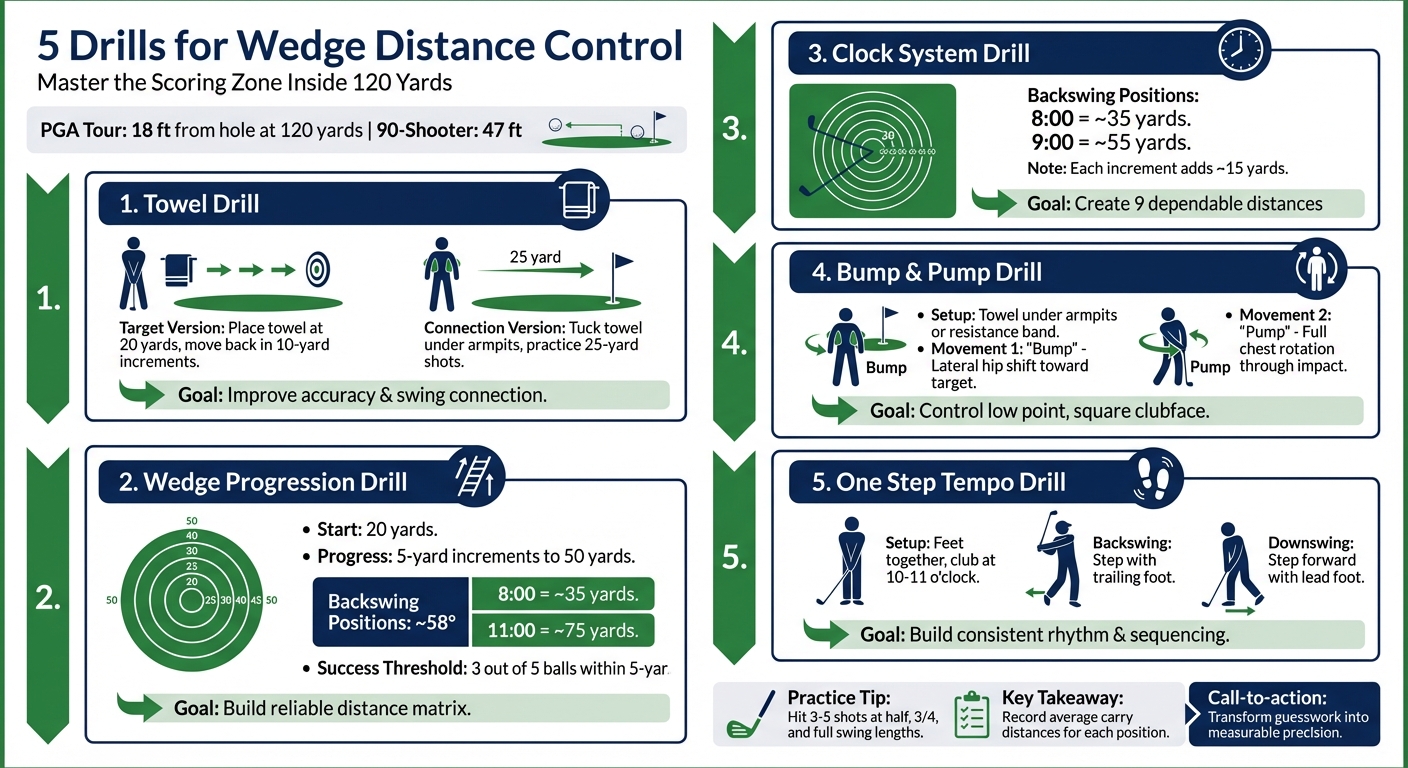
If you’re struggling to control wedge distances, you’re not alone. Many golfers face challenges with consistency inside 120 yards, often leading to longer putts and higher scores. To fix this, you need a structured approach to improve precision and confidence. Here are five drills to sharpen your wedge game:
- Towel Drill: Focus on hitting a towel at incremental distances to improve accuracy. Use a second variation to enhance swing connection by keeping a towel tucked under your arms.
- Wedge Progression Drill: Build a distance matrix by practicing carry distances in 5-yard increments, starting at 20 yards.
- Clock System Drill: Use backswing lengths (e.g., 8:00, 9:00, 11:00 positions) to create consistent, repeatable shot distances.
- Bump & Pump Drill: Improve chest rotation and body pivot for cleaner contact and better control.
- One Step Tempo Drill: Develop steady rhythm and sequencing to maintain consistency under pressure.
5 Essential Wedge Distance Control Drills for Better Golf Scoring
Wedge Distance Control Made Easy [3 Simple Drills]
1. Towel Drill for Wedges
The Towel Drill comes in two forms: one for fine-tuning your distance control and another for improving swing connection. Both drills offer immediate feedback, helping you sharpen your wedge game in terms of both accuracy and mechanics.
For the target drill, lay a towel on the ground about 20 yards away and aim to land your ball on it. Once you can consistently hit the towel, move it back in 10-yard increments. Keep track of your progress to measure improvement. Focus on finishing your swing after contact to develop a better feel for distance.
The connection drill uses a towel to enhance your swing mechanics. Drape the towel across your chest and tuck the ends under your armpits. Practice short wedge shots, starting at around 25 yards, while keeping the towel securely in place. If it falls, it’s a sign your swing needs more core rotation. Mark Blackburn, a Titleist Staff Member, highlights the benefit:
"Grab a towel under your upper arms and keep the towel pinned to your torso while rotating through the downswing. This will allow you to sense the chest rotation required to square the club face and power the shot".
Each drill serves a distinct purpose. The target drill provides clear visual feedback on your distance control, while the connection drill encourages a synchronized motion between your hips, chest, and arms. This alignment helps you control where the club bottoms out, reducing mishits like chunked or thinned shots. For perspective, PGA Tour players average 18 feet from the hole on 120-yard shots, while a 90-shooter averages 47 feet.
Start with the connection drill to build a solid rotational foundation, then move on to the target drill to refine your distance control. These steps are essential for mastering wedge play and lowering your scores.
2. Wedge Progression Drill
The Wedge Progression Drill is a practical way to sharpen your distance control with wedges, moving beyond guesswork to create a reliable system for carry distances. By building a wedge matrix, this drill helps establish a clear framework for consistent wedge play, enhancing your confidence on the course.
The process is straightforward: start at 20 yards and gradually work your way back in 5-yard increments until you reach 50 yards. Parker McLachlin, a GOLF Teacher to Watch, explains:
"Start at 20 yards, then move back five yards until you get to 50. Simply chart your distance control and see how far the ball is carrying from each location".
The drill introduces a challenge with its success threshold system. To progress to the next distance, you need to land 3 out of 5 balls within a 5-yard radius of your target. If you struggle to meet this threshold at a certain range, step back to the previous distance and repeat the process. Tyler, founder of BigTeesGolfWorld, highlights the added challenge:
"With the progressive nature of it, this drill puts some pressure on you, especially at the end".
The key here is to focus on carry distance alone. Use a range finder to measure your carry distances and mark them on your wedge shafts for quick reference during rounds.
3. Clock System Drill
The Clock System Drill takes the guesswork out of distance control by introducing a structured, repeatable approach. Instead of relying solely on feel, this method uses specific backswing lengths as reference points to fine-tune your wedge shots.
Picture a clock behind you, with your head at 12 o’clock and the ball at 6 o’clock. Your lead arm acts as the hour hand. By stopping your backswing at positions like 8:00, 9:00, or 11:00, you can produce consistent shot distances. For example, with a 58° wedge, an 8:00 swing might carry the ball about 35 yards, a 9:00 swing around 55 yards, and an 11:00 swing roughly 75 yards. On average, each increment adds approximately 15 yards.
To create your own wedge matrix, practice three distinct backswing lengths for each wedge, giving you up to nine dependable distances. Hit three to five shots at each clock position, and use a rangefinder to record your average carry distance. Some golfers even write these numbers directly on their club shafts for easy access during play. This method ensures you’re prepared to maintain consistent performance on the course.
The key to success lies in keeping your downswing speed steady, regardless of backswing length. As SwingStation advises:
"The only thing you really have to practice is being able to control the speed of your downswing consistently".
Avoid forcing the club. Instead, let gravity and your body’s natural rotation power the swing. Whether using a shorter backswing or a full one, focus on turning your chest completely toward the target for every shot. This approach promotes control and consistency with each swing.
sbb-itb-bcd8bdd
4. Bump & Pump Downswing Drill
Many golfers make the mistake of using only their arms to hit wedge shots. This often leads to a forced swing and an extended club radius, which increases the chances of chunking the shot. The Bump & Pump Downswing Drill is designed to fix this issue by focusing on chest rotation and body pivot to square the clubface and control shot distance.
To get started, place a towel under both armpits or wrap a resistance band around your chest. This helps keep your arms connected to your body throughout the motion. The drill involves two key movements: the "bump", which is a lateral hip shift toward the target as you begin the downswing, and the "pump", which is a full chest rotation through impact.
One important aspect of this drill is maintaining a consistent distance between the clubhead and your sternum during the swing. This helps you control the low point of your swing, ensuring you strike the ball cleanly before the club touches the turf. By relying on your body rotation rather than just your arms, you’ll achieve better acceleration through impact, resulting in a square clubface, improved spin, and more reliable contact.
Building on the rhythm you practiced in the Clock System Drill, incorporate these mechanics into wedge shots of varying backswing lengths. Whether your backswing stops at 8:00 or 11:00, the downswing should always follow the same pattern: bump your hips toward the target and rotate your chest fully. This consistency in mechanics is key to mastering the downswing.
A common mistake to avoid is slowing down through impact, which often leads to "guiding" the ball and inconsistent results. Instead, approach shorter wedge shots with the same confidence and commitment as a full swing. This drill trains you to use body rotation for steady acceleration, giving you the precision and reliability needed to execute pressure-filled wedge shots with ease.

5. One Step Tempo Drill
Just like the Clock System and Bump & Pump drills, finding a steady rhythm is key to consistent wedge play. The One Step Tempo Drill focuses on building that rhythm. While swing mechanics are important, tempo is what ties everything together – especially when you’re staring down a nerve-wracking 60-yard shot. As PGA Certified Instructor Clint McCormick explains:
"Tempo may not be the most glamorous aspect of golf to work on, but it will have a positive impact on creating a consistent swing, which is crucial when managing wedge distance."
To start, stand with your feet together and extend the clubhead to the 10–11 o’clock position. Let the club swing back naturally. As it does, step with your trailing foot, and during the downswing, step forward with your lead foot to finish in a balanced follow-through. This flowing motion keeps your body and club working as one, avoiding the common mistake of initiating the downswing too early with just your arms.
This drill simplifies the swing by focusing on rhythm rather than overanalyzing positions. McCormick points out:
"By keeping the body and club in motion, it simplifies the swing and encourages better sequencing without forcing you to think about positions."
It’s this natural flow that helps you stay composed when the pressure is on.
Start practicing without a ball to perfect the timing of your footwork. Make sure to wait until your hands reach the top of the backswing before stepping forward with your lead foot. Once you’ve nailed the rhythm, introduce a ball and practice hitting wedge shots at varying distances. Whether you’re aiming for 40 or 80 yards, the tempo should stay consistent. This steady rhythm builds confidence, even in high-pressure situations.
When it matters most, a reliable tempo takes the guesswork out of your swing, replacing it with instinct and trust. As McCormick says:
"Finding your rhythm seeds trust, even when nervous or playing from tough lies."
And that trust is what separates a confident wedge player from the rest.
Conclusion
Mastering wedge play requires more than just talent – it calls for a system that replaces guesswork with structured practice. The drills we’ve discussed, from the Towel Drill for maintaining connection to the One Step Tempo Drill for rhythm, all aim to build a dependable wedge game you can count on, even under pressure. A systematic approach, as outlined here, is the key to consistent results.
Start by hitting 3–5 shots at half, 3/4, and full swing lengths, and record the average carry distance for each. Use tools like a launch monitor or range finder to ensure accuracy. An alignment stick can help maintain consistent ball positioning, as even slight shifts can impact your launch angle and distance.
Once you’ve established your baseline, take it to the next level by testing your distances in pressure-filled scenarios. Instead of practicing the same yardage repeatedly, randomly pick a distance from your matrix and attempt to hit it on the first try. This approach mimics real on-course situations and builds the confidence you’ll need when facing tough shots.
The scoring zone inside 100 yards is where rounds are often decided. As Monique Thoresz, GOLF Teacher to Watch, puts it:
"One of the things that defines great players is their ability to score low even when their ball-striking isn’t up to their usual standards."
These drills transform guesswork into structure and turn vague "feel" into measurable precision. By weaving them into your practice routine, you’ll see steady improvements in your scoring. For more detailed guidance on lowering your scores and incorporating wedge control into a broader game plan, check out How To Break 80. Their eBooks, video courses, and practice plans offer a structured path to making these drills a lasting part of your game.
FAQs
What is the Clock System Drill, and how can it help improve wedge distance control?
The Clock System Drill is a straightforward method to sharpen your wedge distance control by linking specific backswing lengths – think of them as clock positions – with a steady swing tempo. This approach helps you hit consistent and accurate wedge shots, making your game more reliable.
Here’s how it works: Picture a clock face behind you, where your lead arm at the address position points to 6:00. Adjust your backswing to align with positions like 8:00, 9:00, or 10:00, keeping the same tempo for every swing. Hit several shots from each position, and jot down the average carry distance for each backswing length. Over time, this drill helps you develop the muscle memory needed for dependable wedge distances during play. To get the most out of this practice, make it a regular part of your routine and tweak your backswing positions as necessary.
What are the benefits of using the Towel Drill to improve wedge distance control?
The Towel Drill is a straightforward exercise designed to help advanced golfers fine-tune their wedge game. It focuses on improving distance control and accuracy, offering several benefits:
- Sharper distance control: By placing a towel at a specific yardage – say, 20 yards – and aiming to land your shots on it, you improve your ability to judge distances. As you gradually move the towel farther away, your precision and consistency get better.
- Improved swing flow: This drill promotes a smoother, more connected swing. It helps minimize common mistakes like over-relying on your hands or stalling your hips, leading to cleaner contact and fewer mishits.
- Enhanced chest rotation: Pinning a towel under your arms during the swing provides instant feedback on your torso movement. This helps you rotate properly and square the clubface, resulting in more consistent wedge shots.
Adding the Towel Drill to your practice routine can help refine your short game, boost your confidence, and lower your scores.
What is the One Step Tempo Drill, and how can it help you stay calm under pressure?
The One Step Tempo Drill is all about refining your rhythm and consistency – two key ingredients for staying in control when the pressure’s on. By practicing a smooth, intentional swing while stepping into your shot, this drill helps you establish a steady tempo that holds up even in stressful situations.
Make this drill a regular part of your practice, and you’ll start building the kind of muscle memory that keeps you calm and precise with your wedge shots when it counts. It’s a straightforward but powerful way to boost your confidence and elevate your game during tough rounds.
Related Blog Posts
- 5 Bunker Drills to Improve Sand Escapes
- 5 Lag Putting Drills for Better Distance Control
- Bunker Practice Checklist for Beginners
- 5 Putting Drills for Beginners
