
Want to hit better golf shots? Start with a consistent pre-shot routine. A solid routine helps calm your mind, sharpen focus, and improve your performance under pressure. Golf is largely mental, and distractions like overthinking mechanics or worrying about outcomes can ruin your game. A structured pre-shot process ensures you’re mentally prepared before every swing.
Key Takeaways:
- Why It Matters: Over 98% of poor shots stem from mental lapses, not physical errors.
- Steps to Follow:
- Breathing & Relaxation: Deep breaths reduce tension and shift your brain into a calm state.
- Visualization: Picture the perfect shot to prime your body for execution.
- Alignment & Setup: Aim the clubface first, then align your body for consistency.
- Handling Distractions: If your focus wavers, step back, reset, and restart your routine.
- Practice Makes Perfect: Rehearse your routine during practice to make it second nature.
A reliable pre-shot routine helps you stay in control, even in high-pressure situations. Commit to practicing it, and you’ll play with more confidence and consistency.
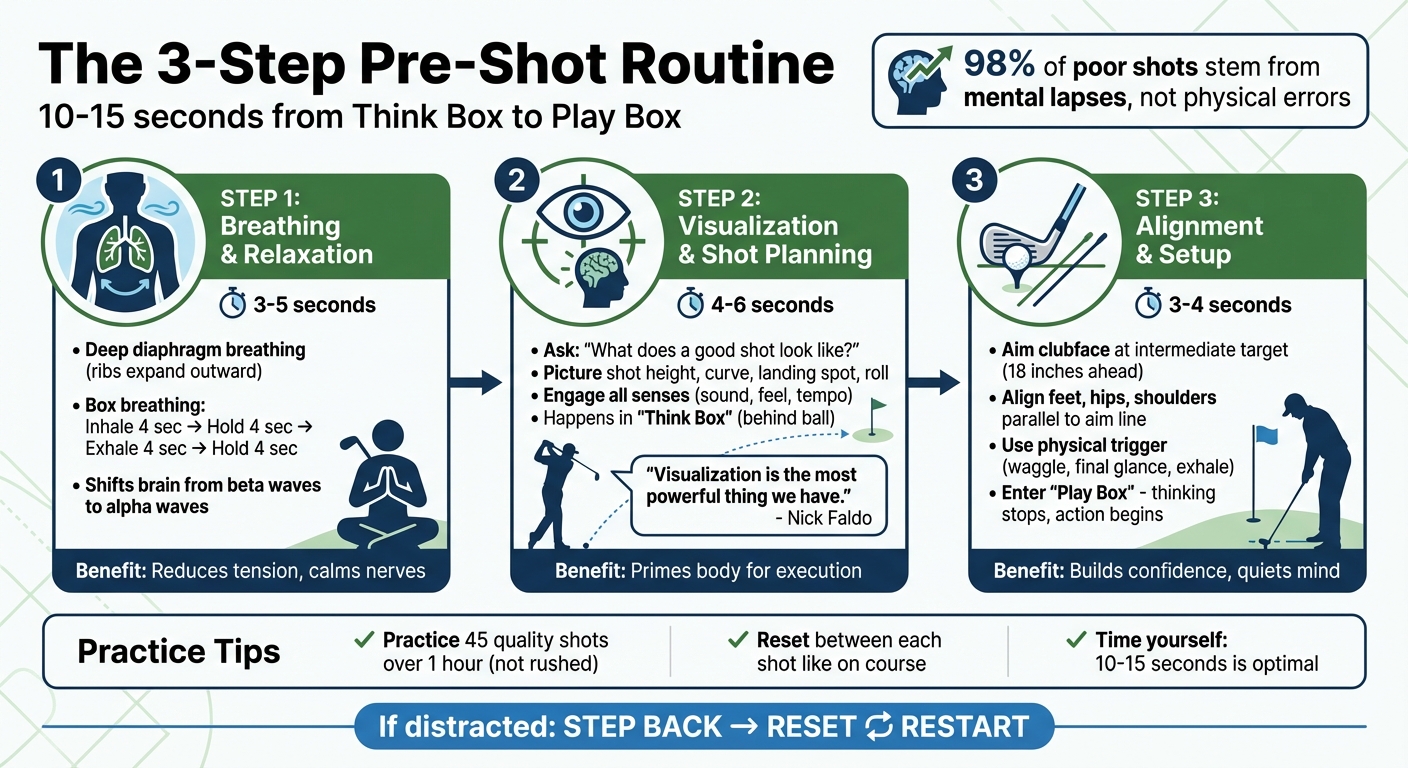
3-Step Pre-Shot Routine for Golf Focus and Consistency
How To Create a Consistent Pre-Shot Routine in Golf
Developing a routine is one of the most effective ways to quickly improve your golf game and lower your scores.
sbb-itb-bcd8bdd
The Main Parts of a Good Pre-Shot Routine
A consistent pre-shot routine isn’t just about habit – it’s about creating a mental anchor that guides you from planning to execution. The best golf tips for routines are simple, quick, and effective, typically taking 10 to 15 seconds from start to finish. The secret lies in breaking the routine into clear phases: first, you analyze and plan your shot behind the ball in the "Think Box", then cross an imaginary line into the "Play Box", where thinking stops, and action takes over.
This process can be broken into three essential steps: breathing and relaxation, visualization, and alignment and setup. Each step has a specific role in shifting your brain from conscious planning to subconscious execution. As Dr. Deborah Graham, a coach for multiple major champions, explains, repetitive routines help reduce mental interference and allow athletes to perform with clarity and focus.
Step 1: Breathing and Relaxation
Breathing is the bridge between thought and action. Deep breaths calm your nerves, easing tension in your neck and shoulders – common areas where stress builds up. It also shifts your brain from analytical "beta" waves to focused "alpha" waves, which are more conducive to athletic performance.
The technique is simple: place your hands on your ribs and breathe deeply, expanding your ribcage outward instead of lifting your shoulders. This activates your diaphragm and ensures a full oxygen supply. For high-pressure moments, try box breathing – inhale, hold, exhale, and hold for equal counts of four seconds. Pro golfer Ludvig Aberg used this technique to stay composed during a crucial final round at Torrey Pines.
Another effective method is the reflex breath: exhale completely to trigger a natural, deep inhale. This clears anxious "what if" thoughts and keeps you grounded in the moment. Use a slow, quiet exhale as your final signal to swing – it tells your brain that it’s time to act, not think. This calm state lays the foundation for clear visualization.
Step 2: Visualization and Shot Planning
Once relaxed, your mind needs a clear target. Visualization works because of "functional equivalence" – your brain treats imagined actions as if they were real, engaging the same muscles and neural pathways needed for execution. This primes your body to perform the shot naturally, without overthinking mechanics.
Start by asking, "What does a good shot look like here?" This question shifts your focus to positive imagery, replacing any negative thoughts with a clear mental picture. Visualize every detail: the shot’s height, curve, landing spot, and roll. The more vivid your mental image, the better your body can replicate it.
"Visualization is the most powerful thing we have." – Nick Faldo
This mental rehearsal happens entirely in the "Think Box." Once you step into the "Play Box", the thinking phase ends. Your focus should shift from internal mechanics to the external target, allowing for fluid, athletic movement.
To enhance visualization, engage all your senses. Imagine the sound of the swing, the feel of the tempo, and the rhythm you want to achieve. If you struggle to visualize clearly, it may signal physical tension – take another deep breath to reset and refocus. With a vivid mental image secured, you’re ready to align your body for execution.
Step 3: Alignment and Setup
The final step is aligning your body to match your mental picture. Start by aiming the clubface first at an intermediate target about 18 inches in front of the ball. This simplifies alignment and ensures precision.
Once the clubface is set, position your feet, hips, and shoulders parallel to the aim line. This consistency builds confidence, allowing you to trust your setup and quiet your mind. The entire setup process should take no more than 15 to 20 seconds – any longer, and tension may creep back in.
Finally, establish a trigger – a small, repeatable action that initiates your swing. This could be a waggle, a final glance at the target, or a quiet exhale. Standing still over the ball for too long can increase tension, so incorporate subtle movements to stay fluid and focused. If doubt or distraction arises, step back into the "Think Box" and restart your routine to regain clarity.
How to Handle Distractions and Stay Focused
Even the best routines can crumble under distractions. Whether it’s internal overthinking or external interruptions, both can throw you off track. The trick is recognizing when your mind starts to wander and resetting your focus before taking action.
Recognizing and Resetting After Distractions
When doubt or tension creeps in, pause immediately. Don’t force the shot. Instead, step back and regroup. Golf instructor Josh Nichols emphasizes this:
"If you are overthinking or doubtful over the ball, back off, regroup, and step in again. Don’t pull the trigger until you have a clear picture of where you do want the ball to go".
Taking a moment to step away from the ball and restart your routine can make all the difference. This approach separates analysis from execution, preventing them from mixing. A great example of this happened during the Australian PGA Championship in December 2017. On the final hole, Cameron Smith faced a heckler who disrupted his pre-shot routine. Instead of pushing through, he paused, let security handle the situation, and restarted his process. That reset helped him secure his first professional title.
Some players use physical resets to refocus, like removing their hat or adjusting their shoes. J.J. Spaun, for instance, relies on controlled breathing – breathing in for three seconds and out for five – to release tension and regain focus. The key is to restart your routine rather than forcing a shot when your concentration slips.
Once your focus is reset, a mental trigger can help you transition seamlessly into execution.

Using a Mental Trigger for Consistency
After managing distractions, a mental trigger can cement your shift from planning to execution. Think of it as your brain’s "go" signal. Whether it’s a verbal cue like "Commit" or "Smooth", a visual cue like a final look at your target, or a physical action like a deep breath or a waggle, this small step tells your mind it’s time to trust your body.
Take the 2014 Open Championship, for example. Rory McIlroy used two verbal cues to stay in control – saying "process" from tee to green to reinforce his routine, and "spot" on the greens to lock in his putting aim. Similarly, during his 2010 Open Championship win, Louis Oosthuizen drew a small red dot on his glove. Before every shot, he focused on that dot to block out distractions and stay locked into his process.
Sports psychologist Matt Cuccaro explains the power of these cues:
"When used it can actually be a form of visualization. If you think of a cue word such as ‘commit’ or ‘smooth’ right, it drives an action that is a desired approach and creates an intention for a movement".
Using the same trigger consistently can make even the most high-pressure moments feel as natural as practice. It builds golf confidence, reduces anxiety, and keeps your pre-shot routine intact, no matter the stakes.
Practicing and Improving Your Pre-Shot Routine
Deliberate practice of your pre-shot routine helps sharpen focus and elevate performance. The goal is to rehearse it so thoroughly that it becomes second nature – like tying your shoes.
Rehearsing in Low-Pressure Settings
Practicing in relaxed environments helps solidify habits that will carry over to high-pressure situations. Avoid rushing through swings. Instead, aim for quality over quantity – hit 45 balls over the span of an hour, fully committing to your routine before each shot. After each swing, step away from the mat and reset, just as you would on the course.
You can also practice without even hitting a ball. Stand behind an imaginary shot and go through your entire routine – mentally and physically – 10 to 15 times. This allows you to focus entirely on perfecting the process.
To keep your mind sharp, switch between clubs and targets. This prevents you from slipping into autopilot. Add some pressure by setting challenges for yourself. For instance, try a "5 in a row" drill where you must restart if you fail to fully commit to your routine on any shot.
Annika Sorenstam’s pre-shot routine was so precise that it lasted exactly 24 seconds throughout her 14-year professional career, rarely varying by more than a single second.
Tracking How Well Your Routine Works
Once you’ve established your routine, it’s essential to measure its effectiveness. Use a stopwatch to time your process – most efficient routines take about 10–15 seconds from start to finish. If your timing fluctuates significantly between practice and play, your routine might not be fully ingrained yet.
Recording your practice sessions on video can help you spot inconsistencies in your setup and alignment. You can also use tools like the Mind Meter Pro to monitor mental focus levels or devices like HackMotion to track wrist angles during your setup.
"A consistent pre-shot routine will make you more consistent. Only if it is mentally consistent and mentally effective!" – Jon Stabler, co-founder of GolfPsych
Keep a journal after each practice session. Rate your commitment to each shot on a scale of 0–100%, note whether you visualized the ball’s flight clearly, and track your focus levels. Research spanning 30 years on Tour players found that 98% of poor shots were caused by mental lapses, not physical errors. Use your notes to identify patterns, such as rushing or losing focus, and work on closing those gaps.
Conclusion: Building Focus Through Routine
A disciplined pre-shot routine is the secret weapon for staying calm and performing under pressure. It helps shift your mindset from overthinking to action, giving you a sense of control when it matters most.
But here’s the catch: consistency is key – not just physically, but mentally. Going through the same motions won’t help if your mind is clouded with doubt or indecision. As Jon Stabler, co-founder of GolfPsych, explains:
"A consistent pre-shot routine will make you more consistent. Only if it is mentally consistent and mentally effective!"
Your routine is more than just a series of steps – it’s a way to reset and refocus. Whether you’re recovering from a tough shot or lining up a putt to win the hole, the same process can center you in the present. This approach ties directly to the strategies for managing distractions, showing how every setback can be met with a deliberate return to your routine. A great example is Scottie Scheffler, whose "robot-like consistency" in his pre-shot routine was credited as a key factor in his rise to World No. 1 in September 2025.
Start with the fundamentals: analyze yardage, wind, and club choice while standing behind the ball. Once you’ve made your decision, commit fully as you step into your setup. Incorporate a physical trigger, like a deep breath or a final look at the target, to signal your mind that it’s time to execute. Make it a habit by practicing this routine intentionally during range sessions.
When your routine becomes second nature, trust takes over. Doubt fades, and you can focus on playing with confidence. By embedding these practices into your game, you’ll ensure that your focus on the course matches the preparation you’ve put in on the range.
FAQs
How do I build a pre-shot routine that fits my game?
To maintain focus, stay calm, and build confidence before every shot, establish a routine you can rely on. Begin by visualizing your target and aligning yourself with it. Take a few deep breaths to center your mind, and go through a smooth practice swing to prepare your body. When you’re ready, step up to the ball confidently and commit to triggering your shot within a few seconds – this helps prevent overthinking. Adjust the routine to suit your style and practice it consistently until it feels completely natural.
What should I do if doubt hits right before I swing?
If doubt creeps in right before your swing, take a moment to reset. Stop, take a deep breath, and refocus on your plan. It’s crucial to fully commit to your shot. Overanalyzing in this moment often leads to hesitation and mistakes. A solid pre-shot routine – like visualizing the shot, locking in on your target, and trusting your choice – can quiet those last-minute uncertainties and set you up for a confident, smooth swing.
How can I practice my routine so it holds up under pressure?
To make your routine second nature, practice it consistently until it becomes automatic. Add some pressure to your practice sessions by including distractions or setting time limits, mimicking real-life scenarios. Stick to your routine just as you would during an actual game. Minimize extra movements that might invite negative thoughts, and use a mental cue or visualization technique to keep your focus sharp. Practicing regularly in different conditions helps you build both confidence and mental toughness.
Related Blog Posts
- 5 Tips To Stay Calm During Golf Tournaments
- Common Golf Distractions And How To Avoid Them
- 5 Steps for a Confident Pre-Shot Routine
- Pre-Shot Routine vs. No Routine: What Works Better?
