
Flexibility plays a central role in improving your golf swing mechanics. It directly affects your ability to generate power, maintain accuracy, and swing consistently. Limited range of motion forces your body to compensate with inefficient movements, increasing the risk of injury and reducing performance. Here’s what you need to know:
- Key Areas: The thoracic spine, shoulders, and hips are essential for rotation, separation, and weight transfer.
- Spinal Mobility: A flexible thoracic spine enhances rotation, power, and prevents overuse of the lower back.
- Shoulder Mobility: Proper shoulder rotation prevents slicing and improves backswing length.
- Hip Flexibility: Flexible hips ensure smooth weight transfer and protect the lower back during the swing.
Research shows an 8-week flexibility and strength program can increase clubhead speed by 3.9 mph, adding 10–15 yards to your drives. By incorporating targeted stretches and mobility exercises into your routine, you can improve your swing mechanics, reduce injury risks, and achieve better results on the course.
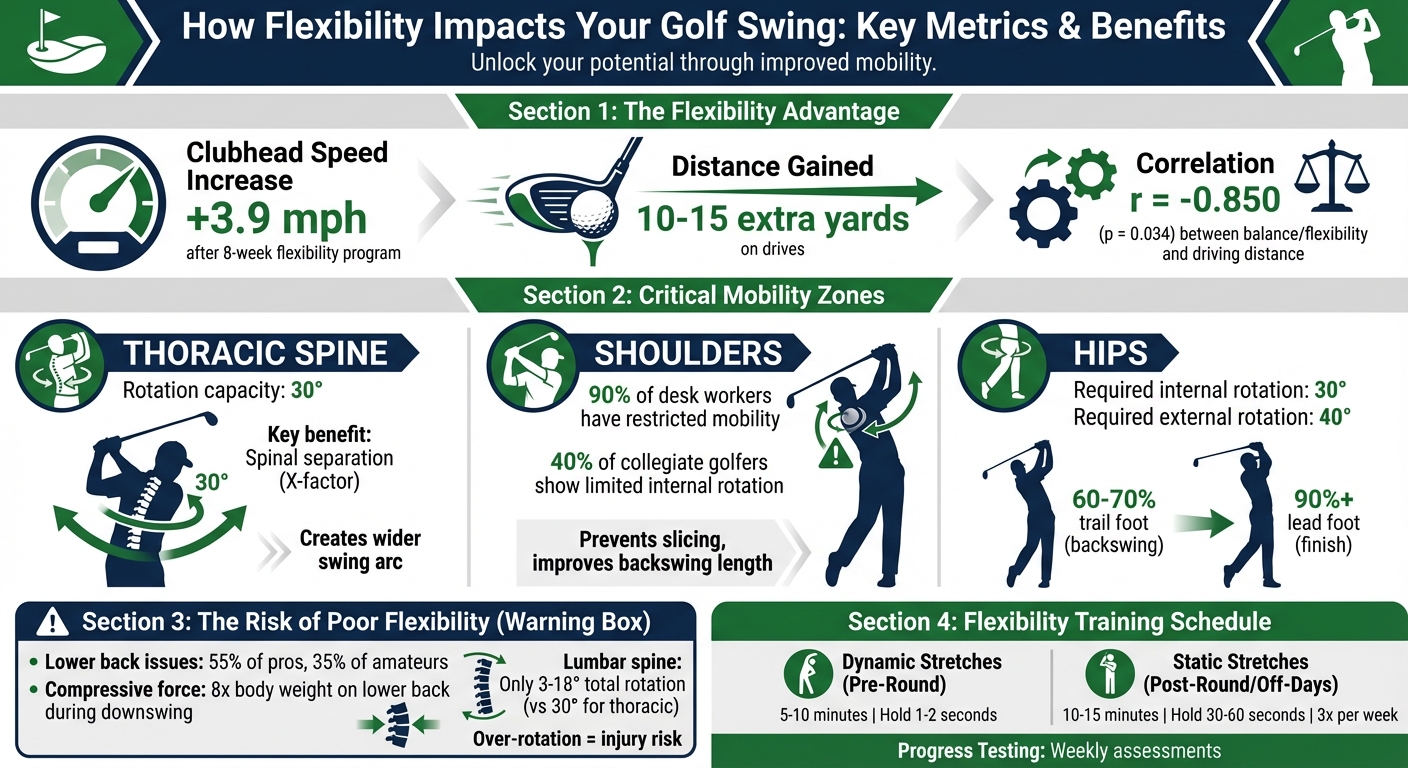
How Flexibility Improves Golf Swing Performance: Key Mobility Metrics
How Spine Flexibility Improves Rotation and Power
Understanding Spinal Rotation in Golf
Your spine serves as the central axis for your golf swing, and its ability to rotate plays a huge role in how much power you can generate. The thoracic spine (mid-back) is built for movement, allowing about 30° of rotation, while the lumbar spine (lower back) is designed for stability, with only 3° to 18° of rotation in total.
Good thoracic rotation enables spinal separation (often called the X-factor) – the difference between how much your shoulders and hips rotate. This separation creates a coiled position, storing energy that can be unleashed during the downswing.
"The spine starts at address in flexion… By the time we are at the top of the backswing, we are no longer in flexion. We are still hinged at the hips, but now we are rotated through the spine while EXTENDED."
- Nicholas Curtis, Chiropractor, Integrated Rehab and Performance Center
A mobile thoracic spine also helps you create a wider swing arc, giving your clubhead more room to build speed. But when your mid-back lacks flexibility, your body may compensate in harmful ways – like over-rotating the lower back, buckling the knees, or relying too much on your shoulders. These compensations not only reduce power but also increase the risk of injury.
Over-rotating the lumbar spine is particularly risky. Moving beyond 3° per joint in this area can lead to serious lower back problems. Studies show that limiting lumbar motion (like with a corset) increases hip rotation by 16% in the trail hip at the top of the backswing and 19% in the lead hip during follow-through. This suggests that proper spinal mobility helps distribute movement safely and efficiently.
Next, let’s look at some stretches designed to improve spinal mobility and enhance your swing mechanics.
Stretching Techniques for Spinal Mobility
Improving spinal separation requires targeted stretches, especially for the mid-back. Here are a few exercises to help you move better and swing stronger.
The Cat-Cow stretch is a great starting point because it works your entire spine. Begin on all fours and alternate between arching your back (Cow) and rounding it (Cat) for 10–15 reps. This stretch reduces tension in the lower back while improving overall spinal flexibility.
Open Book stretches are perfect for improving thoracic rotation. Lie on your side with your knees bent and stacked. Place your hands together in front of you, then slowly rotate your top hand and upper body away, opening your chest toward the ceiling. Hold this position for 30 seconds to one minute. This stretch mimics the rotational movement of your backswing, helping you perform better on the course.
For improving mid-back extension, try thoracic extensions over a foam roller. Lay the roller perpendicular to your spine at shoulder blade height. Support your head with your hands and gently arch backward over the roller. This exercise helps counteract poor posture and increases the extension needed for a strong backswing.
Seated rotations are another excellent drill. Sit on a bench or chair with your feet flat on the ground, place a golf club across your shoulders, and rotate your upper body side to side while keeping your hips steady. This movement trains the separation between your upper and lower body, which is key for generating power in your swing.
"The thoracic spine is central to a fluid and powerful golf swing. Limited mobility in this region can lead to compensations, such as over-rotating the lower back or hips, increasing the risk of injury."
- Dr. Jimmy Keuzter, Midwest Spine and Sport
For the best results, aim to do these exercises at least three times a week. Hold static stretches for 30 seconds to one minute to allow your muscles to relax and lengthen. Regular practice will help maintain and improve your spine’s ability to rotate, reducing the chance of inefficient movements and injuries.
sbb-itb-bcd8bdd
Shoulder Flexibility for Backswing Length and Control
Why Shoulder Mobility Matters in Golf
Your shoulders play a major role in determining the length and control of your backswing. If your shoulder mobility is limited, your body compensates with awkward movements that disrupt your swing. For example, tight shoulders often lead golfers to lift their bodies or shift their weight excessively just to complete a backswing.
One key movement is trail shoulder external rotation – the ability to rotate your shoulder outward while keeping your elbow stable. Without this, "shallowing" the club during the transition from backswing to downswing becomes a real challenge. And if you can’t hit the ball from the inside, slicing becomes almost inevitable.
"If you don’t have proper mobility in your trail shoulder… then you’ll fight a slice no matter how hard you try and swing down into the ball from inside the target line."
- Darin Hovis, Top 50 Golf Fitness Trainer
The statistics back this up. Around 90% of golfers with desk jobs or past rotator cuff injuries experience restricted shoulder mobility. Even among collegiate golfers, 40% showed limited internal rotation in their right shoulder, likely due to the repetitive, one-sided nature of the golf swing. Tight shoulders can also lead to "early extension", where you stand up during your swing. This happens because your body tries to create space your joints can’t naturally provide.
Curious about your own shoulder mobility? Here’s a quick test: Sit with your trail arm bent at 90 degrees and your upper arm parallel to the floor. Try to move your hand back behind your head without shifting your elbow or arching your lower back. If you can’t move past 90 degrees, your shoulder mobility could use some attention.
These challenges highlight the importance of targeted stretches to improve your range of motion.
Shoulder Stretching Exercises
To address shoulder mobility issues, these stretches focus on expanding your range of motion. Hold each stretch for 30–60 seconds and aim to perform them daily, as well as before and after your rounds.
Start with the doorway pec stretch, which targets tight chest muscles that can restrict your backswing. Stand in a doorway, place your forearm against the frame, and lean forward until you feel a stretch across your chest. This helps prevent your pecs from limiting your arm movement.

For improving trail shoulder external rotation, try the cable machine stretch. Set the cable machine to its highest setting with about 20 pounds of weight. Hold the handle with your arm bent at 90 degrees and step forward until you feel a pull in your chest and shoulder. Hold for a few seconds and repeat.
Another effective exercise is shoulder flossing with a golf club. Hold the club with both hands and move it in a smooth arc from the front of your body to behind your back. To make it harder, bring your hands closer together on the club. Wall angels are also great – stand with your back against a wall and slowly raise and lower your arms while keeping your shoulder blades pulled together. This helps refine external rotation and improves your club positioning at the top of your swing.
Don’t neglect your lead arm either. Lat stretches are key for achieving a higher and more controlled backswing. Reach your lead arm overhead and pull it to the opposite side, feeling the stretch along your back. Once you’ve stretched, get into your golf stance and practice the feeling of external rotation. This helps your body adapt to the new range of motion during your swing.
Hip Flexibility for Better Weight Transfer and Downswing
How Hip Mobility Affects Weight Transfer
Your hips are the driving force behind your golf swing, transferring power from your lower body to your upper body. If your hips lack flexibility, this critical transfer breaks down during the transition from backswing to downswing.
"The hips are the biggest gear in the golf swing. They’re where the most energy can be either converted into the upper body or lost."
- Leo Rooney, Director of Performance, Urban Golf Performance
At the top of your backswing, aim to shift 60–70% of your body pressure into your trail foot. As you start your downswing, perform a small lateral hip bump – just 1–2 inches – toward the target, transferring pressure to your lead foot. By the finish, 90% or more of your weight should be on the lead foot.
Your trail hip must rotate externally to load energy, while your lead hip needs internal rotation to clear the path for your downswing. Ideally, you should have at least 30 degrees of internal hip rotation and 40 degrees of external hip rotation. Without this range, your body compensates with swing errors like early extension (pelvis thrusting toward the ball), swaying, or sliding, all of which sap your power and consistency.
Back issues are another common consequence of tight hips, affecting 55% of professional and 35% of amateur golfers. When your hips can’t rotate properly, your lower back takes on the strain, enduring compressive forces up to eight times your body weight during the downswing. Over time, this can lead to significant discomfort and performance setbacks.
Now, let’s look at specific golf tips and drills to improve your hip flexibility and boost your swing.
Hip Flexor Stretches and Drills
The 90/90 stretch is a versatile exercise that targets both internal and external hip rotation. Sit on the floor with both knees bent at 90-degree angles – one leg in front of you, the other to the side. Lean forward over your front shin to work on external rotation, then twist your torso toward your back leg to improve internal rotation. This one stretch addresses the key movements your hips need for a smooth swing.
For hip flexors tightened by sitting or driving, try the half-kneeling hip flexor stretch. Start in a kneeling position with one foot flat on the ground in front of you. Tuck your tailbone under to isolate the hip flexor, then gently lean forward. To deepen the stretch, reach the arm on your kneeling side overhead and toward the opposite side. This helps counteract the effects of sitting and supports better posture throughout your swing.
The pigeon pose is excellent for loosening the deep external rotators and glutes, which are crucial for clearing your lead hip during the downswing. Begin on all fours, slide one knee forward and angle the shin, while extending your back leg straight behind you. Hold this position for 30–60 seconds on each side. Before hitting the course, incorporate dynamic stretches like leg swings (both front-to-back and side-to-side) and "gate openers", where you lift your knee and rotate your hip outward. These movements warm up your joints and prepare them for action.
To test your hip mobility, sit on the edge of a chair and rotate your thigh inward and outward. If your foot doesn’t move at least one-third of the way to parallel with the floor, it’s a sign your mobility needs improvement. A study conducted in November 2017 by Kelsey J. Marshall and Tamra L. Llewellyn at Nebraska Wesleyan University examined 10 collegiate golfers (5 male, 5 female) aged 18–22. They found a strong negative correlation (r = -0.850, p = 0.034) between balance errors and average driving distance in male participants, highlighting the importance of hip flexibility and balance for maintaining the kinematic chain and maximizing club head speed.
15 Minute Golf Stretching & Mobility at Home
Adding Flexibility Exercises to Your Practice Routine
Including flexibility exercises in your routine can directly improve your swing mechanics by boosting both mobility and control.
Creating a Flexibility-Focused Warm-Up Routine
A warm-up lasting five to ten minutes should gradually transition from light activity to dynamic stretches and activation drills. Start with 30 seconds of brisk walking or light jogging to get your blood flowing. Follow this with 30 seconds of arm circles and shoulder swings. Next, perform 8–10 standing torso rotations, holding each for 1–2 seconds, and 8–10 walking lunges with a twist. Add 10 front-to-back leg swings on each side and 10 glute bridges, squeezing at the top for 1–2 seconds. Wrap up with 6–10 practice swings, gradually increasing your speed. This physical preparation is a key component of professional golf lessons designed to build a repeatable swing. This routine preps your muscles and provides a solid foundation for tracking your progress through simple tests.
"If you can do more with your body, you can do more with your swing." – Selena Samuela, Instructor
Save static stretches – those held for 30 seconds or more – for after your round or on rest days. Performing static stretches before playing can actually reduce power. Instead, aim for three 10–15 minute sessions each week to see long-term benefits. For example, Tiger Woods is said to dedicate 40 minutes daily to stretching.
Tracking Progress and Adjusting Your Exercises
After warming up, test your flexibility with these easy assessments:
- Deep Squat: See if you can drop your hips below your knees while keeping your heels flat and chest upright.
- Toe Touch: Check if you can touch your toes with straight knees.
- Seated Rotation: Rotate a club across your shoulders at least 45° in both directions.
If you find your passive range is fine but your active range is lacking, shift your focus to strengthening exercises. Pay attention to tight areas, like lower back stiffness after walking, and adjust your routine to target those specific spots. As your mobility improves, you can increase the difficulty of exercises. For instance, with shoulder flossing, moving your hands closer together makes the stretch more intense, while moving them farther apart eases it.
| Exercise Type | Timing | Goal | Hold Duration |
|---|---|---|---|
| Dynamic | Pre-Round | Activation & Heart Rate | 1–2 seconds |
| Static | Post-Round / Off-Days | Lengthening Tissue | 30–60 seconds |
| Active Tests | Weekly | Progress Tracking | N/A |
How To Break 80 Resources for Swing Improvement

How To Break 80’s Swing Improvement Guides
How To Break 80 provides targeted resources to help golfers refine their swing by addressing mobility issues. Their video series, "Flexible Solutions to Inflexible Swing Faults," led by Roger Fredericks, focuses on common swing errors caused by limited mobility and offers practical drills to correct them. Tools like "Testing Your Shoulder Turn" and "Testing and Stretching Your Hamstrings" are designed to pinpoint physical limitations that might be holding your swing back.
The Golf Flexibility Guides and Golf Stretching Programs offer structured, step-by-step routines that can be done at home or right before a round. Drills such as the "Turn Over the Chair Drill" are included to improve weight shifting and torso rotation, while other exercises focus on maintaining a proper swing path. These resources are designed to complement your current flexibility routine seamlessly, making it easier to integrate them into your practice sessions.
Using How To Break 80’s Resources with Flexibility Training
Combining these drills with your flexibility exercises can directly target the physical limitations that affect your swing mechanics. Incorporate these tools into your pre-round, post-game, and weekly training schedules for maximum benefit.

- Pre-round: Use dynamic stretches from the Flexibility Program to warm up your muscles and improve mobility.
- Post-game: Follow up with static stretches, focusing on areas like the hamstrings, hip flexors, and lower spine to reduce stiffness and support joint health.
- Weekly sessions (2–3 times): Dive into the instructional videos to address weaknesses in your kinetic chain.
As Eric Lenko, MPT, PhD, OCS, TPI-1, explains:
"If you have a deficit at any joint, it might throw off subsequent joints down the chain."
For instance, elbow pain can sometimes stem from restricted shoulder rotation, leading to compensatory movements. Stretching the lower body first can support the "bottom-up phenomenon", where energy flows efficiently from your feet through your torso to the clubhead. By addressing these foundational issues, you’ll be better equipped to achieve a smoother, more effective swing.
Conclusion
Flexibility is the key to unlocking your full potential on the golf course. By improving mobility in your spine, shoulders, and hips, you open up new possibilities for your swing. The result? Longer drives, better consistency, and fewer injuries.
The science backs this up. An 8-week functional training program combining flexibility and weight training led to an average club head speed increase of 3.9 mph, translating to an extra 10–15 yards on driving distance. Additionally, collegiate golfers with better balance and flexibility demonstrated a strong negative correlation (r = -0.850, p = 0.034) with longer drives.
These improvements directly impact your swing mechanics. As Michael Carroll, a TPI Certified Fitness Coach, explains:
"Mobility gives you options for your swing mechanics… if you have poor mobility, you will be limited in the type and degree of movement your body can make in your swing".
Without flexibility, your body compensates in ways that lead to inconsistent shots and a higher risk of injury. But with enhanced mobility, you lay the groundwork for mechanical efficiency and lasting power.
Make the stretching techniques and drills outlined in this guide a regular part of your routine. Focus on key areas like the thoracic spine, hips, and shoulders – often the most affected by modern sedentary habits. These exercises target the core areas that drive power, consistency, and injury prevention in your swing. For additional guidance, check out the resources at How To Break 80, including flexibility-focused video series and structured programs designed to address physical limitations.
Your body powers every shot you take. Give it the flexibility it needs, and you’ll see the difference in your game – from the first tee to the final putt.
FAQs
How can I tell if my mobility is affecting my swing?
If you notice difficulty with a full shoulder turn, maintaining your spine angle, or rotating your hips during your swing, it might be a sign of mobility issues. Other indicators include stiffness, restricted movement, slower clubhead speed, or inconsistent motion. To check your range of motion, try performing some mobility tests or exercises. If smooth movements remain a challenge, it’s a strong sign that limited mobility could be affecting your swing mechanics.
Should I stretch before a round or after?
Stretching after a game is great for helping your muscles recover and boosting flexibility. But don’t overlook the importance of warming up beforehand. Engaging in light activity or dynamic stretches before you play gets your body ready for action and can make a big difference in your performance.
Which area should I fix first: hips, shoulders, or thoracic spine?
Improving thoracic spine mobility is crucial for achieving proper rotation and separation during a swing. When mobility in this area is limited, the body often compensates by overusing the hips and shoulders, which can hurt efficiency and raise the risk of injury. Once thoracic mobility is addressed, shift your attention to hip mobility to enhance torque and stability, and shoulder mobility to fine-tune swing mechanics. Interestingly, improving thoracic mobility often leads to noticeable gains in both hip and shoulder movement.
Related Blog Posts
- 5 Stretches After Golf for Faster Recovery
- How Hip Mobility Boosts Swing Power
- Full-Body Stretching Routine for Golfers
- Ultimate Guide to Flexibility Training for Senior Golfers
