
Biomechanics sensors are wearable devices that help golfers analyze their swing by tracking body movements. These sensors, often placed on the spine (T1 and L4 vertebrae), measure metrics like torso and pelvis rotation using Inertial Measurement Units (IMUs). Studies, including one from Stanford in 2023, show these devices are highly accurate, with deviations under 2° compared to advanced motion capture systems. Key metrics like the X-Factor (torso-pelvis rotation difference) are crucial for boosting clubhead speed and preventing injuries. Incorporating golf strength training can further support these physical demands.
However, accuracy depends on proper sensor placement, secure attachment, and avoiding issues like drift error or data loss. While IMUs are reliable, factors like loose sensors or environmental interference can affect results. For best results, ensure tight placement, consistent calibration, and track trends over time rather than focusing on single readings. These tools, combined with structured golf lessons, can help golfers refine their swing, improve performance, and reduce injury risks.
The World’s First 3D Golf Swing and Body Motion Analyzer!
sbb-itb-bcd8bdd
How Accurate Are Biomechanics Sensors?
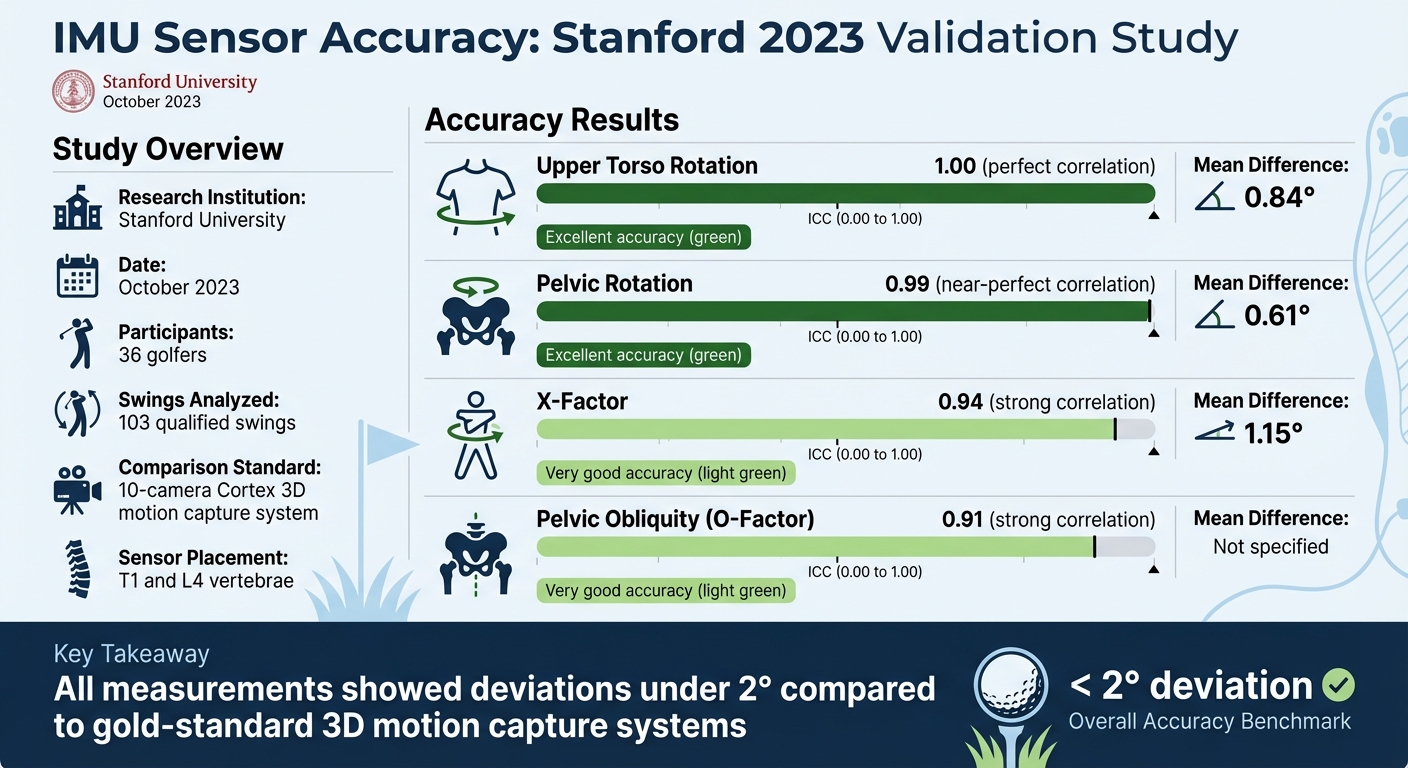
IMU Sensor Accuracy Validation Study Results for Golf Swing Analysis
Validation Studies on IMU Sensors
In October 2023, Stanford researchers conducted a study to validate the accuracy of IMU sensors by comparing them to a 10-camera Cortex 3D system, widely regarded as the gold standard in biomechanics labs. The study involved 36 golfers and focused on sensors placed on the T1 and L4 vertebrae. By analyzing 103 qualified swings, researchers found that IMUs measured rotational kinematics with impressive precision, showing absolute mean differences of less than 1.7° compared to the 3D system.
Key findings included:
- Upper torso rotation: Achieved an Intraclass Correlation Coefficient (ICC) of 1.00 with an absolute mean difference of 0.84°.
- Pelvic rotation: Recorded an ICC of 0.99 with a mean difference of 0.61°.
- X-Factor (a critical metric for clubhead speed): Reached an ICC of 0.94 with a mean difference of 1.15°.
- Pelvic obliquity (O-Factor): Achieved an ICC of 0.91.
These results highlight the reliability of IMUs in capturing biomechanical data for golf swing analysis, making them a practical tool for athletes and researchers alike.
"IMUs provide a practical and viable alternative for golf swing analysis, offering golfers accessible and wearable biomechanical feedback to enhance performance." – Stanford University researchers
Still, achieving such accuracy depends on addressing several operational factors.
Factors That Affect Accuracy
While IMUs have proven to be highly precise, their performance can be influenced by various external factors. One critical aspect is sensor attachment. If a sensor shifts during the backswing, it can introduce artifacts into the data. Using medical-grade adhesives or tight straps is essential to keep the sensors securely in place.
Placement accuracy is another key consideration. Even small deviations when positioning sensors on the T1 and L4 vertebrae can affect readings. This is especially important because IMUs measure spinal rotation, whereas 3D systems often rely on shoulder markers, which may continue to move during follow-through.
Drift error presents another challenge. IMUs calculate position by integrating acceleration and angular velocity, which means small amounts of sensor noise can accumulate over time. This can lead to tracking errors of 12 to 24 inches (30 to 60 cm) during the rapid movements of a golf swing if corrections aren’t applied.
Environmental factors also play a role. Radio interference and Bluetooth data loss can disrupt sensor performance. Additionally, the sampling frequency (usually between 100 Hz and 200 Hz) and the quality of signal processing filters significantly impact the accuracy of derived metrics like rotational velocity.
Key Metrics Measured by Biomechanics Sensors
Understanding S-Factor, O-Factor, and X-Factor
Biomechanics sensors focus on three critical metrics that influence swing power and ball trajectory. The X-Factor gauges the rotational difference between your upper torso and pelvis, essentially the "stretch" you create at the top of your backswing. This separation engages your trunk muscles, leading to increased clubhead speed and added distance.
The S-Factor (shoulder obliquity) measures how much your shoulders tilt relative to the horizontal plane. According to research from Stanford University’s Department of Orthopaedic Surgery, a higher S-Factor during the early downswing is linked to faster clubhead speeds and reduced slicing.
"Upper torso obliquity during the early downswing is also associated with clubhead speed and the direction of the ball outcome – greater obliquity is associated with faster clubhead speed and less slice." – S.E. Kim et al., Stanford University Department of Orthopaedic Surgery
The O-Factor (pelvic obliquity) measures the tilt of your pelvis relative to the horizontal plane. Studies confirm that IMU sensors measure the O-Factor with high reliability, showing an ICC of 0.91. This metric plays a vital role in improving swing efficiency and identifying lower body stability issues during rotation.
Understanding these metrics provides a foundation for refining your swing mechanics.
How These Metrics Lead to Practical Improvements
By analyzing these metrics, golfers can make targeted adjustments to their swing. In December 2022, Stanford researchers introduced the Swing Performance Index (SPI), a scoring system based on data from 11 professional and 5 amateur golfers. This index combines peak pelvic and torso rotational velocities into a single score, standardized to 100 for professionals. The findings were clear: professionals scored 100 ± 10, while amateurs averaged just 82 ± 4. The SPI demonstrated a 97% accuracy rate in predicting player skill levels.
Professional golfers exhibit a specific rotational sequence, with the pelvis reaching peak velocity first, followed by the thorax, arms, and club. If your sensor data reveals that your arms peak before your pelvis, you’re likely losing power and creating inconsistent contact. Monitoring the X-Prime metric, which measures the speed of pelvis and upper torso rotation relative to each other, can help identify whether you’re initiating the downswing correctly with your lower body while keeping your shoulders coiled. This insight allows for precise adjustments that enhance swing mechanics.
These metrics also play a critical role in injury prevention. Faulty rotational biomechanics can increase stress on your lumbar spine, contributing to the 15%–36% incidence rate of lower back injuries among golfers. By tracking your rotational patterns, you can detect harmful compensations early, reducing the risk of pain or long-term damage.
Practical Considerations for Golfers Using Biomechanics Sensors
Accuracy Limitations and Common Errors
Biomechanics sensors can provide valuable insights into your golf swing, but they aren’t without their quirks. For example, IMU sensors, often used to measure upper torso rotation, generally operate within a deviation of less than 5° compared to top-tier 3D motion capture systems. On average, the difference ranges between 0.61° and 1.67°. However, when it comes to derived metrics like the X-factor and O-factor, variability increases significantly. Limits of Agreement for these metrics can hit up to 25.0% for the X-factor and 33.4% for the O-factor.
Another issue is attachment. If sensors are loosely secured, they can introduce errors into your data. Even small placement errors can lead to big discrepancies. On top of that, environmental factors and sensor misalignment can further impact accuracy. Knowing these potential pitfalls is crucial if you want to make the most of your biometric feedback to refine your swing.
Tips for Effective Use
To get the best results from your sensors, it’s important to work around these limitations. Start by securing the sensors tightly to the T1 and L4 vertebrae to ensure they stay in place during high-speed swings. Always use consistent anatomical landmarks for placement and calibrate the sensors to your address position before every session.

"To get reliable data, you’ve got to have your golf launch monitor set up correctly… take a few extra minutes to get your positioning and alignment dialed in correctly." – Sean Ogle, Founder, Breaking Eighty
If you’re practicing indoors with photometric launch monitors, using specialized balls like the Rapsodo RPT can enhance spin measurement accuracy, instead of relying solely on algorithms. Rather than chasing a single "perfect" metric, focus on tracking patterns over time. Observing trends in your data will provide more meaningful insights into your swing mechanics than any one-off measurement.
Combining Sensor Data with Golf Training Resources
Using Sensor Data to Guide Your Training
Sensor data isn’t just about numbers – it’s a powerful tool to fine-tune your golf practice. For instance, low X-factor readings suggest reduced clubhead speed, which can directly impact your distance off the tee. Similarly, correct S-factor readings can help identify and fix slicing issues.
When it comes to putting, tools like Blast Motion sensors measure stroke tempo and consistency. If your tempo is all over the place or your "Strokes Gained: Putting" stats from devices like the Garmin CT10 (priced at $299.99) or the Arccos Caddie ($199.99) aren’t where they should be, it’s a sign to focus on proven putting drills and specific exercises. These insights make it easier to focus your practice on areas that need the most attention, paving the way for more targeted and effective training.
Recommended Resources from How To Break 80
To make the most of your sensor data, pairing it with structured training programs can fast-track your progress. If your metrics show a lack of power – like low X-factor or ground reaction force readings – the Maximum Distance Video Course ($49.00) offers strategies to improve torque and energy transfer in your swing.
For putting struggles revealed by inconsistent data, the Precision Putting Video Course ($49.00) provides drills to help refine stroke tempo and path consistency. And if your S-factor readings point to a persistent slice, the Fix Your Slice & Hit a Draw Video Course ($99.00) delivers step-by-step guidance to correct your swing path and achieve a more controlled draw.
The key is to let your sensor data guide your priorities. Shot-tracking tools can pinpoint whether your biggest weaknesses are off the tee, on approach shots, or around the greens. This targeted approach allows you to build a personalized training plan that addresses your specific needs.
Conclusion
Biomechanics sensors have turned golf training into a precise and data-focused process. Modern IMU sensors offer accuracy on par with professional 3D motion capture systems, boasting correlations between 0.91 and 1.00, while still being portable and user-friendly. What was once exclusive to tour professionals is now within reach for dedicated golfers.
The real advantage of these sensors lies in their ability to provide objective measurements. Most golfers struggle with an accurate perception of their game – overestimating distances or misunderstanding their strengths and weaknesses. Sensors eliminate this guesswork by delivering clear, quantifiable metrics.
"For the average golfer, the single most valuable number they need to know is the carry distance of each club in their bag." – Sean Ogle, Founder, Breaking Eighty
However, data alone won’t improve your game. The key is using this feedback effectively. For instance, focusing on ball speed rather than clubhead speed can help improve center-face contact. By leveraging sensor data, golfers can make better choices about club selection, ball speed, and energy transfer during impact.
When paired with structured training programs like those from How To Break 80, these sensors become even more powerful. They highlight what needs improvement, while targeted training provides the tools to make real progress. Together, they pave the way for measurable and meaningful improvement.
FAQs
How do I know my sensors are placed correctly?
Getting sensors in the right spot is crucial for accurate data. Here’s how to do it:
- Stick to the manufacturer’s guidelines: Attach sensors to the recommended body parts, like the pelvis, arms, or even the club itself.
- Align carefully: Make sure sensors are positioned along key anatomical points, such as the axis of a limb or the pelvis.
- Secure them tightly: Use straps or clips to keep the sensors from shifting during movement.
- Run a quick test: Take a few swings to ensure the sensors stay in place and provide consistent readings.
Taking these steps helps guarantee precise analysis of your performance.
How often should I calibrate IMU sensors during practice?
It’s a good practice to calibrate IMU sensors on a regular basis – usually once every 12 months. That said, if the sensors are used heavily or have been exposed to potential damage, more frequent calibration might be necessary. Regular calibration helps maintain their accuracy and ensures they perform at their best.
Which swing metrics should I track first for real improvement?
Pay attention to clubhead speed, swing path, and body rotation. These three metrics play a crucial role in refining your performance. By using biomechanics sensors, you can measure them with precision, gaining valuable insights into your swing mechanics. Starting with these areas will set the foundation for noticeable improvement and help you fine-tune your technique effectively.
Related Blog Posts
- How Grip Pressure Sensors Improve Golf Swings
- How Swing Sensors Track Biomechanics in Real Time
- How Real-Time Feedback Wearables Improve Your Swing
- Latest Research on Impact Feedback Wearables
