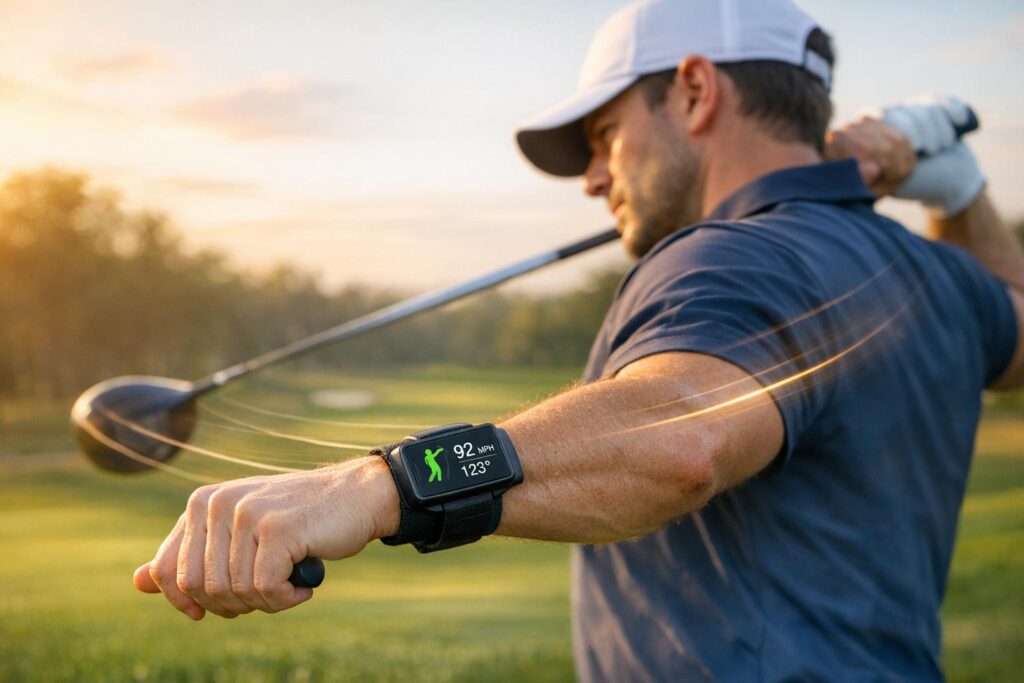
Swing sensors are transforming golf training by providing real-time data on your swing mechanics. These devices, which include wearable sensors and camera-based systems, analyze key metrics like clubhead speed, hip rotation, and shoulder tilt. They help golfers identify mistakes and make precise adjustments instantly, bridging the gap between how your swing feels and what’s actually happening.
Key takeaways:
- Wearable Sensors (IMUs): Portable and affordable, they track 3D acceleration and angular velocity but may have minor accuracy issues due to drift.
- Camera-Based Systems: High-speed cameras offer unmatched precision (up to 0.2mm) for detailed analysis but are expensive and require controlled environments.
- Force Plates: Measure ground reaction forces, revealing weight distribution and power generation insights.
- Real-Time Feedback: Tools like Blast Motion and deWiz provide instant metrics to improve tempo, consistency, and overall performance.
Whether you’re practicing on the course or in a lab, combining wearable sensors for daily use with advanced systems for deeper analysis can help you refine your technique and lower your scores.
This Training Aid Beats Hitting 10,000 Balls on the Range | Golf Game Changer!
How Swing Sensors Measure Biomechanics
Building on the earlier discussion about sensor types, let’s dive into how these systems capture your biomechanics with precision. These tools rely on three main methods, each offering unique insights into your swing.
Inertial Measurement Units (IMUs)
IMUs are small, portable sensors that track motion using accelerometers and gyroscopes. They measure 3D acceleration and angular velocity, which helps calculate metrics like clubhead speed, swing tempo, and rotation angles. These sensors are relatively affordable, with consumer-grade versions priced around $150.
However, IMUs aren’t perfect. They can suffer from drift – errors that accumulate over time due to algorithmic position estimates. While they excel at providing data on rotational speed and acceleration, their measurements are estimates rather than absolute values. Despite this limitation, their portability and wireless capabilities make them ideal for on-the-go use and daily practice. With the data they provide, golfers can make targeted training adjustments to improve consistency and power.
Optical Motion Capture Systems
Optical systems take accuracy to another level by using multiple high-speed cameras to track body and club movements without drift. Take Gears Golf, for example. Their eight-camera system operates at 360 frames per second, capturing over 600 images per swing with an impressive precision of 0.2 mm. This level of detail can even detect subtle movements like slight shaft deflections at impact.
Optical systems are often regarded as the gold standard for validating wearable sensors. Forbes has described Gears as "some of the most sophisticated technology in golf right now that takes incredibly accurate measurements of a golfer’s swing and body position". But this precision comes at a cost – high-end systems like these often run around $25,000 and require a controlled indoor environment with specialized camera setups. Still, the insights they offer are invaluable for fine-tuning your swing and maximizing power.
Beyond motion tracking, understanding the forces at play in your swing adds another layer of analysis.
Force Plate Integration
Force plates bring a new dimension to swing analysis by measuring how your body interacts with the ground. For instance, the Swing Catalyst Balance Plate uses 2,048 high-resolution pressure sensors to track ground reaction forces throughout your swing. This data reveals details like weight distribution, center of pressure shifts, and the pressure dynamics that contribute to power generation.
PGA Professional Lewis Clarke explains:
"As we push into the ground, the ground in effect pushes back up and generates vertical force. This is one of the key power sources for many golfers".
Force plates can uncover details that cameras alone might miss. For example, a golfer might look balanced on video but could actually be placing 70% of their weight on one foot. When paired with high-speed cameras – operating at nearly 300 frames per second – force plates allow for a deeper understanding of how visible body movements align with the pressure patterns driving power.
How Golfers Use Swing Sensors
Swing sensors have become game-changers for golfers, helping them fine-tune their technique both on the practice range and out on the course. Here’s how these tools bring precision and insight to the game.
Improving Swing Consistency
Nailing a consistent swing, especially under pressure, is a challenge for any golfer. Swing sensors step in by identifying exactly where things go off track. For instance, GOLFTEC‘s OPTIMOTION system uses high-speed cameras and AI to capture thousands of swing data points. These metrics – like hip sway and shoulder tilt – are layered directly onto video, making it easier to pinpoint inconsistencies.
Some wearable devices take a more hands-on approach. Take deWiz, for example. It uses "Learning Stimuli" – a slight electric pulse on your wrist when your swing deviates from the intended plane. This immediate feedback helps your brain quickly adjust. As Markus Westerberg, Co-founder of deWiz, explains:
"deWiz provides instant feedback – the logic is based firmly on the user’s ability to learn at a faster speed because they know precisely where their swing is going astray and their brain can rescript their swing pattern exponentially faster."
Advanced systems also catch flaws early in the swing, such as during the backswing. This prevents issues from snowballing into bigger problems during the downswing. GOLFTEC, with its database of over 14 million swings, uses AI to compare a golfer’s movements to professional benchmarks. One success story? A student named Jacob, who shaved 15 strokes off his score in just six months using this data-driven feedback.
Creating Custom Training Programs
Swing sensors shine when it comes to tailoring training programs to individual needs. They capture detailed metrics like timing and tempo, which are critical for building a solid swing. For instance, the ideal tempo ratio for full swings is typically 3:1 (backswing to downswing), while putting aims for a 2:1 ratio.
Beyond tempo, these devices track biomechanics like the X-factor (hip-to-shoulder rotation), S-factor (shoulder obliquity), and O-factor (pelvic obliquity). These metrics directly affect driving distance and clubhead speed. Some sensors even monitor grip pressure, identifying if you’re gripping too tightly at certain points.
The Blast Golf sensor, priced between $119.96 and $149.95, goes a step further by recommending drills based on the data it collects. For example, if your tempo is inconsistent, the app might suggest "Tempo Training" drills with real-time voice feedback. Fredrik Lindblom, a professional golfer and instructor, highlights its simplicity:
"The Blast Motion sensor captures critical data points that make the data collection very simple and allows me to be confident in my teachings."
These sensors can even be used for "air swings" – practicing tempo and speed without hitting a ball. This helps build muscle memory for specific distances. Plus, modern apps let instructors remotely monitor progress, assign tailored training plans, and review video clips with data overlays.

On-Course vs. Lab-Based Use
The setting where you use your swing sensor – on the course or in a lab – affects the type of analysis you get. Wearable devices like Blast Golf and DuoTrac (available for around $99 on pre-order) are perfect for on-course use. They’re portable, easy to set up, and provide instant feedback during live play.
On the course, sensors are especially helpful for creating wedge carry charts. By measuring your backswing length for partial wedge shots, you can develop a reliable system for various distances. Jason Koo, Founder of Coach Labs, underscores the importance of a complete picture:
"If you only track your swing without any consideration of weight shift, you are only getting half the picture."
Meanwhile, lab-based systems, like those at GOLFTEC centers, offer a deeper dive into biomechanics. These setups use dual-camera systems to capture over 4,000 data points in controlled environments. While not portable, their precision is unmatched. GOLFTEC reports that 96% of students using their data-driven instruction improve, with an average reduction of seven strokes.
Many golfers use a combination of both approaches. Lab-based evaluations help identify core mechanical issues, while portable sensors reinforce those changes during real play. This hybrid method blends detailed analysis with practical, real-time feedback for the best results.
sbb-itb-bcd8bdd
Comparing Swing Sensor Technologies
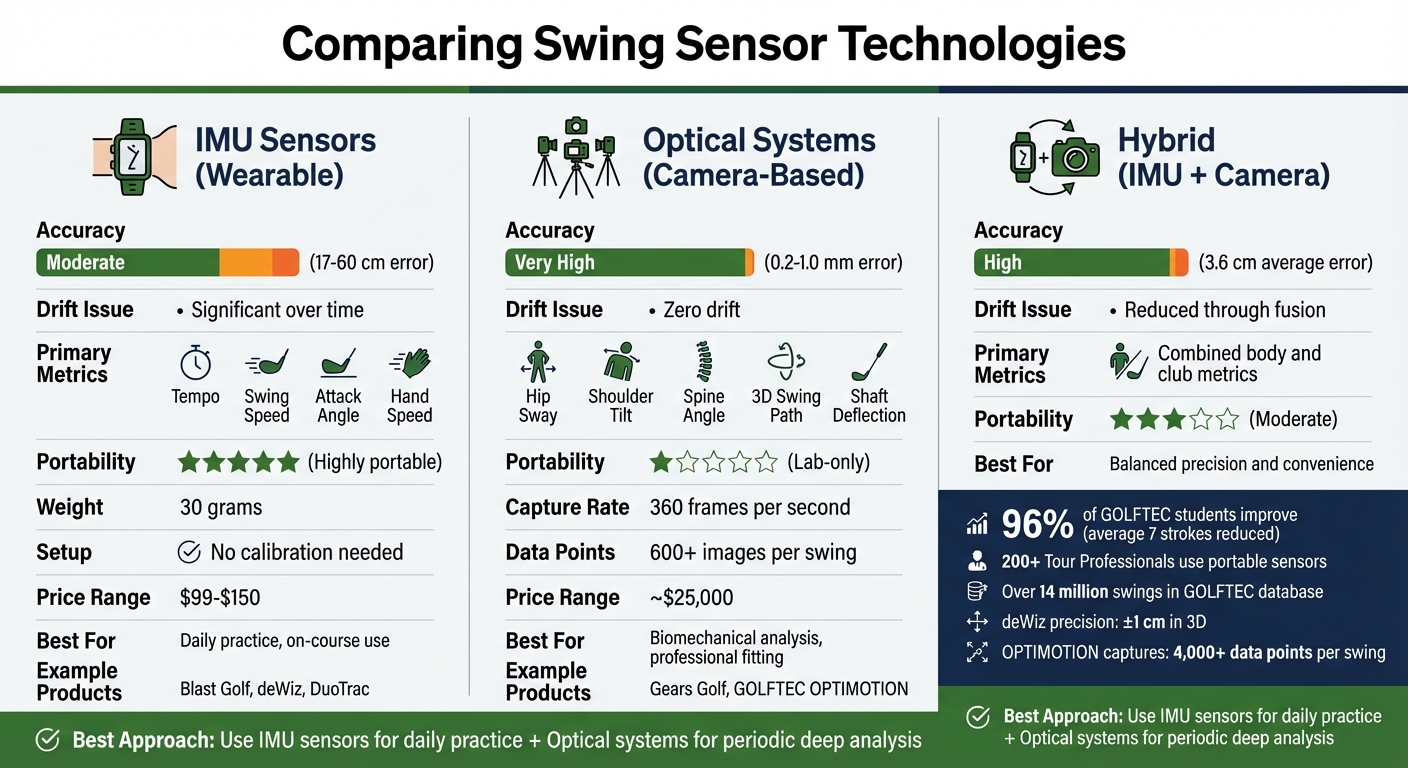
Golf Swing Sensor Technologies Comparison: Accuracy, Portability, and Cost
Let’s dive into the details of swing sensor technologies by comparing their accuracy, portability, and usability. Understanding these factors will help you choose the right system for your golf training goals.
Accuracy and Metrics Tracked
When it comes to precision, optical systems are unmatched, while IMUs (Inertial Measurement Units) provide practical benefits for everyday golfers. High-end optical setups, like Gears Golf, boast exceptional accuracy – measuring down to 0.2 mm. They capture over 600 images per swing at an impressive 360 frames per second. These systems track critical metrics such as shaft deflection, joint angles, and 3D swing paths, all without any drift.
On the other hand, IMUs face challenges with drift errors, which can range from 30 cm to 60 cm due to noise during rapid motion. Advanced signal processing can help reduce this error to around 17 cm, but it still doesn’t match the precision of optical systems. Another limitation of IMUs is their dynamic range; during high-speed swings, they may saturate, which impacts accuracy in the fastest parts of your swing.
Here’s a quick comparison of the technologies:
| Technology | Accuracy | Primary Metrics | Drift Issue |
|---|---|---|---|
| IMU Sensors | Moderate (17–60 cm error) | Tempo, swing speed, attack angle, hand speed | Significant over time |
| Optical Systems | Very High (0.2–1.0 mm error) | Hip sway, shoulder tilt, spine angle, 3D swing path | Zero drift |
| Hybrid (IMU + Camera) | High (3.6 cm average error) | Combined body and club metrics | Reduced through fusion |
Optical systems clearly excel in providing absolute positioning without drift, while IMUs rely on algorithms that can introduce inaccuracies. But accuracy isn’t the only factor – portability and ease of use are just as important, especially for golfers practicing on the go.
Portability and Ease of Use
Precision is great, but when you’re on the course, convenience matters. Devices like the Blast Golf sensor, priced between $119.96 and $149.95, are designed with portability in mind. These lightweight sensors (just 30 grams) attach directly to your club and sync to your phone without any need for calibration. They’re compact enough to fit in your pocket, making them a go-to choice for on-course practice. In fact, more than 200 Tour Professionals rely on these portable sensors for their training.
In contrast, optical systems are less practical for everyday use. They require a controlled lab environment with multiple high-speed cameras (typically eight or more) carefully positioned around the hitting area. While newer dual-camera setups offer slightly more flexibility, they still can’t compete with the grab-and-go simplicity of wearable sensors. As Forbes noted about Gears Golf:
"This is perhaps some of the most sophisticated technology in golf right now that takes incredibly accurate measurements of a golfer’s swing and body position… I’ve never seen any communicated as intelligently, accurately and quickly as this".
However, this level of sophistication comes with the trade-off of complex setup requirements.
For most golfers, the solution lies in a balanced approach. Use IMUs for daily practice and real-time feedback on the course, and reserve optical systems for specialized sessions like biomechanical analysis or professional club fitting. This way, you can enjoy the best of both worlds – precision when you need it and convenience when it matters most.
Conclusion: Using Swing Sensors to Improve Your Golf Game
Swing sensors are changing the way golfers approach training, offering tools that bring precision and insight to every practice session.
These devices provide real-time biofeedback that helps refine your mechanics. Whether it’s a portable IMU sensor you can use on the course or an advanced optical system for detailed analysis, the data they deliver is invaluable. For instance, deWiz can measure swing precision to within ±1 cm in 3D, while GOLFTEC’s OPTIMOTION captures over 4,000 data points per swing. This level of detail allows you to make adjustments based on hard facts, not guesswork, leading to smarter, more effective practice sessions.
To get the most out of these tools, focus on key metrics that impact your performance – like the X-factor (hip-shoulder rotation) and weight transfer during your swing. As deWiz’s CTO points out, instant feedback speeds up the learning process, helping you make corrections in real time and see faster results.
The best approach combines wearable sensors for everyday practice with occasional sessions using optical systems for deeper analysis or fine-tuning, such as club fitting. GOLFTEC’s data backs this up: 96% of their students improve their game, shaving an average of 7 strokes off their scores. It’s clear that incorporating data-driven training into your routine can take your game to the next level.
FAQs
How do swing sensors track and improve my golf swing in real time?
Swing sensors leverage cutting-edge biomechanics to analyze critical elements of your golf swing, such as rotation, angle, and force. These small devices, typically attached to your club or body, use tiny inertial measurement units (IMUs) to capture motion data. That data is then sent instantly to a connected device, like your smartphone or smartwatch.
Through this real-time feedback, you can get visual, audio, or even haptic alerts that show how your swing stacks up against professional standards. This allows you to make quick adjustments, fine-tune your mechanics, and lower the chance of injury – all while helping you improve faster out on the course.
How do IMU sensors differ from optical motion capture systems in tracking swing biomechanics?
IMU (Inertial Measurement Unit) sensors and optical motion capture systems take very different approaches to tracking swing biomechanics. IMU sensors are small, wearable devices equipped with accelerometers and gyroscopes. They measure movement directly from the body or club, offering real-time feedback during play. Their portability makes them incredibly convenient, though they can sometimes face minor accuracy challenges, like orientation drift. On the other hand, optical motion capture systems rely on high-speed cameras and reflective markers to generate highly precise 3D motion data. These systems are incredibly accurate but require a controlled environment and a significant setup, making them impractical for use on the course.

IMU sensors are a great fit for golfers looking for quick, on-the-go insights, while optical systems are best suited for lab-based, in-depth analysis. For tips and drills to refine your swing using these tools, explore the resources at How To Break 80.
Can swing sensors be used effectively both on the golf course and in a lab?
Modern swing sensors are incredibly adaptable, working seamlessly in both lab settings and out on the golf course. Devices like wrist-worn inertial sensors can track your swing motion with pinpoint accuracy, down to the centimeter, while also providing real-time corrections to minimize drift.
On the course, these sensors pair with mobile apps to deliver instant feedback, helping golfers fine-tune their technique in actual playing conditions. In a lab environment, they enable controlled data collection for in-depth biomechanical analysis, making them an essential tool for improving your game no matter where you practice.
Related Blog Posts
- How Tech Enhances Junior Golf Swing Analysis
- How to Use Motion Sensors for Putting Practice
- How Grip Pressure Sensors Improve Golf Swings
- Wearable Swing Analyzers: Are They Worth It?
