
If I want a corporate golf clinic to work for mixed skill levels, I’d lean on short-game stations first. About 60% of golf shots happen inside 100 yards, and better play there can trim 4 to 8 strokes per round. That’s why short-game games fit group events so well: they use less space, move fast, and let beginners and low-handicap players compete in the same setup.
Here’s the article in plain terms:
- I’d use 7 drills that cover putting, chipping, pitching, bunker play, and up-and-down scoring
- I’d run them in 10- to 15-minute rotations so groups keep moving
- I’d keep scoring simple, such as 3 points for a hole-out, 2 for closest, and 1 for second closest
- I’d build the session around small groups, usually 2 to 4 players per station
- I’d use basic gear like wedges, putters, tees, towels, alignment sticks, and a few target markers
The seven drills are:
- Up and Down Game Station
- Ladder Distance Control Putting Challenge
- Multi-Distance Chipping Progression
- Par 2 Short Game Course Around the Green
- Greenside Bunker Consistency Challenge
- Target Circle Putting Station
- Competitive Chipping Points Game
What stands out most to me: these drills work because they test touch, pace, landing spot control, and pressure without needing a full range. They also keep people close together, which helps the social side of a corporate event.
Quick Comparison
| Drill | Main Skill | Best For | Usual Time |
|---|---|---|---|
| Up and Down Game | Chipping + putting together | Mixed groups | 10–15 min |
| Ladder Putting | Speed control | Newer players and contests | 10–15 min |
| Multi-Distance Chipping | Landing spot control | Small-group reps | 10–15 min |
| Par 2 Short Course | Scoring and shot choice | Team or individual play | 15–30 min |
| Bunker Consistency | Sand contact | Players who want a harder test | 5–10 min |
| Target Circle Putting | Short-putt pressure | Fast group rotations | 10–15 min |
| Chipping Points Game | Scored accuracy | Leaderboards and finals | 5–10 min |
If I were setting up this kind of event, I’d see this article as a simple plan for building a short-game clinic that is easy to run, easy to score, and fun for a mixed crowd.
Dan’s Top-10 Short Game Practice Drills to put PURPOSE to your PRACTICE
sbb-itb-bcd8bdd
Why Short Game Drills Fit Corporate Golf Events
Short-game stations give beginners and experienced players a fair shot at doing well. These drills reward touch and decision-making, not just power, so newer golfers can stay in the mix while experienced players still get a solid test. They also build confidence fast because people can see results almost right away.
Run each drill in 10- to 15-minute stations to keep rotations simple and energy high. That timing makes it easy for groups to move from one station to the next without things dragging. And that movement helps people mix, chat, compare approaches, and meet different participants during the event.
A simple scoring system adds just enough pressure without making the game feel intimidating:
- 3 points for holing out
- 2 points for closest
- 1 point for second closest
That light pressure gives the drill a bit of on-course feel while still keeping it easy to join.
With that setup in place, start with an up-and-down station to combine chipping and putting in one simple game.
1. Up and Down Game Station
The Up and Down Game Station works well at a corporate event because it feels a lot like what players face on the course. Each player starts from a fairway, rough, or bunker lie, hits one chip, pitch, or bunker shot, and then putts out.
Primary Short-Game Skill Trained
This drill builds scrambling, along with distance control and putting under pressure. As Krista Dunton, GOLF Top 100 Teacher, puts it:
"I would do more up and down games. People practice putting, they practice short game. They never put them together."
Best Group Format for Corporate Clinics
Keep each station to 2 to 4 players. Set par at 3 for beginners and 2 for stronger players.
Space and Equipment Needed
You’ll need a greenside practice area with stations set about 10 to 40 yards from the hole. Each player should have:
- 4 to 5 golf balls
- A pitching wedge, sand wedge, lob wedge, and putter
Use tees or alignment sticks to mark landing spots and station locations.
Typical Time per Station
One attempt usually takes about 2 to 5 minutes per player.
After this combined station, move to a putting-only drill so players can work on pace control by itself.
2. Ladder Distance Control Putting Challenge
After the up-and-down station, shift the focus to pace control with a ladder putting challenge. This game is fast to set up, doesn’t need much room, and does a great job of teaching speed on the greens. Place 6 to 10 tees in 2-foot increments, starting 3 feet from the hole. If a player makes the putt, they move back one tee. If they miss, they move forward one tee. The first player to make a putt from the farthest tee wins.
Primary Short-Game Skill Trained
Distance control has a direct effect on scoring and is one of the best ways to avoid three-putts with better strategy. This station is simple, which makes it easy to teach touch without turning it into a long lesson. For those looking to dive deeper, exploring structured golf lessons can provide additional technical foundations.

For newer golfers, the ladder helps connect backstroke length with roll distance. That click matters. They start to feel how a shorter stroke sends the ball one distance and a longer stroke sends it another.
For better players, the same drill tightens tempo and pace calibration. It helps them build a repeatable lag putting process instead of guessing. Improving lag putting and distance control can reduce three-putts by as much as 63%.
Best Group Format for Corporate Clinics
For clinic play, this works best in a head-to-head format with 2 to 4 players at each station. Use the simple rule set: make a putt and move back, miss and move forward.
If the group has more playing experience, add a twist by staggering the tees instead of lining them up straight. That way, each putt brings a different break or slope into play, which makes the station tougher and more game-like.
Space and Equipment Needed
You’ll need a flat or slightly uphill area on the practice green that’s about 15 to 45 feet long. The gear list is short:
- 6 to 10 tees
- One ball per player for competition, or three balls per player for practice
- A putter
You can also place an alignment stick 10 to 12 inches behind the hole as a speed-control target. In that version, a good putt finishes between the hole and the rod.
Typical Time per Station
Time: 10 to 15 minutes.
3. Multi-Distance Chipping Progression
After working on pace control on the green, move just off the putting surface and switch the focus to landing control. Players chip from set distances to a marked landing zone – 5, 10, 15, 20, and 25 yards out – with attention on where the ball lands, not where the hole sits.
Primary Short-Game Skill Trained
This drill helps players build landing spot awareness, controlled carry, and rollout control. That matters because the landing spot does most of the work. Hit the right spot, and the ball has a much better shot at finishing close.
As PGA Teaching Professional Nicolai Cetti Engstrøm puts it:
"If you cannot control where you land the ball when chipping into the green, you have no chance of hitting the ball close to the hole repeatedly."
Use a 2×2-foot towel or an alignment-rod square as the landing zone. Give 1 point for each ball that lands inside the zone. For ladder play, the rule is simple: a player must land one ball in the current zone to move on. Miss, and they drop back one level. If you want to make the station harder, have players chip the same distance with different clubs to compare flight and rollout.
Best Group Format for Corporate Clinics
Head-to-head matches or small-group ladders tend to work best. Keep each station to 2 to 4 players so everyone gets enough reps. For bigger events, assign one station leader to track scores and keep people rotating without delays.
Space and Equipment Needed
You’ll need a short-game area with at least 25 to 50 yards of surrounding space and about 10 to 15 feet of width per station. Each station should have:
- 5 to 10 balls per player
- Alignment rods, tees, or bright towels to mark landing zones
- A mix of wedges, such as a pitching wedge, 52°, 56°, and 60°
Typical Time per Station
Time: 10 to 15 minutes per group rotation.
4. Par 2 Short Game Course Around the Green
After players get a few single-shot reps in, this drill turns those shots into a simple scoring loop. Set up 9 “holes” around the green: 3 easy, 3 medium, and 3 hard, with shots from 10 to 40 yards. Each hole is a par 2. Players chip once, then putt out. It sounds simple, but posting a good score is another story. Use the first few holes as a warm-up, then make things tougher as the group moves around the green.
Primary Short-Game Skill Trained
This format works on scrambling, club selection, and handling pressure. And that’s what makes it more than a basic up-and-down drill. Players aren’t just hitting one shot and moving on. They have to read the lie, pick the club, choose a landing spot, and then finish the job with the putter on each hole.
As GOLF Top 100 Teacher Krista Dunton points out:
"The key is to hit some different shots – and you’ve got to put each shot together with the putt."
That’s the point. Each hole asks for a slightly different answer, which makes the course a tougher and more useful test than a one-shot station.
Best Group Format for Corporate Clinics
Small groups of 2 to 4 players tend to work best, whether you run the station as a team scramble or with handicap-adjusted individual scoring. Handicap-adjusted scoring helps keep things competitive when the group includes a mix of skill levels.
Space and Equipment Needed
You’ll need a practice green with access to rough, bunker, and fairway lies nearby. Each player should have a mix of clubs, usually from an 8-iron to a lob wedge, plus a putter, scorecard, and pencil.

Typical Time per Station
A full 9-hole circuit usually takes 20 to 30 minutes per group. It also helps to include at least one bunker lie, so players start thinking about the next station before they get there.
5. Greenside Bunker Consistency Challenge
After the around-the-green course, use this station to lock in bunker contact. Draw a line in the sand and practice entering the sand at that same spot on every swing. When players can repeat that entry point, place the ball 3 inches in front of the line. From there, every rep starts from the same base.
For higher-handicap players, this drill usually feels less stressful. The club hits the sand before the ball, so the task feels simpler and easier to trust.
"A consistent bunker player is someone who has perfected the skill of entering the sand at the same point every time." – Bradley Turner, Director of Online Golf Instruction, Keiser University College of Golf
Primary Short-Game Skill Trained
This drill builds sand entry consistency and low-point control. Players use the wedge’s bounce to repeat the same 6-inch splash point. Then they can change backswing length – from knee-height to a fuller swing – to learn distance control without moving the entry point.
Best Group Format for Corporate Clinics
Start with the full group on the line drill before moving into solo reps. Once players can enter the sand cleanly without a ball, add a landing zone. A towel or hula hoop set 3 to 5 feet onto the green works well.
You can score each shot that finishes inside the landing zone. One bunker can usually handle 3 to 4 participants at a time with a turn-based rotation. Keep players at least 10 to 15 feet apart for safety.
Space and Equipment Needed
A standard practice bunker with green space next to it is enough for this station. You’ll need:
- Sand wedges
- Golf balls
- Alignment sticks or rakes to draw lines
- Towels or hula hoops for landing targets on the green
Typical Time per Station
Plan on 5 to 10 minutes per rotation. Start with a few reps without a ball, then move into target swings.
6. Target Circle Putting Station
After bunker work, move into a pure putting test built around golf tips for fast reads and clean starts. Place 6 to 12 balls around one hole, each 3 feet from the cup, at different clock positions. That setup creates a mix of breaks and speeds, so every putt feels a little different. Players have to reset their read each time, which keeps the station sharp and active. The fast rotation also helps groups stay engaged while giving each player plenty of visible reps.
Primary Short-Game Skill Trained
This drill trains start-line accuracy and make rate under pressure. The pressure shows up fast because one miss sends the player back to the first spot, which tightens focus right away.
Best Group Format for Corporate Clinics
Groups of 3 to 4 players per hole tend to work best. To keep things moving, use 4 positions instead of a full 12-ball circle: 12, 3, 6, and 9 o’clock. You can also match the target to the group’s skill level so the challenge fits the pace:
| Skill Level | Target (Consecutive Makes) | Distance |
|---|---|---|
| 20+ Handicap | 1 lap (4 putts) | 3 feet |
| 11–20 Handicap | 3 laps | 3 feet |
| 0–10 Handicap | 5 laps | 3 feet |
Space and Equipment Needed
Use a 3- to 6-foot radius around a single cup on the practice green. A 2% to 4% slope works well because it changes the read from spot to spot. Each station needs:
- 6 to 12 golf balls
- Tees or ball markers
- One putter per participant
Typical Time per Station
Plan for 10 to 15 minutes per rotation.
7. Competitive Chipping Points Game
After the pure putting station, shift into a scored chipping game to add a little pressure. End the rotation with a points-based chipping test from 10 to 15 yards off the green, using scoring rings around the hole. Each player hits 5 to 10 balls per round, and every shot earns points based on how close it finishes to the cup.
The ring setup makes scoring simple and fast.
| Scoring Zone | Points | Description |
|---|---|---|
| Hole Out | 5 pts | Ball goes directly in the cup |
| Inner Ring | 3 pts | Within about 3 feet of the hole |
| Middle Ring | 2 pts | Within 6 feet of the hole |
| Outer Ring | 1 pt | Within 10 to 12 feet of the hole |
| Missed Target Zone | −2 pts | Penalty for stronger players |
Primary Short-Game Skill Trained
This drill is built around scoring under pressure. Every chip has a clear point value, so players tend to focus harder on each shot instead of just flipping balls toward the green.
Best Group Format for Corporate Clinics
For bigger events, an individual leaderboard works well because players can stack points across the day, with winners announced at the end. If you want more of a head-to-head feel, a "Darts" format pairs two players who alternate shots until one reaches a set total, such as 50 points, first.
Space and Equipment Needed
Set aside a 10-yard buffer from the fringe to keep the station clear. Use hula hoops, towels, or alignment sticks to mark the scoring rings. It also helps to have one person track scores and keep things moving.
Typical Time per Station
Plan on 5 to 10 minutes per player or small group, depending on how many balls each person gets.
Drill Comparison: Skill Focus, Difficulty, and Group Fit
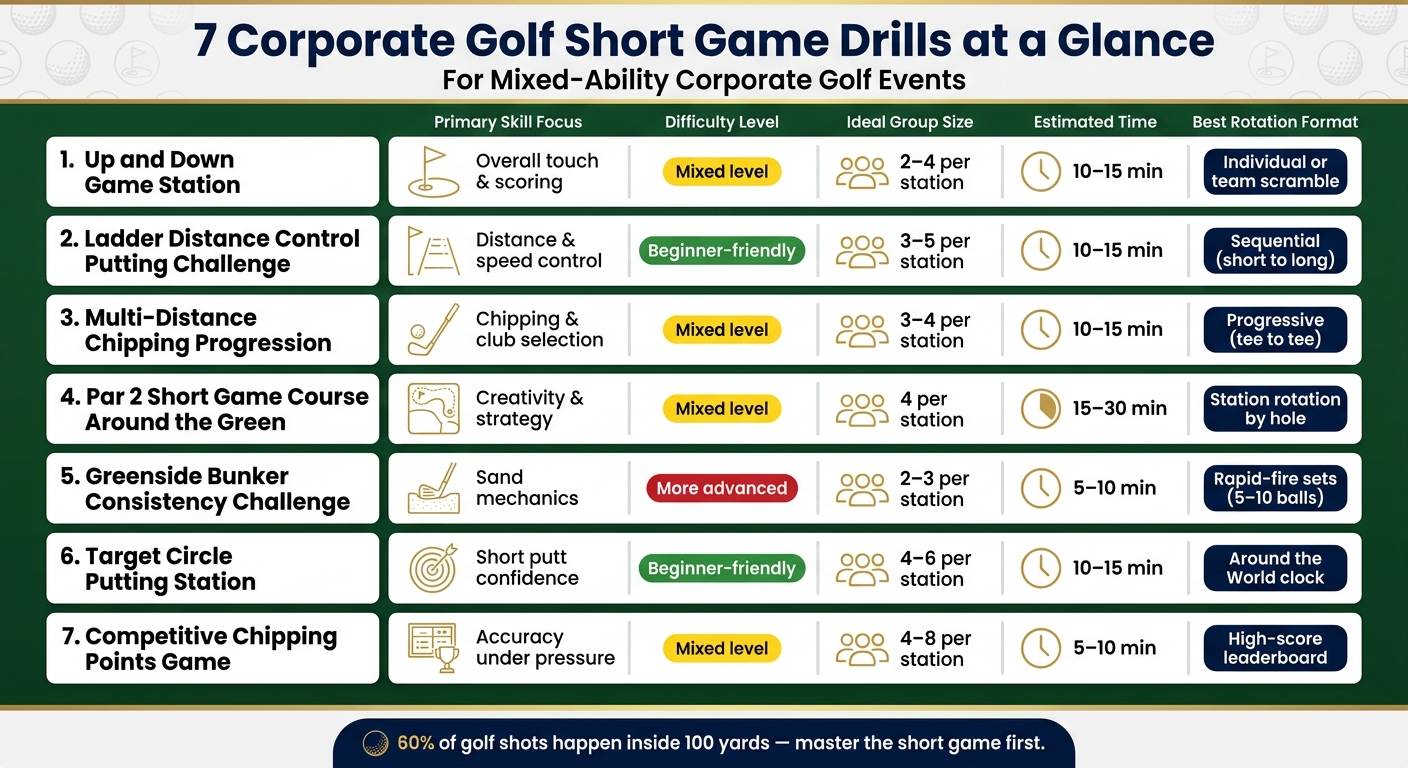
7 Corporate Golf Short Game Drills: Skills, Time & Group Size at a Glance
Each drill suits a different kind of group. A side-by-side view makes it easier to pair the right drill with the right players.

Use the table below to match each drill to skill level, group size, and rotation style.
| Drill | Primary Skill Focus | Difficulty Level | Ideal Group Size | Best Rotation Format |
|---|---|---|---|---|
| 1. Up and Down Game | Overall touch & scoring | Mixed level | 2–4 per station | Individual or team scramble |
| 2. Ladder Putting | Distance & speed control | Beginner-friendly | 3–5 per station | Sequential (short to long) |
| 3. Multi-Distance Chipping | Chipping & club selection | Mixed level | 3–4 per station | Progressive (tee to tee) |
| 4. Par 2 Short Course | Creativity & strategy | Mixed level | 4 per station | Station rotation by hole |
| 5. Bunker Consistency | sand mechanics | More advanced | 2–3 per station | Rapid-fire sets (5–10 balls) |
| 6. Target Circle Putting | Short putt confidence | Beginner-friendly | 4–6 per station | "Around the World" clock |
| 7. Chipping Points Game | Accuracy under pressure | Mixed level | 4–8 per station | High-score leaderboard |
This setup helps you balance pace and challenge across the event.
A couple of trends jump off the page. Ladder Putting and Target Circle Putting can handle slightly larger groups without things getting clogged up. Bunker Consistency works best with fewer players, since sand practice tends to slow down once too many people pile in.
If your group leans beginner, build the schedule around Ladder Putting, Par 2 Short Course, and Target Circle Putting. Then slot in the Bunker Consistency Challenge as an optional station for players who want a tougher test.
Planning Table: Space, Equipment, and Time per Drill
Use this table to set up the seven stations above for a mixed-ability corporate group.
| Drill | Space Required | Equipment Needed | Est. Time |
|---|---|---|---|
| 1. Up and Down Game Station | Apron or fringe of practice green | Wedge, putter, 10–15 balls | 10–15 min |
| 2. Ladder Distance Control Putting Challenge | Flat area of practice green | Putter, 4–5 tees/markers, balls | 10–15 min |
| 3. Multi-Distance Chipping Progression | Short-game area with 25–50 yards of surrounding space | Wedges, balls, hula hoops or cones | 10–15 min |
| 4. Par 2 Short Game Course Around the Green | Perimeter of practice green | Wedges, putter, balls, scorecards | 15 min |
| 5. Greenside Bunker Consistency Challenge | Practice bunker | Sand wedge, 5–10 balls, rake or alignment stick | 10 min |
| 6. Target Circle Putting Station | Practice green around one hole | Putter, 6–12 balls, tees/markers | 10 min |
| 7. Competitive Chipping Points Game | Chipping green | Wedges, 5–10 balls per player, scorecards | 10 min |
One practical note: the Greenside Bunker Consistency Challenge is the only station that needs a dedicated sand bunker. If your venue doesn’t have one, swap it for the tee contact drill. Place a tee about 2 inches in front of the ball on grass, then have players strike the ball first and the tee second. That teaches the same descending strike without using sand.
For markers, use clubs, towels, or alignment rods. It also helps to have extra wedges on hand at the chipping stations. For more ways to improve your technique, explore our full library of golf drills.
With the stations mapped out, the next step is making player rotations easy and orderly.
Tips for Running a Corporate Short Game Workshop
Use these rules to keep all seven stations moving without delays. The whole session runs on rotations, so keep each station to 10 to 15 minutes and use a whistle or a quick announcement to signal the change.
Put a sign at every station that explains the drill and the scoring. That way, players can get started right away instead of waiting for someone to talk them through it. Physical targets help too. Towels or hula hoops make the goal clear at a glance, which cuts down on setup time and confusion.
The one-ball rule is another simple fix that works well. Have each player go through a full pre-shot routine before hitting, instead of raking balls and swinging over and over. It keeps rotations moving and makes each shot matter.
For groups with mixed skill levels, use point-based games rather than stroke play. It keeps things fair, keeps people engaged, and makes scoring easier to manage. Once the scoring is set, each station should be simple enough for the group to run on its own without waiting for an instructor.
For continued practice, How To Break 80 offers short-game drills and wedge work plans.
Conclusion
The best corporate short-game drills are fast to teach, easy to score, and fair for every skill level. Put these seven drills together, and any group has a simple way to practice scoring without turning the session into a headache.
Short-game practice matters for one plain reason: a huge share of scoring shots happens inside 100 yards.
These stations do more than help people hit better shots. They also make the event more social. Guests stay in the same area, talk more, and feel less pressure than they might during full-swing practice. That blend of instruction and interaction is a big part of why short-game clinics work so well at corporate events.
For more short-game drills and practice plans, How To Break 80 offers practical resources.
FAQs
Which drill is best for beginners?
The Miniature Golf Short Game Course is a great fit for beginners because it feels more like play than practice. Pick a target hole and try to hole out in two strokes, and you start building touch, distance control, and confidence without it feeling like work.
For more golf improvement tips and guides, How To Break 80 offers practical resources to help players improve their skills.
How many stations should I use at one event?
There’s no set number of stations for a corporate golf event. The right setup depends on how many people are taking part, their skill levels, and how much space and equipment the venue gives you.

A common approach is to use 6 to 8 stations around the hole. Some game-based formats stretch that to 9 locations.
The goal is simple: pick a number that keeps the event fun, easy to run, and in line with your team-building goals.
What if the venue has no practice bunker?
If your venue doesn’t have a practice bunker, you can still sharpen your short game with drills built around trajectory and distance control.
Try chipping and pitching from the fringe or light rough with an 8-iron, 9-iron, or wedge. You can also use simple drills like up-and-down challenges and landing zone drills with just the putting green and the grass around it.
Related Blog Posts
- Golf Practice Checklist: 8 Drills for Weekend Warriors
- 5 Bunker Drills to Improve Sand Escapes
- Corporate Golf Clinics for Driving Accuracy
- Best Drills From Short Putt Clinics
