
A pre-shot routine helps me keep my mind clear, my target simple, and my swing more committed. The research in this article points to three main ideas: routines cut down swing thoughts, keep attention on the shot instead of mechanics, and help performance hold up when pressure kicks in.
Here’s the short version:
- Less overthinking: thinking about mechanics during the swing can interfere with motion I’ve already trained.
- Better focus: picking a clear target and finishing decisions before I step in helps keep attention on the shot.
- More control under pressure: in a 2024 study of 15 low-handicap male golfers, adding 4-2-8 breathing to a routine improved heart rate variability and helped clubhead speed (Hedges’ g = 0.92) and total distance (Hedges’ g = 0.78) under pressure.
- Simple routines work best: the main goal is doing the same steps each time, not making the routine long.
- Common routine parts: mental trigger, assessment, visualization, practice swing, alignment, and a final cue to swing.
In other words: I play better when I decide behind the ball, step in with one clear picture, and start the swing without delay. A routine gives me a small reset before every shot.
If I want to use this on the course, the takeaway is simple: improve your golf game by keeping the routine short, repeat the same pattern, breathe slowly, and swing within about 3 seconds after my final look at the target._
Pressure in Golf and Your Pre-Shot Routine | Titleist Tips

sbb-itb-bcd8bdd
What Research Says About Pre-Shot Routines
Research points to three main upsides: routines help you swing with less mental clutter, keep your mind on the shot at hand, and help performance hold up when the heat is on.
Automatic Execution and Less Overthinking
Thinking about swing mechanics during the swing can get in the way of patterns you’ve already trained. Research shows that paying attention to mechanics interferes with the automatic control processes needed for steady execution. A set routine helps stop what researchers call the "unraveling of automaticity", so you can lean on trained motor patterns instead of trying to steer every part of the swing by hand.
EEG data points in the same direction. Lower verbal-analytical processing is linked to more automatic movement execution.
That matters because automatic execution depends a lot on where your attention goes.
Attention Control and Shot-Specific Focus
A pre-shot routine also works like an attention filter. It pairs a cue that blocks out distractions with shot-specific steps, such as target selection and visualization, to keep your mind fixed on the shot.
Research suggests that focusing on the landing spot works better than focusing on the clubface or swing mechanics. For skilled golfers, thinking about where the ball should land takes less conscious monitoring of lower-level mechanics. That gives the motor system more room to do what it already knows how to do.
And this becomes a bigger deal once pressure starts tugging your attention away from the target.
Steadier Performance Under Pressure
Pressure changes things fast. In a 2024 Thammasat University study of 15 low-handicap male golfers, adding a slow 4-2-8 breathing pattern to the pre-shot routine increased heart rate variability, which is a sign of better stress control, and improved clubhead speed and distance (Hedges’ g = 0.92) and total distance (Hedges’ g = 0.78) under pressure compared with standard conditions.
Put simply, slower breathing helped the brain stay calm and focused. That supports the same automatic execution and attention control described above.
These findings point to the routine pieces that matter most.
How Pre-Shot Routines Sharpen Focus and Ease Pressure
Directing Attention to One Target and One Task
The research matters most when it shows what to do over the ball. Studies suggest golfers stay calmer when planning ends before setup begins. In plain English: make your choices behind the ball, then step in and swing. A good routine keeps decision-making behind the ball so execution over the ball stays simple. When those two phases get mixed together, doubt creeps in. That’s when hesitation and tentative swings show up.
A tighter visual cue helps too. Pick something precise, like an intermediate target a few feet in front of the ball on the target line. That gives your mind one clear target and makes alignment easier. Once that target is locked in, visualization and breathing can help keep the routine calm and committed.
How Visualization, Breathing, and Practice Swings Help
Visualization works like a mental rehearsal before you step in. Picture the ball flight before you swing, and you give your mind a clear preview of the shot. It’s a bit like running a scene in your head before the camera starts rolling.
Breathing matters too. Slow diaphragmatic breathing helps steady attention under pressure. A simple pattern to try is:
- Inhale for 4 seconds
- Hold for 2 seconds
- Exhale for 8 seconds
You can use that during visualization and just before the backswing. In one study, golfers using an SPB-integrated routine reported higher mental clarity scores (3.33 ± 0.49) than those using a standard routine (2.40 ± 0.63). That same steadiness can help stop rushed choices and half-committed swings.
Practice swings have a job as well. When the motion of your practice swing matches the ball flight you visualized, it builds a clearer feel for the actual swing. That link between what you picture and what you feel is often what turns a tentative move into a committed one.

Cutting Down Rushed Decisions and Tentative Swings
Pressure tends to speed everything up, both your thoughts and your tempo. A routine pushes back by giving you a fixed sequence to follow. That can help you keep your rhythm and stop that rushed feeling from taking over.
One simple anchor is the 3-second rule: once you’ve settled into your setup and taken your final look at the target, start your swing within three seconds. Stay over the ball too long, and doubt gets a chance to walk in.
The best routines aren’t longer. They’re just clearer.
Routine Components That Appear Most Often in Research
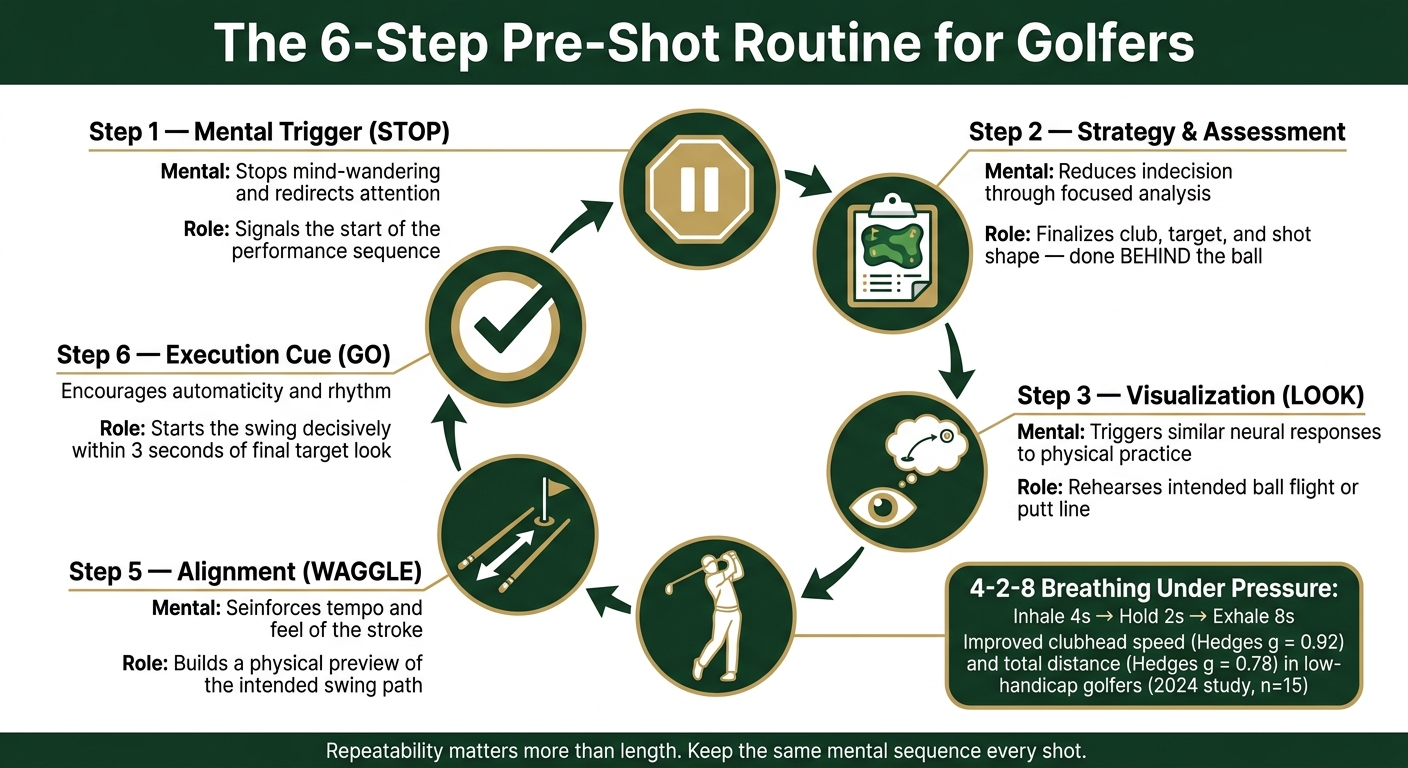
Pre-Shot Routine Steps for Golfers: The STOP S.L.O.W. GO Method
Core Elements of an Effective Routine
If you want to turn those mental gains into actionable golf tips you can use on the course, research keeps circling back to the same small group of steps.
Research and coach consensus point to six repeatable parts: mental trigger, assessment, visualization, practice swing, alignment, and a final cue.
The routine usually starts with a mental trigger – often a word like "Stop" or "Focus" – that interrupts mind-wandering and shifts attention to the shot.
Next is assessment: reading the lie, checking yardage, factoring in wind, and picking a club and target. The idea is simple: do your analysis behind the ball, then switch to execution once you’re over it.
After that comes visualization, where you form a clear mental picture of the ball flight or putt line. Research notes that imagery is similar enough to physical practice to trigger similar responses.
Then comes a practice swing to rehearse the feel of the shot. Alignment follows, with the body set in relation to the target line. The routine ends with a final Go cue that starts the swing in a clear, decisive way.
Routine Components at a Glance: Purpose and Role
Here’s what each step is doing.
| Routine Component | Mental Benefit | Role in Execution |
|---|---|---|
| Mental Trigger (Stop) | Stops mind-wandering and redirects attention | Signals the start of the performance sequence |
| Strategy and Assessment | Provides focused attention and reduces indecision | Finalizes club, target, and shot shape |
| Visualization (Look) | Similar enough to physical practice to trigger similar responses | Rehearses the intended ball flight or putt line |
| Practice Swing | Helps rehearse the feel of the stroke | Reinforces the tempo and path of the intended swing |
| Alignment (Waggle) | Supports a proper setup | Positions the body relative to the target line |
| Execution Cue (Go) | Encourages automaticity and rhythm | Starts the swing decisively |
Repeatability matters more than length. What counts is doing the same sequence each time, so the brain recognizes the pattern and moves into execution.
Key Takeaways for Golfers
Why Consistency Matters More Than Complexity
The best routine is the one you can do almost on autopilot. It doesn’t need to be long or fancy. It needs to be repeatable.
That’s the big message from the research. Repeatability matters more than length. In a Delphi study with 36 NCAA Division I coaches, five of the six steps in the STOP S.L.O.W. GO model reached 100% consensus on usefulness.
Keep your mental sequence the same from shot to shot. Then change only the details tied to the shot in front of you. Elite golfers do this well: they shift the physical parts based on shot type, but the mental template stays steady.
What the Research Means for Practice and Play
In practice, this leads to one simple rule: treat the routine as part of the shot, not as a warm-up.
That matters because routines hold up under pressure only when you’ve used them again and again, both on the range and on the course.
For drills and guides, visit How To Break 80.
FAQs
How long should my pre-shot routine be?
Your pre-shot routine should take about 15 to 20 seconds. That’s usually enough time to assess the target, picture the shot, and get lined up without dragging things out or giving your mind too much room to wander.
Once you’re set and looking at the ball, start your swing within 3 seconds. That part matters. If you stand over the ball too long, tension tends to creep in.
For short shots, a tighter routine of 10 to 12 seconds often works better and can help you stay precise.

When should I decide on the shot?
Decide on your shot while you’re still standing behind the ball, in the think box or decision phase. Check the wind, your lie, and any hazards. Then pick your club and choose a precise landing spot. Keep it simple.
Once you step into the play box, the decision phase is done. If doubt creeps in at that point, step away and start your routine again.
Can a routine help when I feel nervous?
Yes. A steady pre-shot routine can help you handle nerves and feel less pressure during a round.
When you go through the same steps each time, your mind has something simple to lean on. That can settle racing thoughts, loosen physical tension, and tune out distractions. Just as important, it moves your attention away from picking apart your swing and back to trusting it.
If doubt or tension creeps in, step back and start your routine again.
Related Blog Posts
- 5 Steps for a Confident Pre-Shot Routine
- Pre-Shot Routine vs. No Routine: What Works Better?
- Pre-Shot Routine for Better Focus
- Ultimate Guide to Mental Resets on the Course
