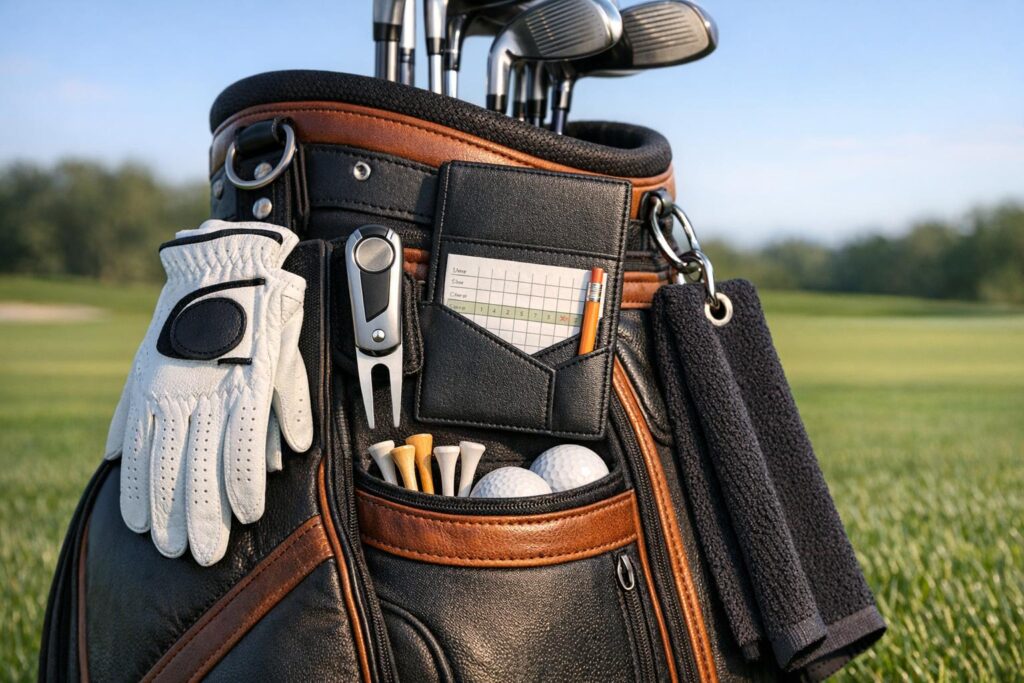
Your golf bag isn’t just for clubs – it’s your toolkit for a better game. The right accessories can improve your performance, keep you comfortable, and ensure you’re ready for any situation on the course. Here’s a quick rundown of 10 must-have items:
- Golf Balls: Keep 9–12 balls handy. Use premium balls for play and older balls for practice. Clean them often for better performance.
- Golf Tees: Carry around 20 tees in various sizes for different clubs. Durable plastic or bamboo options are great choices.
- Golf Glove: A snug, well-fitted glove improves grip and prevents blisters. Carry backups for wet or worn-out gloves.
- Ball Marker: Essential for marking your ball’s spot on the green. Metal markers are durable, and advanced options aid alignment.
- Golf Towel: Use microfiber towels to clean clubs and keep grips dry. A two-towel system works best – one for clubs, one for sweat.
- Divot Tool: Repairing pitch marks keeps greens in good shape. Look for lightweight, foldable tools with added features like ball markers.
- Golf Umbrella: A double-canopy design withstands wind and protects against rain and sun. Sizes range from 60–68 inches.
- Rangefinder or GPS Watch: Rangefinders offer precise yardages, while GPS watches provide quick distance overviews and extra features.
- Club Cleaner Brush: Keep grooves dirt-free for better spin and control. Dual-bristle brushes with groove cleaners are practical and affordable.
- Portable Ball Retriever: Retrieve balls from hazards and save money. Compact, collapsible designs fit easily in your bag.
These tools not only enhance your game but also help maintain course etiquette. From keeping your clubs clean to marking your ball, every accessory serves a purpose. Check your bag today – are you missing any essentials?
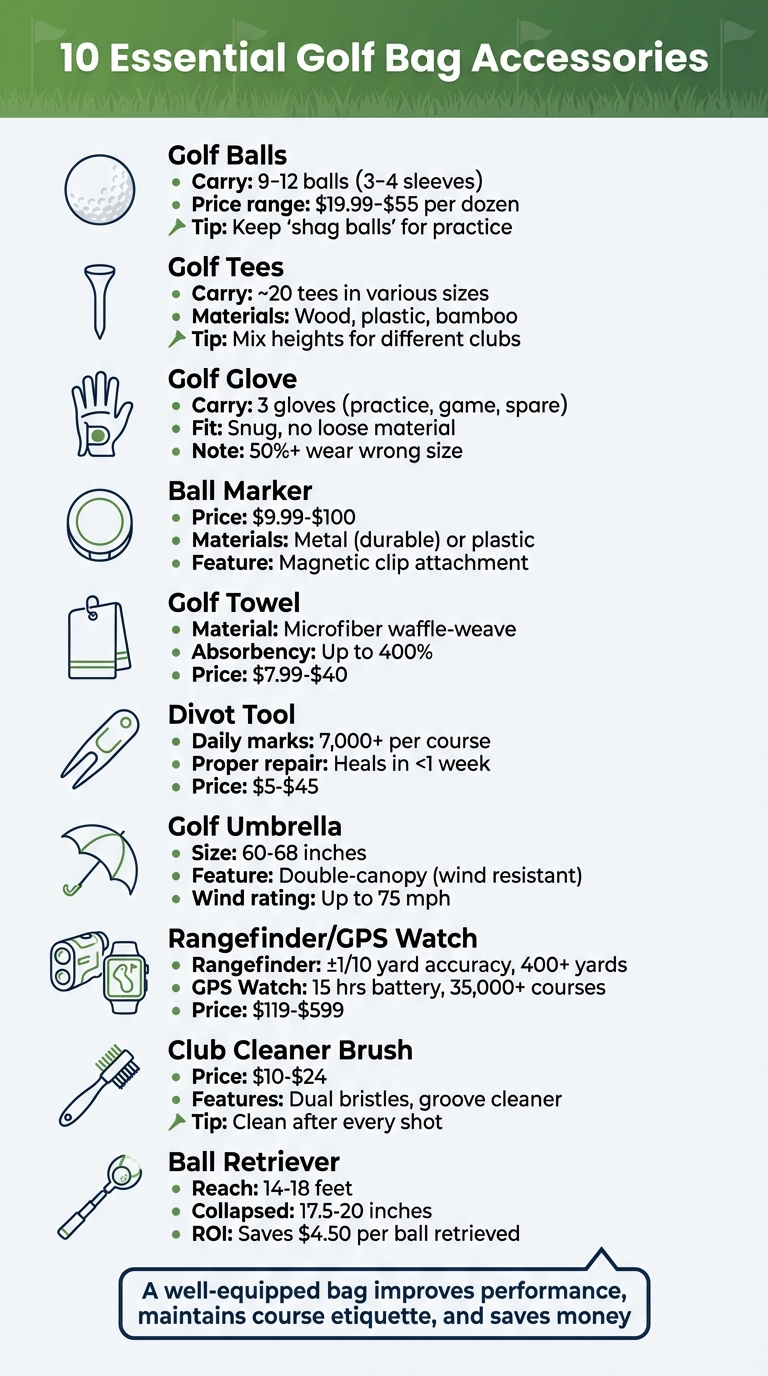
10 Essential Golf Bag Accessories Every Golfer Needs
10 Essential Items to Have in Your Golf Bag
1. Golf Balls
Golf balls are a must-have for any golfer, but it’s easy to underestimate how many you’ll need. Jessica Marksbury, Editor at Golf.com, suggests keeping three to four sleeves – about 9 to 12 balls – in your bag at all times. She advises:
"Depending on your skill level, three to four sleeves should always do the trick. If you need more than that in a given round, you might want to spend some time on the range before playing again."
For beginners, affordable two-piece balls like the Callaway Warbird (around $19.99 per dozen) are a smart choice. Mid-handicap players might prefer three-piece balls, which offer a balance between distance and feel. Advanced players, on the other hand, often go for premium four- or five-piece balls, which can cost up to $55 per dozen.
It’s also a good idea to carry some "shag balls" – older or slightly damaged balls – in a separate pocket. These are perfect for practice shots when you’re waiting on a slow group or tackling a risky water hazard. To avoid confusion during play, make sure to mark your balls for easy identification.
If you’re looking to save money, buying recycled or used balls in bulk can be a great alternative to expensive pro shop options. And don’t forget to clean your balls between holes – dirt and mud can mess with their trajectory and impact your score. Staying prepared and maintaining your gear can make a big difference in your game.
2. Golf Tees
Having the right golf tees can make a noticeable difference in your game. The height of the tee plays a crucial role in ensuring optimal contact with the ball. For instance, taller tees work best with drivers, while shorter tees are ideal for irons. Gabe Coyne, CEO of Stix Golf, highlights the importance of this choice:
"The tee height is generally a personal preference, but a good rule of thumb is to choose a tee that elevates the ball halfway above the clubhead."
When preparing for a round, it’s smart to carry a mix of tees. Standard tees are perfect for drivers, longer tees suit larger clubs, and shorter tees provide precision for irons or par-3 shots. Experts suggest keeping around 20 tees in your bag to ensure you’re well-prepared.
Golf tees come in a variety of materials, each offering unique benefits. Wooden tees give a natural feel but tend to break easily. Plastic tees are durable, often lasting over 100 shots, while bamboo tees stand out as a sturdy and eco-conscious option.
For those looking to fine-tune their performance, specialty tees with multiple prongs are designed to reduce friction during contact. However, it’s worth noting that some specialty options, like anti-slice and castle tees, are not permitted in tournament play. Brightly colored tees can also be a practical choice – they’re easier to spot on the grass after your shot.
Selecting the right tees is a small but important part of your overall golf setup. With the right mix, you’ll be better equipped for a focused and effective round.
3. Golf Glove
A golf glove improves your grip and gives you better control over the club. It reduces slippage during your swing by creating friction between your hand and the club, while also protecting your lead hand from blisters and calluses.
The glove is worn on your lead hand – left for right-handed players and right for left-handed players. Getting the right fit is more important than many golfers realize. According to FootJoy, over 50% of golfers wear the wrong glove size, often choosing one that’s too big. Your glove should fit snugly, with no loose material. As Red Rooster puts it:
"A well-fitted golf glove will help to apply the right amount of pressure on your club, minimizing the likelihood that your hands will slip or that the club face will rotate."
To maintain performance, always have backups. Carry at least three gloves: one for practice, one for your game, and a spare. Gloves lose their grip when they get wet or worn out, so having extras on hand is a smart move, especially for the later holes.
For rainy weather, use rain gloves designed to maintain grip even when wet. For everyday play, gloves made from premium Cabretta leather are a solid choice. To keep your spares in top condition, store them in zip-up pouches to protect them from moisture.
4. Ball Marker
A ball marker might seem like a small accessory, but it plays a big role in your game. It helps you mark the exact spot of your ball on the green, ensuring you follow the Rules of Golf and avoid a one-stroke penalty for lifting your ball without marking its position first. This little tool is not just about practicality – it’s also about respecting golf etiquette when playing with others.
Using a ball marker gives you the chance to clean your ball and realign it for a more accurate putt. It’s a simple yet effective way to keep your game sharp while maintaining courtesy on the green.
When selecting a marker, durability matters. Metal options, like stainless steel or aluminum, tend to outlast plastic ones, which may be cheaper but are often less reliable. For convenience, consider markers that attach to a magnetic hat clip or strap – they’re easy to grab when you need them. It’s also smart to carry a flat, coin-style backup in case your main marker gets in the way of another player’s line.
Price-wise, standard ball markers typically range from $12.95 to $20.00. If you’re looking for something more budget-friendly, bulk packs of plastic markers can cost as little as $9.99 for 50 to 150 pieces. On the other end, high-tech alignment markers with advanced features can go for as much as $100.00.
Speaking of alignment, many modern markers include features like triple-track lines or 3D domes to help with precision. The OnPoint 3D dome marker, for example, boasts a three-rail alignment system that claims to improve putting performance by 12%. Whether you’re a casual player or a serious competitor, having a reliable ball marker is a must on the green.

5. Golf Towel
A good golf towel isn’t just a nice-to-have – it’s a must for maintaining your gear and improving your game. By keeping your club grooves clean and your grip dry, a towel plays a key role in ensuring consistent shots and better ball control. Clean grooves mean better contact and spin, while a dry grip helps you avoid slipping during your swing.
When choosing a golf towel, microfiber with a waffle-weave pattern is a smart pick. It’s known for its impressive absorbency – up to 400% – and quick-drying capabilities, all while effectively trapping dirt and debris. Adam Zammiello from Golf.com emphasizes this point:
"The material of a towel will determine its absorbency, how fast it dries or remains wet, and how well it cleans your clubs".
For convenience, look for towels with a carabiner clip or a magnetic attachment (some with up to 25 lbs of pull strength) to keep them easily accessible on your bag or clubs.
A two-towel system can be especially effective: use one towel for cleaning your clubs and another for wiping sweat. For the cleaning towel, dampen one half to loosen dirt and use the dry half to polish your clubs.
If you’re on a budget, tri-fold microfiber towels are available starting at just $7.99. For those seeking something more advanced, magnetic or dual-layer options typically range from $25.00 to $40.00.
Like other tools in your golf arsenal, a reliable towel ensures you stay focused and ready for every shot on the course.
sbb-itb-bcd8bdd
6. Divot Tool and Pitch Repair Tool
A divot tool, sometimes called a pitch mark or ball mark repair tool, is a small handheld device designed to fix ball marks on the green. Using this tool is essential for keeping the course in top condition and ensuring fair play for everyone.
On average, a golf course sees more than 7,000 pitch marks each day. Properly repaired marks heal in under a week, while those left unattended – or repaired incorrectly – can take weeks to recover. As Golf Digest editors explain:
"Repairing ball marks is one of the simplest ways you can do your part to keep your course in good condition, but it requires the right equipment".
Given this, knowing how to use the tool correctly is just as important as having one. To fix a pitch mark, insert the prongs at a 45° angle around the edge of the mark and gently push the turf inward toward the center. Avoid lifting upward, as this can damage the grass roots. Afterward, smooth the surface by lightly tapping it with your putter. This method not only restores the green but also ensures an even playing surface for all.
Divot tools come in a variety of styles and price points. Basic plastic or metal tools cost as little as $5–$10, and many courses even provide them for free. Mid-range options, like the Pitchfix 2.0, are priced between $14 and $20. For those seeking premium tools, options with titanium finishes or added features – like magnetic ball markers, bottle openers, and groove cleaners – range from $35 to $45. Switchblade-style tools, which fold to prevent pocket damage or injury, are especially convenient. Choose a tool that suits your preferences without adding unnecessary bulk.
Taking the time to repair pitch marks consistently demonstrates care for the course and respect for fellow golfers.
7. Golf Umbrella
A good golf umbrella does more than just keep you dry – it protects you from both rain and sun while standing up to tough winds. As Dylan Dethier from Golf.com puts it:
"You don’t want to be the guy or gal with the weak umbrella blown inside-out by a gust of wind; that will leave you wet and upset."
To avoid that scenario, focus on features designed for durability and performance, especially in windy conditions.
The double-canopy design is key. This feature includes vents in the fabric that let wind pass through instead of catching underneath and flipping the umbrella inside out. For example, the ShedRain Vortex Vent can handle winds up to 75 mph, while the Gustbuster Pro Series is rated for gusts up to 55 mph. Many high-performance models also use lightweight fiberglass frames, which are built to withstand strong gusts without adding unnecessary weight.
For sun protection, look for a UPF 50+ rating and reflective lining to block UV rays and reduce heat. A standard size, typically between 60 and 68 inches, provides enough coverage for you and your golf bag.
Prices range from $20 for basic models to $80 for premium versions. Features like automatic opening mechanisms and rubber-coated handles for a secure grip make the umbrella even more practical. A dependable golf umbrella ensures you’re prepared for any weather and complements the rest of your gear on the course.
8. Rangefinder or GPS Watch
Knowing the exact yardage can take the guesswork out of your game and help you choose the right club. A rangefinder uses laser technology to measure the distance directly to the flagstick, while a GPS watch relies on satellite data and preloaded course maps to provide distances to the front, middle, and back of the green.
Laser rangefinders are all about precision. They can measure distances up to 400+ yards with an accuracy of within 1/10th of a yard. It’s no surprise that over half of PGA Tour, PGA Tour Champions, and LPGA Tour players trust Bushnell rangefinders during practice rounds. As Jonathan Wall from GOLF.com puts it:
"There’s a reason why PGA Tour caddies use these devices to plot out the course each week".
High-end models like the Bushnell Pro X3 (priced around $599) come with slope functions to account for elevation changes and even display wind speed and direction. For those on a tighter budget, options like the Golf Buddy Voice 2 SE start at approximately $130. If you prefer something wearable, a GPS watch might be your go-to.
GPS watches offer convenience by staying on your wrist, giving you instant yardages without needing a direct line of sight. For example, the Garmin Approach S42 provides 15 hours of battery life in GPS mode – enough for about three rounds – and costs roughly $119. Many GPS watches also include additional features like score tracking, stat collection (fairways hit, putts, etc.), and even music playback. The SkyGolf SkyCaddie LX5 stands out with over 35,000 ground-verified course maps preloaded. Whether you want pinpoint accuracy or hands-free convenience, your choice depends on your preferences and the conditions you typically play in.

When deciding, consider your playing style and course conditions. A rangefinder is ideal if you need precise yardage to the pin and often play on courses with significant elevation changes. On the other hand, a GPS watch is perfect for quick overviews of the hole and digital stat tracking without needing to carry an extra device. Both tools simplify your game and reduce uncertainty.
If you play on hilly courses, look for a device with a slope function to adjust for uphill or downhill shots. Keep in mind that laser rangefinders generally use replaceable batteries, while GPS watches need recharging every 2–3 rounds.
9. Club Cleaner Brush
Dirt and grass stuck in your club’s grooves can throw off your shot. A club cleaner brush helps keep those grooves clear, ensuring the clubface grips the ball properly for better spin and control. PGA professional Brittany Olizarowicz emphasizes its importance:
"As a golf professional, I always kept golf cleaning tools or a golf club brush tool in my bag. It’s really not worth taking a swing and having it impacted by a piece of dirt or debris." – Brittany Olizarowicz
A quality club cleaner brush is designed to handle different cleaning needs. Most brushes, priced between $10 and $20, feature dual-bristle heads: stiff wire bristles for scrubbing iron faces and softer nylon bristles for woods and hybrids. The Yoport Retractable, for instance, scored 9.5/10 for its ergonomic handle and dual-bristle design.
For tougher cleaning tasks, look for brushes with an integrated groove cleaner – a retractable spike that helps dislodge packed sand and mud from grooves. Many models also include a retractable zip-line that extends 2–3 feet, allowing you to clean clubs without detaching the brush.
Some modern options, like the GrooveIt Brush (around $24), take it a step further with a built-in water reservoir that sprays the clubface while you scrub. It even comes with a 3-year warranty on its nylon bristles. To avoid scratching delicate finishes, use nylon bristles for woods, hybrids, and forged irons, and reserve wire bristles for standard steel irons when deeper cleaning is required. Clean grooves between shots can make all the difference, ensuring consistent spin and ball flight.
10. Portable Golf Ball Retriever
A portable golf ball retriever can save you a surprising amount of money. With golf balls costing around $55 per dozen (roughly $4.50 each), recovering just eight high-quality balls from water hazards already covers the cost of most retrievers.
But it’s not just about the savings – it’s also about the mental game. Freelance golf writer Michael Croley shares an interesting perspective:
"Fetching a ball from oblivion, and realizing you can, might even give you more confidence on the tee." – Michael Croley
This makes picking the right retriever even more important.
When shopping for one, focus on portability and design. Look for models that collapse to about 17.5–20 inches so they can easily fit in your bag’s side pocket. For instance, the Igotcha Jawz extends up to 14 feet but folds down to just 17.5 inches, earning high marks (9.7/10) for its stability and secure grip. If you often deal with deeper water hazards, the Search N’ Rescue Magic Gripper reaches up to 18 feet. Keep in mind, though, that longer models can be trickier to control when fully extended.
Durability is another key factor. Opt for materials like stainless steel or anodized aluminum to resist rust. Budget-friendly options start at $10–$25, but mid-range picks like the Callaway 15′ Retriever (around $39.99) or premium models like the Search N’ Rescue (about $59.95) offer better durability and reach.
To keep your retriever in top condition, wipe and dry the telescoping shaft after each use to prevent rust and ensure smooth operation. Avoid using it to pry balls out of heavy mud or rocks – it’s built for retrieving, not heavy-duty leverage. With proper care, a quality retriever can last for years and save you hundreds of dollars in lost balls.
Conclusion
Having the right accessories in your golf bag not only sharpens your game but also ensures you’re respecting the course and your fellow players. Tools like rangefinders and clean club grooves enhance your shot accuracy and control, while a divot tool helps you maintain the greens. As Nick Heidelberger, Senior Editor of GolfLink, wisely states:
"Every golf bag needs a divot tool and if every golfer made it a personal goal to fix more pitch marks than they make, the world would indeed be a better place".
These small upgrades can make a big difference in your overall experience. For instance, ball markers ensure you don’t interfere with your playing partner’s line on the green. And as Jessica Marksbury, Editor at Golf.com, points out:
"A rangefinder can dial in your yardages in the blink of an eye, helping you play faster and more efficiently".
Take a moment to review your bag for the essentials. Keep your club faces clean after every shot to maintain peak performance. On the green, make it a habit to repair your pitch marks and even fix an extra one to contribute to course upkeep.
While a well-stocked bag is a step toward improving your game, there’s always room to grow. For more tips and resources to refine your skills, check out How To Break 80 (https://break80.guide).
FAQs
How can I choose the best golf ball for my playing style and skill level?
Choosing the right golf ball comes down to understanding your swing speed and what aspects of your game you want to enhance. If your driver swing speed exceeds 105 mph, a high-compression ball (90+ compression) can help you achieve greater distance and a straighter ball flight. On the other hand, if your swing speed is below 85 mph, a low- or mid-compression ball (70–80 compression) is a better fit, offering more launch and a softer feel, especially around the greens. For those with swing speeds in the 85–95 mph range – often mid-handicap players – a balanced ball that combines distance with spin control can be a great choice.
If hitting longer drives is your main focus, look for golf balls with a firmer core that maximize distance. However, if you want more control in your short game, balls with softer covers that produce higher spin on approach shots will serve you well. To find the ball that complements your swing, try testing a few options on the range. You’ll quickly notice which one feels just right. For more advice on improving your game and refining your gear, check out the resources from How To Break 80.
What makes a rangefinder better than a GPS watch for measuring distances on the golf course?
Rangefinders offer accurate, line-of-sight measurements straight to your target, often factoring in slope adjustments for uphill or downhill shots. This precision takes the guesswork out of your game, acting almost like a virtual caddie. Just point, shoot, and instantly get the yardage you need, making your pre-shot routine quicker and keeping the pace of play steady.
On the other hand, GPS watches use satellite data to show distances to key points on the hole, like the front, middle, and back of the green. While they’re convenient, they might not provide the same level of accuracy for pinpointing exact pin locations. Plus, having to glance at your wrist can interrupt your focus and rhythm. For golfers who prioritize precision and speed, rangefinders tend to be the go-to choice.

Why should I always carry a divot tool in my golf bag?
A divot tool plays a key role in keeping the golf course in great condition. It’s designed to help you easily fix pitch marks and divots on the green, ensuring the surface stays smooth for putting and avoiding additional damage. Using one isn’t just about maintenance – it’s a way to show respect for the game and your fellow players by helping preserve the course for everyone’s enjoyment.
Related Blog Posts
- Golf Practice Checklist: 8 Drills for Weekend Warriors
- How to Prepare for Golf in Extreme Heat
- Winter Golf Gear Checklist
- Checklist for Junior Golf Tournament Prep
