
I’d choose a putting book based on your biggest miss – not its title. If you miss your starting line, look for setup and aim instruction. If you often face long second putts, focus on distance control. Then test one lesson at a time, using a fixed distance such as 3 feet to track short-putt results.
Here’s how I’d sort the books in this guide:
Quick Comparison
| Book | Main focus | Best fit |
|---|---|---|
| Dave Pelz’s Putting Bible | Research, mechanics, and putting physics | Readers who want detailed instruction |
| Putting My Way | Jack Nicklaus’s approach to fundamentals, equipment, and strategy | Readers who prefer a player’s perspective |
| Putt Like a Pro | Setup and stroke mechanics | Golfers working on their stroke |
| The Art of Putting | Feel and simple mechanics | Readers who want fewer technical checkpoints |
| Bulletproof Putting in Five Easy Lessons | Stroke, aim, speed, and mental approach | Readers who prefer short lessons |
| Putting Secrets | Pre-putt routines and green reading | Beginners and casual golfers |
| The Little Book of Breaking 80 | Scoring mindset and short game | Amateurs whose scores have stalled |
Before choosing, I’d check for clear explanations, repeatable drills, and coverage of setup, aim, stroke, green reading, speed, and routine. I’d also separate the author’s equipment preferences from advice I can test.
My next step: <u>pick one method and measure results over several rounds</u>. Track three-putts, short-putt success, and how far first putts finish from the hole. If you need practice support, How To Break 80 offers short videos and a putting game to pair with your book.
Books on Putting Mechanics and Strategy
These books approach putting through data, player experience, and basic mechanics.
Dave Pelz’s Putting Bible
Dave Pelz’s Putting Bible uses research to guide instruction. It suits analytical golfers who want a structured approach and are willing to put time into putting drills.
Putting My Way
Jack Nicklaus’s Putting My Way shares player-tested advice on fundamentals, equipment, and strategy. It’s a good fit for readers who prefer learning from a player’s experience. Treat his techniques as options to test – not rules to copy.
Putt Like a Pro
Putt Like a Pro focuses on setup and stroke mechanics.
The next section turns to books centered on feel, simplicity, and shorter lessons.
sbb-itb-bcd8bdd
Books on Putting Feel and Short Lessons
The Art of Putting
Stan Utley’s The Art of Putting combines feel with simple mechanics and short instruction. It takes a lighter approach than the preceding mechanics-focused books and suits golfers who want fewer technical checkpoints and more practice time. Readers who want detailed guidance may find it too sparse.
Work on one adjustment at a time and build a consistent mental approach to handle frustration or the yips.
The next book offers a more structured path through short lessons.
Bulletproof Putting in Five Easy Lessons
Michael McTeigue’s Bulletproof Putting in Five Easy Lessons covers pendulum stroke mechanics, green reading and aiming, speed control, and the mental approach across five lessons. It suits readers who prefer instruction in short chunks.
Use those lessons as a practice framework. Work on each until you can repeat it consistently before moving to the next. Short lessons still take repetition to improve pace, break, and consistency.
Choose a Book and Plan Your Practice
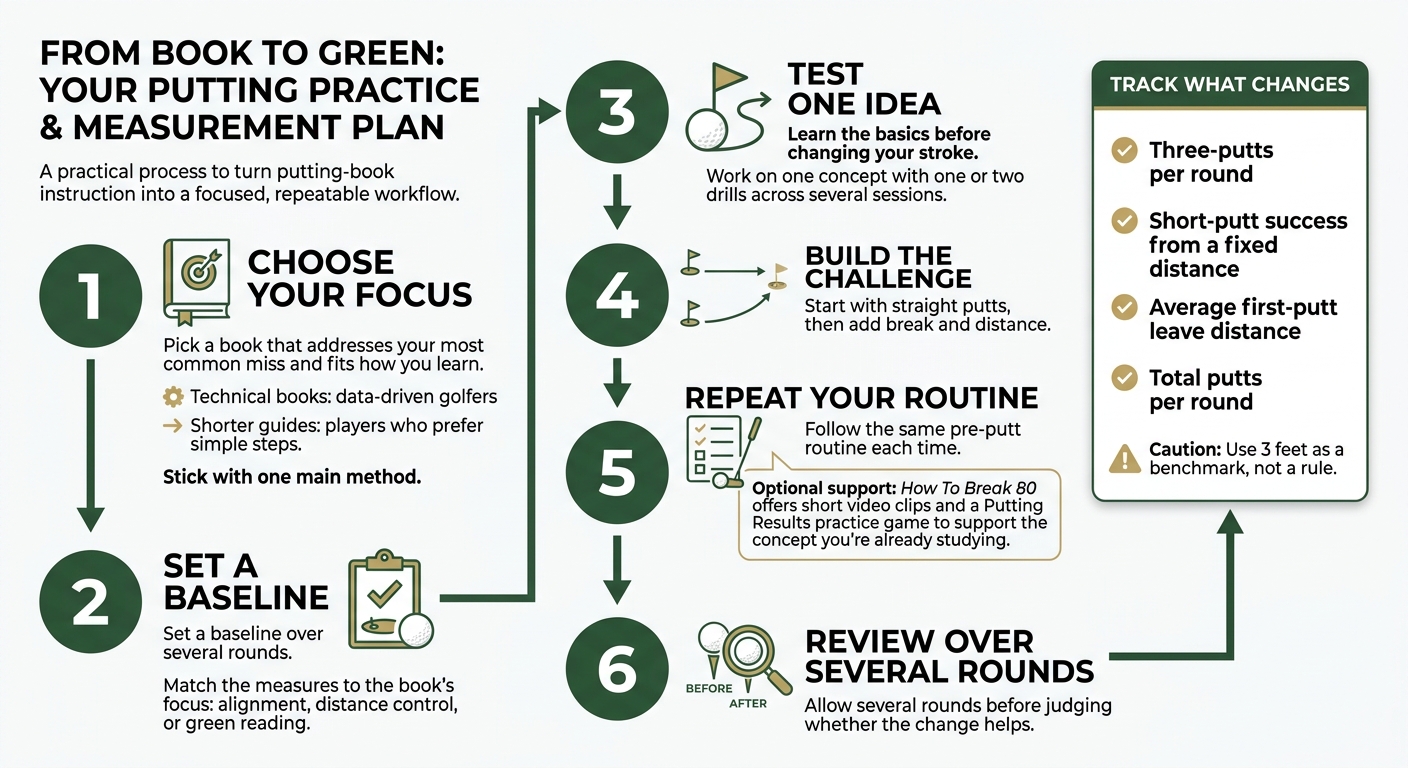
Putting Practice Plan: From Book to Better Results
Compare Books by Approach and Reader Needs
Pick a book that addresses your most common miss and fits how you learn. Technical books work well for data-driven golfers. Shorter guides suit players who prefer simple steps they can put to work. Stick with one main method.
Use this table to match each book’s approach to your putting needs and reading preferences.
| Title and author | Primary approach | Strongest topics | Suitable reader | Main limitation |
|---|---|---|---|---|
| Dave Pelz’s Putting Bible – Dave Pelz | Technical and scientific | Mechanics and putting physics | Detail-oriented readers | Too technical for some readers |
| Putting Secrets – Jack Moorehouse | Simple and concise | Pre-putt routines and green reading | Beginners and casual golfers | Too brief for deep instruction |
| The Little Book of Breaking 80 – Shane Jones | Scoring decisions and mental game | Scoring mindset and short game | Amateurs at a plateau | Repeats key ideas |
Put Lessons Into Practice and Track Results
Learn the basics before changing your stroke, then test one idea at a time. Set a baseline over several rounds, using measures that match the book’s focus on alignment, distance control, or green reading. Track three-putts per round, short-putt success from a fixed distance, and average first-putt leave distance. Keep total putts per round as a secondary measure.
Work on one concept with one or two drills across several sessions. Start with straight putts, then add break and distance. Follow the same pre-putt routine each time, and allow several rounds before judging whether the change helps. Use 3 feet as a benchmark, not a rule.
For more structure, pair the book’s drills with a focused practice tool.

Add Practice Support From How To Break 80
How To Break 80 offers short video clips and a Putting Results practice game to help you work on the concept you’re already studying.
Conclusion: Choose Lessons and Measure Progress
Use these three checks to compare the books above and choose one that addresses your biggest miss. A focused book is enough if it gives you a clear practice task and a way to track progress.
Check Setup and Stroke Instruction
Look for guidance on eye position, alignment systems, and grip pressure, along with how loft, alignment, and grip affect strike and roll. The book should separate setup preferences – such as putter type or grip – from the mechanical requirements of impact.
Check Speed Control, Green Reading, and Strategy
Check for lessons on green reading, slope or grain where relevant, entry speed, and three-putt prevention. Strategy should include smart lag putting with safe targets, handling pressure, and adjusting to changing green conditions. Make sure the book also gives you drills you can repeat.
Check Practice Plans and On-Course Use
Choose a book with specific drills, a simple practice game, or a way to track progress between sessions. Tie that work to a consistent pre-putt routine, and judge the lesson over several rounds, not one good session.
FAQs
How can I tell which putting skill needs work?
Track your putting performance over time to spot patterns and see which skills aren’t improving. Missing short putts? Check your setup alignment and whether your putter face is square. If your distance control varies, look at your pace or tempo.
Data-driven training aids or video analysis can help pinpoint issues with alignment, face control, or stroke rhythm. How To Break 80 offers eBooks, video courses, and drills to help you work on these fundamentals.
What if a book’s putting method feels unnatural?
Don’t force the stroke. Choose a simpler, repeatable approach, and adjust your setup while keeping the putter face under control and aligned. Jack Moorehouse’s “Putting Secrets” focuses on simple instructions and fundamentals, including pre-putt routines and reading greens.
Pair a practice aid that targets your specific issue with structured drills. Use its feedback to guide your practice until the motion feels natural, not forced.
How do I adapt putting drills to faster greens?
Focus on rhythm and tempo to improve touch and distance control. Keep a consistent 2:1 backstroke-to-downstroke ratio to help avoid over-accelerating on faster greens. A metronome can keep your stroke steady and controlled instead of rushed. Use structured feedback tools to find the pace that gets the ball to finish at the hole, so you can measure your practice results and repeat the process.
Related Blog Posts
- 7 Common Putting Mistakes Beginners Make (And How to Fix Them)
- Ultimate Guide to AimPoint Green Reading
- How Stance Affects Putting Alignment
- How to Improve Putting: Beginner’s Guide
