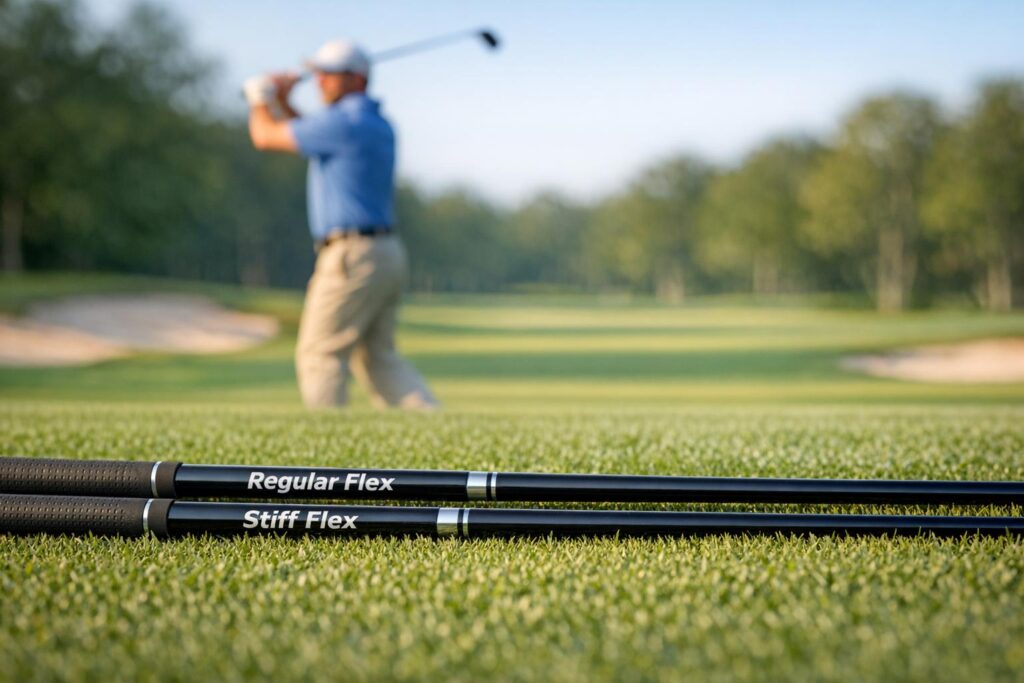
When it comes to choosing between regular and stiff flex golf shafts, the decision boils down to your swing speed and playing style. Here’s the quick answer:
- Regular Flex: Best for swing speeds of 80–95 mph, with driver distances around 210–240 yards. Ideal for players with smoother, slower swings who prioritize distance and forgiveness.
- Stiff Flex: Suited for swing speeds of 90–105+ mph, with driver distances of 240–260+ yards. Perfect for faster, more aggressive swings that need control and precision.
Key Differences:
- Regular Flex: Softer, lighter, higher launch, more spin, forgiving for slower swings.
- Stiff Flex: Firmer, heavier, lower launch, less spin, offers control for faster swings.
Quick Tip: If you’re unsure, opt for the more flexible shaft. Proper fitting is crucial – consult a professional to match your swing speed and tempo.
Quick Comparison:
| Feature | Regular Flex | Stiff Flex |
|---|---|---|
| Swing Speed | 80–95 mph | 90–105+ mph |
| Driver Distance | 210–240 yards | 240–260+ yards |
| Launch Angle | Higher | Lower |
| Primary Benefit | Distance and Forgiveness | Control and Precision |
| Common Miss | Two-way (left/right) | Pushes right |
Choosing the right shaft can improve your game significantly, so take the time to test and get fitted for the best results.
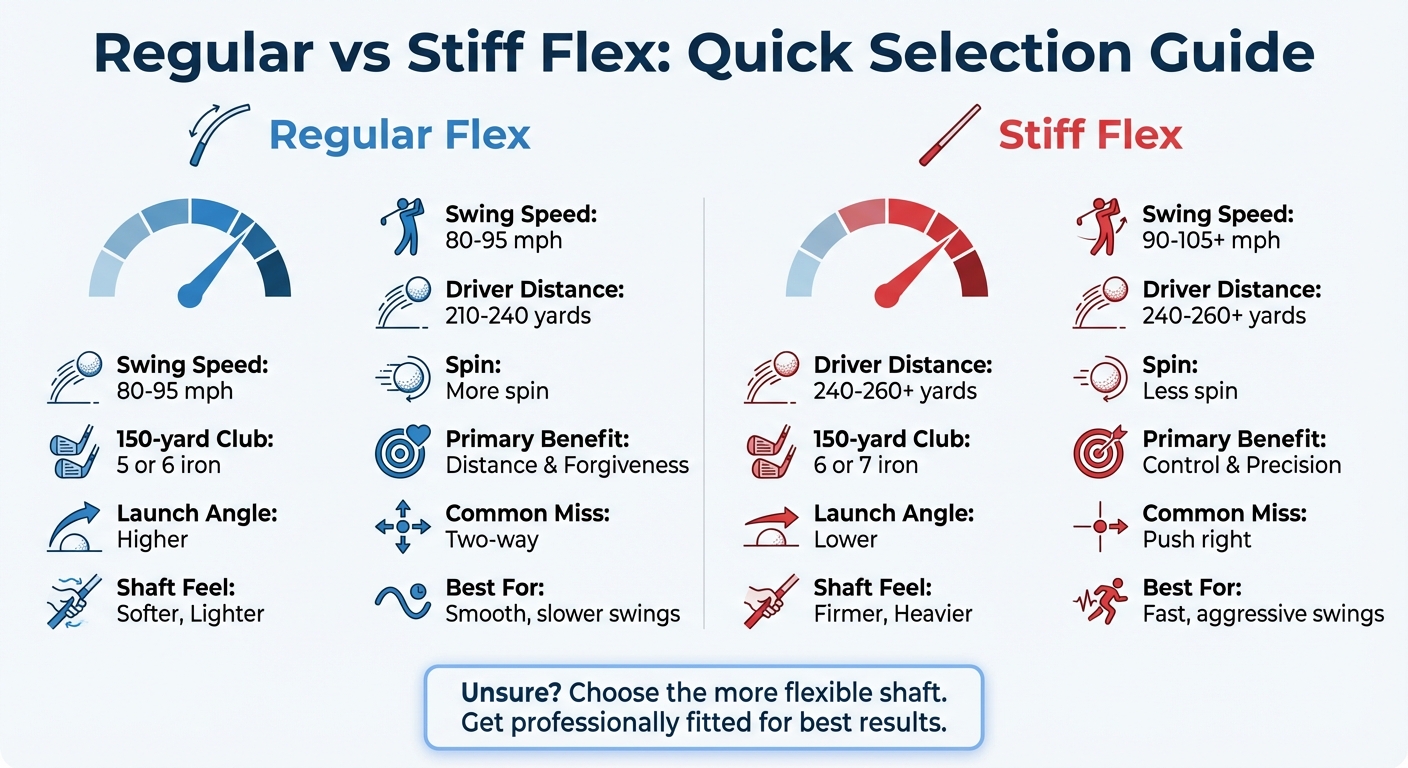
Regular vs Stiff Flex Golf Shaft Comparison Chart
Regular and Stiff Flex Shafts Explained
Regular Flex Shaft Characteristics
Regular flex shafts are designed with a softer bend, allowing them to flex more during your swing. This added flexibility, combined with higher torque, means the shaft twists more at impact. For golfers with swing speeds between 80–95 mph, this setup helps optimize launch and ball flight. Typically, players using regular flex shafts achieve driver distances of 200–230 yards and rely on 5- or 6-irons for shots around 150 yards.
This type of shaft is especially forgiving for amateur players, making it easier to get the ball airborne and maximize distance, even with moderate swing speeds. However, for golfers with faster swings, a stiffer alternative might be more suitable.
Stiff Flex Shaft Characteristics
Stiff flex shafts, on the other hand, are built with a firmer, heavier construction that reduces bend and torque. This design provides experienced players with greater control over ball flight, influencing both launch and accuracy. With a higher kick point, stiff flex shafts promote a lower, more penetrating ball trajectory.
These shafts are best suited for golfers swinging their driver at speeds of 90–110 mph, who typically carry the ball over 230 yards – often reaching distances of 240–260+ yards. From 150 yards, these players usually opt for a 6 or 7 iron. Nick Lomas, Founder of GolfSpan, highlights the advantages:
"The stiffer shafts should give you more control over your swing without having to swing faster, provided you have the right club in your hands".
While stiff shafts offer precision and control for high-speed swings, they are less forgiving. Using a stiff shaft without the necessary swing speed can lead to lower ball flights, reduced distance, and a tendency to push shots to the right.
Regular vs Stiff Flex: Key Differences
Comparison Table
When comparing regular and stiff flex shafts, the differences extend beyond just swing speed. Here’s a breakdown of how they perform across key factors:
| Feature | Regular Flex | Stiff Flex |
|---|---|---|
| Target Swing Speed | 80–95 mph | 90–105+ mph |
| Driver Carry Distance | 210–240 yards | 240–260 yards |
| Launch Angle | Higher | Lower |
| Primary Benefit | Adds distance for slower swings | Enhances control for faster swings |
| Common Miss (if ill-fitted) | Two-way miss (left and right) | Pushes right with low trajectory |
| Weight Impact | Lighter; boosts swing speed | Heavier; improves control and feel |
Not sure which to choose? Brian Foy, PGA Professional and Founder of Steadfast Golf Shafts, offers this advice:
"If you’re right on the fence, I would highly and always recommend going with the weaker flex."
How Each Flex Affects Ball Flight and Control
Understanding how these flex options influence ball flight and control can help you make a more informed decision.
Regular flex shafts are built to add whip to your swing, helping golfers with slower swing speeds generate extra power and distance. This added flex creates a higher launch angle and more spin, which helps keep the ball in the air longer. However, for players with faster, more aggressive swings, this flexibility can work against them, making it harder to control the clubface at impact.
Stiff shafts, on the other hand, are designed to handle the force of faster swings, preventing the shaft from over-flexing and losing energy. This leads to a lower, more penetrating ball flight with reduced spin – ideal for players with high swing speeds. The firmer design also delivers a more stable feel and greater resistance, which aggressive swingers often prefer. But if a stiff shaft is used without the necessary swing speed, it can result in lower ball flights, shorter distances, and a tendency to push shots right.
Dispersion patterns reveal the trade-offs. Regular flex shafts provide more forgiveness and a smoother feel for golfers with a relaxed, rhythmic swing. Stiff shafts, while offering better accuracy and reduced twisting, demand a precise and powerful swing to unlock their potential. Picking the right shaft flex is crucial to maximizing both distance and control – topics we’ll dig deeper into as we help you find the best fit for your game.
How to Choose Between Regular and Stiff Flex
When to Choose Regular Flex
To find the right shaft for your swing, start by looking at your driver swing speed. If your swing speed falls between 80–95 mph and you’re carrying the ball 210–240 yards, a regular flex shaft is likely your best bet. Here’s a quick test: if you can comfortably hit a 5 or 6 iron from 150 yards, regular flex is probably the way to go.
Nick Lomas, Founder of GolfSpan, puts it simply:
"Everyone who swings under 90 mph should swing a regular shaft."
Regular flex shafts are ideal for golfers with a smooth, steady tempo and less aggressive acceleration at impact. If your focus is on gaining distance rather than pinpoint precision, a regular flex shaft provides the "whip" needed to maximize carry. It’s also a lighter, easier-to-swing option for players who prefer a more forgiving feel.
When to Choose Stiff Flex
If your driver swing speed is between 90–105 mph and you’re carrying the ball 240–260 yards, a stiff flex shaft is a better choice. Another indicator? If you’re hitting a 6 or 7 iron from 150 yards, stiff flex is likely more suitable for your game.

Nick Lomas explains the benefits:
"A stiff shaft offers less flexibility and more resistance and control, benefiting golfers with swing speeds over 90 mph."
Stiff flex shafts are designed to reduce over-flexing, giving players with fast, aggressive swings better control. If you generate speed quickly in the final part of your downswing or transition rapidly from backswing to downswing, the added resistance helps maintain energy and accuracy. For golfers who can hit long but struggle with accuracy – spraying shots left and right – a stiffer shaft can provide more stability and precision.
Getting Fitted and Testing Options
Whether you’re leaning toward regular or stiff flex, getting properly fitted is key to finding the right shaft. A professional fitting provides valuable data on swing speed, spin rate, and shot dispersion, helping you make an informed decision. Since shaft stiffness can vary across manufacturers – a stiff shaft from one brand might feel like a regular from another – testing with a launch monitor is crucial.
Brian Foy, PGA Professional and Founder of Steadfast Golf Shafts, highlights the importance of feel:
"There’s no set scale to how you profile a regular, a stiff, or an X, or a ladies, or a senior. The main thing is understanding the feel of the shaft and how it can work for you in your swing."
A good fitter will analyze your tempo and how much load you place on the shaft during your downswing, helping you select the right flex for optimal launch and control. They can also fine-tune other factors like kick point, shaft weight, and length to further enhance your performance. After narrowing down your options, take your favorites to the course and test them in real-world conditions. The ideal shaft should feel balanced and natural, neither too rigid nor too flexible, as you swing through impact.
sbb-itb-bcd8bdd
Stiff vs Regular Flex Driver Shaft! What Driver Flex Should You Be Using! Amateur Vs Pro Driver Flex
Conclusion
Picking the right shaft – regular or stiff flex – comes down to your swing speed. If your swing averages between 80–95 mph (producing drives of 210–240 yards), a regular flex shaft is a good fit. For faster swings in the 90–105 mph range (240–260 yards), a stiff flex shaft is the better choice.
Focus on your average swing performance rather than those rare power shots. This approach ensures more consistent results on the course. If you’re uncertain, leaning toward a more flexible shaft can help you maintain better feel and avoid losing distance.
Keep in mind, shaft flex ratings can differ across manufacturers. That’s why a professional fitting is so valuable. Using tools like a launch monitor, you can get precise data on swing speed, spin rate, and shot dispersion to make an informed decision.
Lastly, take your top shaft options out on the course. The right shaft should feel comfortable and balanced, giving you confidence at impact. By testing them in real play, you’ll confirm which one consistently enhances your game.
FAQs
How can I find my swing speed to choose the right shaft flex?
To figure out your swing speed and pick the right shaft flex, you’ve got a couple of solid options. One of the most reliable ways is using a launch monitor like TrackMan or FlightScope. These devices measure your driver swing speed in miles per hour (mph) when you take full-speed swings. Don’t have access to one? A professional club fitter can also provide precise readings with their specialized tools.
If you’re after a quicker estimate, smartphone apps or video analysis tools can come in handy. Simply record your swing using a high-frame-rate camera, then use a swing-speed calculator app to get a rough idea. Once you know your speed, you can match it to flex recommendations: 85–90 mph usually pairs well with regular flex, while 95–100 mph is better suited for stiff flex. Testing different shafts is always a good idea to find the one that feels right and delivers the best results.
Want to sharpen your swing for more consistent speed readings? Check out the free drills and guides offered by How To Break 80.
How can I tell if my golf shaft flex is wrong?
Using the wrong shaft flex can seriously affect your performance on the course. You might notice a drop in distance, slower clubhead speed, or erratic ball flight. If the shaft is too stiff, it can feel rigid and make it tough to generate power. On the flip side, a shaft that’s too flexible might feel overly loose, throwing off your timing.
Other red flags include poor accuracy – think frequent slices, hooks, or shots that consistently miss the mark. If your swing feels awkward or unnatural, it could be a sign that your shaft flex needs a closer look. A visit to a club fitter or experimenting with different shafts can help you zero in on the right fit for your swing speed and playing style.
For more ways to sharpen your skills and optimize your gear, How To Break 80 offers a range of resources, from drills and swing mechanics guides to expert fitting tips, all designed to help you elevate your game.
Can a professional club fitting improve my game?
Getting professionally fitted for your golf clubs can make a world of difference in your game. Fitters use advanced tools to measure critical factors like ball speed, swing speed, launch angle, and spin rate. This ensures your clubs are tailored to match your swing. For instance, if your driver swing speed is below 90 mph, a regular-flex shaft can help you achieve more distance with a higher launch. Meanwhile, players with swing speeds over 90 mph often see better control and accuracy with a stiffer shaft.
What’s more, a fitting session isn’t just about numbers. It’s also about how the clubs feel in your hands. You’ll get to test different shaft options and find the ideal mix of power and precision. Even small tweaks – like adjusting shaft weight, length, or flex – can add extra yards and tighten your shot dispersion. Combine these equipment upgrades with the drills and swing tips from How To Break 80, and you’ll be well on your way to lowering your scores and reaching your goals on the course.
Related Blog Posts
- Shaft Flex Types: Beginner vs. Advanced
- Ultimate Guide to Golf Shaft Optimization Software
- How Shaft Flex Affects Ball Flight
- Checklist for Choosing Steel or Graphite Shafts
