
Real-time feedback wearables are transforming golf practice by offering instant, data-driven insights into your swing mechanics. These devices track wrist angles, tempo, balance, and club path, delivering haptic or audio alerts when your form deviates. This allows you to make corrections mid-swing, speeding up skill development and improving consistency.
Key takeaways:
- Wrist angles: Correcting wrist extension at impact can add up to 25 yards to your shots.
- Tempo: Ideal backswing-to-downswing ratio is 3:1; wearables help maintain this rhythm.
- Balance: Alerts identify stability issues like sway or standing up at impact.
- Club path: Detects over-the-top moves or improper transitions.
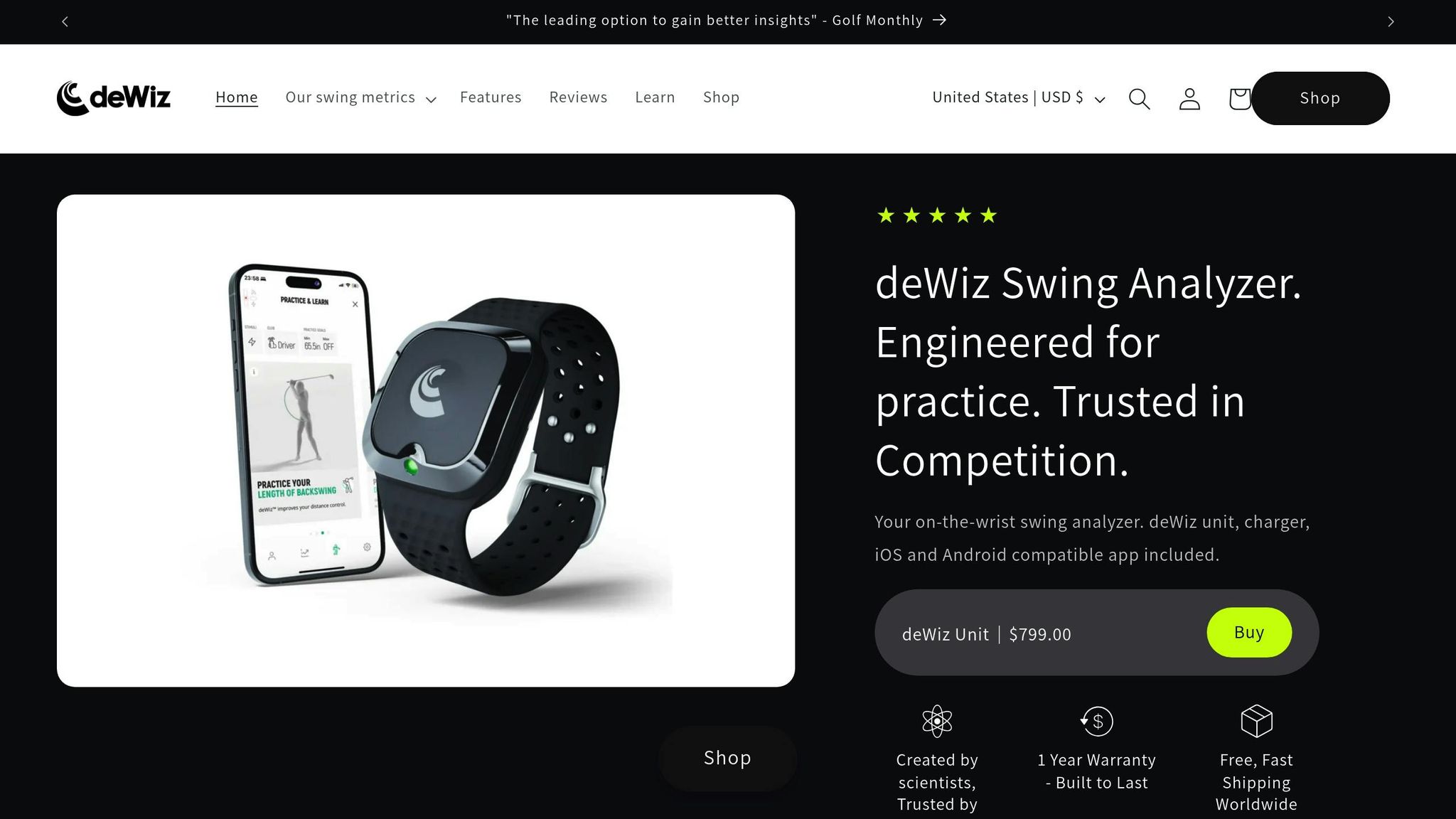
Devices like the deWiz Swing Analyzer ($699–$799) and HackMotion ($345–$995) offer professional-level analysis for golfers of all skill levels. By pairing these tools with focused practice drills, you can address common issues like early wrist release or excessive cupping, leading to better accuracy, distance, and overall performance. Whether you’re a beginner or a seasoned player, wearables provide precise feedback to refine your game.
Unlock Your Golf Swing with This Tiny Device | deWiz Golf Review
Key Swing Metrics Tracked by Wearables
Golf Swing Metrics: How Wearables Track Performance by Handicap Level
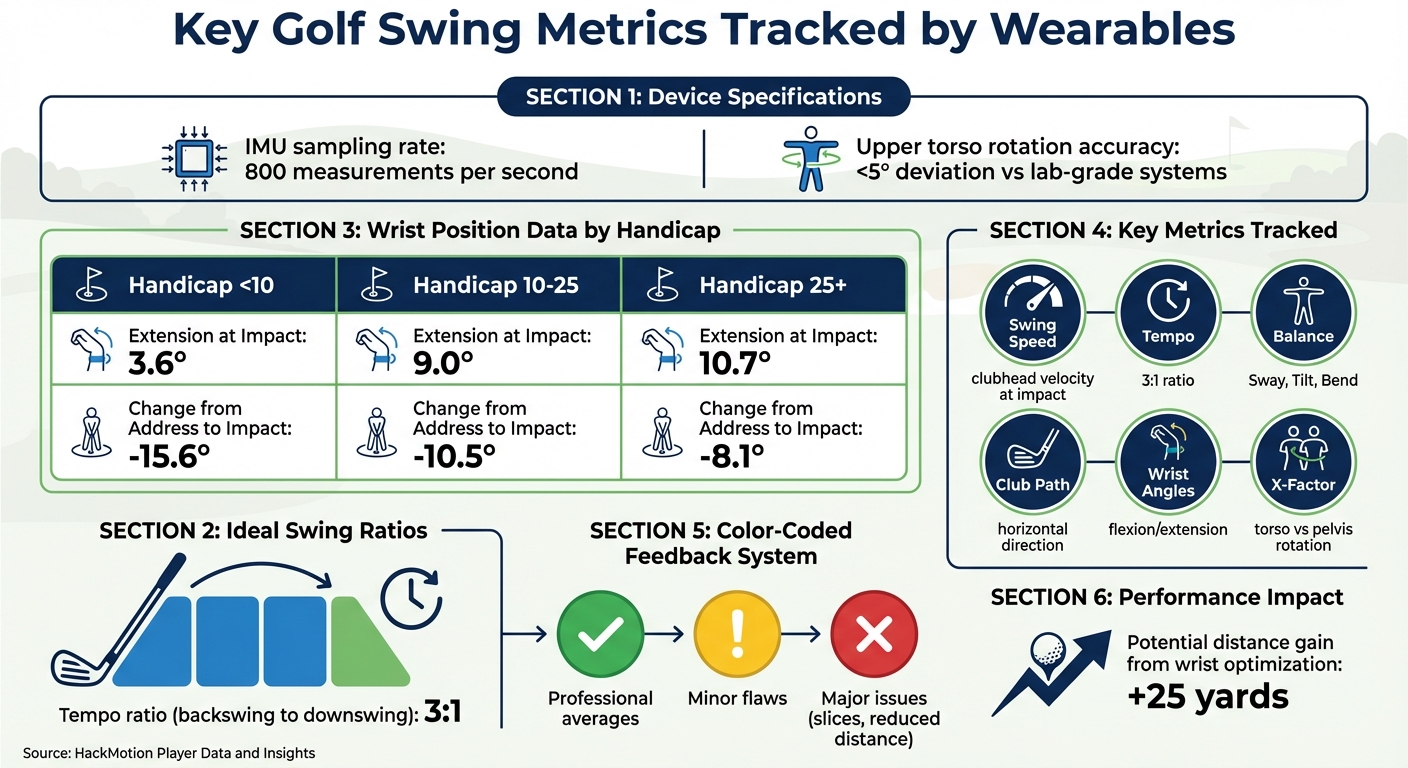
Modern golf wearables are packed with technology to analyze your swing, capturing dozens of data points in real time. Among these, a few key metrics stand out for their direct impact on your performance. Using high-speed IMUs (inertial measurement units) that sample at an impressive 800 measurements per second, these devices provide insights that can reshape your practice sessions.
Swing Speed and Tempo
Swing speed measures how fast your clubhead or hands are moving at the moment of impact, and it’s a critical factor in determining the distance your ball travels. But speed alone isn’t the full story – tempo plays an equally important role. Tempo refers to the ratio of your backswing time to downswing time, and wearables track both phases to help you maintain a steady rhythm.
"Tempo is the ratio of your backswing time to your downswing time. Zepp uses data from thousands of pros to establish an ideal ratio, which is very close to 3:1." – Spencer Lanoue, CaddieHQ
This 3:1 ratio means your backswing should take three times longer than your downswing. If your tempo is rushed, it often results in an over-the-top motion, leading to slices and reduced power. Wearables are designed to flag these inconsistencies, guiding you toward a smoother, more efficient swing.
Another key factor in generating power is the X-Factor, which measures the difference in rotation between your upper torso and pelvis. IMU-based sensors have been shown to measure upper torso rotation with less than a 5-degree deviation compared to lab-grade motion capture systems, making them a reliable tool for tracking this critical aspect of your swing.
Beyond speed and tempo, maintaining balance is essential for consistent ball striking.
Balance and Weight Distribution
Solid balance is the foundation of any good golf swing. Wearables track metrics like Sway (side-to-side body movement), Tilt (shoulder and hip angles), and Bend (flexion in your knees and hips) to reveal areas where your stability may falter.
A common issue for higher-handicap players is "standing up" at impact – losing their spine angle as they swing through. This often occurs when golfers release their wrist angles too early, forcing their body to straighten as a compensation. Wearables can detect these subtle movements in real time, providing instant feedback to help you maintain proper posture.
Advanced systems make this feedback easy to understand with color-coded alerts: green indicates movements that align with professional averages, while yellow or red highlight flaws that could lead to slices or reduced distance. This visual system allows golfers to quickly identify and address balance issues without needing to decipher raw data.
Once balance is under control, refining your club path and impact position brings everything together.
Club Path and Impact Position
Your club path, or the horizontal direction your clubhead travels at impact, determines whether your shot will curve left, right, or fly straight. Wearables analyze metrics like the Club Plane (the angle of your swing’s arc) and Hand Plane to detect common issues like "over-the-top" moves, where the downswing plane is steeper than the backswing plane. This is one of the main culprits behind slicing.
Wrist positioning at impact is another critical element of shot accuracy. Wearables like HackMotion provide real-time feedback on your lead wrist’s flexion and extension, helping you achieve the flat or slightly bowed wrist position that professional golfers maintain through impact.
| Handicap Level | Extension at Impact | Change: Address to Impact |
|---|---|---|
| Less than 10 | 3.6° | -15.6° |
| 10 to 25 | 9.0° | -10.5° |
| More than 25 | 10.7° | -8.1° |
Source: HackMotion Player Data and Insights
Correcting wrist angles can lead to significant gains. By optimizing your wrist position, you can improve your launch angle and spin rate, potentially adding 25 yards to your shots. These adjustments, grounded in precise data, can make a noticeable difference in your game, starting with a deeper understanding of your swing mechanics.
How Real-Time Feedback Improves Your Swing
From Data to Corrections
Every swing you take tells a story, and wearable devices like deWiz and HackMotion are there to capture every detail. These gadgets analyze your wrist position, hand path, and tempo at lightning speed, sending the data straight to a connected app. Once there, algorithms compare your movements to professional benchmarks and your own baseline patterns.
Here’s where it gets interesting: haptic alerts. These immediate, corrective signals kick in the moment your swing veers off course. Markus Westerberg, Co-founder and Chief Product Officer at deWiz, shares the science behind this:
"The brain would learn quicker with instantaneous reminders, leading to the Learning Stimuli feature created on motor learning science".
This method leverages subconscious learning to help you develop better habits faster than traditional trial-and-error approaches.
The connected apps don’t stop there. They offer visual biofeedback using 3D avatars and hand-trace lines that replicate your swing. You can pinpoint exactly where your club path went wrong – whether it’s going "over the top" or excessive wrist cupping. By combining physical cues with visual insights, these tools create a feedback loop that speeds up your progress and tackles swing faults as they happen.

Common Swing Corrections
Real-time feedback isn’t just about spotting errors – it’s about fixing them on the fly. Wearables are particularly effective at addressing some of the most common swing issues.
One major problem is early wrist release, also known as "flipping." This affects over 56% of golfers with handicaps between 10 and 25+. Amateurs tend to release at 0.07 seconds, compared to 0.02 seconds for pros, which reduces compression and distance. Real-time audio cues alert you immediately, helping you maintain proper lag during impact.
Another frequent issue is excessive wrist cupping at the top of the backswing. Wearables can detect when your wrist angles exceed optimal ranges. By setting an audio range in the app, you can practice slow-motion backswings, aiming to keep the device silent. The absence of sound confirms you’re within the correct mechanical range. This "no-sound" drill is a simple yet effective way to build muscle memory without needing a coach by your side.
Over-the-top transitions are another challenge that wearables can help you correct. During the PGA TOUR Constellation Furyk & Friends tournament, deWiz captured data on three-time major champion Vijay Singh’s swing using customized firmware. Under tournament pressure, Singh’s transition was 2 inches less "over the top", showing a 54% improvement in swing path consistency compared to his range sessions. While most of us aren’t aiming for tour-level precision, the same haptic feedback system can guide you toward a neutral swing path by alerting you when your downswing plane strays too far.
sbb-itb-bcd8bdd
Adding Wearables to Your Practice Routine
Pairing Wearables with Practice Drills
To get the most out of wearables, stick to a simple cycle: diagnose, drill, and retest. Start by taking five diagnostic swings to pinpoint your main issue. The app will highlight problem areas in red or yellow – these are your focus points for the session.
It’s important to tackle one metric at a time. Trying to fix everything at once can lead to frustration and slower progress. For instance, if your wearable indicates early wrist release, make that your sole focus. Use the device’s audio or haptic feedback to alert you when you’re maintaining proper lag. Practice slow-motion drills until you can complete five successful reps in a row.
One drill that pairs well with wrist wearables is the Motorcycle Drill. This exercise helps you rotate your lead wrist into flexion during the downswing. The wearable confirms you’re avoiding the dreaded flip that robs you of compression and distance. For tempo issues, many wearables offer a metronome feature. Use it to practice the ideal 3:1 backswing-to-downswing ratio that top ball strikers achieve.
After completing your drills, take five full-speed swings and review the app’s evaluation screen. Your goal is to see your target metric improve – red turning to green – indicating you’ve made real progress. This structured "diagnose > drill > retest" approach transforms your practice sessions into focused, measurable improvement efforts.
Pairing these targeted drills with a structured training plan can speed up your progress even more.
Using How To Break 80 Resources for Practice
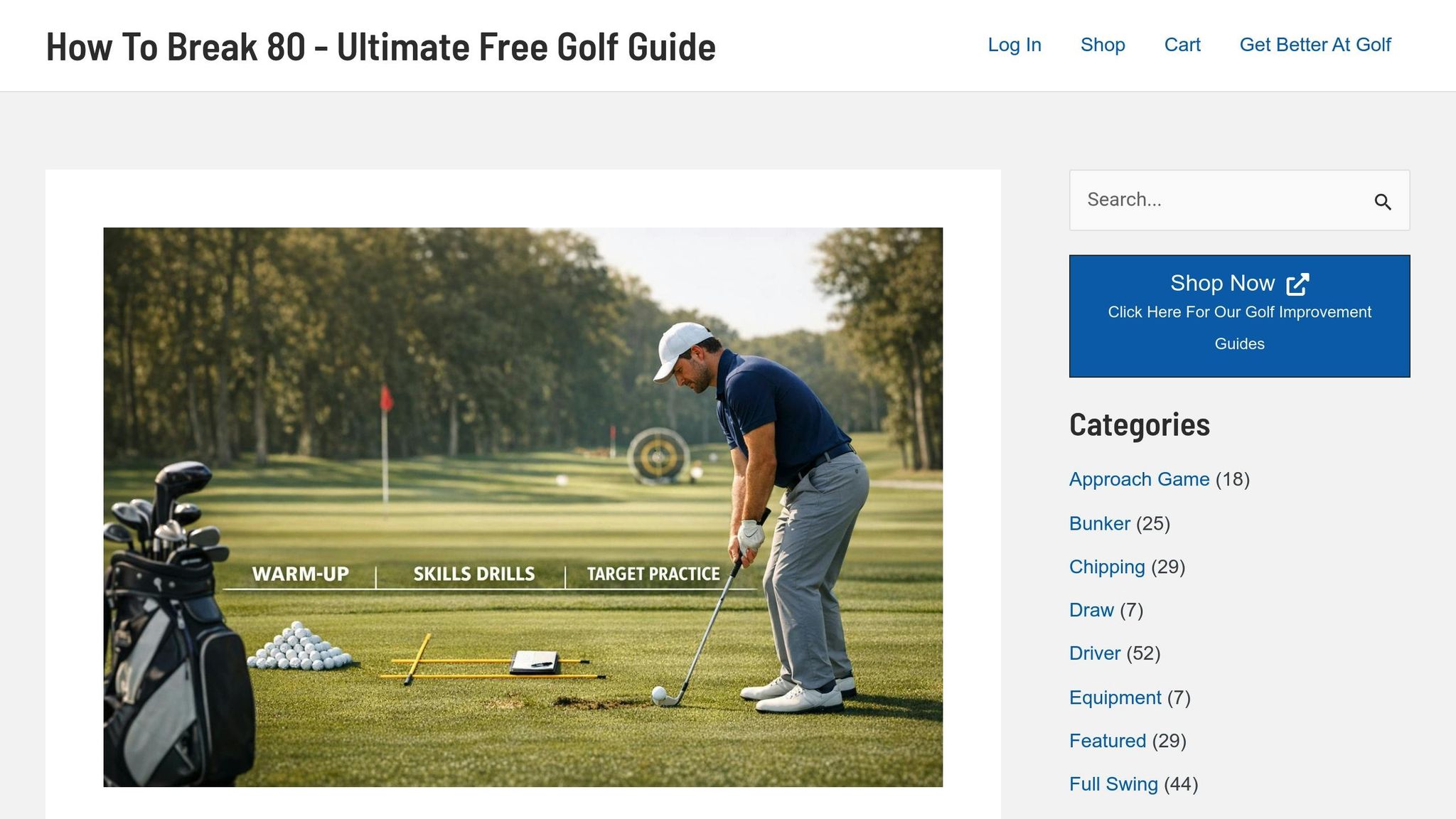
While wearables supply real-time feedback and data, structured training plans provide the guidance you need to stay on track. The 5-Week Practice Plan from How To Break 80 organizes your sessions into focused 30-minute routines, helping you avoid aimless practice that rarely leads to results.
If you’re working through video courses like the Precision Putting Video Course ($49.00) or Maximum Distance Video Course ($49.00), set your wearable to biofeedback mode. As the course walks you through key mechanics – like maintaining a flat left wrist or shifting weight properly – your device will alert you the moment you deviate from the ideal position. This bridges the gap between theory and execution.
For specific challenges, such as casting or over-the-top transitions, combine drills from the How to Break 80 eBook ($29.00) with your wearable’s guided practice mode. Start by recording a baseline, then track your improvement after completing the modules. The blend of expert instruction and objective feedback creates a highly effective learning environment, making your practice time more productive than ever.
Tracking Progress Over Time
Using Apps for Benchmarking
Wearable apps make it easy to track every training session, creating a detailed timeline of your progress. These apps save videos, data, and even coach feedback, allowing you to look back weeks or months to see how much you’ve improved.
One of the standout features is the ability to compare your performance against professional benchmarks. For instance, high-end systems like HackMotion Pro (priced at $995) allow you to overlay your wrist angles with data from PGA Tour players. Let’s say your wrist extension at the top of your backswing is 24.3 degrees. With this system, you’ll see that the pros average just 14.5 degrees. That 10-degree difference becomes a clear target for improvement. You can also save your best swings as favorites, using them as a personal benchmark for future practice sessions.
This ability to compare and analyze your performance provides a solid foundation for setting specific, data-driven goals.
Setting Goals for Improvement
Once you’ve identified where you stand compared to professional benchmarks, you can set clear, actionable improvement goals. Instead of vague aspirations, the data lets you focus on measurable targets. For example, reducing wrist extension can directly add distance to your shots, giving you a clear objective to work toward.
Start by addressing your biggest weakness, which apps often flag in red or yellow. If you’re a 10-25 handicap golfer and your wearable shows you’re flipping your wrists – a common issue for 56.68% of players in this range – make fixing that your top priority. Data-driven systems report that 96% of users see improvement, with an average reduction of 7 strokes from their scores.
Set both short-term and long-term goals to stay on track. A short-term goal might be reducing wrist extension from 17 degrees to 15 degrees within two weeks. A long-term goal could be reaching the sub-10 handicap benchmark of 14.5 degrees within three months. The app’s historical data will help you monitor your progress and adjust your practice routine as needed.
Conclusion
Real-time feedback wearables are changing the way golfers practice by replacing guesswork with precise, actionable data. Instead of analyzing what went wrong after a poor shot, devices like HackMotion and deWiz deliver instant cues – whether through haptic, audio, or visual signals – allowing you to make adjustments mid-swing. This immediate feedback speeds up the process of learning new motor patterns, helping you develop the correct "feel" for consistent execution.
Studies show that golfers using these systems can shave an average of 7 strokes off their scores and add over 20 yards to their drives. How? By optimizing wrist angles and addressing common issues like early wrist release, these wearables provide the kind of detailed insights that lead to tangible improvements.

Pairing wearable data with targeted drills creates a fast track for progress. Instant feedback helps your brain absorb and refine motor patterns much more efficiently than traditional methods. This combination of real-time data and purposeful practice fosters a cycle of diagnosing issues, correcting them, and continuously improving.
With these tools, you can train smarter. Whether you’re working to fix a slice, fine-tune your wedge distances, or stay consistent under pressure, wearables offer precision insights that were once reserved for tour professionals. For extra drills, strategies, and guides to maximize your wearable data, check out How To Break 80. By blending technology with structured practice, you can accelerate your journey to lower scores and a more dependable game.
FAQs
How can real-time feedback wearables help me improve my golf swing?
Real-time feedback wearables are transforming how golfers refine their swings by offering instant insights into swing mechanics. These devices measure key aspects like wrist movement, swing speed, and swing path, giving you the tools to spot and fix problems as they occur. Whether through vibrations, sounds, or visual cues on an app, they provide immediate feedback, making it easier to adjust in the moment and build muscle memory for more consistent swings.
What sets these wearables apart is their ability to analyze your individual swing patterns. They offer personalized tips and drills tailored to your needs, making technique improvement not only more efficient but also more targeted. Over time, this approach helps you achieve a more reliable swing, boosts your performance, and enhances your confidence on the course.
What swing metrics do wearables track to help you improve your game?
Wearable devices are designed to monitor essential swing metrics, offering real-time feedback to fine-tune your technique. These metrics include hand and club positions, backswing length, maximum hand speed, tempo, and swing plane direction.
By breaking down these data points, these devices highlight specific areas that need work, helping golfers make precise adjustments and improve their overall performance on the course.
Can wearable devices help fix issues like early wrist release in my golf swing?
Wearable devices can be a game-changer when it comes to fixing problems like early wrist release in your golf swing. These gadgets offer real-time feedback and detailed swing data, allowing you to spot and address issues right away. By tracking elements like wrist angles, swing path, and other critical mechanics, wearables help you fine-tune your technique and elevate your performance on the course.
Related Blog Posts
- 5 Metrics To Track Golf Practice Effectiveness
- How Grip Pressure Sensors Improve Golf Swings
- Wearable Swing Analyzers: Are They Worth It?
- How Swing Sensors Track Biomechanics in Real Time