
Most putts miss low because golfers underestimate the break. Learning to read greens effectively can save strokes and improve your score. Subtle slopes, grain direction, and green speed all influence how your ball moves, especially in the final three feet. Here’s what you need to know:
- Fall Line: Water’s natural flow reveals the slope’s direction. Identify the higher side to predict the break.
- Grain Direction: Grass growing downhill speeds up putts, while uphill slows them down.
- Green Speed: Faster greens amplify breaks; slower ones require firmer strokes.
- Angles Matter: View the green from multiple perspectives to detect hidden slopes.
- Use Your Feet: Walking the putt’s line helps feel micro-slopes missed by the eye.
Practice drills, like the Aim Spot Drill or One Ball Drill, can sharpen your skills. Tools like the $49 Precision Putting Video Course offer structured training to help you achieve 26–30 putts per round. Mastering green reading could reduce three-putts and shave 3–8 strokes off your game.
How to Read Putting Greens by Using Your Feet | Titleist Tips

Green Break Basics
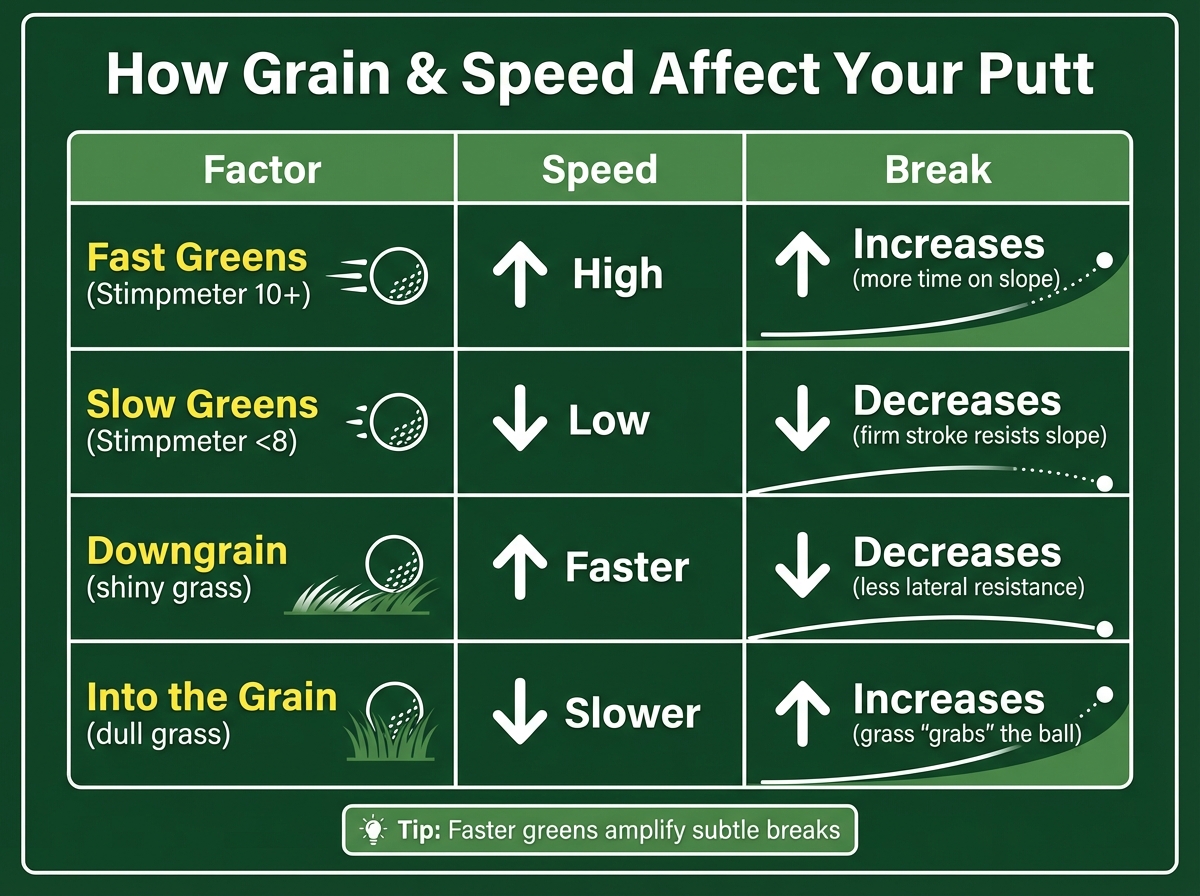
How Grain Direction and Green Speed Affect Putt Break
Getting a handle on how your golf ball behaves on the green – factoring in the fall line, grain, speed, and green design – is key to reading subtle breaks. Let’s break it down into three essential concepts.
Finding the Fall Line
The fall line is the path water would naturally follow if poured onto the green. It’s the straight uphill or downhill route through the hole and serves as the baseline for every putt. Any ball that strays from this line will veer toward the low side of the slope.
To locate the fall line, think about this: If I poured a bucket of water here, where would it flow?. Once you’ve pinpointed it, examine about 5 feet on either side of your intended line to identify the higher side. The ball will naturally break away from that higher side, with the break becoming more pronounced as the ball nears the hole.
Take a close look at the cup’s edge. One side might appear frayed or brownish (often called the "dead side"), while the other looks sharp and clean. The grass grows toward the ragged side, pointing you to the grain direction and the downhill slope.
How Grain and Speed Affect Breaks
Grain – the direction the grass grows – adds another layer of complexity to your putt. Stand behind your ball and look toward the hole: shiny or silvery grass means a downgrain putt, while darker, dull green indicates you’re putting into the grain. As Andrew Rice, a GOLF Top 100 Teacher, explains:
"Grain grows downhill. Bermuda grass, bent grass, it all has grain and it all grows in a certain direction. Grain grows downhill."
Downgrain putts roll faster because there’s less friction, which means they break less – gravity has less time to pull the ball off course. On the flip side, putts into the grain roll slower, giving slopes more influence and creating a bigger break.
Green speed also plays a huge role. Joe Plecker, Director of Instruction at Landings Club, notes:
"The faster the greens speeds, the smaller the influence of the grain; the slower the greens get, the greater the influence becomes."
On faster greens (Stimpmeter readings of 10+), the ball spends more time rolling, allowing even slight slopes to affect the path. Slower greens (readings under 8) require a firmer stroke, which can help counteract the slope.
| Factor | Speed | Break |
|---|---|---|
| Fast Greens | High | Increases (more time on the slope) |
| Slow Greens | Low | Decreases (firm stroke resists slope) |
| Downgrain | Faster | Decreases (less lateral resistance) |
| Into the Grain | Slower | Increases (grass "grabs" the ball) |
Typical Green Design Features
Course design also plays a big part in how greens break. Many older greens are intentionally sloped from back to front to aid drainage and improve visibility from the fairway. This means you’re more likely to face uphill putts from the front of the green and trickier downhill putts when playing from the back.
Bunkers can also provide clues. Architects often design greens so water flows past bunkers instead of into them. The high side of a nearby bunker often indicates the slope direction. Additionally, greens tend to break away from mountains and toward the lowest surrounding terrain, which could extend for miles.
Grain direction can also be influenced by external factors. Grass often grows toward water sources, drainage areas, or even toward the setting sun in the West. If you’re struggling to spot the grain on a closely-mown green, check the fringe – longer grass there can make the growth direction easier to see.
Methods for Spotting Subtle Breaks
Once you’ve got the basics down, it’s time to step up your game with practical techniques. These strategies will help you identify those tricky, hard-to-spot slopes during your round.
Reading from Different Angles
To uncover hidden slopes, don’t limit yourself to just the view behind the ball – check multiple angles. Viewing from behind the hole, for example, can reveal slopes and elevations that might not be visible from the ball’s position. Golf instructor Kellie Stenzel, a Top 100 Teacher, advises expanding your perspective:
"Look wider – about 5 feet to the left and right of your intended line. Ask yourself, ‘Which side is higher?’ The ball will naturally break away from the higher side."
Walking the putt’s length or even circling it provides a full 360-degree view, helping you detect micro-slopes. As you approach the green from about 20 yards away, take a moment to observe the general drainage patterns. Squatting behind the ball can also give you a better sense of the slope’s severity. And don’t worry about slowing the game down – a thorough green-reading process should only take 15 to 20 seconds, keeping the pace of play intact.
By combining these visual observations with physical feedback, you’ll get a more complete picture of the green.
Using Your Feet to Feel Micro-Slopes
Your feet can be just as valuable as your eyes when it comes to reading greens. Jim Powers, a golf instructor, explains how to use them effectively:
"Use your feet like spirit levels. As you walk around the putt, feel the slope underfoot. Subtle break? You’ll often sense it more than see it."
Take a walk from your ball to the hole and back again, paying attention to any slight inclines or declines you feel underfoot. PGA Professional Brittany Olizarowicz highlights how this tactile feedback can enhance your read:
"If you can feel yourself walk down towards the hole or feel a slight slope up as you move back to your ball, you can add these bits of information to your putting knowledge."
If your eyes tell you the putt is flat but your feet detect otherwise, trust what you feel. Subtle breaks often reveal themselves through physical sensations more than visual cues.

Studying the Last Few Feet
After gathering input from various angles and using your feet, zero in on the final few feet of the putt. This is where the ball slows down and becomes more affected by breaks and grain. Kellie Stenzel underscores the importance of this area:
"The ball breaks more as it slows near the hole, so the final few feet are especially important."
To pinpoint the critical "Zero Line" – the point where the slope transitions from uphill to downhill – walk in an arc about 15 feet from the hole. This will help you locate the exact spot where the slope changes direction. Mark Sweeney, creator of AimPoint, simplifies the concept:
"It’s all about reading greens, not reading putts."
For longer putts, break the line into segments and prioritize understanding the break in the final stretch. Look for drainage clues, like muddy patches, to identify low areas that might influence the ball’s path. These small details can make all the difference in refining your aim and speed.
sbb-itb-bcd8bdd
Creating a Pre-Putt Routine
To make these green-reading techniques a natural part of your game, establish a pre-putt routine that reinforces your observations. This routine builds on the visual and tactile methods of green reading discussed earlier. A consistent approach keeps you focused, helps you handle pressure, and transforms green reading from guesswork into a dependable process.
Building a Green-Reading Sequence
Begin your green read from about 20 yards away to assess the overall slope and drainage. Once you’re on the green, walk past the hole on its low side and observe the line from behind both the ball and the cup – this helps uncover any hidden slopes. Use the "wide look" method by scanning about 5 feet to the left and right of your intended line to identify which side is higher, as the ball will naturally break away from the elevated side. Pay close attention to the final three feet of the putt, where even minor breaks become more noticeable. As a final step, incorporate tactile feedback to confirm your observations. Keep the entire process efficient, aiming to complete it within 15–20 seconds to maintain the game’s pace.
Adjusting Aim and Speed
After completing your read, pick a precise target – like a specific blade of grass – rather than a vague zone. This sharpens your focus and ensures a more accurate putt. Keep in mind that hitting the ball harder generally reduces the break, resulting in a straighter path, while a softer stroke allows the ball to follow the slope more.
Before committing to your line, assess whether the putt is uphill, downhill, or flat. This will help you decide how much power to apply. For uphill putts, a longer backstroke is typically needed, whereas downhill putts call for a shorter, more controlled motion. Double-check your earlier observations by examining the grass: shiny grass indicates you’re putting with the grain, while dull grass means you’re going against it. When uncertain, aim slightly higher than you think is necessary. Missing on the high side usually leaves a shorter second putt, as the ball naturally breaks toward the hole as it slows.
Learning from Missed Putts
Every missed putt is an opportunity to learn. PGA Tour Putting Coach Ralph Bauer explains:
"Without enough speed, a good putt will miss low and with too much speed, a good putt will miss high."
A miss on the low side often points to insufficient speed, while a high-side miss suggests you hit the ball too hard. Focus on the final third of the putt to gather meaningful feedback.
Also, pay attention to your playing partners’ putts. Watching their ball paths provides real-time insights into how the green behaves. Over time, you’ll start noticing trends – some greens may break more than they initially appear, or the grain might subtly influence the ball’s movement. Trust your instincts; your first read, especially when squatting behind the ball, is often the most accurate. Avoid overthinking or second-guessing yourself.
Use these observations to fine-tune your green-reading skills during practice drills, helping you become more confident and consistent on the greens.
Practice Drills for Green Reading
Training both your eyes and feet can make spotting those subtle breaks on the green much easier. Golf instructor Jim Powers highlights this perfectly: "Most 3-putts start with a bad read – not a bad stroke." This shows just how important dedicated green-reading drills are – they help align your instincts with the actual break of the green, leading to more precise putts. Once you’ve honed your green-reading skills, it’s time to focus on drills that improve your accuracy on the starting line.
Drills for Starting Line Accuracy
The Aim Spot Drill is a great way to match your reads with the ball’s actual movement. Start by finding a breaking putt on the practice green and picking a specific target – a blade of grass or a small discoloration works well. Mark that spot with a tee, then roll five balls toward it without adjusting your aim. Pay attention to how the balls roll. If all five trend in the same direction, tweak your read to better match the green’s true break.
Another useful exercise is the "One Ball" Drill, which mimics the unpredictability of real course conditions. Using just one ball, take a putt, then move to a completely different hole for your next attempt. This forces you to make a fresh green read each time, just like you would during an actual round, where you rarely face the same putt twice. With these drills in your toolkit, the next step is to sharpen your ability to recognize grain and slope.
Grain and Slope Recognition Exercises
Grain direction can have a big impact on your putts, and the Color Contrast Drill helps you train your eyes to spot it. When you step onto the practice green, look closely for color variations in the grass. Shiny or lighter patches indicate you’re putting down-grain (faster), while dull or darker areas mean you’re putting into the grain (slower). Andrew Rice, a GOLF Top 100 Teacher, explains that "Grain grows downhill. Bermuda grass, bent grass, it all has grain and it all grows in a certain direction". Walking around the green and observing these color shifts builds your ability to recognize patterns.
Pair this with the Foot-Sensing Exercise to detect subtle slopes. Walk around the hole and use your feet to feel for micro-slopes that your eyes might miss. Focus on where it feels like you’re walking uphill or downhill. This tactile approach strengthens your ability to consistently identify micro-slopes, giving you a better read on the green.
Using Structured Training Resources
For golfers looking to take their green-reading skills to the next level, structured training tools can be a game-changer. The Precision Putting Video Course ($49) offers drills specifically designed to improve green reading and putting accuracy. Another option is the How to Break 80 eBook, currently available for $29 (marked down from $99). This eBook features a "Bulletproof Step-by-Step Putting Roadmap" on page 59, along with six detailed practice drills complete with diagrams. According to the program, these resources can help golfers aim for 26–30 putts per round, potentially saving 3 to 8 strokes. Incorporating these tools into your practice routine can make green reading feel like second nature.
Conclusion
Understanding subtle green breaks has a direct impact on your score. Research shows that 80% of missed putts are low, often due to underestimating the break. This highlights how many golfers mistakenly blame their putting struggles on stroke mechanics, when the real issue lies in reading greens effectively. Misjudging breaks can cost you critical strokes, making green reading a skill worth mastering.
The techniques outlined here – examining the green from multiple angles, using tactile feedback to detect micro-slopes, checking the grain, and focusing on the final few feet – are practical tools that can transform your putting game. As PGA Tour Putting Coach Ralph Bauer explains:
"Green reading… is an often-overlooked variable that when improved can quickly lower our scores".
Improving your green reading not only builds confidence but can also reduce three-putts and shave 3 to 8 strokes off your game.

To solidify these skills, consistent practice is key. Dedicating just 10–15 minutes to focused drills two to three times per week can lead to noticeable improvements. For those looking for structured guidance, the Precision Putting Video Course ($49) provides step-by-step training designed to help you achieve 26–30 putts per round – and ultimately lower your score.
FAQs
How does the grain on a green impact your putt?
Grain refers to the direction in which the grass blades on the green are leaning, and it plays a big role in how your ball rolls. When your putt moves with the grain (the shiny side of the grass), it will roll faster. On the other hand, putting against the grain (the darker side) will slow it down. Grain doesn’t just affect speed – it can also influence the break of your putt. Depending on the slope and the direction the grass leans, the grain might either exaggerate or lessen the ball’s curve.
To spot the grain, look closely at the green. Shiny areas indicate the grass is leaning away (with the grain), while darker patches show it’s leaning toward you (against the grain). You can also lightly feel the grass with your hand or foot to confirm the direction. Once you’ve identified the grain, adjust your putt accordingly. If you’re putting into the grain, add a bit more force. When going with the grain, ease up on your stroke. Regular practice will help you fine-tune these adjustments and sharpen your ability to read and respond to the grain’s effects.
How can I find the fall line on a green?
To find the fall line on a green, rely on your feet to sense the slope as you walk toward the hole. Notice the direction where the ground naturally funnels the ball straight downhill and through the cup. This is the fall line. Trust your balance and the subtle changes in the slope to help you pinpoint it.
What’s the best way to practice reading subtle green breaks?
To get better at reading subtle green breaks, start by paying attention to the green as you approach it from about 20 yards out. Notice the overall slope and picture where water would naturally flow. This can help you spot the main tilt and any smaller contours.
Take a walk around your putt and use your feet to sense the slope – it’s often easier to feel subtle breaks than to see them. Once you’ve pinpointed the fall line, try using the AimPoint finger system to gauge the slope percentage and figure out the break direction. For instance, holding up one finger represents roughly a 1% slope.
Consistency is key, so make practice a habit. Set up drills by repeating the same putt multiple times, marking your aim point with a tee, and analyzing your results. Practicing on a variety of greens will fine-tune your ability to pick up even the smallest breaks.
Related Blog Posts
- How to Master Speed Control on the Greens
- 7 Common Green Reading Mistakes
- How to Read Double Breaks on Challenging Greens
- Ultimate Guide to Reading Green Grain