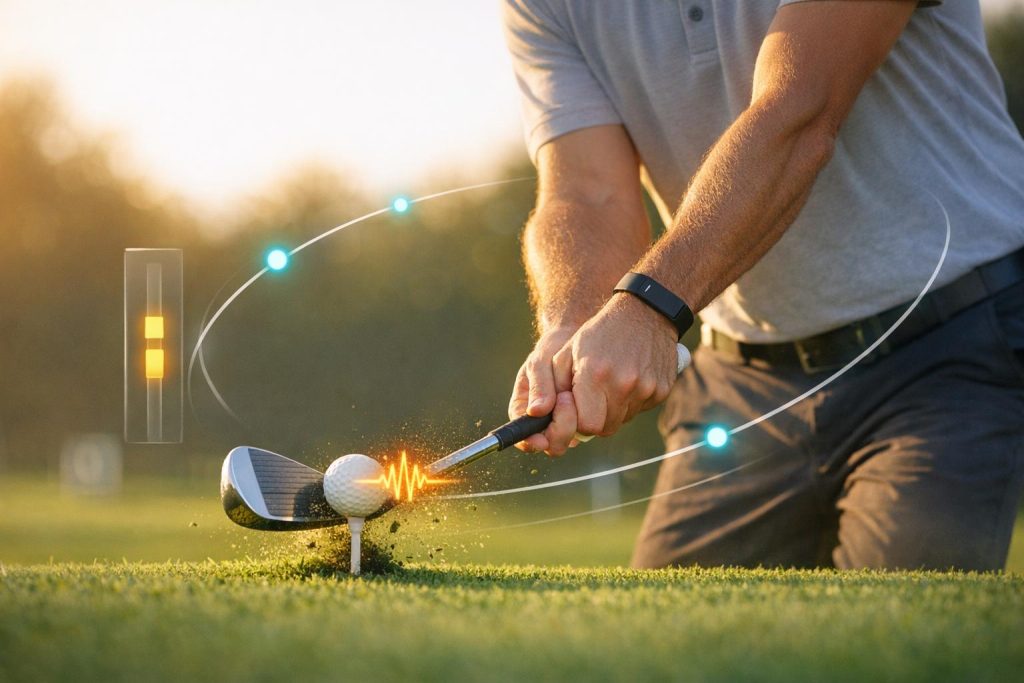
Impact feedback wearables are transforming golf training by providing real-time swing analysis at a fraction of the cost of traditional lab setups. These portable devices use sensors to track metrics like torso rotation, wrist angles, and swing phases, helping golfers improve their swing technique, prevent injuries, and track progress over time. Key highlights from recent studies include:
- Accuracy: Stanford research found IMU-based wearables matched lab equipment with a correlation of 1.00 for upper torso rotation.
- Affordability: Products like Arccos Smart Sensors ($180) and Shot Scope CONNEX ($100) offer precise shot tracking comparable to expensive tools.
- Skill Development: Wearables with AI-driven insights, such as SVM-powered devices, achieve 94.2% accuracy in swing analysis.
- Practical Benefits: Real-time feedback helps golfers correct technical flaws with irons immediately, reducing bad habits and improving long-term performance.
While wearables may not match the precision of high-end launch monitors, they are accessible, cost-effective tools that deliver reliable data for tempo, timing, and overall improvement. Whether you’re a beginner or a pro, these devices can elevate your game by combining advanced technology with practical usability.
Is HackMotion Golf a SCAM or Game Changer ? (1 Year Review) Discount Code
sbb-itb-bcd8bdd
Recent Research Findings
Golf Wearable Device Performance Comparison: Accuracy and Key Metrics
Real-Time Feedback Improves Swing Mechanics
Getting instant feedback can do wonders for refining swing mechanics. A study on best putting techniques and mechanics showed that both seasoned and novice players benefited from real-time feedback, helping them adjust their tempo ratio closer to the ideal 2:1 target (backswing to downswing). This adjustment led to more consistent performance. Practicing putting drills can further reinforce these mechanical improvements.
SVM-powered devices take swing analysis to the next level. These tools analyze swings in real time, offering immediate coaching suggestions with an impressive 94.2% accuracy in motion classification. Unlike older systems, these wearables pinpoint specific technical flaws and present them in an easy-to-understand format during practice.
"Experimental findings indicate that the proposed smart golf equipment using SVM achieves an accuracy of 94.2%, providing real-time feedback and accurate swing analysis, enhancing players’ performance via improved motion classification and consistency." – IEEE
This kind of instant correction not only sharpens current skills but also speeds up long-term learning.
Faster Learning and Better Skill Retention
Wearable tech has proven its ability to speed up skill development and retention. In one notable case, Jessy Lauer, a Harvard researcher, tracked a golfer’s progress over 18 months using a single wrist-worn sensor. The device used "motion primitives" – a set of movement patterns – to identify technical flaws and provide targeted feedback. The result? The golfer’s handicap dropped from 50 to 2.2.
By catching errors early, these devices prevent bad habits from taking root. This accelerates the learning process and helps players retain proper technique, reducing mistakes during motor learning.
Comparing Different Wearable Devices
Wearable devices vary in performance, but each type offers unique benefits.
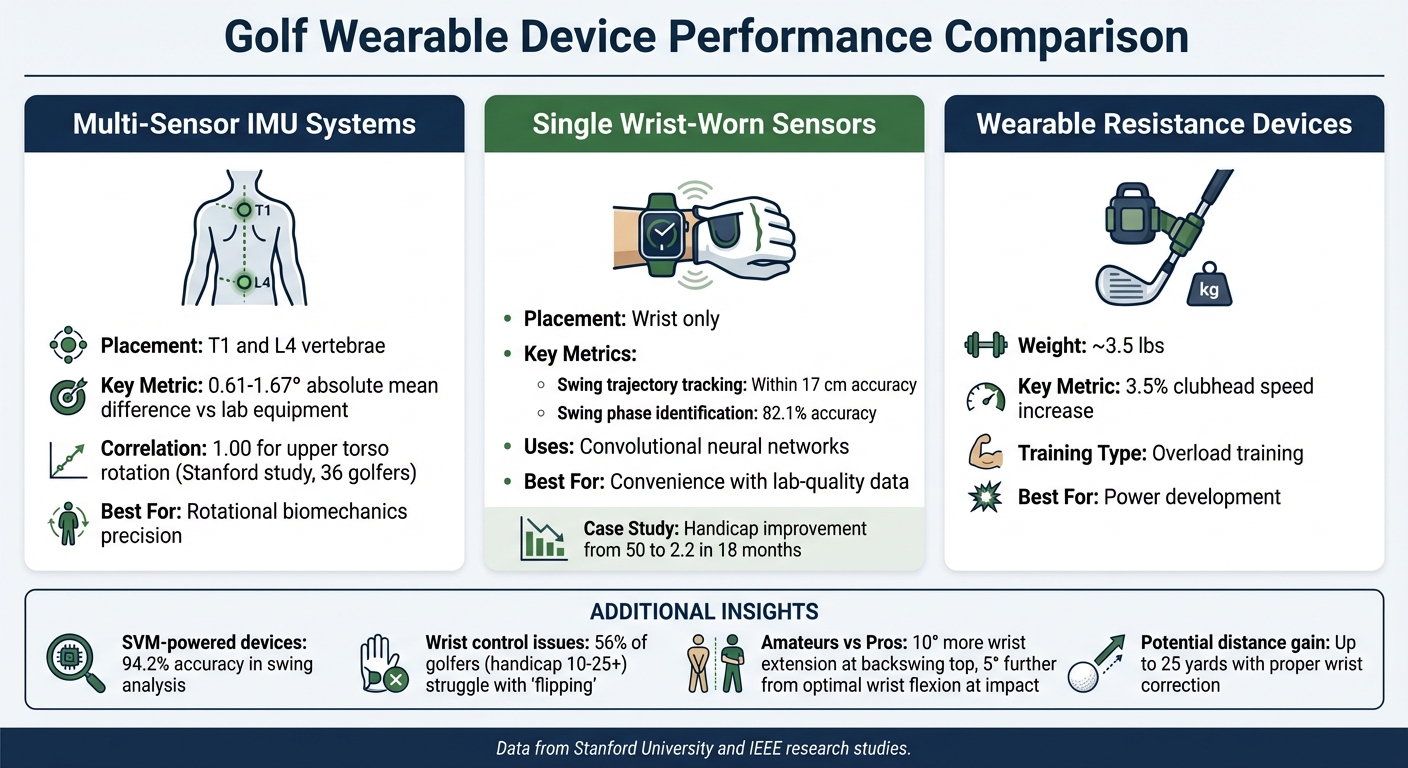
- Multi-sensor IMU systems: These devices, often placed on the T1 and L4 vertebrae, excel in measuring rotational biomechanics. A recent Stanford study tested them on 36 golfers, showing they measured upper torso and pelvic rotation with an absolute mean difference of just 0.61 to 1.67 degrees compared to a 10-camera lab system.
- Single wrist-worn sensors: These have seen dramatic improvements. Using convolutional neural networks, they now track swing trajectories within 17 cm – on par with multi-sensor systems. They also identify key swing phases (address, impact, finish) with 82.1% accuracy.
- Wearable resistance devices: These small weights, attached to the body, are designed for "overload" training. They’ve been shown to boost clubhead speed by 3.5% when using about 3.5 lbs of resistance.
For precision in rotational mechanics, multi-sensor systems are the go-to choice. However, single wrist-worn devices now offer lab-quality data with unmatched convenience. For players looking to increase power, wearable resistance devices provide measurable improvements in clubhead speed.
How Golfers Can Use Impact Feedback Wearables
Finding and Fixing Swing Problems
Wearables can pinpoint exactly where your swing goes wrong. Devices like deWiz use haptic feedback – gentle electric pulses – to notify you immediately when your swing strays off-plane or exceeds your set limits. This instant feedback trains your brain faster than relying on golf lessons, video analysis, or trial-and-error adjustments.
One of the most common culprits? Wrist control. Over 56% of golfers with handicaps between 10 and 25+ struggle with "flipping", where their wrists extend too early before impact. This leads to weak contact, slices, and a loss of distance. Real-time wrist tracking from wearables can show if your clubface is open or closed, helping you identify and correct slice or hook tendencies.
The numbers tell the story: amateurs typically show 10° more wrist extension at the top of their backswing compared to professionals. By the time they reach impact, high handicappers are about 5° further from optimal wrist flexion than low handicappers. Fixing this can lower launch angle and spin, adding up to 25 yards to your shots.
For a deeper dive into your swing, use 3D swing visualization available in wearable companion apps. These apps create a 3D avatar that mirrors your movements, making it easy to spot issues like "over-the-top" swings or poor transitions. You can even use "tournament mode" during actual rounds to see how pressure affects your mechanics compared to practice sessions on the range.
Combining these insights with specific drills will help you improve even faster.
Combining Wearables With Practice Drills
To get the most out of your wearables, pair them with focused drills. For example, the "Release Drill" involves taking the club to parallel and moving into impact while ensuring your wrists stay in the "green zone", as tracked by your wearable.
If slicing is your issue, try the "Motorcycle Drill." During the downswing, flex your lead wrist downward as if revving a motorcycle. Your wearable will confirm when you’ve achieved the correct bowed wrist position at impact. To address an over-the-top swing path, use the "Barrier Drill." Place a second ball just outside your target ball and monitor your hand path to ensure it narrows toward a neutral position.
The P6 Drill is great for eliminating flipping. Pause when your club is parallel to the ground before impact (the P6 position) and hit from there. Your wearable will track whether you’re maintaining the proper wrist angles during this critical part of the swing. Adjust your device settings depending on the club you’re using – irons require more shaft lean and wrist flexion, while drivers need a more neutral hand position for an upward strike.
Start with slow-motion swings to perfect your wrist angles. Aim for five correct repetitions before progressing to full-speed swings. This gradual "slow-to-fast" method builds muscle memory that translates seamlessly to the course.
Limitations of Impact Feedback Wearables
Accuracy and Reliability Issues
Wearables can’t match the precision of professional launch monitors when it comes to measuring your swing. For example, grip-mounted sensors like Blast Motion calculate clubhead metrics from the handle. This method introduces errors due to shaft bending, twisting, and flexing, which affect the accuracy of the readings.
These grip-mounted sensors tend to underestimate clubhead speed by 2–4 mph compared to TrackMan. The problem becomes more pronounced with longer clubs – drivers with shafts over 45 inches show the largest discrepancies, while wedges are generally more accurate. Additionally, some wearables show nearly double the swing-to-swing variability compared to professional launch monitors. This means that even identical swings can produce wildly different readings.

"Blast Motion needs to provide far more transparency about the variance of their measurements – particularly when using different clubs with different shaft characteristics." – David Maduram, Training Reviewer, CT Golf Reviews
Wrist-worn devices face their own set of challenges, particularly with drift error. Rapid rotation during a swing amplifies sensor noise, leading to trajectory errors that can range from 30 to 60 cm. Faster and wider swings tend to increase these orientation errors. However, timing metrics like tempo and backswing-to-downswing ratios are far more reliable because they are directly measured by the device’s internal sensors.
These technical limitations highlight the trade-offs involved in using wearables as training tools. Instead of focusing on absolute numbers, golfers should pay attention to trends. For example, tracking whether your swing speed improves by 3 mph over time is more meaningful than worrying about whether you’re hitting exactly 105 mph. To ensure consistency, validate your wearable’s readings against a professional launch monitor and focus on relative improvements.
Beyond accuracy, cost also plays a big role in deciding which tools to use.
Price and Accessibility
While wearables face accuracy challenges, cost and accessibility are equally important factors. Professional-grade launch monitors are priced far beyond what most golfers can afford. For instance, a TrackMan Pro IIIe costs about $16,000, and the Foresight GC2 + HMT runs around $10,000. High-end Doppler radar systems can go up to $30,000. Even golf-specific smartwatches, like those from Garmin, range from $99 to over $2,000.
Wearables offer a more affordable and portable alternative, making swing analysis accessible to a broader audience. However, this affordability comes with trade-offs. The same grip-mounted sensors that make these devices budget-friendly also introduce systematic bias and measurement variability, which can lead to poor decisions about equipment if users aren’t aware of the limitations. Golfers must weigh the high price of professional-grade accuracy against the moderate precision of wearables that cost a fraction of the price.
"We’re going to buy our wearable tech from Walmart, TJ Maxx – just an average clothing store pretty soon. It’s not going to have to be a $700 watch." – Reed Ferber, Professor, University of Calgary
Experts believe that the future of wearable technology will be even more accessible. Sensors may eventually be integrated into everyday clothing and sold at mass-market retailers, eliminating the need for expensive, dedicated hardware. Until then, budget-conscious golfers should focus on using wearables for tempo and timing feedback – areas where even lower-cost devices tend to perform reliably.
Conclusion
What’s Next for Golf Training Wearables
Golf training wearables are evolving rapidly, with a clear trend toward single-sensor, wrist-worn systems capable of reconstructing an entire swing. Back in early 2025, researcher Jessy Lauer showcased a system that helped a golfer improve their handicap from 50 to 2.2 within just 1.5 years. This was achieved by using motion primitives to identify flaws and provide targeted feedback.
"There is a pressing need for advanced biomechanical tools that analyze the swing as a whole, potentially using unsupervised, data-driven methods to uncover underlying motion primitives." – Jessy Lauer, Harvard University
AI is also playing a growing role in personalizing wearable feedback. Professional players like Bryson DeChambeau and Rory McIlroy already use data-driven platforms to guide their on-course strategies. Looking ahead, future devices could incorporate biometric monitoring to track hydration, heart rate, and muscle fatigue – helping golfers optimize performance and reduce injury risks. Augmented reality glasses may soon add another layer of innovation, overlaying real-time data such as wind conditions or green contours directly onto the player’s view [29, 31].
Wearables are also getting smarter in delivering real-time feedback. Devices with vibration modules now provide instant haptic adjustments, allowing players to correct wrist motion mid-swing. Meanwhile, smart grips with pressure sensors and microchipped golf balls that track flight data are expanding the ecosystem of connected golf technology [30, 31]. Together, these advancements are bringing cutting-edge tools directly onto the course.
Getting Started With Wearables
For those new to the world of golf wearables, starting with simpler devices can make the transition smoother. A GPS smartwatch, like the Garmin Approach series, is a great entry point. It tracks yardage and basic swing metrics without overwhelming you with excessive data [29, 30]. Once you’re comfortable, you can add clip-on analyzers like Blast Motion, which provide instant feedback on specific aspects of your swing, such as tempo and impact angles [29, 30].
To track progress over time, consider apps that store your data for longitudinal analysis. Focus on relative improvements, such as increasing your swing speed by 3 mph over a period, rather than fixating on absolute numbers.
If you’re looking for deeper insights and structured practice, resources like How To Break 80 (https://break80.guide) offer eBooks, video courses, and free guides to complement your wearable data. Combining this technology with well-designed drills creates productive challenges, often referred to as "desirable difficulties", that lead to meaningful and lasting improvements.
FAQs
Which swing metrics from wearables are most trustworthy?
The most dependable swing metrics from wearables focus on orientation estimation and reducing drift errors. For instance, using convolutional neural networks to enhance orientation accuracy and applying constraints on wrist speed are highly effective. These approaches can bring error rates down to approximately 60% of baseline – comparable to results from studies that involve extra sensors.
How do I pick between wrist, multi-sensor, or resistance wearables?
When deciding which device to use, consider the type of feedback you’re looking for:
- Wrist sensors: Perfect for tracking swing trajectory and timing with precision. They’re great when you need quick, actionable feedback to refine your technique.
- Multi-sensor systems: These offer more detailed biomechanical data, such as shoulder and hip rotation. They’re ideal for deeper analysis and can even help identify risks for potential injuries.
- Resistance wearables: These are designed for strength training rather than providing real-time swing feedback, making them a better fit for building power.
If you want instant feedback, wrist sensors are a solid choice. But if you’re after a full-body analysis, multi-sensor systems are the way to go.
How should I validate wearable data against a launch monitor?
To ensure the accuracy of wearable data, compare key metrics – such as clubhead speed, ball speed, and carry distance – against readings from a launch monitor. Tools like correlation coefficients (e.g., Pearson’s r) can help determine the strength of the relationship between the two data sources. Additionally, Bland-Altman plots are useful for assessing agreement and identifying any systematic differences. These methods help confirm that the wearable provides measurements that align closely with the launch monitor, ensuring both reliability and consistency.
Related Blog Posts
- How Grip Pressure Sensors Improve Golf Swings
- Wearable Swing Analyzers: Are They Worth It?
- How Swing Sensors Track Biomechanics in Real Time
- How Real-Time Feedback Wearables Improve Your Swing
