
If your golf game feels inconsistent, your shaft flex might be the problem. A stiff flex shaft is designed for players with faster swing speeds (95–110 mph) and helps control ball flight, improve accuracy, and stabilize the clubface. Here are five signs you might need a stiffer shaft:
- Hooks and Unpredictable Shots: Excessive hooks or erratic ball flight can result from a shaft that’s too flexible, causing the clubface to close too early.
- High, Weak Trajectories: Drives that balloon and lack roll may indicate too much shaft flex, leading to excessive spin and poor distance.
- Inconsistent Iron Distances: Large gaps in iron distances suggest the shaft isn’t matching your swing timing, reducing sweet spot contact.
- Loss of Clubhead Feel: If the club feels "whippy" or disconnected, your current shaft flex might not suit your swing tempo.
- Weak Approach Shots: Approach shots falling short and lacking spin could mean your shaft is too stiff, preventing proper energy transfer.
To confirm, use a launch monitor or consult a professional fitter to analyze your swing speed, spin rate, and launch angle. Matching your shaft flex to your swing can lead to straighter, more controlled shots and better performance on the course.
Is your Driver Shaft Too Soft or Too Stiff?
1. Your Shots Hook Too Much and Fly in Unpredictable Directions
If your shots are hooking wildly or veering off course, the problem might be your shaft flex. A shaft that’s too flexible for your swing speed can release too early during the downswing. This early release causes the clubface to close prematurely at impact, sending the ball left with a hook spin. If your shots consistently start left and curve further left, your shaft could be too soft for the power you’re generating.
PGA Professional Brittany Olizarowicz explains it perfectly:
A fast tempo with a soft shaft makes the club lag… It can release early and shut the face, leading to heel strikes or hooks.
This premature release throws off your timing, making it harder to square the clubhead at impact.
The issue becomes even more noticeable as your swing speed increases. A regular flex shaft may not handle the torque and twisting forces you create. Matthew from Southampton Golf Club paints a vivid picture:
Think about swinging a pool noodle with a clubhead on the end, you may generate speed, but the clubhead becomes unstable.
If this sounds familiar, it’s a strong sign that your current shaft flex isn’t cutting it.
To confirm, try using impact tape to check for heel strikes – this can indicate an early release. Additionally, a launch monitor session can provide more clarity. If your driver swing speed is consistently over 95–97 mph, it’s likely time to upgrade to a stiffer shaft. A stiffer shaft will stabilize your clubhead, reduce hooks, and tighten your shot dispersion.
Making the switch to a stiffer shaft ensures the clubface stays square through impact, giving you straighter, more controlled shots. The result? More fairways hit and fewer frustrating hooks.
2. Your Driver and Woods Launch Too High with Weak Trajectory
If your drives are soaring high but falling short with little roll, your shaft flex might be the issue. A shaft that’s too flexible can release too early during the downswing, increasing dynamic loft at impact. This early release leads to shots that balloon – flying high but lacking the forward momentum needed for distance .
Tim Briand, Executive Vice President at True Spec Golf, explains that overly flexible shafts can cause excessive spin, higher ball flights, and inconsistent dispersion. On the other hand, shafts that are too stiff result in low launches with insufficient spin, which also limits performance.
A shaft that’s too soft can push spin rates beyond the ideal range of 2,000 to 2,800 rpm, causing the ball to climb too high and stall mid-flight, costing you distance . Golf Influence sums it up well:
Since backspin creates shot height, hitting the ball on an upward incline due to a flexible shaft can send your ball skyward, creating a tremendous loss of length for your drives.
To figure out if your shaft flex is the problem, use a launch monitor to analyze your numbers. If your driver swing speed is between 95 and 110 mph but your spin rate is over 2,800 rpm or your launch angle is much higher than 15 degrees, it’s time to consider a stiffer shaft . A stiffer flex with a higher kick point can help lower your trajectory, reduce spin, and regain the distance lost from weak, floating shots.
Switching to a stiffer shaft can also stabilize the clubhead at impact, keeping your launch angle in the ideal 12 to 15 degree range. This adjustment produces a stronger, more penetrating ball flight. Up next, let’s see how your iron distances and shot feedback can provide even more insight into your shaft flex needs.
3. Your Iron Distances Vary Too Much Between Shots
If your iron distances fluctuate wildly – like hitting 150 yards with one swing and 165 yards with the next – it’s a strong sign your shaft flex might not be right. When the flex doesn’t match your swing, it throws off your timing, reduces sweet spot contact, and makes the clubhead arrive at inconsistent angles at impact.
Here’s how it works: a shaft that’s too flexible releases too early, often leading to heel strikes and high, weak shots. On the flip side, a shaft that’s too stiff delays the release, which shifts contact and lowers efficiency in launching the ball . As Brittany Olizarowicz, a scratch golfer and instructor, puts it:
The wrong shaft can wreck your timing, cost you distance and make good swings feel like bad ones.
For most players, a 6-iron swing speed between 84 and 91 mph typically pairs best with a stiff flex shaft. But if you’re in that speed range and still noticing big distance gaps, it’s time to investigate further. Tools like impact tape or a launch monitor can help you track where you’re striking the ball. If you’re consistently missing the center of the clubface, even with solid swings, it’s likely your shaft flex is to blame.
Golf Influence emphasizes the importance of timing in your swing:
Since the golf swing needs synchronization, having too much flex or too little flex can cause the body to get ahead or behind the swing, making it difficult to square the clubface at impact.
These distance inconsistencies are often accompanied by changes in how the club feels during your swing. If the club feels off – too heavy, too light, or like you’re muscling it through the ball – it’s another clue that your shaft flex needs adjusting. A softer flex might help if you’re struggling to let the club do the work.
Next, we’ll dive into how the feedback from your shaft impacts your ability to control the clubhead throughout your swing.

sbb-itb-bcd8bdd
4. You Can’t Feel Where the Clubhead Is During Your Swing
If you often lose track of the clubhead’s position during your swing, the issue could be that your shaft flex doesn’t match your swing tempo. When the shaft is too soft, it creates a "whippy" sensation, making the clubhead lag behind and disrupting your timing and control. PGA caddy George Garrick explains it well:
A softer shaft… is more flexible and more ‘whippy’. A stiff shaft… won’t ‘whip’ as easily when you swing it back and forth since it takes a lot more strength and speed to create the same amount of flex.
On the other hand, a shaft that’s too stiff can feel lifeless – almost like swinging a steel rod. This makes it hard to sense the clubhead "loading" during your backswing or transition, robbing you of the feedback you need. As Dallas Golf points out:
If you can’t feel the weight of the clubhead loading through the shaft, it’s probably too stiff.
The trick is to match your shaft to your swing tempo, not just your swing speed. For instance, pairing a fast, aggressive swing with a soft shaft leads to excessive lag, while combining a smooth, steady rhythm with a stiff shaft might make you feel like you’re forcing the club through the swing. Scratch golfer and instructor Brittany Olizarowicz emphasizes the importance of trusting how the club feels in your hands:
Feel is feedback. If the shaft feels too soft, too stiff or like it takes effort to swing, trust that instinct.
If your practice swings feel disconnected or unstable, it’s a clear sign that your shaft flex may not be right for you. This lack of feel impacts all aspects of your game, so it’s worth taking a closer look at your equipment to ensure it complements your swing.
5. Your Approach Shots Fly Weak and Don’t Spin Enough
If your approach shots are falling short of the green and lack the spin to hold it, your shaft flex might be working against you. A shaft that’s too stiff can fail to flex properly during the downswing, meaning it doesn’t store and release enough energy for a solid launch or adequate spin. This often results in a ball flight that drops off too quickly instead of cutting through the air with a steady, powerful trajectory. Matthew from Southampton Golf Club explains it well:
If the shaft is too stiff, your shots will seem to drop unexpectedly due to insufficient spin.
Shafts with a high kick point or a stiff tip section can make this issue even worse. Brittany Olizarowicz, an Instruction Writer at MyGolfSpy, adds:
Too little spin: Often caused by tip-stiff or heavy shafts.
If your swing speed is in the 75–95 mph range and you’re using a stiff shaft, this could be the root of your problem. Stiff shafts can also deloft the clubface at impact, robbing your shots of the lift they need to stick on the green. When your approach shots feel flat and lack that satisfying compression at impact, it’s a good idea to reassess your shaft flex. Make sure your entire shaft setup aligns with your swing speed and overall swing dynamics.
How to Find Your Right Shaft Flex
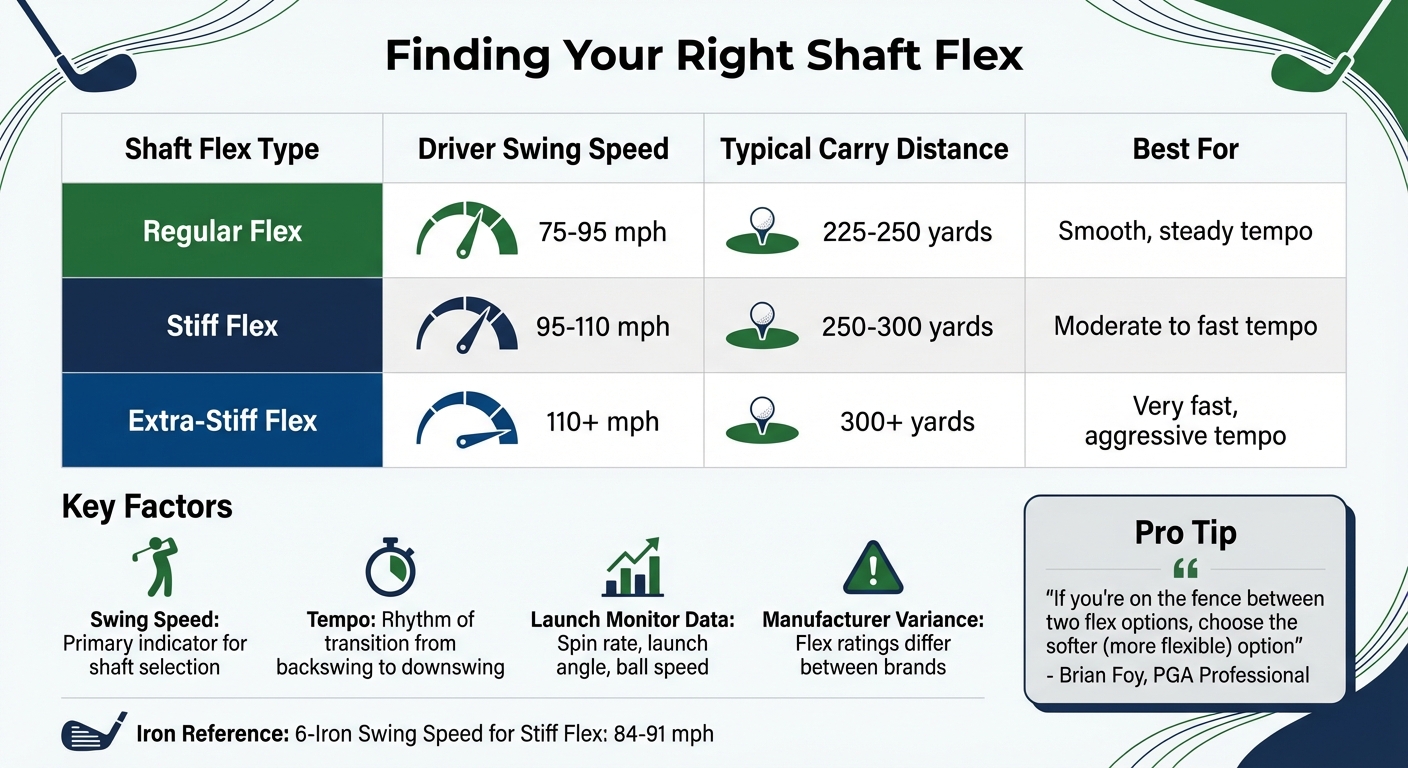
Golf Shaft Flex Guide: Swing Speed, Distance, and Flex Type Comparison Chart
Once you’ve identified the signs that your shaft flex might need adjustment, the next step is fine-tuning it to match your swing.
While swing speed is a great starting point, it’s not the only factor to consider. Generally, golfers with driver swing speeds between 95 mph and 110 mph often fit into the stiff flex category. Those swinging between 75 mph and 95 mph typically fall into the regular flex range. If your swing speed exceeds 110 mph, an extra-stiff flex is likely the best fit. To put it in perspective, a stiff flex is suited for carries between 250 and 300 yards, while a regular flex works better for shots in the 225 to 250-yard range. But speed alone doesn’t tell the whole story – your swing tempo is just as important.
Tempo refers to the rhythm of your swing, particularly the transition from your backswing to your downswing. If your swing has a smooth, steady flow, you might benefit from a softer flex, even if your speed suggests otherwise. On the other hand, golfers with a faster, more aggressive transition often need stiffer shafts to handle the added force and maintain control of the clubface through impact. As Brian Foy, a PGA Professional and founder of Steadfast Golf Shafts, explains:
"If you’re right on the fence, I would highly and always recommend going with the weaker flex."
For the most accurate results, a professional fitting session using launch monitors like Trackman can eliminate the guesswork. These tools provide detailed data on your swing speed, launch angle, and spin rate, giving you a clear picture of how different shafts perform with your unique swing. Keep in mind that flex ratings can vary between manufacturers, so testing multiple brands is essential to find the perfect match.
One more tip: a consistent swing makes fitting sessions more effective. Resources like How To Break 80 offer drills to help you develop a repeatable swing, which not only improves your overall game but also ensures your equipment is tailored to your needs. Pairing a solid swing with the right shaft flex is a winning combination for better ball control and lower scores.
Conclusion
Struggling with excessive hooks, inconsistent iron distances, weak approach shots, or a lack of control in your game? These could be signs that you need a stiff flex shaft to regain accuracy and consistency.
For players with a swing speed between 95 and 110 mph, a stiff flex shaft is often the best fit. However, keep in mind that shaft flex classifications vary across manufacturers – what one brand labels as "stiff" might feel entirely different in another.
The most reliable way to find the right shaft is through a professional fitting. Using launch monitors, fitters can analyze your swing speed, launch angle, and spin rates, giving you precise insights into how different shafts perform with your swing. With this data, you’ll be equipped to make adjustments that can lead to immediate improvements.
Once you’ve matched your equipment to your swing, refining your mechanics becomes the next step. Resources like How To Break 80 offer drills and strategies to help you build a consistent, repeatable swing that fully leverages your new shaft’s potential. The combination of the right shaft and solid fundamentals is a game-changer for better control and lower scores.
Don’t let mismatched equipment hold you back. If these performance issues sound familiar, it might be time to explore whether a stiff flex shaft is the key to unlocking your best game yet.
FAQs
How can I tell if a stiff flex shaft is right for my swing speed?
To figure out if a stiff flex shaft matches your swing, start by measuring your swing speed. You can use tools like a launch monitor, radar, or a swing tracking app to get accurate results. Generally, for drivers, a swing speed between 95–105 mph suggests that a stiff flex shaft could work well. For irons, the recommended swing speed range is slightly lower, typically between 90–95 mph.
After determining your swing speed, take a stiff flex shaft to the range and give it a try. Pay attention to the results: if the ball launches with a lower trajectory, your shots feel stable and controlled, and your accuracy improves, you’ve likely found a good match. On the other hand, if the shaft feels too stiff or you notice a drop in distance, a regular flex might be a better fit.
For more advice on improving your swing and choosing the right gear, explore the free resources and guides available on How To Break 80.

How can I tell if I need a stiffer golf shaft?
To figure out if a stiffer shaft is right for you, try using tools designed to measure your swing performance. A launch monitor is a great option – it provides data like swing speed, launch angle, and spin. This information can help you match your stats to the recommended shaft flex ranges. Alternatively, a swing speed radar or a clip-on sensor can quickly measure your swing speed, giving you a clear idea if a stiffer shaft might be necessary.
You can also use impact tape on your clubface to see where you’re making contact with the ball. If you consistently hit toward the toe, it might indicate your shaft is too stiff. On the other hand, strikes toward the heel could mean the shaft is too soft. These tools offer practical insights to help you fine-tune your equipment for better accuracy and control.
Can getting professionally fitted help if my shots are inconsistent?
Getting a professional fitting is a game-changer. It helps pinpoint if your equipment – like the shaft flex – is mismatched with your swing. The right shaft can make all the difference, giving you more consistent and precise shots.
A fitting goes beyond just the shaft. It also looks at details like club length and grip size to ensure your gear matches your playing style. These tweaks can have a noticeable impact on your performance out on the course.
Related Blog Posts
- Shaft Flex Types: Beginner vs. Advanced
- How Shaft Flex Affects Ball Flight
- Checklist for Choosing Steel or Graphite Shafts
- Regular vs Stiff Flex: Which to Pick
