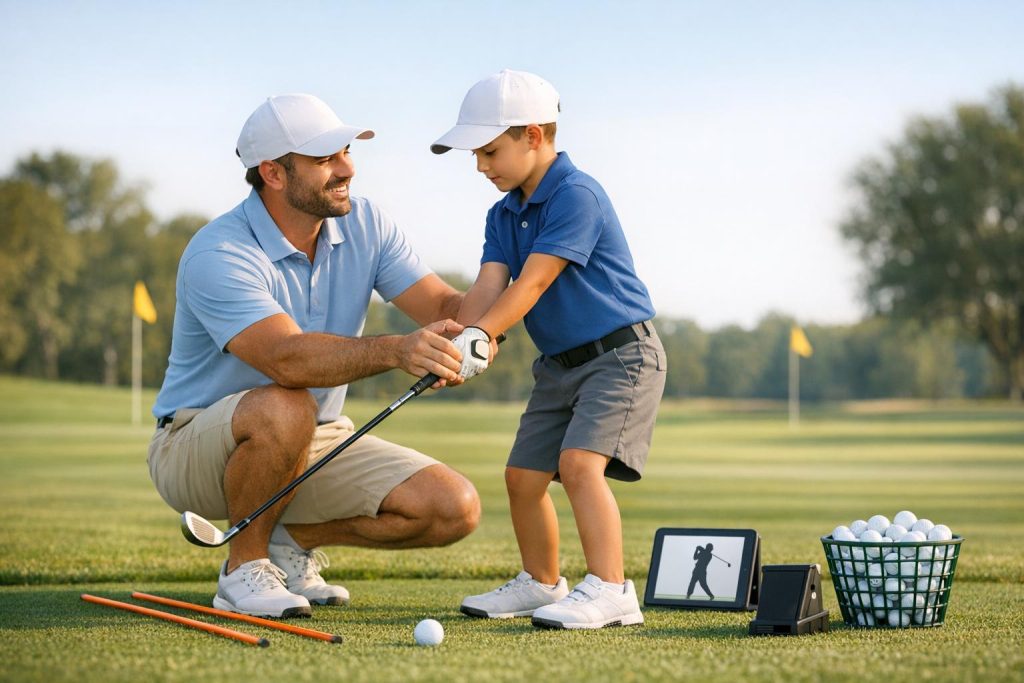
Private golf clinics are a game-changer for junior beginners. They provide personalized instruction, focused practice, and a supportive learning environment tailored to each young golfer’s needs. Here’s why they stand out:
- One-on-One Coaching: Instructors focus entirely on the junior golfer, addressing specific challenges like grip, stance, or swing mechanics.
- Faster Skill Development: Real-time feedback and advanced tools, like video analysis, help juniors improve quickly and avoid bad habits.
- Targeted Problem Solving: Sessions concentrate on individual weaknesses, using drills and strategies designed to overcome specific issues.
- Custom Learning Pace: Kids learn at a comfortable speed, building confidence without pressure.
- Mental and Strategic Growth: Beyond technique, clinics teach patience, focus, and course management.
Private lessons range from $40 to $100 per session, with package options for multiple sessions. These clinics combine expert instruction with flexible scheduling, making them an ideal choice for junior golfers aiming to build skills and confidence on the course.
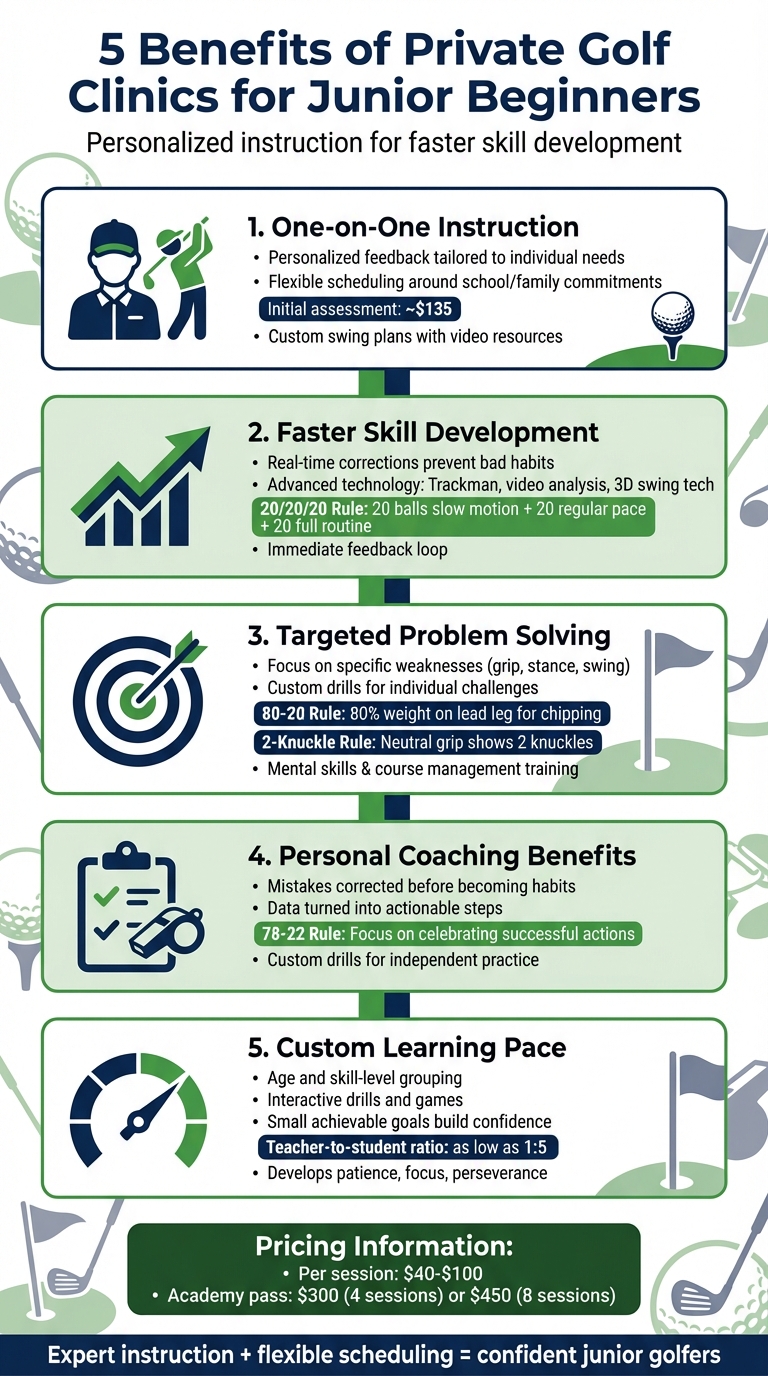
5 Key Benefits of Private Golf Clinics for Junior Beginners
Beginner Golf Lessons | Junior Golf | Putting, Chipping, Backswing
sbb-itb-bcd8bdd
1. One-on-One Instruction Matched to Each Player
Private clinics give junior golfers the chance to work directly with a seasoned instructor who focuses entirely on their needs. Without the distractions of group lessons, the coach can quickly address issues like improper ball positioning or an overly tight grip, offering feedback tailored to the golfer’s unique style.
These sessions are highly adaptable to the junior’s preferred way of learning. Some might need to see a demonstration, others might learn better by practicing the correct motion, and some might prefer a detailed verbal explanation. This personalized setup allows the coach to provide immediate corrections, unlike group settings where feedback often comes later. This real-time guidance not only sharpens technique but also lays the groundwork for a training plan designed specifically for the individual.
Many private clinics begin with an initial assessment, typically priced around $135, to create a customized swing plan supported by video resources. This tailored roadmap pinpoints areas for improvement, whether it’s fixing a slice or fine-tuning swing mechanics. From there, the instructor designs drills that directly target these challenges, avoiding the one-size-fits-all approach of group lessons. This ensures every session delivers focused, professional guidance that addresses the golfer’s specific needs.
Additionally, private lessons offer flexible scheduling, making it easier to fit sessions around school and family commitments – something group classes often struggle to accommodate. This flexibility fosters consistent, long-term progress, allowing junior golfers to build their skills at a pace that works for them.
2. Faster Skill Development with Focused Practice
Private clinics offer an environment where every moment is maximized for improvement. With the instructor’s full attention, every detail of a junior golfer’s swing – whether it’s the stance, grip, or follow-through – is carefully analyzed and fine-tuned. This level of focus is hard to achieve in group lessons, where attention is divided among multiple students. The result? Faster adjustments and quicker progress during practice.
One of the biggest advantages is the speed at which corrections are made. If a junior golfer notices something off in their swing, the instructor can address it immediately. This quick feedback loop prevents bad habits from taking root and helps players improve their technique and driving for beginners in real-time.
On top of that, cutting-edge technology takes this personalized feedback to another level. Tools like Trackman, video analysis, and 3D swing technology break down every aspect of the swing with pinpoint accuracy . These tools make complex ideas – like swing plane or club path – easier to understand by giving juniors a clear visual of what’s happening. Seeing these details makes it much simpler to make the right adjustments.
To help these changes stick, instructors often use structured methods like the 20/20/20 Rule: hit 20 balls in slow motion, 20 at a regular pace, and 20 more while going through a full pre-shot routine. By combining this method with drills tailored to each golfer’s specific weaknesses, practice becomes more productive and leads to noticeable improvement.
"Coaches do not simply provide players with a map as to how to get to their ultimate destination, but better yet, ‘carry’ them, assist them, guide them, and support them as they embark on the journey".
This hands-on coaching style, combined with immediate feedback, advanced tools, and structured practice strategies, sets private clinics apart. It’s a level of precision and support that group lessons simply can’t replicate.
3. Direct Focus on Problem Areas
Every junior golfer faces their own set of challenges – like an overly strong grip, uneven weight distribution, or inconsistent ball contact. Private clinics allow instructors to home in on these specific issues and build a plan to address them. Instead of spending time on broad topics that may not apply, coaches can focus entire sessions on the exact areas where improvement is needed. This approach naturally leads to drills tailored to fix these weaknesses.
Advanced tools help instructors quickly spot unique swing flaws. For instance, they can measure the "sway gap" – the distance between the upper and lower body at impact – to ensure proper weight transfer. Ideally, the lower body should be about six inches ahead of the upper body at contact.
"In private golf instruction, you get the undivided attention of a seasoned professional who can pinpoint specific areas for improvement and offer customized drills to tackle those challenges."
To tackle these issues, instructors introduce targeted drills that address specific flaws. For example, juniors struggling with chipping are taught the 80-20 Rule: keeping 80% of their weight on the lead leg during setup encourages a descending blow and avoids "chunking" the shot. For grip problems, the 2-Knuckle Rule helps: a neutral grip should show two knuckles on the lead hand at setup, with fewer knuckles indicating a tendency to miss shots to the right.
Private clinics don’t stop at physical mechanics. They also emphasize mental and strategic skills. Instructors guide juniors on course management, golf etiquette, and building mental toughness – areas often skipped in group settings but essential for long-term success. These elements complement the physical adjustments, reinforcing the value of one-on-one coaching.
4. Faster Progress Through Personal Coaching
Personal coaching offers immediate feedback, helping to correct mistakes before they turn into bad habits. This kind of real-time adjustment ensures that every practice session becomes more productive and focused on improvement.
"This rapid feedback loop can lead to quicker improvement and a more enjoyable learning experience." – Bill Flood Golf Academy
While advanced technology can provide precise data on swing mechanics, personal coaching takes it a step further. Coaches use this data to create tailored advice, turning complex diagnostics into simple, actionable steps for each junior golfer. This personalized guidance speeds up the learning process and helps skills develop more efficiently.
Structured methods, like the 20/20/20 rule, reinforce new techniques during lessons. Sessions often end with custom drills designed for independent practice, ensuring progress continues between lessons. This organized approach builds consistency and confidence over time.
Beyond the technical side, personal coaching also boosts mental resilience. By applying the 78-22 rule – which focuses on celebrating successful actions – coaches help juniors maintain a positive mindset. This approach reduces frustration and keeps young golfers motivated throughout their journey.
With these combined benefits, personal coaching doesn’t just enhance skills – it also adapts to the pace and needs of each junior golfer, setting the stage for steady and lasting improvement.

5. Learning Speed Adjusted to Each Junior Golfer
Private golf clinics cater to each child’s learning pace by grouping juniors based on their age and skill level. This approach allows young golfers to concentrate on basics like grip and stance without feeling rushed or overwhelmed. It ties in seamlessly with the one-on-one attention discussed earlier, ensuring every child gets the support they need.
Coaches take the time to provide personalized tips to improve form and technique. Instead of pushing ahead too quickly, juniors practice each skill until they feel confident. This methodical approach lays a solid foundation for future progress.
To keep things fun and engaging, clinics often incorporate interactive drills and games. These activities not only make learning enjoyable but also help maintain focus. Setting small, achievable goals – like hitting a series of quality shots – boosts confidence and keeps motivation high. Celebrating these successes reinforces progress and builds self-esteem.
But it’s not just about physical skills. This tailored pacing helps juniors develop important traits like patience, focus, and perseverance. Grouping kids with peers of similar skill levels also fosters teamwork and sportsmanship. This supportive and encouraging environment makes golf a positive and enjoyable experience, sparking a lasting love for the game.
Conclusion
Private clinics offer tailored instruction, focused skill-building, and a confidence boost that sets juniors up for long-term success. With small teacher-to-student ratios – sometimes as low as 1 to 5 – each young golfer gets the individual attention needed to establish a strong foundation.
These clinics go beyond teaching technical skills. They also nurture essential character traits like patience, perseverance, and sportsmanship – qualities that serve juniors well both on and off the course. As instructor Britt Sharrock puts it:
"Coaches do not simply provide players with a map as to how to get to their ultimate destination, but better yet, ‘carry’ them, assist them, guide them, and support them as they embark on the journey".
This mentorship-driven approach leaves a lasting impression, shaping young athletes in meaningful ways.
To complement this growth, parents can use tools like How To Break 80, which provides practical drills, video lessons, and free guides. These resources are perfect for keeping young golfers engaged between sessions, offering exercises they can practice at home or in nearby parks to reinforce what they’ve learned.
When it comes to cost, private junior lessons typically range from $40 to $100 per session. For a more structured option, academy passes are available, costing around $300 for four sessions or $450 for eight sessions. With expert coaching, helpful resources, and consistent practice, young golfers can refine their skills and develop a lifelong love for the game.
FAQs
How do I know if my child is ready for private golf clinics?
Your child might be ready for private golf clinics if they can concentrate for short periods, follow simple instructions, and show an interest in the game. These clinics are designed to be fun and engaging while promoting motor skill development. They focus on building confidence in young beginners, making the learning process enjoyable and encouraging.
How many private sessions does a junior beginner usually need?
Junior beginners typically start with a package of 16 private lessons, which is often paired with an extra 8 lessons at no additional cost. This brings the total to 24 sessions, offering a solid framework for consistent progress and skill-building in young players.
What should my child practice between private lessons?
Between private lessons, your child can work on drills designed to sharpen their accuracy, control, and overall golf abilities. For example, target practice can help with aim, while putting drills like tic-tac-toe are great for honing distance control. Chipping exercises are excellent for improving precision. To keep things enjoyable, try incorporating fun challenges like golf bowling or setting up obstacle courses. These activities not only make practice more engaging but also reinforce essential skills.
Related Blog Posts
- Top 5 Regional Junior Golf Clinics
- Benefits of One-on-One Junior Golf Lessons
- Ultimate Guide to Florida Junior Golf Clinics
- Advanced Swing Clinics vs. Private Lessons
